





Why “Tier 1 Liquidity” Needs a Harder Look
There are many retail FX brokers that proudly announce Tier 1 liquidity across their marketing materials, and the term has become a bit of a buzzword across the industry. “Tier 1 liquidity” appears on homepages, account comparison tables, MetaTrader bridge pages, white label brochures, investor decks, liquidity provider one-pagers, and banner ads.
The pitch from the broker usually sounds very appealing and serious. Trade with direct access to deep institutional liquidity from global banks such as Citi, JPMorgan, UBS, Deutsche Bank, Barclays, or Goldman Sachs. It sounds as if a trader with a $2,000 margin account is resting directly against a global dealer bank’s balance sheet.
But that is not how retail FX usually works. Retail traders do not normally have bilateral credit lines with global FX dealer banks. Most retail brokers do not have clean direct access either. Institutional FX is not built around cash sitting in neat little account boxes waiting to be matched one trade at a time. It is built around credit permissions, exposure limits, prime brokerage agreements, netting, collateral, legal give-up terms, settlement controls, post-trade processing, and the ability of large intermediaries to absorb counterparty risk without wasting balance sheet, i.e. absorbing counterparty risk without unnecessarily consuming the intermediary’s limited capacity to take on assets, liabilities, and risk exposures.
The balance-sheet point matters because when a bank extends credit to a broker, it is taking on risk. If the broker or one of its counterparties fails, the bank could be exposed to losses. Because of this, regulators require banks to hold capital against those risks.
Following the 2008 financial crisis, international banking rules were tightened under a framework known as Basel III. Among other things, these rules require banks to measure and manage the credit risk they face when dealing with trading counterparties in products such as foreign exchange, derivatives, and securities financing transactions. The more risk a bank takes on, the more capital it must set aside to absorb potential losses.
In practical terms, a bank credit line is not a free resource. Every dollar of credit extended consumes risk capacity, regulatory capital, and balance-sheet resources. Banks therefore do not hand out large credit lines simply because a broker has a polished website or a catchy marketing campaign. They grant them only after assessing the broker’s financial strength, operational controls, collateral arrangements, and overall creditworthiness.
So when a retail broker says “Tier 1 liquidity,” the useful question is not whether a price somewhere in a chain originated from a major bank. Often it did. The useful question is more specific: how many credit intermediaries sit between the retail trader and that bank? That is where the real structure appears. The trader sees a bid and offer. Behind that quote you may find a web of broker credit, Prime of Prime access, bank prime brokerage, liquidity aggregation, internal matching, collateral calls, net open position limits, margin rules, and settlement procedures.
The phrase “Tier 1 liquidity” can therefore be true in a loose marketing sense and still not show the whole picture. It may describe part of the price source, while not mentioning anything about who faces the client, who holds the collateral, who controls the credit line, who internalizes the order, who hedges the residual exposure, and which counterparties will remain financially and operationally stable when markets become highly volatile.
Retail FX Is a Credit Chain, Not a Direct Bank Feed
The simplified retail marketing line often looks something like this: “Retail trader to broker to Tier 1 bank liquidity”. It is a neat picture, but an incomplete one.
The real structure is usually less neat. A retail trader faces a retail broker. The retail broker may internalize some flow and hedge other flow. Where it hedges externally, it may send exposure to a Prime of Prime provider. That Prime of Prime provider may clear through one or more Tier 1 bank prime brokers. The Tier 1 bank prime broker may support access to executing banks, ECNs, non-bank market makers, and settlement systems. Sometimes there are more layers. Sometimes fewer. The broker may use several liquidity routes, or it may depend on one upstream provider while claiming “multiple liquidity providers” because the price stream contains several names.
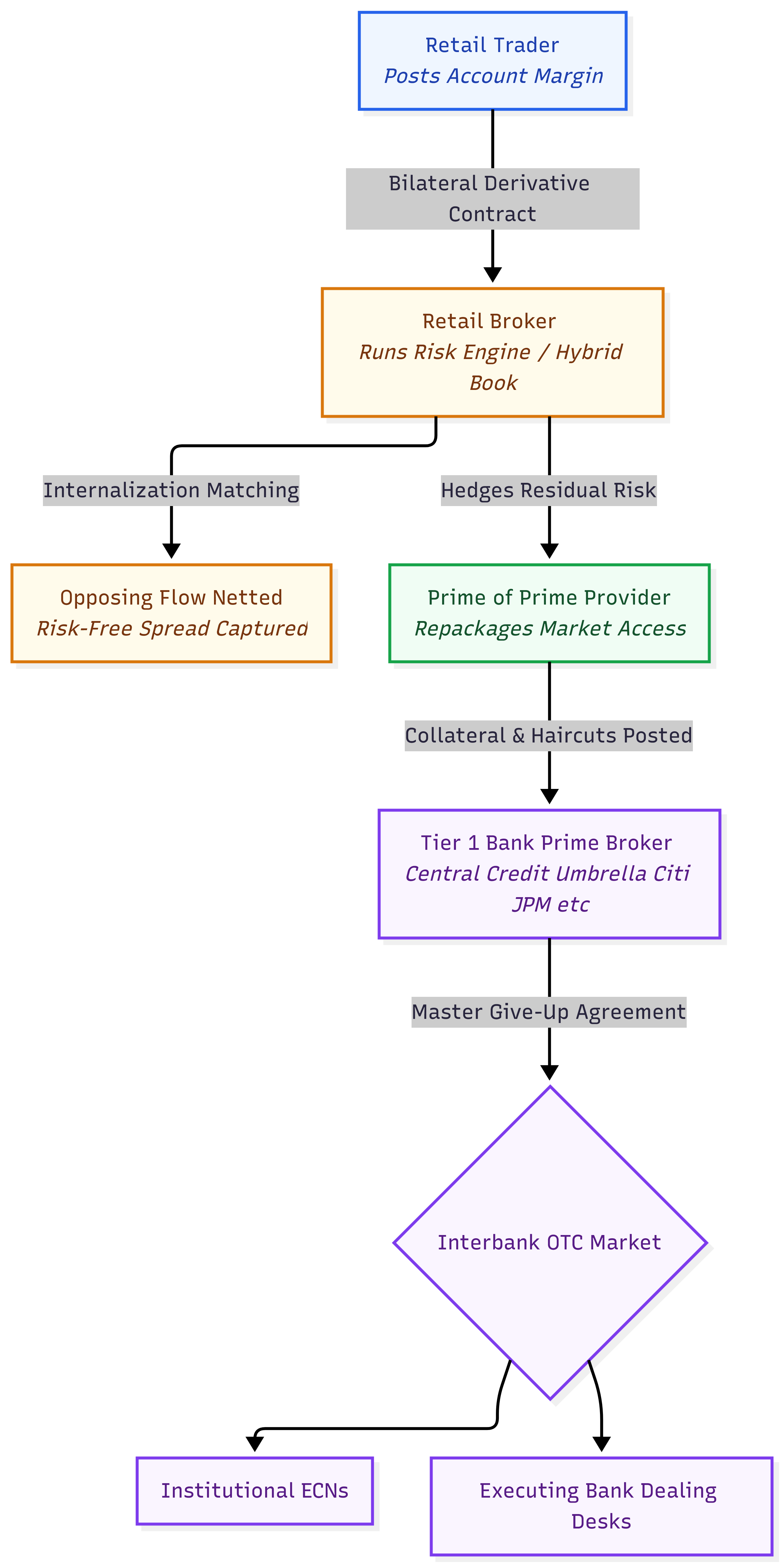
To understand the full picture, it is necessary to keep in mind that institutional FX is a credit market before it is a price market. A price on a screen is useless if the participant has no permission to trade on it. The BIS working paper on the foreign exchange market explains that FX spot trades historically involved a bilateral extension of credit because trades settle after the trade date through transfers of bank balances in the relevant currencies. That is why banks sit at the center of the market structure. Credit access comes first; execution comes after.
A retail trader on a trading platform sees EUR/USD at 1.08420 by 1.08421. The trader sees a price. The broker sees a risk event and a series of questions that need to be answered by the automatic systems that are working behind the scenes:
- What is the account balance?
- Is margin sufficient?
- Is the symbol enabled?
- Is the client allowed to trade this product?
- Does the broker internalize this flow?
- Is the broker long or short on net exposure?
- Is the upstream hedge route available?
- Is the Prime of Prime margin headroom sufficient?
- Has an upstream liquidity provider widened spreads or cut size?
- Is the market in abnormal conditions?
- Has the bridge throttled execution?
- Is the quote firm, indicative, or last look based?
This is why the phrase “liquidity provider” needs careful handling. In retail FX, a liquidity provider may, for instance, be a bank, a non-bank market maker, a Prime of Prime, an ECN, an internal dealing book, or an aggregator combining several sources. The trader may not know which one filled the trade, whether the broker became principal, whether an offsetting client trade absorbed the exposure, or whether only the net residual exposure moved upstream.
The BIS discussion of FX trade execution, published in the BIS Quarterly Review on 8 December 2025, notes that customers can connect to dealers and more than a dozen non-bank liquidity providers, also called principal trading firms, while liquidity aggregators help bundle access across venues and providers. This is a fragmented market that technology partially stitches together. It is not a single pipe into one big bank vault.
That fragmentation can be useful. It can tighten spreads, improve quote competition and reduce dependence on one dealer. But it also introduces dependency that is hard to see from the front end. A broker may advertise multiple banks, several ECNs, and several non-bank providers, while still relying on one Prime of Prime credit route. If that route fails, the price source list does not save the broker.
A more honest retail disclosure would say something like this: “We access institutional FX pricing through Prime of Prime relationships and liquidity aggregation. Prices may include bank, non-bank, ECN and internal sources. We may act as principal. We may internalize some flow and hedge residual exposure externally. Execution depends on account type, liquidity conditions, product terms, risk limits and upstream counterparty availability.”
What a True FX Prime Broker Actually Does
A true FX prime broker is not simply a liquidity provider. That description is too shallow.
A prime broker is usually a major bank or a broker-dealer within a large banking group. The BIS work on the prime broker hedge fund nexus describes prime brokerages as a set of services offered to hedge funds and other non-bank financial institutions by broker-dealers, centered on leverage through derivatives and securities financing, plus the infrastructure needed for market access, custody, clearing, and related support.
In FX trading, the prime broker gives an institutional client a credit umbrella. The client can trade with several executing brokers or venues, but the credit relationship is centralized through the prime broker. This matters because opening separate bilateral credit, settlement, and collateral relationships with every executing bank would be inefficient. A hedge fund may want pricing from Bank A in EUR/USD, Bank B in USD/JPY, a specialist dealer in emerging market FX, and an ECN for certain electronic flow. Prime brokerage lets the fund access that spread of counterparties under one central credit arrangement.
The mechanics rely on give-up arrangements. The client executes with a dealer. The trade is then given up to the prime broker. Once accepted, the prime broker becomes the credit counterparty for the trade under the agreed structure. The New York Fed’s documentation for the 2005 Master FX Give Up Agreement describes these give-up relationships as arrangements where a party designated by a prime broker executes transactions with a dealer that are then given up to the prime broker. It also notes that the accompanying compensation agreement can provide for losses if the prime broker does not accept the give-up.
That acceptance step is not a formality. The prime broker may reject trades that are outside approved products, tenors, limits, or reporting terms. A trade can be clicked and agreed at the execution layer, but still create problems if it falls outside the prime brokerage agreement. The Foreign Exchange Committee user guide to the Master FX Give Up Agreement explains that prime brokers may reject trades that are not permitted transaction types, are outside tenor limits, breach credit limits, or contain mismatched details.
The FX Global Code also makes the prime broker’s credit role explicit, stating that market participants acting as prime brokers play a unique role in assuming the credit risk of authorized trades executed by prime brokerage clients. The FX Global Code‘s treatment of prime brokerage makes clear that credit risk and trade discrepancy management are core to the model.
This structure explains why a prime broker is not handing out “liquidity” in the retail sense. It is providing credit intermediation, market access, clearing, settlement support, limit management, collateral treatment, and counterparty risk control. The liquidity may come from executing dealers and venues. The prime broker’s role is to make that trading possible under a controlled credit umbrella.
That is also why direct Tier 1 prime brokerage access is hard to obtain. Banks do not onboard every broker that asks. They review factors such as ownership, financial strength, audited accounts, risk controls, systems, legal documentation, governance, regulatory status, client base, expected volumes, and stress risk. They also ask whether the relationship is worth the capital and operational burden.
A small retail FX broker with highly leveraged, behaviorally correlated clients represents a very different credit profile from an institutional counterparty such as a hedge fund, asset manager, or bank. Retail flow can be highly clustered, event-sensitive, and prone to sharp margin stress during volatility spikes, with a higher risk of rapid drawdowns and negative equity in gap markets. From a prime broker or bank perspective, these characteristics are evaluated primarily through the lens of counterparty credit risk, capital consumption, and operational exposure rather than purely as a revenue opportunity.
This is why Prime of Prime providers exist. They sit between large bank prime brokers and smaller institutions that want access to institutional-style liquidity but cannot obtain, maintain, or economically justify direct Tier 1 prime brokerage access.
Prime of Prime Providers and the Retail Broker Layer
A Prime of Prime provider, often shortened to PoP, is a credit transformer. The PoP may hold one or more relationships with Tier 1 bank prime brokers, clearing brokers, non-bank liquidity providers, or institutional venues. It then repackages that access into a format smaller brokers, fintech trading firms, funds, regional brokers, and white labels can use.
The PoP does not only resell prices. It intermediates credit, margin, technology, liquidity aggregation, reporting, and risk controls.
The broker posts collateral to the PoP. The PoP sets margin requirements, product limits, permissible flow rules, mark-to-market rules, liquidation terms, and bridge connectivity. The broker then offers leveraged trading accounts to retail clients under its own client agreement. The retail client posts margin to the broker. The broker may internalize some trades, net others, and hedge the remaining risk through the PoP.
The chain is therefore layered. The retail client faces the broker. The broker faces the PoP. The PoP faces its bank prime broker or other upstream clearing relationships. The executing liquidity may come from banks, non-bank market makers, ECNs, or internal sources. The client sees one platform price, but that price is supported by multiple legal and credit relationships.
This is the central retail FX truth: retail margin access is built on institutional credit access above it, and each layer changes the economics. The bank prime broker sets minimum revenue expectations and other relationship terms, and charges the PoP through spread, financing, margin, capital cost, and clearing fees. The PoP charges the retail broker through spread markups, commission, financing, margin policy, bridge fees, reporting charges, service packages, etcetera. The retail broker charges the client through spread, commission, overnight financing, slippage rules, internalization economics, account fees, and so on.
Prime of Prime access can be legitimate and valuable. A strong PoP gives smaller brokers access to better price sources, more professional infrastructure, and cleaner risk management than they could build alone. It can aggregate bank and non-bank liquidity, provide execution bridges, manage margin calls, monitor exposure, support reporting, and reduce the burden placed on Tier 1 banks. But the PoP layer also creates concentration risk. A broker may depend heavily on one PoP for pricing, hedging, and clearing. If that PoP has a system outage, loses its own prime broker line, tightens margin, reduces limits, flags the broker’s flow as toxic, or suffers financial stress, the broker’s external execution capacity can change quickly.
This is why “multiple liquidity providers” is not enough as a disclosure. A broker may receive many price streams through one PoP. That is price source diversity, not clearing diversity. If all those prices arrive through one upstream credit route, the broker has one major point of failure. A broker with two or three independent PoPs or clearing routes has a different risk profile from a broker with 20 names inside an aggregator but only one credit pipe.
Liquidity Aggregation
Liquidity aggregation is the process of consolidating executable quotes, available depth, and trading interest from multiple liquidity providers into a single pricing and execution venue, allowing orders to access the best available prices and greater market depth. The sources may include banks, non-bank market makers, ECNs, other PoPs, and internal broker liquidity.
The broker’s aggregator ranks, filters, and distributes those prices to platforms such as MetaTrader 5, cTrader, and proprietary front ends. It may apply markups, reject stale quotes, filter last-look responses, manage depth, and route trades according to rules.
Internalization and Net Exposure
Internalization means the broker fills client orders inside its own risk environment rather than sending every trade to an external counterparty. This can happen in several ways. The broker may match opposing client flow. It may fill a client from its own book. It may warehouse residual risk for a period. It may hedge only the net exposure left after internal matching.
Suppose Client A buys 10 lots of EUR/USD and Client B sells 10 lots of EUR/USD around the same time. If the broker quotes Client A at the offer and Client B at the bid, those exposures can offset. The broker has no net market exposure after the match. It has captured the spread between the two client prices and avoided paying an external spread on both tickets. That is the clean internalization outcome: spread capture with little or no directional risk.
The matching does not need to be perfect. If clients collectively buy 100 lots and sell 76 lots, the broker can internalize 76 lots of opposing flow and decide what to do with the remaining 24 lots. The residual can be held, hedged, skewed, partially offset later, or sent to a PoP. Retail broker economics depend more on net exposure than gross volume.
The BIS Working Paper No. 1094 – The foreign exchange market, published in April 2023, notes that large bank dealers began internalizing trades in the early to mid-2000s, waiting for offsetting customer trades rather than immediately hedging positions in the interdealer market. The logic is simple: if enough customer flow offsets naturally, the dealer can reduce external hedging costs.
Retail forex brokers use a similar economic logic, though under a different regulatory and client protection setting. Internalization reduces transaction costs when flow offsets. It can improve speed and allow tighter displayed spreads. It can also create conflicts when the broker acts as principal and profits from client losses.
Internalization is not automatically B-booking. If the broker matches two opposing client trades, it may retain no directional risk. If it fills a client internally and immediately hedges the net risk externally, it has internalized execution but not retained long-term client P&L exposure. B-booking starts when the broker keeps the client’s trade on its own book and bears the opposite market exposure. Suppose the client loses, the broker gains. If the client wins, the broker pays.
Many retail FX and CFD brokers run hybrid models. They internalize small or statistically weak flow, hedge large or profitable clients, route news traders differently, and use client segmentation to decide which exposure to retain. The risk engine may consider account size, win rate, latency, strategy type, holding period, product, leverage use, trade timing, and P&L history. A beginner trading 0.03 lots during quiet hours may be treated differently from a profitable latency-sensitive trader entering before news.
Many brokers are not purely basic A-book or purely basic B-book. Instead, a broker might, for instance, run a matched book for some flow, a B-book for some flow, a full external hedge for some flow, and a delayed hedge for residual exposure. Instead of asking if a broker is A-book or B-book, it is more useful to ask how much flow is internalized, how client flow is segmented, when residual risk is hedged, and how the broker controls conflicts when it acts as principal.
For retail traders, this matters because internalization can affect execution quality, slippage, stop fills, spread widening, and rejection rates. For auditors and asset managers, it matters because the broker’s real liquidity risk is tied to net exposure, upstream margin, and the ability to externalize risk during stress.
Collateral and Margin Haircuts
A retail trade creates more than a platform position; it creates a collateral and exposure chain. The retail trader deposits margin with the broker. The broker uses its own capital, risk book, and upstream relationships to support client trading. Where the broker hedges externally, it may need to post margin or collateral to a Prime of Prime provider. The PoP must then satisfy its own margin and collateral obligations to its upstream prime broker or clearing relationships.
Each layer has its own margin logic. The retail platform may offer 1:30 leverage, 1:100 leverage, or more, depending on jurisdiction, and client classification. The broker’s upstream margin rate may be completely different. The PoP may apply higher margin to volatile pairs, exotic currencies, concentrated exposure, or weekend positions. The Tier 1 bank prime broker may apply its own models, stress add-ons, credit limits, and collateral eligibility rules.
Each participant in this chain must therefore satisfy its own margin requirements. However, posting collateral is only part of the equation. Equally important is how that collateral is valued. The same asset is not necessarily accepted at its full market value by every counterparty. This is where margin haircuts become important. While margin determines how much collateral must be posted, a separate set of rules determines how much that collateral is worth for risk purposes. These valuation adjustments are known as margin haircuts, and they vary according to the quality, liquidity, and risk characteristics of the collateral being pledged.
A margin haircut is the reduction applied to collateral value to account for risk. Cash in major currencies may receive favorable treatment. Less liquid collateral may be discounted more heavily. Open positions in volatile products may require higher margin. Concentrated exposures may trigger add-ons. A broker that gives clients 2% margin on a major FX pair may not receive equivalent economics upstream, especially once netting, concentration, product mix, and stress assumptions are applied.
The term “haircut” is finance jargon that refers to trimming or cutting down the value of something. Imagine you pledge an asset worth $100 as collateral. The lender or counterparty doesn’t assume it can always realize the full $100 if it has to sell the asset quickly. Instead, it “cuts” the recognized value. For example:
- Market value of collateral: $100
- Haircut: 10%
- Collateral value recognized for margin purposes: $90
The $10 reduction is the haircut.
The name is fitting because, like a haircut, only a portion is removed.
The important takeaway here is that retail trader margin and broker margin are not the same thing. Retail clients think in account margin. Brokers think in aggregate exposure. PoPs think in client portfolio risk. Bank prime brokers think in counterparty credit exposure, settlement risk, capital use, and net open position limits.
NOP Limits
The Net open position (NOP) is the exposure left after offsetting long and short positions. At the client level, each trader has an open position. At the broker level, the relevant external risk is the net exposure after internal matching and any hedges. At the PoP level, net exposure may be aggregated across several broker clients. At the bank prime broker level, the PoP’s net exposure is monitored against approved credit and trading limits.
The Global Foreign Exchange Division (GFXD) of the Global Financial Markets Association (GFMA), an industry body representing major FX market participants, has published a set of encouraged practices for FX prime brokerage. These recommendations focus on improving the monitoring and management of credit limits in FX prime brokerage (FXPB) transactions. The paper discusses overall trading limits, give-up limits, and platform limits because credit limit breaches can create operational and market risk across the FXPB chain.
Institutional risk analysis involves factors such as how much usable credit exists after netting, margin haircuts, concentration limits, product limits, prime broker acceptance, and stress buffers.
Collateral treatment adds another complication. In regulated retail settings, client money rules may require segregation and restrict use of client funds. In professional or offshore settings, title transfer or broader collateral use may apply. The details matter. Can the broker legally and practically use client money to support upstream hedging? Is margin treated as client money, firm money, security collateral, or title-transferred collateral? Are retail clients treated differently than professional clients? What happens if the broker fails? What happens if upstream collateral is trapped?
The answers to these questions determine the legal nature of the client’s claim in the event of the broker’s insolvency. Depending on the account structure, applicable law, and contractual arrangements, the client may have a protected client money claim, an unsecured creditor claim, a contractual claim to collateral, or indirect exposure through a chain of counterparties. The precise terms of the client agreement are therefore critical, but those terms are ultimately governed and constrained by the applicable regulatory framework.
You can find out more about retail broker insolvency and third-party insolvency in our article about Client Money Segregation.
Rehypothecation
Rehypothecation is also part of this discussion. It refers to the reuse of collateral posted by one party to support obligations elsewhere. The legal mechanics vary by jurisdiction, account type, and contract. If collateral can be used to support upstream obligations, the client’s exposure may become linked to a wider counterparty chain, and this introduces a new type of risk.
Rehypothecation refers to the practice of a broker reusing client collateral that has been posted to support trading positions. In a retail FX context, this typically means that the margin or free equity a trader deposits is not held in a completely idle, segregated state, but may be used by the broker within permitted regulatory and contractual limits to manage liquidity needs, hedge exposure, or meet margin requirements with upstream liquidity providers or prime brokers.
For a retail trader, the key point is not the mechanics themselves, but what they imply about risk transmission. When collateral is rehypothecated, it becomes part of a wider funding chain that can include liquidity providers, clearing relationships, and prime brokerage arrangements. This does not usually affect day-to-day trading, pricing, or account balances in normal conditions. However, in stressed market events or during broker distress, the fact that client collateral may be operationally re-used means that exposures are not fully isolated at every level of the system. This is one reason why broker failures can become slower and more complex to unwind, as administrators must determine what portion of funds is truly client-owned versus what has been encumbered through upstream obligations.
For retail traders, rehypothecation risk is not something that is directly visible in a trading platform, but it can be partially assessed through the broker’s legal and disclosure documents. The most important place to look is the client agreement and the “funds” or “client money” section, where brokers state whether client funds are held under full segregation rules or whether certain rights of use, set-off, or security interests apply. Some brokers explicitly state whether they have a right to use client assets for hedging or operational purposes, which is a direct indicator of rehypothecation potential. Another useful signal is the regulatory framework under which the broker operates, since strict regimes such as the UK FCA impose strict client money segregation standards that impact a broker’s ability to use client funds for rehypothecation.
In practical terms, retail traders should pay attention to whether the broker clearly states “client money is held in segregated accounts” and whether there are additional clauses that allow the broker to transfer, pledge, or use those funds in the course of business. The presence of vague language around “security interests,” “lien rights,” or “general use of funds” can indicate a higher degree of rehypothecation flexibility. While this does not automatically imply unsafe practices, it does indicate that client funds may be more integrated into the broker’s broader liquidity structure.
Ultimately, rehypothecation is part of how modern FX markets function, but for retail traders it is less about operational involvement and more about understanding how isolated their funds really are if something goes wrong. The more tightly a broker restricts use of client funds and the stronger the segregation regime, the lower the dependency on upstream financial relationships, and the more insulated the retail trader is from broader counterparty stress.
Settlement Risk, CLS, and Post-Trade Controls
Settlement risk is another part of FX trading risk that is often overlooked until it becomes apparent.
FX settlement risk is the risk that one party transfers the currency it sold but does not receive the currency it bought. It is often called Herstatt risk, after the 1974 failure of Bankhaus Herstatt.
CLS, the global payment-versus-payment settlement infrastructure for the foreign exchange market, explains in its paper on FX settlement risk that Herstatt’s closure left counterparties exposed because the bank had received Deutsche marks but had not delivered the corresponding US dollars. That is the basic settlement failure: one leg pays, the other does not.
The FX Global Code’s settlement principles press market participants to reduce settlement risk where practicable, including through settlement methods that eliminate settlement risk, such as Payment versus Payment (PvP) where available. The Code further treats settlement risk as something that should be measured, monitored and controlled like other counterparty exposures. Under Payment versus Payment (PvP), one currency leg does not settle unless the corresponding counter currency leg also settles. CLS settlement mitigates settlement risk by synchronising payment instructions for both legs of the trade. That does not remove every FX risk, but it addresses the principal risk created by unsynchronised currency payments.
Retail traders rarely see or consider this risk layer. Many retail FX products are margined OTC derivatives or CFDs rather than physically settled currency transactions. But brokers, PoPs, banks, asset managers, and auditors still need to care about settlement architecture, especially where deliverable FX, institutional accounts, prime brokerage, multi-currency collateral, and non-PvP settlements are involved.
This is also where post-trade operations matter. Trade confirmation, allocation, give-up acceptance, mismatch resolution, margin calculation, and settlement instructions are not dull back-office chores. They are risk controls. The FX Global Code’s treatment of prime brokers and trade discrepancies is a reminder that an FX transaction is not truly finished when the trader clicks. It is finished when it is accepted, confirmed, margined, netted, settled, or otherwise contractually resolved.
In calm markets, weak post-trade operations can go unnoticed. In stressed markets, they can become very apparent.
Stress Events: PoP Failure, Negative Balances, and Broker Insolvency
During periods of market stress or operational disruption, failures within the FX liquidity chain can expose structural vulnerabilities that are often overlooked during peaceful times.
Events such as Prime of Prime (PoP) failures, significant negative client balances, or broker insolvencies highlight the importance of understanding how risk is managed and transferred across the liquidity ecosystem.
A PoP may, for instance, suffer a capital event, operational outage, cyber incident, risk engine failure, fraud issue, liquidity provider withdrawal, or prime broker limit reduction. If the PoP’s Tier 1 prime broker freezes or terminates credit, downstream brokers may lose execution or hedging capacity quickly. A broker can show 20 price sources in a liquidity deck and still depend on one key credit route. The retail client experiences this as a platform issue. Spreads widen, orders are rejected, symbols are disabled, certain products move to close only, execution slows, and stop fills become worse. Withdrawal request processing may slow because the broker’s treasury and operations teams are dealing with upstream collateral problems.
A second failure mode starts at the bottom of the chain. A market gap occurs. Many retail clients go negative at once. Stops do not fill at expected prices. Liquidity disappears. The broker’s client ledger shows debit balances instead of positive equity. The broker may still owe money upstream on hedges, margin, and clearing exposure. The PoP demands payment. Retail clients may be unable or unwilling to pay their negative balances, and in some jurisdictions, mandatory negative balance protection (NBP) will prevent the broker from collecting from retail clients. Even in jurisdictions where brokers can collect, that process can be long and cumbersome, and does not help the broker in this very moment, when it is stuck between immediate upstream obligations and unreliable downstream recoverability.
The Swiss Franc Shock in January 2015
The Swiss franc shock in January 2015 is a good example of how a tail event can shake brokers and even prompt broker insolvency. After the Swiss National Bank removed the EUR/CHF floor on 15 January 2015, retail FX brokers faced extreme price gaps and client losses.
FXCM, then one of the world’s largest retail FX brokers, announced that its clients had generated approximately $225 million in negative equity balances, leaving the firm at risk of breaching regulatory capital requirements. To avoid insolvency and restore compliance with regulatory capital requirements, FXCM secured a $300 million emergency term loan from Leucadia National Corporation on 16 January 2015, allowing the broker to continue normal operations.
FXCM was one of the most visible cases, but it was definitely not the only broker affected by the Swiss National Bank’s decision to remove the EUR/CHF floor on 15 January 2015. The event impacted the entire retail FX industry at the same time, and several brokers and trading firms experienced significant operational and financial stress.
Among the most notable failures was Alpari (UK), which entered insolvency proceedings shortly after the shock. The firm, along with its Swiss subsidiary, was unable to withstand the scale of client losses generated by the extreme CHF move and the resulting illiquid market conditions. Other major brokers were also affected but remained solvent. IG Group reported substantial client losses amounting to tens of millions of pounds, which materially impacted earnings and required increased risk provisioning, though the firm continued operating. Saxo Bank similarly faced significant client losses and negative account balances, resulting in a notable financial hit while maintaining business continuity. FXPro reported exposure to negative client balances and increased credit risk, absorbing losses but continuing operations. Interactive Brokers experienced client-related losses, but its stronger capital position and risk framework allowed it to absorb the impact without threatening its solvency, and the firm subsequently strengthened its margining and risk management policies in response to the event.
Overall, while FXCM and Alpari represented the most severe outcomes, the Swiss franc shock exposed systemic weaknesses across the retail FX sector, particularly in relation to liquidity evaporation, leverage, and the handling of negative client balances.
The fact that Alpari UK actually failed, and was not saved by any emergency loan or similar, highlights the risk to traders when brokers are hit by a tail event of this magnitude, and why the legal framework in which a broker operates becomes so important. A statement published by the UK Financial Conduct Authority (FCA) shows that Alpari (UK) Limited (Alpari) formally entered into Special Administration Regime insolvency proceedings on 19 January 2015, just a few days after the removal of the EUR/CHF floor. In their statement, the FCA also explains how the Special Administration Regime (SAR) exists partly to help return client money and assets as soon as reasonably practicable. The Alpari UK case shows how client money segregation is important. A broker can fail, e.g. because the firm suffers losses from negative client balances, hedging obligations, capital deficits, and operational stress. When that happens, segregation gives clients a stronger legal pathway to have their own money and assets returned to them instead of this money and assets going into the firm’s bankruptcy estate or similar. In jurisdictions where client money and asset segregation is not legally required, or where the requirements are vague and leave a lot of discretionary power to the broker, clients tend to find themselves in a worse situation when a broker becomes insolvent.
It should be noted that even under strict regimes, the process of actually getting your money back from your insolvent broker can be long and difficult. The collapse of MF Global UK Limited in October 2011 is often used as an example of how complex client money recovery can become when a financial firm fails. MF Global UK Limited collapsed in October 2011 as part of the wider failure of its US parent, MF Global. After the collapse, the UK entity entered the special administration regime (SAR), a legal process designed specifically for investment firms holding client assets. The goal was to identify, protect, and return client money to customers as fairly and efficiently as possible. At the time, UK financial firms were regulated by the Financial Services Authority (FSA), which was the UK regulator before it was replaced by the FCA in 2013. The FSA required firms to keep client money separate from the firm’s own funds under strict safeguarding rules. In legal terms, this meant client money was treated as being held on trust for clients rather than belonging to the firm itself.
In the court process known as “Re MF Global UK Ltd (in special administration)”, the administrators had to reconstruct and verify all client entitlements. They issued statements to 4,637 clients, covering nearly all known claimants (about 99.8%). In total, client money claims amounted to a little over US$2.223 billion. The key lesson from this case is that even when client funds are legally segregated and protected under trust-style rules, returning that money is not straightforward. Administrators may need to verify claims, resolve disputes, identify missing or unknown clients, make interim payments, seek court guidance, and manage significant administrative costs. Even where client money is held under trust-style rules, distribution can involve claim validation, rejected claims, unknown claimants, court directions, interim distributions, and high administrative costs.
Client asset rules are not a magic eject button. This is why serious traders and auditors should not stop at “client funds are segregated.” The next questions matter. Where are funds held? Under what legal entity? Does the client agreement use title transfer? Are professional clients treated differently? What happens to open positions on insolvency? Are upstream margin calls funded from firm capital or client collateral? Are records clean enough for rapid distribution? Are reconciliations performed properly? Does the broker have a tested wind-down plan?
The nasty part about stress is that weaknesses compound. A market shock can create client debit balances, upstream margin calls, hedging losses, platform outages, withdrawal pressure, liquidity provider restrictions, public reputation damage, and regulatory attention in the same week. A broker that looks solid during calm markets may not survive that pile-up.
Mandatory NBP
Above, we mentioned that in some jurisdictions, regulators require brokers to provide Negative Balance Protection (NBP) on all retail accounts. Below, we will take a closer look at this and how it impacts the broker’s own risk.
When a leveraged account has NBP, the client cannot be held liable for a negative balance, and the broker must absorb the loss. From a retail client perspective, this is a significant protection. It ensures that losses are capped at the account balance, even in volatile or fast-moving markets. However, this protection effectively transfers tail-risk exposure from the client to the broker, meaning the broker itself carries the residual risk in extreme market conditions.

So, while mandatory NBP improves consumer protection, it also changes the broker’s risk profile. In sharp gap events or periods of extreme illiquidity, stop-loss orders and broker liquidation mechanisms may not execute at the intended price levels. This is because stop-losses are not guaranteed execution tools; they are contingent on market liquidity. When prices gap beyond available liquidity, such as during major macro shocks or flash crashes, orders may be filled at the next available price, which can be significantly worse than expected. Similarly, broker margin close-out systems rely on continuous pricing and available liquidity. If markets move too quickly or gap between quotes, the system may not be able to liquidate positions at or near the margin close-out threshold. As a result, account equity can move from positive to negative almost instantaneously, without passing through intermediate levels where risk controls would normally trigger.
In these scenarios, the resulting negative balance becomes a direct cost to the broker under NBP regimes. The broker must absorb this loss, even though it was not able to control execution outcomes at the intended risk thresholds. This structural asymmetry means that while NBP is highly beneficial for retail clients, it increases the importance of robust risk management at the broker level, including appropriate hedging, capital buffers, and exposure controls.
If not properly managed, this tail-risk transfer can contribute to broker stress during extreme events. This is why episodes such as the Swiss franc shock in 2015 are often cited; they demonstrate how rapidly client accounts can move beyond zero in gap conditions, and how the obligation to cover those losses can create significant financial pressure on brokers.
Reading Liquidity Disclosures and Asking Better Questions
Broker disclosures often reveal more by omission than statement. A weak disclosure says: “We work with top tier liquidity providers to deliver deep liquidity and fast execution.” This tells the reader almost nothing. It does not say whether the broker acts as principal, whether trades are internalized, whether external hedging uses one PoP or several, whether the liquidity is bank or non-bank, whether client money supports upstream margin, or whether the broker has clearing redundancy.
A stronger disclosure says: “We may act as principal to client trades. We may internalize client orders and hedge net exposure externally. External hedging may be conducted through Prime of Prime relationships and liquidity aggregation including bank and non-bank sources. Client money treatment depends on account classification and legal entity. Our order execution policy explains execution venues and relevant factors.” This might not be the setup you would prefer, but at least you know what you are getting, and you can either accept the conditions with your eyes open or keep looking for a broker where the terms are better aligned with your specific preferences.
Examples of words to watch are principal, agent, matched principal, market maker, liquidity provider, Prime of Prime, prime broker, hedging counterparty, execution venue, internalization, client money, title transfer, collateral, set off, margin call, close out, force majeure, and abnormal market conditions.
More information can be found in our article about Client Money Segregation.
For serious traders, evaluating a broker from this perspective will start with the exact legal entity that is your contractual counterpart. Which company faces the client account? What regulator supervises it? Which client agreement applies? A broker group may have several entities, and the liquidity, client money, and leverage arrangements may differ sharply between them.
The next question is capacity. Does the broker act as principal, agent, matched principal, or a combination depending on product? In OTC retail FX and CFDs, the broker often acts as principal, which means the client faces the broker rather than an upstream bank. That is not automatically bad, but it should be clearly stated rather than hidden behind a vague sales pitch about “Tier 1 liquidity”. Do not hesitate to scrutinize how well marketing aligns with reality. Does the broker imply direct bank access when access is mediated through a PoP? Does the “Tier 1 liquidity” claim explain whether the broker internalizes trades?
Then ask deeper questions about Prime of Prime access. Does the broker use one PoP or several? Are there independent clearing routes or only multiple price sources through one provider? Has failover routing been tested in production or merely documented? What happens if the primary PoP freezes execution, widens margin, or reduces limits? “This has never happened” or “this is unlikely to happen” are not sufficient answers.
Net Open Position (NOP) monitoring is another useful test. A serious broker should be able to explain how net open position is monitored by currency pair, product, counterparty, legal entity, and group exposure. It may not disclose exact numerical limits, and that is fair. But it should be able to explain the control framework.
The funding question is also very important. How are upstream margin calls funded? From firm capital? From title-transferred collateral? From client money where permitted? From a treasury buffer? What happens if retail clients go negative but upstream hedges create immediate payment obligations? This is one of the best questions in the entire review because it connects retail leverage to broker solvency.
The next step is looking at the settlement layer. This is not something a retail trader needs to manage directly, but it is still useful as part of broader due diligence when assessing a broker. It helps identify how operational and counterparty risks are handled within the trading and liquidity chain. When speaking with a broker or evaluating its institutional setup, relevant questions include whether deliverable FX trades are settled on a payment-versus-payment (PvP) basis where possible, and how any non-PvP settlement exposure is measured, monitored, and controlled. It is also reasonable to ask how settlement instructions, trade confirmations, and reconciliation of discrepancies are managed within the firm’s operational framework, and whether these processes are aligned with principles such as those set out in the FX Global Code. While retail traders do not interact with these mechanisms directly, the quality of these controls can be an indicator of how robust a broker’s infrastructure is, particularly under stressed market conditions.
It is important not to confuse price sourcing with credit infrastructure. A broker can have strong price sources and weak credit redundancy. It can have tight spreads and poor capital. It can have good normal market execution and poor stress execution. It can have clean technology and vague legal terms. It can have bank liquidity in the stream and no direct bank relationship of its own. Compliance teams will typically dive deep into questions where the difference between price sourcing and credit infrastructure becomes very clear. Are client money statements consistent with upstream collateral use? Are professional clients exposed to broader collateral reuse or title transfer? Does the broker stress test negative client equity? Does it have a written PoP failure plan? Are liquidity provider concentration risks disclosed to governance and risk committees?
The Gist of It All
While evaluating a broker from a credit and liquidity perspective, it is important not to get so caught up in legal jargon and technical details that you lose sight of the overarching picture. You are simply trying to find out what the chain looks like and how it can impact you as a trader.
Retail FX runs on credit. The retail trader posts margin to a broker. The broker manages client exposure, internalization, and external hedging. The broker may post collateral to a Prime of Prime provider. The Prime of Prime provider manages its own clearing, credit, and margin relationships with upstream prime brokers or liquidity sources. Around that chain sit banks, non-bank market makers, ECNs, settlement systems, liquidity aggregators, margin haircuts, net open position limits, and legal agreements.
A retail broker marketing claim of “Tier 1 liquidity” will often be about price source and not the risk chain. For small hobby traders, this may seem academic until spreads vanish, stops slip, withdrawals slow, or a broker enters administration. The quality of the liquidity chain can decide whether execution holds during stress, whether collateral remains accessible, whether positions can be hedged, whether a broker survives negative client equity, and whether client claims are clean if insolvency procedures begin.
Asking “who provides the price?” is not enough. We need to know who carries the credit risk, who controls the limit, who holds the collateral, who internalizes the flow, and how this chain has been reinforced to handle stress better.
Addendum: What Is This Magnificent Tier 1 of the FX Market and Why Has Tier 1 Liquidity Claims Become So Prevalent in Retail FX Broker Marketing?
For a retail trader who already understands that they do not have direct access to “Tier 1 liquidity”, no matter what their online retail broker claims in the shiny popup adds, the next logical step is to ask what this Tier 1 actually is in practice, and why Tier 1 liquidity has become such a dominant marketing term in the retail FX industry.
“Tier 1” in foreign exchange does not refer to a formal regulatory category. There is no global regulator, exchange, or rulebook that defines what a Tier 1 liquidity provider is. Instead, it is an industry term that has evolved to describe the largest, most creditworthy global dealer banks that sit at the core of the interbank FX market. These are institutions such as JPMorgan Chase, Citigroup, Goldman Sachs, Deutsche Bank, UBS, and Barclays. They are considered “Tier 1” not because of a legal designation, but because they consistently act as primary price makers in the global FX market and maintain the deepest balance sheets, largest credit lines, and most active bilateral trading relationships.
Historically, this tiered structure developed through the evolution of the interbank FX market itself. Before electronic trading, foreign exchange was dominated by voice trading between banks. Liquidity was relationship-based. If a bank trusted you and had a credit line with you, you could trade. If not, you could not. This naturally created a hierarchy where a small group of large banks consistently quoted prices to each other and to the broader market, while smaller institutions depended on access through intermediaries.
The modern “Tier 1” concept emerged as electronic trading systems replaced voice execution in the late 1990s and early 2000s. Platforms such as Reuters Dealing and EBS (Electronic Broking Services) began to centralize interbank pricing, allowing banks to stream executable prices electronically to each other. But even as technology changed, the credit structure did not disappear. FX was and is still fundamentally a bilateral OTC market, meaning every trade depends on credit exposure between counterparties rather than a central clearinghouse.
This is where the distinction becomes important. Tier 1 liquidity is not a venue, exchange, or pool in a legal sense. It is a credit tier inside an OTC network. Access to Tier 1 pricing depends on whether a participant has sufficient credit standing and prime brokerage relationships to face those banks directly. Large hedge funds, asset managers, and non-bank market makers may access this tier indirectly through prime brokerage arrangements, but even then, execution is still constrained by credit limits and internal risk appetite on the bank side.
One of the most important characteristics of Tier 1 liquidity providers is that they are not obligated to provide continuous liquidity in all conditions. Unlike a central exchange market maker with formal obligations, FX banks can widen spreads, reduce quote size, or withdraw pricing entirely when market conditions become unstable. This is a critical point often missed in retail marketing. Tier 1 liquidity is deep, but it is not guaranteed liquidity. This became especially visible during stress events such as the Swiss franc shock in 2015, when even major banks rapidly pulled back pricing in EUR/CHF due to extreme volatility and uncertainty. In such moments, liquidity does not simply “thin out”. It becomes discontinuous, and pricing gaps appear because participants are unwilling or unable to quote risk.
From a regulatory perspective, Tier 1 FX liquidity providers operate under national banking and investment banking frameworks rather than a unified FX-specific regime. There is no global “FX regulator” overseeing Tier 1 liquidity as a system. Instead, these banks are supervised by their domestic regulators (for example, the FCA in the UK, the Fed and OCC in the US, FINMA in Switzerland, and BaFin in Germany), with capital adequacy, risk management, and market conduct rules applied at the institutional level. The FX Global Code, developed by central banks and market participants, provides voluntary best-practice guidelines, but it is not legally binding. This means that much of the “structure” of Tier 1 liquidity is shaped by market convention, credit discipline, and internal risk limits rather than hard global regulation.
Another important aspect is that Tier 1 liquidity is not a single unified pool. Each bank maintains its own pricing, risk models, and internal inventory management. What is often referred to as “the interbank market” is in reality a fragmented network of bilateral relationships. A quote from one Tier 1 bank is not automatically identical or interchangeable with another. Prices may differ slightly across banks depending on inventory, client flow, and risk exposure.
For retail traders, the relevance of Tier 1 liquidity is therefore indirect. It is not a place where retail orders are executed, but rather the upstream source of the pricing ecosystem that eventually filters down through prime brokers, Prime of Prime providers, and retail brokers. When brokers advertise “Tier 1 liquidity,” they are generally signaling that their pricing is derived from these top-tier bank feeds, not that retail trades are executed directly against those institutions.
“Tier 1 liquidity” has become a powerful retail marketing phrase mainly because it translates a complex, multi-layer institutional structure into something simple, prestigious, and emotionally persuasive. At its core, FX is an over-the-counter market with multiple layers of intermediation between retail traders and the banks that actually sit at the top of the system. Most retail traders do not see this structure. They see a trading platform, a spread, and a list of prices. That makes them naturally sensitive to signals of quality and trustworthiness rather than technical architecture. The term “Tier 1” is effective because it borrows credibility from the banking world. Names like JPMorgan Chase, Citigroup, Goldman Sachs, Deutsche Bank, UBS, and Barclays carry strong associations with scale, regulation, and institutional credibility. For a retail audience, referencing these institutions creates an implied sense of safety and sophistication, even if the actual trading relationship is several steps removed through Prime of Prime providers and internal broker execution systems.
Another reason the term has gained traction is that retail FX brokers compete heavily on perceived execution quality. Since most brokers offer similar products (leveraged CFDs, similar platforms, and comparable leverage ratios), they need differentiators that are easy to communicate. “Tight spreads,” “low latency,” and “Tier 1 liquidity” are all shorthand signals designed to imply institutional-grade execution without requiring the client to understand the underlying liquidity chain.
There is also a structural ambiguity that makes the term particularly useful in marketing. “Tier 1 liquidity” is not a regulated or formally defined category. There is no global standard that specifies exactly what qualifies as Tier 1, how much flow is involved, or how directly a broker must connect to it. Because of this lack of definition, the phrase can be used flexibly. In practice, it often means that the broker receives pricing feeds that are ultimately derived from top-tier banks, rather than implying any direct execution relationship.
Modern FX execution is highly aggregated, and even retail brokers that operate through multiple intermediaries may still source pricing that includes contributions from major banks at the top of the market structure. This makes the claim technically defensible in many cases, even if the economic reality is that the retail trader is trading against the broker’s internal execution model rather than directly interacting with those banks.
Finally, the phrase persists because it is effective. Retail traders are not primarily evaluating credit structures or liquidity hierarchies. They are assessing trust, fairness, and execution quality under uncertainty. “Tier 1 liquidity” compresses a complex chain that involves dealer banks, prime brokers, Prime of Prime providers, and internal broker systems into a simple signal that sounds institutional and reliable.
In summary, Tier 1 liquidity is best understood as the core credit and pricing layer of the global FX market, dominated by a small group of systemically important banks operating in a loosely regulated, bilateral OTC environment. Its depth and reputation are real, but its accessibility is conditional, fragmented, and mediated through multiple layers of financial intermediation before it reaches the retail trader. When “Tier 1 liquidity” shows up in retail broker marketing, it typically describes the origin of pricing, not the execution counterparty.