




Momentum trading is a popular strategy for forex, stocks and other assets that aims to take advantage of strong price trends. Below we uncover the key definitions and learn about some popular strategies, indicators and software. We also review whether momentum intraday trading works and provide some ideas and tips to boost your education.
Momentum Trading Brokers in Russian Federation
-
- Demo account
- Platforms: MT4, MT5, TradingCentral
- Min. deposit: $5
-
- Demo account
- Regulator: ASIC, CySEC, FSA, SCB, CMA-Kenya
- Min. deposit: $200
-
- Demo account
- Regulator: ASIC, VFSC, FSA
- Platforms: MT4, MT5, cTrader, TradingView, DupliTrade
-
- Demo account
- Regulator: ASIC, CySEC, FSCA, BVI FSC
- Platforms: Web Platform, MT4, MT5, TradingCentral
-
- Demo account
- Instruments: CFDs, Forex, Indices, Shares, Commodities
- Regulator: ASIC, CySEC, FSCA, FSC
-
- Demo account
- Regulator: FMA, FSA
- Min. deposit: $0






Learn how we test brokers and why you can trust our ratings.
Here is a short summary of why we think each broker belongs in this top list:
- XM 4.8/5 XM is a globally recognized forex and CFD broker with 20+ million clients in 190+ countries. Since 2009, this trusted broker has been delivering low trading fees across its growing roster of 1000+ instruments. It also offers a comprehensive MetaTrader experience that we've observed firsthand placing test trades.
- IC 4.8/5 IC Markets (now IC) is a globally recognized forex and CFD broker known for its excellent pricing, comprehensive range of trading instruments, and premium trading technology. Founded in 2007 and headquartered in Australia, the brokerage is regulated by the ASIC, CySEC and FSA, and has attracted more than 200,000 clients from over 200 countries.
- Fusion Markets 4.6/5 Fusion Markets is an online broker established in 2017 and regulated by the ASIC, VFSC and FSA. It is best known for its low-cost forex and CFD trading, although its multiple account types and copy trading solutions cater to a range of traders. New clients can sign up and start trading in 3 easy steps.
- Markets.com 4.4/5 Established in 2008, Markets.com is a long-standing, multi-regulated broker with oversight from the CySEC and FSCA. It offers unique features to track hedge fund moves and insider trades, while providing stock signals to alert traders to market opportunities. Its choice of accounts (Classic to Professional) caters to all levels of active trader. 72.3% of retail accounts lose money.
- FBS 4.3/5 Founded in 2009, FBS is an award-winning CFD broker operating in over 150 countries with a client base exceeding 27 million traders. Traders are supported at every stage of their journey with 24/7 assistance, market analytics, trading calculators, and competitive pricing with zero commissions.
- BlackBull 4.5/5 BlackBull is a New Zealand-based CFD broker providing diverse trading opportunities on over 2,180 instruments. After undergoing a rebrand in 2023, it now sports a modern look and feel complete with professional-grade trading tools and ultra-fast execution speeds averaging 20ms.
Community Sentiment
See how users rate these brokers based on the average customer ratings submitted on DayTrading.com, plus ratings from Trustpilot, the Apple App Store and Google Play.
| Broker | Our Users' Rating | Trustpilot Score | Trustpilot Reviews | iOS App Rating | Android App Rating |
|---|---|---|---|---|---|
| XM | 3080 | ||||
| IC | 2 | ||||
| Fusion Markets | 10336 | ||||
| Markets.com | 1258 | ||||
| FBS | 10253 | ||||
| BlackBull | 3521 |
XM
With a low $5 minimum deposit, advanced charting platforms in MT4 and MT5, expanding range of markets, and a Zero account offering spreads from 0.0, XM provides all the essentials for active traders.
 Christian Harris, Reviewer
XM quick facts
- Demo Account
- ✔Yes
- Instruments
- CFDs, Forex, Stocks, Commodities, Indices, Thematic Indices, Precious Metals, Energies
- Regulator
- CySEC, DFSA, FSCA, SCA, FSA, FSC-Belize, FSC-Mauritius, CMA-Kenya, CMA-UAE
- Platforms
- MT4, MT5, TradingCentral
- Minimum Deposit
- $5
- Minimum Trade
- 0.01 Lots
- Account Currencies
- USD, EUR, GBP, JPY, ZAR
Pros
- XM’s growing roster of 1,400+ instruments provides diverse short-term trading opportunities, with unique turbo stocks, fractional shares, and more recently thematic indices.
- XM’s customer support has delivered over years of testing, with 24/7 assistance in 30 languages, response times of under 2 minutes and a growing Telegram channel.
- XM’s Zero account is ideal for day trading with spreads from 0.0 pips, 99.35% of orders executed in <1 second, and no requotes or rejections.
Cons
- XM is falling behind the curve by not offering cTrader, which is favored over MetaTrader by some serious traders for its smoother user experience and superior charting package.
- Although trusted and generally well-regulated in some regions, XM also has global entities registered with the weak regulators like FSC (Belize) and FSA (Seychelles), whilst UK clients are no longer accepted, reducing its market reach.
- While the XM app stands out for its usability and exclusive copy trading products, the selection of technical analysis tools needs to be improved to meet the needs of advanced traders.
IC
IC (formerly IC Markets) offers superior pricing, exceptionally fast execution and seamless deposits. The introduction of advanced charting platforms, notably TradingView, and the Raw Trader Plus account, ensures it remains a top choice for intermediate to advanced day traders.
Christian Harris, Reviewer
IC quick facts
- Demo Account
- ✔Yes
- Instruments
- CFDs, Forex, Stocks, Indices, Commodities, Bonds, Futures, Crypto
- Regulator
- ASIC, CySEC, FSA, SCB, CMA-Kenya
- Platforms
- MT4, MT5, cTrader, TradingView, TradingCentral, DupliTrade, Quantower
- Minimum Deposit
- $200
- Minimum Trade
- 0.01 Lots
- Account Currencies
- USD, EUR, GBP, CAD, AUD, NZD, JPY, CHF, HKD, SGD
Pros
- You have access to over 2,250 CFDs across various markets, including forex, commodities, indices, stocks, bonds, and cryptocurrencies, allowing for diversified trading strategies.
- As a tightly regulated and widely respected broker, IC prioritizes client security and transparency, helping to ensure a reliable trading experience globally.
- IC secured DayTrading.com's 'Best MT4/MT5 Broker' in 2025 for its seamless, industry-leading MetaTrader integration, refined over years to maximize the platform experience.
Cons
- There are fees for certain withdrawal methods, including a $20 wire charge, which can eat into profits, especially for frequent withdrawals.
- The breadth and depth of tutorials, webinars and educational resources still need work, trailing alternatives like CMC Markets and reducing its suitability for beginners.
- Despite four industry-leading third-party platforms, there is no proprietary software or trading app built with new traders in mind.
Fusion Markets
Fusion Markets is a standout option for forex traders looking for excellent pricing with spreads near zero, industry-low commissions and recently TradingView integration. It’s a particularly good broker for Australian traders where the company is headquartered and regulated by the ASIC.
 Jemma Grist, Reviewer
Fusion Markets quick facts
- Demo Account
- ✔Yes
- Instruments
- CFDs, Forex, Stocks, Indices, Commodities, Crypto
- Regulator
- ASIC, VFSC, FSA
- Platforms
- MT4, MT5, cTrader, TradingView, DupliTrade
- Minimum Deposit
- $0
- Minimum Trade
- 0.01 Lots
- Account Currencies
- USD, EUR, GBP, CAD, AUD, NZD, JPY, CHF, HKD, SGD
Pros
- The range of charting platforms and social trading features is excellent, with MT4, MT5, cTrader and more recently TradingView, catering to a wide range of trader preferences.
- Fusion Markets offers best-in-class support with very fast, friendly and helpful responses during tests and no frustrating automated chatbot to navigate.
- Withdrawal processing times have been slashed to under an hour and can be processed 24/7, making it faster and easier for active traders to withdraw any gains.
Cons
- There is no proprietary trading platform or app built with beginners in mind, a notable drawback compared to AvaTrade.
- While the selection of currency pairs trumps most rivals, the broker's alternative investment offering is average with no stock CFDs beyond the US.
- Traders outside of Australia must sign up with weakly regulated global entities with limited safeguards, though in August 2026 they made negative balance protection available to all eligible accounts.
Markets.com
Markets.com is best suited to retail investors who trade frequently but don’t want to calculate commissions, thanks to its spread-only pricing (EUR/USD around 1.3 pips). It especially appeals to short-term traders who value fast execution, flexible asset choice spanning 2,200+ instruments and proprietary tools like hedge fund confidence indices and insider trade alerts.
Christian Harris, Reviewer
Markets.com quick facts
- Demo Account
- ✔Yes
- Instruments
- CFDs, Forex, Stocks, Commodities, Indices, Crypto, ETFs, Bonds
- Regulator
- ASIC, CySEC, FSCA, BVI FSC
- Platforms
- Web Platform, MT4, MT5, TradingCentral
- Minimum Deposit
- $200
- Minimum Trade
- 0.01 Lots
- Account Currencies
- USD, EUR, GBP, AUD, ZAR, SEK, NOK, DKK, CHF, PLN, CZK
Pros
- Switching between the proprietary web platform (great for alerts and quick analysis) and MT5 (strong for algorithmic EAs) was smooth in our tests; positions synced across desktop, web, and mobile without gaps or re-quotes.
- Within the 2,200+ CFDs, Markets.com offers thematic baskets like the Warren Buffett Blend and Cannabis Blend, which behaved like ready-made mini-ETFs during testing, saving the work of balancing weights manually.
- Markets.com provides commission-free trading on most assets with spreads starting from around 0.6 pips on major forex pairs, making it cost-effective for casual traders.
Cons
- While CySEC and FSCA oversight is solid, the SVGFSA and BVIFSC entities offers 1:500 leverage under a light-touch framework, meaning protections like compensation schemes and strict conduct rules lag behind the strictest regulatory standards.
- The proprietary web platform felt a bit basic once we pushed into advanced charting with fewer drawing/indicator options than full TradingView or MetaTrader.
- Inactivity charges kick in after just 3 months, while variable spreads are wider than top ECN brokers during testing, which may deter day traders and high-frequency traders.
FBS
FBS is an excellent choice for day traders at every level and budget, with just a $5 minimum deposit and intensive academy for aspiring traders alongside access to MT4 and MT5.
Christian Harris, Reviewer
FBS quick facts
- Demo Account
- ✔Yes
- Instruments
- CFDs, Forex, Indices, Shares, Commodities
- Regulator
- ASIC, CySEC, FSCA, FSC
- Platforms
- FBS App, MT4, MT5
- Minimum Deposit
- $5
- Minimum Trade
- 0.01 Lots
- Account Currencies
- USD, EUR, AUD, JPY
Pros
- FBS offers lightning-fast execution speeds from just 10 milliseconds, placing it among the industry leaders for highly active traders like scalpers who demand rapid order processing.
- 24/7 customer support that performed excellently during testing is available, alongside a $5 minimum deposit, and a huge variety of 200+ funding options, making it ideal for traders with small accounts.
- The introduction of the FBI Assistant has given active traders useful, AI-powered intelligence to assess charts and patterns with potential trade ideas that can be executed in one click.
Cons
- There are only four base currencies available - EUR, USD, AUD and JPY (region dependant) - which isn't practical for minimizing currency conversion fees for many global traders, and is especially striking given the broker’s user base spans over 150 nations.
- Although the FBS app offers a terrific mobile trading experience for aspiring traders and MT4/MT5 cater to advanced traders, the absence of cTrader and TradingView, which are increasingly offered by alternatives like Pepperstone, will deter day traders familiar with these platforms.
- Despite enhancing the selection of currency pairs, now providing over 70, FBS still trails industry leaders like BlackBull Markets in its market offering with a particularly narrow selection of commodities and indices.
BlackBull
After improving its trading infrastructure with Equinix servers in London, reducing latency for traders, BlackBull is an obvious choice if you want to day trade stock CFDs with ECN pricing. With competitive spreads and no commission on a growing roster of digital tokens paired with USD, BlackBull also works for active crypto traders.
Christian Harris, Reviewer
BlackBull quick facts
- Demo Account
- ✔Yes
- Instruments
- CFDs, Stocks, Indices, Commodities, Futures, Crypto
- Regulator
- FMA, FSA
- Platforms
- BlackBull Invest, BlackBull CopyTrader, MT4, MT5, cTrader, TradingView, AutoChartist
- Minimum Deposit
- $0
- Minimum Trade
- 0.01 Lots
- Account Currencies
- USD, EUR, GBP, CAD, AUD, NZD, JPY, ZAR, SGD
Pros
- BlackBull is a much greater fit for aspiring traders following the overhaul of its ECN Prime account, now featuring improved spreads averaging 0.16 on EUR/USD and a more accessible minimum deposit of $0 compared to the old $2,000.
- After partnering with ZuluTrade and Myfxbook, alongside improvements to its own CopyTrader, and finally enabling cTrader Copy, BlackBull offers one of the most comprehensive copy trading experiences we've seen.
- With two ECN-powered accounts (Standard and Prime), plus Prime+ - an active trader rewards program offering trading rebates - BlackBull accommodates beginners through to high-volume active traders.
Cons
- Despite a growing selection of 2,180+ assets, including additions to its Asia Pacific indices, they are mainly stocks with an average selection of currency pairs and indices.
- Although the Education Hub now features improvements like webinars and tutorials, the courses we’ve explored need more focus on explaining the wider economic factors influencing prices.
- Unlike most top brokers, BlackBull charges an irritating $5 withdrawal fee, which can detract from the overall cost-effectiveness, especially for active traders who frequently move funds.
See top brokers for online trading
What Is Momentum Trading?
The definition of momentum is the rate of acceleration of an asset’s price, or, the speed at which the price changes. Momentum day trading is therefore an investment strategy that aims to capitalise on this.
The goal for investors is to react to market information by buying rising securities and selling them when they appear to have reached a peak. This herding strategy follows other participants in the market who seek buying opportunities in short-term uptrends. The trader then sells when momentum drops and repeats the process on the next uptrend.
Momentum trading requires a good level of technical analysis, specifically measuring trends using oscillators and other indicators. These can help analyse the three main factors in trading momentum:
- Volume – This is the number of assets traded in a given time frame (not the number of transactions). Entry and exit points rely on liquidity in the market, which is when there is a high number of buyers and sellers.
- Volatility – Volatility is the level of an asset’s price change. A highly volatile market is characterised by large price swings, whilst low volatility is more stable. Momentum traders take advantage of volatile markets, seeking profits from short-term rises and falls.
- Time Frame – Momentum trading generally works with short-term movements, though trades can be held for a long period of time if the trend is strong. This makes it suitable for both long-term position traders, as well as day traders or scalpers.
Now that we’ve covered the basics, let’s look at how to day trade momentum with some examples of popular strategies.
Momentum Trading Strategies
To start trading momentum, you will need to consider the asset that you are interested in. You can trade momentum with any market, including forex, stocks, futures, mutual funds, ETFs, or using options. You can even do high-frequency momentum trading with cryptocurrencies. Since momentum relies on volume, it makes sense to consider more liquid markets, such as EUR/USD, gold or Bitcoin.
You’ll then need to develop a system based on a range of technical indicators and graphical tools. If you’re new to trading, don’t forget to take advantage of your broker’s demo account, where you can practice risk-free on real-time charts.
The momentum indicator is the obvious first choice for most traders. The indicator shows how strong a trend is by comparing the most recent closing price to the previous one. Since it’s an oscillator, it is characterised by a single line that ranges to and from a centre line. The reading shows you how quickly the price is moving.
Let’s take a look at some strategies involving other popular indicators:
Moving Averages (MAs)
Moving averages allow you to identify price trends by filtering out market noise and short-term fluctuations. MA lines can be applied for different periods and can show traders whether a trend is accelerating. When the MAs crossover, this signifies a reversal in the trend.
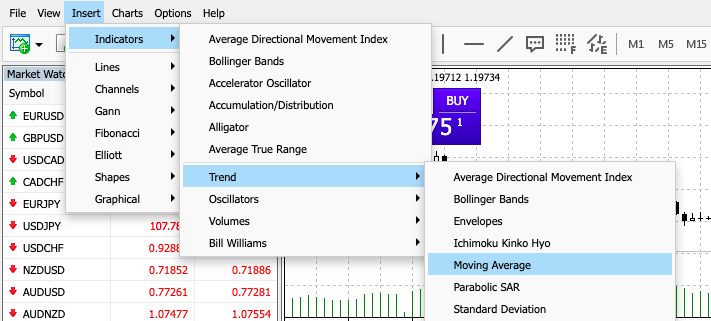
Note that MAs tend to be lagging indicators, i.e. the signals occur after the price has already moved. It’s also important to combine MAs with other indicators to detect your exit points when momentum trading.
Alternatively, you could analyse the market with a moving average convergence divergence (MACD) to identify the relationship between the two MAs of an asset’s price. It’s also an excellent tool for playing breakouts as they can help to spot a reversal in a trend.
Relative Strength Index (RSI)
The RSI provides entry and exit signals based on whether the asset is overbought or oversold. This momentum trading strategy can therefore tell you when to buy and sell, by oscillating between 0 and 100. If it drops below 30, it is thought to be oversold, whilst a reading over 70 is considered overbought.
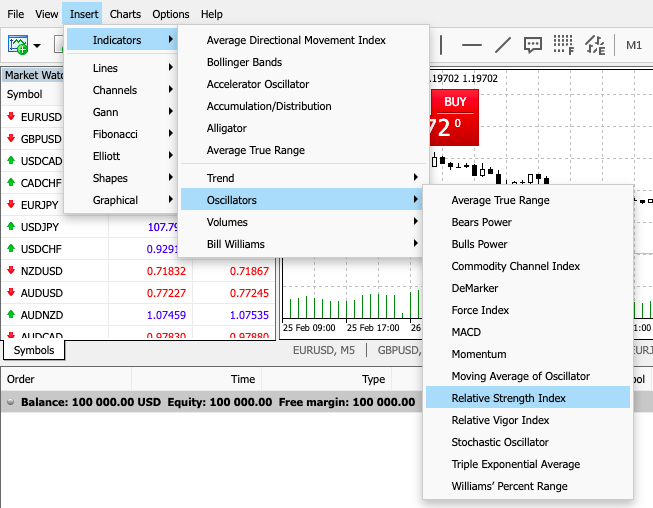
Momentum traders will look for opportunities within this range as it signifies a clear trend. Note that RSI is most effective when used with other indicators because trends can unexpectedly stay in overbought or oversold territories for long periods of time.
Stochastic Oscillator
This indicator tracks the speed of an underlying market by comparing the most recent closing price to the previous trading range. It’s therefore ideal for predicting price movements. The stochastic oscillator consists of two lines on the chart: the indicator line and the signal line.
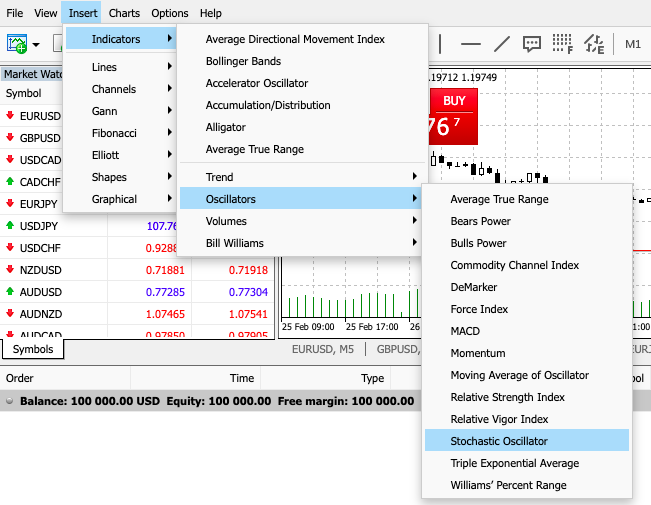
The indicator line oscillates between 0 and 100 (with a reading over 80 signifying an overbought market and a reading below 20 representing an oversold market). The signal line will indicate to the trader a potential change in direction if it crosses with the indicator line.
In some cases, the stochastic might not fall back to 20, meaning the trend could continue upwards, despite pullbacks.
Regardless of which set-up you decide to master, proper risk management rules will help to protect your capital and ensure you don’t run into a disaster. It’s worth learning how to calculate your risk per trade and the position size formula before committing any funds.
Your broker might also be able to provide some advice and tips on good forex strategies to use, although PDF downloads and video guides are available from plenty of other sources too.
Momentum Trading Tools
Whether you’re developing your current method or picking up a new one, it could be worth employing some trading tools. These will depend on your own preferences and goals, so take some time to consider what these are before starting.
Automation
Automated tools and software are popular among traders who don’t have as much time to monitor trades throughout the trading day.
Trading bots, for example, are computer algorithm programs based on signals which can determine buy and sell points. Although they don’t suit all momentum trading strategies, they can act as quick market scanners that, when conditions are good, can automatically submit orders on the trader’s behalf.
You can recruit bots for virtually any strategy and algorithm, as they are widely available in most top platforms. The platforms use either proprietary or universal programming languages, such as Python or, in MetaTrader’s case, MQL4 and MQL5.
Such technology has already allowed traders to streamline their trading strategies, though we could see exciting future developments with the wider use of artificial intelligence and machine learning.
Software
The quality of the software you use will have a huge impact on your day-to-day trading models and setups. Once you sign up to a broker, you will usually have a choice of at least two different platforms to choose from.
Think carefully about the features of the platform and what you require to start your momentum trading. The platform should offer a range of technical analysis tools, chart time frames and risk management features. Today, most brokers will also offer a mobile trading app for those who prefer to trade on-the-go.
If you’re an advanced trader, some platforms such as MetaTrader or cTrader allow you to code your own custom bots and indicators, which you can also backtest within the platform. A community forum, economic calendar and help guides can also be useful.
Alerts
Trading alerts are customisable, automatic notifications that trigger when prices move or certain conditions change. They are usually pre-included within your platform and can be sent via email, SMS or push notification.
Alerts are extremely useful tools that ensure that you never miss an opportunity in the markets and can be used as part of your risk management strategy. For example, price alerts will tell you when there has been a certain percentage change, whilst technical indicator alerts notify you of any buy and sell points.
Some momentum trading platforms even allow you to set reminders about global events and central bank announcements directly from your economic calendar.
Signals
Trading signals trigger buy and sell suggestions when a pre-determined set of criteria has been met. These can vary from simple signals on earnings reports or volume changes to complex signals based on existing ones.
Signals can either be generated by another trader, or an automated forex robot, depending on the preference of the subscriber. You can get both free and paid momentum signals, but note that not all providers are reliable or robust.
In addition, be aware of any trading scams that claim ‘guaranteed’ success or unrealistic returns; these are especially targeted at beginners.
How Much Does Time Of Day Matter For Momentum Trades?
The time of day plays a significant role in short-term momentum trading, as market activity and volatility vary throughout the trading session.
To illustrate, let’s consider the US markets:
- Market Open (09:30 – 11:00 ET): This is one of the most volatile periods due to the influx of overnight news, earnings reports, and pre-market positioning. High volume and sharp price movements are ideal for momentum traders looking to capitalise on quick breakouts or reversals. Patterns like opening range breakouts and gap fills are common during this window.
- Midday Lull (11:00 – 13:30 ET): Trading activity often slows down as institutional traders take a break and market participants digest the morning’s moves. Lower volume can lead to choppier price action, making momentum strategies less effective. False breakouts and whipsaws are more likely during this quieter period.
- Afternoon Session (13:30 – 16:00 ET): Volatility typically picks up again as traders position themselves ahead of the close. This is another prime window for momentum strategies, especially when volume surges during the last hour (the ‘power hour’). Patterns like trend continuation or late-day breakouts are more likely to emerge.
Momentum strategies tend to be most effective at the open and in the final hours of trading, when volatility and volume are highest.
Is Momentum Trading Suitable For Beginners?
If we look at momentum trading vs scalping or day trading, the former is considered a more straightforward view of the markets. The aim is to take advantage of expected price changes and close positions when the trend loses strength.
Momentum trading allows you to follow market sentiment within liquid and popular markets. Herding strategies like this can create the potential for profits because you can use volatility to your advantage. You can also familiarise yourself with popular indicators and oscillators that can set you up for other strategies, including RSI, MAs and Stochastics.
However, momentum trading can be expensive, especially if you’re trading stocks with high turnover. If you compare this strategy vs trend-following or position trading, it can also be quite time-intensive for those who have busy lives outside of their trading platform.
It’s also worth noting that momentum trading focuses more on price action and technical analysis rather than long-term fundamentals, which might be a turn-off for some. Finally, since momentum trading works best in bull markets due to investor herding, this means that profit opportunities are reduced in bear markets, due to cautious investors.
Education
Different types of trading style and experience may require various forms of education, research tools and trading tips.
When trading with momentum strategies, much of your analysis will be based on quantitative data and price action rather than long-term economic developments. As such, we’ve provided a few ideas below that you could add to your technical learning checklist.
- YouTube video tutorials
- Online research papers
- Momentum trading podcasts
- Books (paper and digital PDFs)
- Broker or third-party blogs & newsletters
- Community group forum or trading chat room
- Momentum trading course or Forex Academy
Bottom Line
Now that we’ve explained a few potential strategies, popular indicators and useful trading tools, you should have a good idea of how to do momentum trading in the forex market. You may need to research which options would work best for you and look at online broker and trading platform reviews.
As with all strategies, momentum trading requires practice and dedication. Whether you’re a novice or an advanced trader, a demo account can help you to achieve your goals in your own time. Finally, always stick to your golden risk management rules to protect your capital.
FAQ
What Is A Momentum Trading Strategy?
A momentum strategy reacts to market information by buying when price trends are strong and selling when the assets appear to lose momentum. There are a variety of indicators needed for momentum trading, including moving averages and oscillators. You can also model your own strategy using custom bots or indicators if offered by your platform.
Does Momentum Trading Work?
Momentum trading is a herding strategy that aims to be ahead of the game by being the first to cash out and exit. This can work very well when markets are volatile and liquid but success is not always guaranteed. This is because the markets can change unexpectedly, causing investors to act more cautiously.
Is Momentum Trading Profitable?
Momentum trading can be profitable if you are experienced, patient and have robust risk management calculations in place. Nonetheless, just because you’re using risk management tools, it does not mean that you are immune to a losing streak. Risk tools help to minimise your losses but they are not bulletproof.
When Can I Trade With Momentum Strategies?
There are certain hours of the day where the market traded is more active. Whether you’re trading on the UK or Indian stock market, for example, the ideal trading hours will depend on the asset you are trading and the session times. Most brokers will post these trading hours and market holidays on their website.
Is Momentum Trading Legal?
Yes, momentum trading is legal. Restrictions to trading in general usually depend on your broker, so check with your jurisdiction and your provider’s domiciled location.