


Brokers with API access (application programming interface) are gaining popularity thanks to the rise of automated trading, advancements in technology and the increasing size of financial markets. Our tests show APIs are not just trivial trading tools, but provide opportunities for advanced software integration and strategy implementation.
Dig into our selection of best brokers with API access and find out how to get the most out of an application programming interface for online trading.
Top 6 API Brokers
After our latest hands-on tests, we recommend these brokers with a trading API:
-
- Demo account
- Regulator: ASIC, CySEC, FSA, SCB, CMA-Kenya
- Min. deposit: $200
121 readers visited IC in the last 30 days, 1 of them from Russian Federation -
- Demo account
- Regulator: FMA, FSA
- Min. deposit: $0
-
- Demo account
- Regulator: FCA, ASIC, CySEC, SCA, SCB, CMA-Kenya
- Platforms: Web Platform, MT4, TradingView
-
- Demo account
- Min. deposit: $0
- Min. trade: 0.01 Lots
149 readers visited IG in the last 30 days, 1 of them from Russian Federation -
- Demo account
- Regulator: FCA, ASIC, FMA, DFSA, FSC
- Platforms: Axi Copy Trading, MT4, AutoChartist
-
- Demo account
- Regulator: NFA, CFTC, CySEC
- Min. trade: 1 contract
215 readers visited NinjaTrader in the last 30 days






Learn how we test brokers and why you can trust our ratings.
What Makes These Brokers The Best for API Access?
Here’s why these platforms stood out in our API tests, from reliability and documentation to speed and integration options:
- IC is the best broker for API trading in Russian Federation in 2026 4.8/5 IC Markets (now IC) is a globally recognized forex and CFD broker known for its excellent pricing, comprehensive range of trading instruments, and premium trading technology. Founded in 2007 and headquartered in Australia, the brokerage is regulated by the ASIC, CySEC and FSA, and has attracted more than 200,000 clients from over 200 countries.
- BlackBull 4.5/5 In testing, BlackBull Markets' FIX API demonstrated exceptional performance with average execution speeds under 75 milliseconds, surpassing the industry average of 130 milliseconds. Their ECN infrastructure, utilizing the NY4 Equinix data center, ensures deep liquidity and tight spreads, starting from 0.0 pips plus a $2 commission per lot. This setup is advantageous for algorithmic traders and high-frequency strategies.
- Capital.com 4.3/5 Established in 2016, Capital.com initially focused on CFDs across forex, indices, stocks, commodities, and crypto, aimed squarely at active traders. Over the years it has added more instruments, obtained multiple regulatory licenses, improved its charting tools, and introduced an 1X account that lets you trade without using margin (borrowed funds), now catering to a diverse mix of traders worldwide.
- IG 4.5/5 IG’s REST API offered reliable order execution with moderate latency during our evaluations, making it ideal for automated strategies but less suited for ultra-low-latency needs. Their API supports advanced market data and order types, while spreads remained competitive, especially on major indices and forex pairs.
- Axi 3.7/5 In our tests of Axi's API, execution latency averaged around 110 milliseconds, suitable for day trading but may limit high-frequency traders. They offer tight spreads, from 0.0 pips on Pro accounts, and provide a free VPS for low-latency trading. However, Axi's exclusive use of MetaTrader 4 may not appeal to those seeking more advanced platforms.
- NinjaTrader 4.5/5 NinjaTrader is a US-headquartered and regulated brokerage that specializes in futures trading. There are three pricing plans to suit different needs and budgets, as well as ultra-low margins on popular contracts. The brand's award-winning charting software and trading platform also offers a high-degree of customization and superb technical analysis features.
How Safe Are These Platforms For API-Based Trading?
We assessed each broker’s trustworthiness to help API traders protect their funds and systems:
| Broker | Trust Rating | Guaranteed Stop Loss | Negative Balance Protection | Segregated Accounts |
|---|---|---|---|---|
| IC | ✘No | ✔Yes | ✔Yes | |
| BlackBull | ✘No | ✔Yes | ✔Yes | |
| Capital.com | ✔Yes | ✔Yes | ✔Yes | |
| IG | ✔Yes | ✔Yes | ✔Yes | |
| Axi | ✘No | ✔Yes | ✔Yes | |
| NinjaTrader | ✘No | ✘No | ✔Yes |
Are These API Brokers Good for Advanced Traders?
Experienced developers will value these brokers’ low-latency infrastructure, flexible data access, and other complementary tools:
| Broker | Automated Trading | VPS | AI | Pro Account | Max Leverage* | Low Latency | Extended Hours |
|---|---|---|---|---|---|---|---|
| IC | Expert Advisors (EAs) on MetaTrader, cBots on cTrader, Myfxbook AutoTrade | ✔Yes | ✘No | ✘No | 1:5000 | ✔Yes | ✘No |
| BlackBull | Expert Advisors (EAs) on MetaTrader, cBots on cTrader | ✔Yes | ✔Yes | ✘No | 1:500 | ✔Yes | ✘No |
| Capital.com | Expert Advisors (EAs) on MetaTrader | ✘No | ✔Yes | ✔Yes | 1:30 | ✔Yes | ✘No |
| IG | Expert Advisors (EAs) on MetaTrader, build your own on ProRealTime | ✔Yes | ✔Yes | ✔Yes | 1:30 (Retail), 1:250 (Pro) | ✔Yes | ✔Yes |
| Axi | Expert Advisors (EAs) on MetaTrader, Myfxbook | ✔Yes | ✔Yes | ✔Yes | 1:500 | ✔Yes | ✘No |
| NinjaTrader | NinjaScript or via Automated Trading Interface | ✘No | ✘No | ✘No | 1:50 | ✔Yes | ✘No |
*Maximum leverage on any instrument. Actual leverage can vary by asset, client type, entity and country.
Compare The Top API Broker Ratings
See how each broker with API access scored across all our testing areas:
| Broker | Trust | Platforms | Assets | Mobile | Fees | Accounts | Research | Education | Support |
|---|---|---|---|---|---|---|---|---|---|
| IC | |||||||||
| BlackBull | |||||||||
| Capital.com | |||||||||
| IG | |||||||||
| Axi | |||||||||
| NinjaTrader |
Community Sentiment
See how users rate these brokers based on the average customer ratings submitted on DayTrading.com, plus ratings from Trustpilot, the Apple App Store and Google Play.
| Broker | Our Users' Rating | Trustpilot Score | Trustpilot Reviews | iOS App Rating | Android App Rating |
|---|---|---|---|---|---|
| IC | 4 | ||||
| BlackBull | 3530 | ||||
| Capital.com | 15274 | ||||
| IG | 10414 | ||||
| Axi | 8414 | ||||
| NinjaTrader | 1271 |
Why Use IC For API Trading?
IC (formerly IC Markets) offers superior pricing, exceptionally fast execution and seamless deposits. The introduction of advanced charting platforms, notably TradingView, and the Raw Trader Plus account, ensures it remains a top choice for intermediate to advanced day traders.
 Christian Harris, Reviewer
IC quick facts
- Demo Account
- ✔Yes
- Instruments
- CFDs, Forex, Stocks, Indices, Commodities, Bonds, Futures, Crypto
- Regulator
- ASIC, CySEC, FSA, SCB, CMA-Kenya
- Platforms
- MT4, MT5, cTrader, TradingView, TradingCentral, DupliTrade, Quantower
- Minimum Deposit
- $200
- Minimum Trade
- 0.01 Lots
- Account Currencies
- USD, EUR, GBP, CAD, AUD, NZD, JPY, CHF, HKD, SGD
Pros
- IC offers fast and dependable 24/7 support based on firsthand experience, particularly when it comes to accounts and funding issues.
- IC offers among the tightest spreads in the industry, with 0.0-pip spreads on major currency pairs, making it especially cost-effective for day traders.
- IC secured DayTrading.com's 'Best MT4/MT5 Broker' in 2025 for its seamless, industry-leading MetaTrader integration, refined over years to maximize the platform experience.
Cons
- Despite four industry-leading third-party platforms, there is no proprietary software or trading app built with new traders in mind.
- The breadth and depth of tutorials, webinars and educational resources still need work, trailing alternatives like CMC Markets and reducing its suitability for beginners.
- While IC offers a selection of metals and cryptos for trading via CFDs, the range is not as extensive as brokers like eToro, limiting opportunities for traders interested in these asset classes.
Why Use BlackBull For API Trading?
After improving its trading infrastructure with Equinix servers in London, reducing latency for traders, BlackBull is an obvious choice if you want to day trade stock CFDs with ECN pricing. With competitive spreads and no commission on a growing roster of digital tokens paired with USD, BlackBull also works for active crypto traders.
Christian Harris, Reviewer
BlackBull quick facts
- Demo Account
- ✔Yes
- Instruments
- CFDs, Stocks, Indices, Commodities, Futures, Crypto
- Regulator
- FMA, FSA
- Platforms
- BlackBull Invest, BlackBull CopyTrader, MT4, MT5, cTrader, TradingView, AutoChartist
- Minimum Deposit
- $0
- Minimum Trade
- 0.01 Lots
- Account Currencies
- USD, EUR, GBP, CAD, AUD, NZD, JPY, ZAR, SGD
Pros
- After partnering with ZuluTrade and Myfxbook, alongside improvements to its own CopyTrader, and finally enabling cTrader Copy, BlackBull offers one of the most comprehensive copy trading experiences we've seen.
- With two ECN-powered accounts (Standard and Prime), plus Prime+ - an active trader rewards program offering trading rebates - BlackBull accommodates beginners through to high-volume active traders.
- BlackBull is a much greater fit for aspiring traders following the overhaul of its ECN Prime account, now featuring improved spreads averaging 0.16 on EUR/USD and a more accessible minimum deposit of $0 compared to the old $2,000.
Cons
- Unlike most top brokers, BlackBull charges an irritating $5 withdrawal fee, which can detract from the overall cost-effectiveness, especially for active traders who frequently move funds.
- Despite a growing selection of 2,180+ assets, including additions to its Asia Pacific indices, they are mainly stocks with an average selection of currency pairs and indices.
- Although the Education Hub now features improvements like webinars and tutorials, the courses we’ve explored need more focus on explaining the wider economic factors influencing prices.
Why Use Capital.com For API Trading?
Capital.com is a great match for day traders with its thousands of CFDs, SmartFeed providing tailored market updates, and TradingView charts for advanced technical indicators paired with Capital.com’s fast and reliable order execution.
Christian Harris, Reviewer
Capital.com quick facts
- Demo Account
- ✔Yes
- Instruments
- CFDs on Forex, Stocks, Indices, Commodities, ETFs, Crypto
- Regulator
- FCA, ASIC, CySEC, SCA, SCB, CMA-Kenya
- Platforms
- Web Platform, MT4, TradingView
- Minimum Deposit
- $20
- Minimum Trade
- 0.01 Lots
- Account Currencies
- USD, EUR, GBP, AUD, SEK, NOK, DKK, CHF, HKD, PLN, CZK, AED, HUF, MXN
Pros
- Traders who prefer robust charting can connect their Capital.com account directly to TradingView. This lets you use TradingView’s advanced tools and community ideas alongside Capital.com’s execution, blending a popular charting platform with a regulated broker’s access.
- Capital.com enhanced the mobile trading experience in 2026 with an AI assistant, live trading analytics, and a more customizable home screen with cleaner watchlists.
- Capital.com has an especially strong selection of forex (120+), commodities (70+) and cryptos (500+ pairs), catering to traders interested in these asset classes and needing depth.
Cons
- While Capital.com supports MT4, it lacks MT5 integration, limiting access to advanced trading features, including additional timeframes, indicators, and order types.
- The broker’s research resources focus on educational content and in-house analysis but do not currently include third-party tools such as Trading Central, Autochartist, sentiment indicators, and professional-level screeners that some top competitors offer.
- Capital.com offers primarily a standard CFD account and a professional account (subject eligibility) with higher leverage, but it lacks ECN/raw spread accounts or tiered pricing, which can limit trading flexibility for high-volume scalpers.
Why Use IG For API Trading?
IG continues to provide a comprehensive package with an intuitive web platform, best-in-class education for beginners, advanced charting tools bolstered by its recent TradingView integration, real-time data, and robust trade execution for experienced day traders.
Christian Harris, Reviewer
IG quick facts
- Demo Account
- ✔Yes
- Instruments
- CFDs (not in US), Forex, Stocks, Indices, Commodities, ETFs, Futures, Options, Crypto, Spread Betting (UK only)
- Regulator
- CFTC, NFA, FCA, BaFin, ASIC, FINMA, MAS, JFSA, FMA, DFSA, BMA, CONSOB
- Platforms
- Web, L2 Dealer, MT4, TradingView, AutoChartist, TradingCentral, ProRealTime
- Minimum Deposit
- $0
- Minimum Trade
- 0.01 Lots
- Account Currencies
- USD, EUR, GBP, CAD, AUD, JPY, ZAR, SEK, DKK, CHF, HKD, SGD
Pros
- The IG app offers a superb mobile trading experience with a clean design that helped it secure Runner Up at our 'Best Trading App' award.
- As a well-established broker, IG operates under strict regulatory guidelines in multiple jurisdictions, maintaining a high level of trust.
- IG offers an extensive collection of professional and engaging educational resources, including webinars, articles, and analysis.
Cons
- IG has discontinued its swap-free account, reducing its appeal to Islamic traders.
- IG applies an inactivity fee of $12-$18 per month after 2 years, deterring casual investors.
- Beginners might find IG’s fee structure complex, with various fees for different types of trades or services, potentially leading to confusion or unexpected charges.
Why Use Axi For API Trading?
Axi is a stand-out option if you want to day trade forex on the MetaTrader 4 platform thanks to the broker’s growing selection of 70+ currency pairs, the MT4 NextGen upgrade, and tight spreads from just 0.2 pips if you opt for the Pro account.
Christian Harris, Reviewer
Axi quick facts
- Demo Account
- ✔Yes
- Instruments
- CFDs, Forex, Stocks, Indices, Commodities, Crypto
- Regulator
- FCA, ASIC, FMA, DFSA, FSC
- Platforms
- Axi Copy Trading, MT4, AutoChartist
- Minimum Deposit
- $0
- Minimum Trade
- 0.01 Lots
- Account Currencies
- USD, EUR, GBP, CHF, PLN
Pros
- Axi offers a terrific MT4 experience, enhanced with the NextGen plug-in for advanced order management and analytics, and complete with low execution latency of approximately 30ms.
- Axi introduced an intuitive AI trading feature in 2026 that enables MT5 users to manage accounts and configure trades directly through Claude in a large step towards agentic trading.
- Axi's latest copy trading app is really intuitive based on our tests with useful filtering options to match strategies with individual risk preferences.
Cons
- Axi still has our confidence but issues with the ASIC and FMA in recent years mean it needs to continue providing a secure environment while adhering to licensing conditions.
- Axi is falling behind by only offering MT4 when many rivals now support MT5, cTrader, TradingView and proprietary software for a slicker experience with more advanced tools.
- Despite performing well whenever we use it, Axi's support is unavailable 24/7, which can be inconvenient for traders in different time zones or those needing assistance outside standard trading hours.
Why Use NinjaTrader For API Trading?
NinjaTrader continues to meet the demands of active futures traders looking for low fees and premium analysis tools. The platform hosts top-rate charting features including hundreds of indicators and 10+ chart types.
Christian Harris, Reviewer
NinjaTrader quick facts
- Demo Account
- ✔Yes
- Instruments
- Futures and options on futures, covering indices, commodities, currencies, interest rates, crypto and single stocks
- Regulator
- NFA, CFTC, CySEC
- Platforms
- NinjaTrader Desktop, Web & Mobile, eSignal
- Minimum Deposit
- $0 (live trades must meet intraday margin minimums, e.g., $50 to trade micro contracts)
- Minimum Trade
- 1 contract
- Account Currencies
- USD, EUR, GBP, CAD, AUD
Pros
- The market replay function is a standout feature — you can download tick-by-tick historical data, rewind to any specific date, and interact with it as if trading live, making it genuinely useful for both strategy testing and real-world practice
- Nano contracts — one-hundredth the size of standard contracts on NinjaTrader — allow traders to size positions with precision and manage risk at a much smaller scale, a meaningful advantage for those building positions gradually
- NinjaTrader launched CME Group Single Stock futures in July 2026, allowing traders to express directional views in top U.S. companies like Nvidia, and Amazon without needing options
Cons
- Intraday margin requirements can spike by as much as four times in the 15 minutes leading up to major economic news releases, and may stay elevated for several minutes after volatility subsides — a detail that can catch underprepared traders off guard at exactly the wrong moment.
- NinjaTrader was fined $250k in 2025 for failing to implement an adequate anti-money laundering (AML) program and for supervisory failures.
- NinjaTrader was acquired by Kraken in May 2025, and while it continues to operate independently for now, traders who value long-term stability may have reservations about how the platform's direction and pricing could shift under new ownership.
How DayTrading.com Chose The Best Brokers With API Access
For each broker in our toplist, we conducted hands-on testing of their API access. We evaluated connection reliability, speed, documentation quality, and overall user experience, focussing on the needs of active traders.
Our goal was to assess how well each API supports fast execution, strategy automation, and seamless integration, and we recorded our findings to rank the best options available.
How APIs Work In Trading
An application programming interface (API) is a set of programming code that requests data and sends instructions between software platforms.
APIs are becoming more and more widespread in a range of industries and the number of trading brokers with APIs is steadily growing from our research.
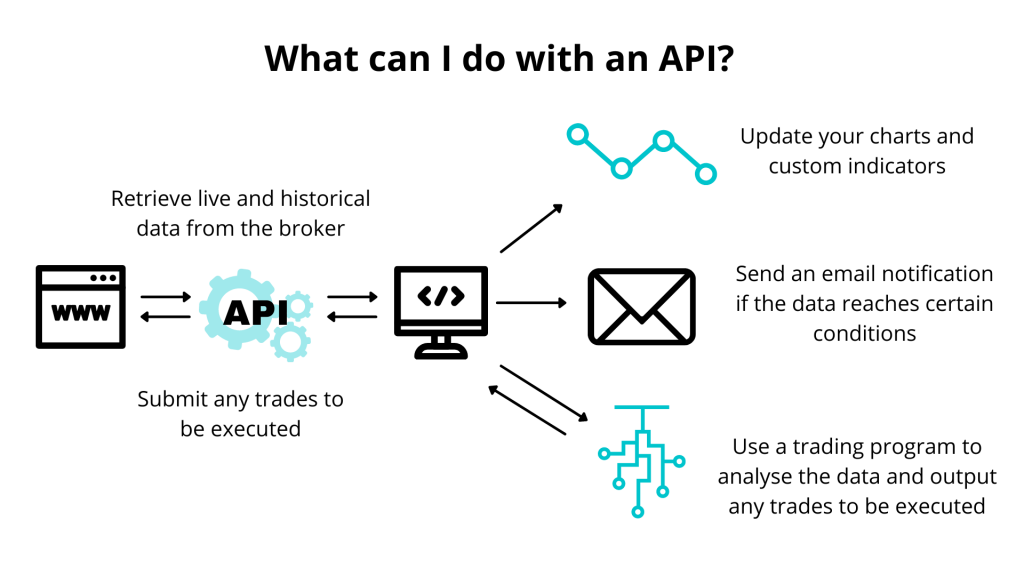
APIs essentially act as a communication bridge for information between a broker’s servers and custom software applications employed by the user.
APIs have several useful applications including sending orders from third-party trading software or receiving live or historical data. For example, an API can be used to connect a set of automated trading algorithms with your preferred broker’s trading platform.
APIs play an important part in many automated trading strategies. In the past, traders would have had to filter through opportunities on one platform and potentially place trades on another. Now that brokers with APIs are becoming more common, this process has been simplified.
Algorithmic trading via APIs allows users to exploit useful trading opportunities by placing instant, accurate trades, removing the need for manual supervision.
Using programming languages such as Python, traders can develop their own applications or complex strategies and automatically execute trades using their broker’s API.
There are two main uses for APIs in trading:
Third-Party Applications – Traders using third-party applications, such as MetaTrader 4, may need access to the broker’s API for pricing data and the ability to place trades.
Developer Applications – Using programming languages like Python, Java or C++, many short-term traders are now beginning to develop their own automated trading applications. APIs allow them to access a broker’s pricing data and place trades.
If you want to find more broker-specific information about a particular API, you should be able to find the API documentation on the firm’s main site. This will give you information on how to authenticate the API, what data is available, how to place orders through the API and other technical details.
Some brokers with APIs will also provide a library of pre-written code to make interaction easier. This will usually be in the broker’s native coding language. This library will usually contain a set of functions for placing a trade, allowing you to avoid writing your own and speeding up the development process.
Pros Of Trading With An API
- Automate Trading – APIs are essential for connecting your automation algorithms with your broker’s servers. This goes for fully and semi-automated trading strategies. Algorithmic trading is very useful to implement strategies that would be very difficult and time-consuming to do manually, like high-frequency trading.
- Historical Data – Automated trading systems require historical data. With an API, you can seamlessly obtain this information and store, analyze and use it to your liking. Traders often use historical data for backtesting strategies.
- Custom Indicators – APIs allow traders to automate their own trading signals and indicators. There are many libraries within various coding languages in which custom indicator solutions can be found.
- Create Custom Alerts – If you are looking for customized notifications sent to your email, you can use an API to retrieve stock prices, spreads or even the value of your portfolio and notify you when these fulfil certain conditions.
- Create Your Own Trading Terminal – If your broker’s trading terminal is not exactly what you are looking for, you can build your own custom terminal and use your broker’s API to populate it with data and implement trading functionalities.
Cons Of Trading With An API
- Steep Learning Curve – If you are new to coding, APIs can seem quite daunting. It is recommended you practise first with an API for a demo account before placing real trades. There are many tutorials online and brokers with APIs offer examples on their documentation to help you get started.
- Limits & Quotas – Brokerages will often limit the frequency with which you can use the API to avoid overloading their bandwidth. For example, they may limit how many trades you can do per minute or hour, how often you can fetch information or which historical data you can access. Ensure that your broker’s limits are enough for your trading needs and implement limits in your code so you do not exceed the allowed quota.
- Fees – Most brokers with API support offer them for free but, if you want to go over their established limits, you might need to pay a fee and some brokers might charge a commission on your profit only for using the API.
- Security – To access your broker’s API you will need a key, which acts as a password. However, there are different protocols for APIs and they all offer different characteristics, often with a trade-off between speed and security. Research the protocol used by your broker and the security measures they implement for a secure experience.
Getting Started With A Broker’s API
- Consider Your Strategy: Decide which trading strategy you will be using and write a simple version in your programming language of choice. Make sure you understand the requirements of your strategy – for example, consider how much historical data you will need, which will be your trading frequency, any third-party applications you’d like to use and which assets are you looking to trade.
- Choose The Best Broker With An API For Your Specific Needs: You will need to evaluate brokers according to their general features, as well as their API tools. Some of the characteristics to consider are countries where they accept clients, market access, security, fees and customer service. Furthermore, some of the API features you need to think about are:
- API Demo: Do they offer a demo account and can you access it via the API? This will allow you to test your code and strategies with low risk and ensure that a paid account will be a good fit for your needs.
- Coding Language & Data Formatting: Ensure the API works with a language that you are comfortable with and that the format of the outputted data can be well understood by your program. JSON is a well-known data format that can be read by different coding languages.
- Documentation: A well-explained API is a must, especially for beginners. Choose a broker that offers complete documentation with examples and code snippets to make the learning curve easier.
- Support: The broker’s customer support should also cover their API, so they can help with more technical questions or issues.
- Quotas & Fees: If a broker has a limit on API trading, ensure your trading needs are well within this limit or that you are happy to pay the corresponding fees.
- API Type: Do you prefer REST, WebSocket or SOAP APIs? They each have specific characteristics, though the differences may not be huge if you are just getting started.
- Open An Account & Register For The API: Open an account with your selected broker, ideally a demo account, and register for API access. You will then get a key that you can use to log in.
- Set Up The API & Test Your Strategy: Check that you can access the API with no trouble, try out the code examples provided and connect your strategy to the API. Also, link your API to any third-party software you would like to use. When you are comfortable, test your strategy. It is recommended you do so for a few weeks to fully de-bug any technical issues that come up and tweak your strategy if needed.
- Use The Trading API With A Live Account: Once you are happy with your broker and their API and your strategy has been tested, you are ready to go live. Always ensure you monitor your strategy and the API and do not hesitate to contact the broker’s help desk or trading community if you have any issues.
Bottom Line
Brokers with APIs and their use are becoming increasingly ubiquitous. They allow users to create custom terminals and implement advanced trading strategies through automation.
Having a good grasp of coding languages such a Python, Java and C++ will give you the edge when trading using brokers with APIs. However, there are numerous free online tutorials about coding and APIs and many good brokers that we’ve tested provide comprehensive documentation to help get you started.
FAQ
What Should I Compare When Looking For Brokers With APIs?
When starting with APIs, make sure you can test your code on a free demo account. Find out which coding language and format are used by the broker and ensure you are comfortable with them. Make sure the broker has comprehensive API documentation, as well as reasonable fees and limitations.
Do Brokers Charge To Use APIs?
Alongside regular brokerage fees, some firms we’ve tested place limitations on the information you can receive using their API. For example, you may only be able to update your live data once every 5 minutes. Brokers may also charge additional fees if you wish to increase the amount of information you can receive.
Should I Start Using My Broker’s API?
Trading using a broker’s API can have advantages for active traders that specialize in algorithmic trading and want to develop more complex strategies.
However, make sure you are aware that you will need to have at least basic to intermediate programming knowledge to start trading via an API.