
Title Transfer Collateral Arrangements in Professional Trading



- The Hidden Risk Behind Leaving Your Retail Trader Classification
- Why Brokers Want TTCAs
- Why TTCA Matters When Traders Change From Retail To Professional Classification
- Understanding The Basics Of A TTCA
- What Happens If The Broker Fails?
- Margin, Leverage, And Elective Professional Status
- The European Union: Retail Protection Vs. Professional Collateral Treatment Under MiFID II
- The UK: Retail Protection vs. Professional Collateral Treatment
- Dubai (DIFC): Retail Protection Vs. Professional Collateral Treatment In A Tier 2 Jurisdiction
- Saint Vincent And The Grenadines: Retail Protection Vs. Professional Collateral Treatment In A Tier 3 jurisdiction
- TTCA Evaluation
The Hidden Risk Behind Leaving Your Retail Trader Classification
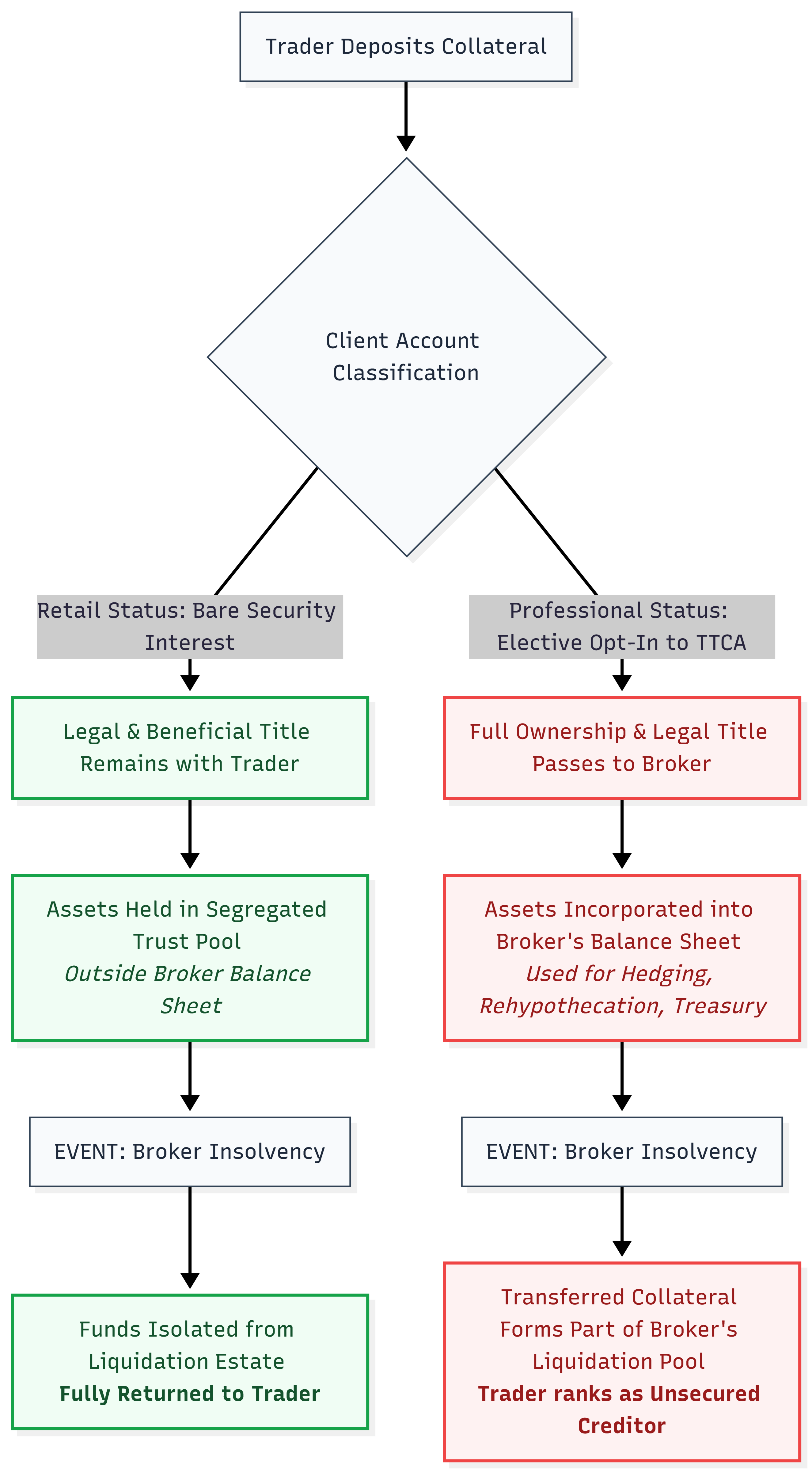
A Title Transfer Collateral Arrangement (TTCA) is one of the most consequential provisions a trader may agree to in a brokerage or derivatives agreement, yet many clients accept it without fully understanding its legal effect. Under a TTCA, legal and beneficial title to cash, securities, or other collateral passes from the trader to the broker, or to another collateral taker for the purpose specified in the agreement. Once the transfer is made, the client no longer owns the transferred collateral. Instead, the client acquires a contractual right to the return or redelivery of equivalent cash or equivalent assets in accordance with the terms of the TTCA.
In many jurisdictions, client money and assets are required to be segregated from the firm’s own money and assets, and this includes collateral that is held under a security interest or custody arrangement. It is thus subject to applicable custody rules and may receive protection in the event of the firm’s insolvency. If the trader enters into a TTCA, all this changes, because the client is no longer the legal owner of the money and assets. Collateral transferred under a valid TTCA generally becomes part of the broker’s own balance sheet.
Consequently, if the broker becomes insolvent and a TTCA is in place, the client generally does not have a proprietary claim to the transferred collateral itself. Instead, the client has a contractual claim for the return of equivalent money and assets, and the treatment of that claim will depend on the governing law, the insolvency regime, the terms of the TTCA, and any applicable statutory protections.
In many jurisdictions, the client’s claim in respect of collateral transferred under a TTCA will rank as a simple unsecured claim unless otherwise protected by law or contract, and this can greatly reduce a client’s chance of getting it back. When a broker enters insolvency proceedings, it does not have enough assets to satisfy all of its liabilities. The insolvency process distributes the broker’s remaining assets among creditors according to statutory priority rules. Clients who retain ownership of segregated assets can generally recover those assets because they do not form part of the broker’s insolvency estate.
By contrast, where collateral has been transferred under a TTCA, the client no longer owns those assets. Instead, the client has a contractual claim against the broker for the return of equivalent assets or their value. If that claim is unsecured, it will rank behind secured and preferential creditors and is likely to be satisfied only in part. This means that the trader might recover only a fraction of the value of the transferred collateral.
Why Brokers Want TTCAs
Brokers use Title Transfer Collateral Arrangement (TTCAs) because TTCAs are commercially beneficial for them. A TTCA gives the broker full ownership of collateral. That can make funding, clearing, hedging, margining, and treasury operations easier. If the broker owns the collateral, it may be able to use it to meet margin calls, secure its own obligations, support prime brokerage arrangements, rehypothecate securities, reduce funding strain, or manage liquidity more flexibly. For the broker, the arrangement turns client collateral into usable balance sheet material.
TTCAs are very common in the professional trading sphere, and they are also very important. Prime brokers, clearing brokers, futures firms, and OTC derivatives dealers often need to move collateral quickly. A broker facing a clearing house, prime broker, or liquidity provider may have to meet margin calls on a tight timetable. If the broker must keep every client asset segregated and untouched, it needs more of its own capital to support the same activity. If it can take title to client collateral, it can fund parts of the business more efficiently. That is the commercial logic. Professional markets often use title transfer structures, especially in derivatives and prime brokerages, and large institutions understand that collateral mobility is part of the price of leverage and market access.
Simplifying Legal And Operational Risk Management
For a broker, TTCAs can simplify legal and operational risk management. Modern financial institutions operate within complex networks of counterparties, clearing houses, custodians, settlement systems, and financing providers. Each layer requires collateral to be delivered, substituted, recalled, or liquidated at very short notice.
A title transfer arrangement removes many of the legal uncertainties that arise when a firm merely holds a security interest over client assets. Instead of determining whether the client has granted sufficient rights to use the collateral in a particular transaction, the broker already owns the asset outright and can deploy it immediately. This can reduce legal friction, shorten documentation, and prevent disputes over the scope of a security interest.
Improving The Broker’s Balance Sheet Flexibility
TTCAs also improve a broker’s balance sheet flexibility. Financial firms are subject to capital, liquidity, and prudential requirements. The efficient use of assets is commercially valuable. Collateral received under a TTCA can often (depending on applicable law) be incorporated into the firm’s wider treasury and funding activities rather than sitting idle in segregated client accounts. The same pool of collateral may support secured borrowing, reduce external funding needs, or be used in repo and securities lending markets. Where regulation places limits on how collateral may be reused, outright ownership generally provides greater flexibility.
Reducing The Costs Of Providing Leveraged Trading
From a commercial perspective, TTCAs can reduce the costs of providing leveraged trading. Offering leverage requires brokers to finance positions, meet margin requirements with clearing brokers, and absorb fluctuations in market exposure throughout the trading day. These activities consume capital and liquidity. If client collateral can be reused as part of those funding arrangements, the broker’s financing costs may fall. Lower funding costs can make leveraged products more profitable or allow brokers to offer more competitive pricing.
In highly competitive markets where spreads and commissions are often very thin, the ability to use client collateral efficiently can represent an important source of economic value.
Coping With Market Stress
The commercial benefits of TTCAs become even more significant during periods of market stress. Sharp price movements can generate substantial intraday margin calls from clearing houses or liquidity providers. A broker that owns client collateral has greater flexibility to respond immediately without raising additional funding or liquidating its own assets.
From the firm’s perspective, this enhances resilience and reduces liquidity risk. From the client’s perspective, however, the same mechanism means that assets which might otherwise have remained protected as client property become part of the broker’s own financial resources and are exposed to the broker’s creditworthiness.
TTCAs Are Not Morally Wrong, But Traders Need To Understand The Risks
None of the broker benefits stated above means that TTCAs are inherently improper. They perform an important function in wholesale financial markets and are widely used between sophisticated institutions that negotiate terms on an informed basis and price the associated counterparty risk accordingly. The commercial rationale is clear. The issue is not whether brokers derive genuine operational and financial benefits from TTCAs (they plainly do), but whether clients fully understand that those benefits are obtained by transferring ownership of their assets and accepting the consequences if the broker later becomes insolvent.
This becomes especially acute when machinery designed for sophisticated participants is opened up to smaller professional clients who do not fully understand the insolvency consequences. A hedge fund with counsel, operations staff, and counterparty credit processes probably knows exactly what it is giving up. An individual day trader applying for professional CFD status because they want 1:200 leverage might not. The broker’s incentive is not neutral. TTCAs improve the broker’s position. They can reduce operational friction and funding cost, but they also shift credit risk to the client. The trader gives up ownership, and the broker gains ownership.
Why TTCA Matters When Traders Change From Retail To Professional Classification
In many jurisdictions, financial services regulations prohibit or significantly restrict brokers from using TTCAs with retail clients, while permitting their use for professional or institutional clients (subject to applicable legal and regulatory requirements). If a trader changes classification from retail to professional, they lose that regulatory protection. This is something many traders, even the experienced ones who qualify for professional status, are unaware of or believe is unimportant.
When traders apply for professional status, it is usually because they want things such as higher leverage, fewer product restrictions, looser margin limits, more flexible dealing terms, and access to services that retail clients cannot use. The pitch is often clean. You are experienced. You trade size. You understand risk. The broker can give you better terms if you apply for professional status and fulfil the requirements to be reclassified. But the upgrade can also move the trader into a very different legal environment, and a TTCA is often buried in the new account agreement for the professional account.
This is why understanding the true implications of a TTCA matters a lot when you are standing at the boundary between retail and professional status. In many jurisdictions, retail clients are given the highest level of regulatory protection, and that often includes not allowing TTCAs for retail accounts. Professional clients are instead more likely to be allowed to take on more risk, including opting into TTCAs.
The danger is that some active traders think that passing the “professional” assessment is only about the good stuff. They want bigger leverage, improved margin rules, access to more financial products, and generally to be able to see themselves as expert traders. But being classified as a professional trader also comes with implications that brokers are not so eager to advertise in bold print, and in many jurisdictions, that will include the ability to sign a legally binding agreement that transfers the ownership of collateral from the client to the firm. The broker can now take title to collateral that would otherwise sit inside client money or client asset custody protections. That is a serious upgrade in risk.
Understanding The Basics Of A TTCA
A TTCA is not the same as a normal security interest.
Under a normal security interest, the client may remain the owner of the asset while granting the broker rights over that asset if the client defaults. The broker has protection, but the title does not necessarily pass immediately. Under a TTCA, the title does pass. The broker receives full ownership and becomes subject to a contractual obligation to return equivalent money or assets when the client’s obligations are satisfied.
The exact details can vary depending on the contract and jurisdiction.
The United Kingdom – An Example Of TTCA Regulation
In the UK, the Financial Conduct Authority (FCA) glossary defines the term title transfer collateral arrangement used in CASS 6 (Custody rules) and CASS 7 (Client money rules). In the context of CASS 6, it pertains to a safe custody asset, and in CASS 7, to client money.
As you can see, in both cases, full ownership is transferred from the client to the firm. In CASS 7, it is an arrangement where a client transfers full ownership of money to a firm to secure or otherwise cover present, future, actual, contingent, or prospective obligations. In CASS 6, the same concept applies to assets that would otherwise be safe custody assets. The important phrase is “full ownership”. This is very different from leaving something with your broker as security and retaining the ownership rights as long as you fulfil your obligations.
When you transfer full ownership, the asset is no longer yours. You have a contractual claim, but that claim is against the broker. If the broker fails, you are not pointing to a segregated client account and saying, “that is mine”. You are saying “the broker owes me equivalent value”, and you have lined up with all the other claimants who have a contractual claim against the broker. Those are not the same thing. In insolvency, you are much more likely to get fully compensated if you have a proprietary client asset claim than if you are standing in line with all the unsecured creditors while administrators count what is left. Companies that have enough money and assets to cover all claims typically don’t enter into insolvency proceedings in the first place.
The FCA’s collateral rules make that distinction clear.
In CASS 3 on collateral, the FCA explains that a bare security interest gives the firm rights only on client default.
CASS 3 also makes clear that under a “right to use arrangement”, the client has transferred to the firm the legal title and associated rights to the asset, so that when the firm exercises its right to treat the asset as its own, the asset ceases to belong to the client and in effect becomes the firm’s asset and is no longer in need of the full range of client asset protection.
For money, we find important rules in CASS 7 – Client money rules, especially in CASS 7.11 – Treatment of client money.
CASS 7.11.103/01/2018R (3) states that a firm must not enter into a TTCA in respect of money belonging to a retail client, while CASS 7.11.103/01/2018R (4) makes clear that money that is subject to a TTCA is no longer client money.
Read that last part slowly. Money subject to a TTCA does not amount to client money. That means the money is outside the normal FCA client money trust and distribution framework. It is not segregated for the client in the usual statutory sense. It is not part of the client money pool on the same basis as segregated cash. The broker owns it. The client has a contractual claim.
Some arrangements may include netting rights, close-out rights, or even a security interest granted back to the client. But the core point remains: the statutory client money or custody protections have been displaced. The FCA even notes in CASS 7.11.601/06/2015G that when a firm has received full title or full ownership of money under a collateral arrangement, the fact that it grants a security interest to the client to secure repayment does not make the money client money. In other words, dressing the arrangement with a repayment mechanism does not put the asset back into the statutory client money pool.
It is clear that a TTCA comes with a new type of broker credit risk. The client is no longer only exposed to market risk. The client is exposed to the broker’s solvency. If the broker uses the transferred collateral in its own financing, hedging, clearing, or treasury operations, the client’s economic exposure becomes connected to the broker’s wider balance sheet. If the broker survives, the arrangement may work as intended. If the broker fails, the trader may discover that “my collateral” was legally “the broker’s asset”.
This is the part traders often miss because the platform still shows a balance. The screen may display cash equity, margin, free margin, and collateral value. Operationally, it may look like the money is sitting in your account. Legally, ownership has moved.
A TTCA changes three things at once:
- It changes ownership because the broker owns the collateral.
- It changes insolvency status because the client now has a contractual unsecured claim instead of a segregated proprietary claim.
- It changes risk analysis because the trader must now evaluate the broker’s creditworthiness, treasury controls, and insolvency arrangements.
What Happens If The Broker Fails?
The real test of TTCA is not how it works on a normal trading day. The real test is broker insolvency.
In jurisdictions with strong trader protection rules, regulatory requirements are typically in place to keep client funds and assets separated from broker funds and assets. A TTCA changes this completely, since money and assets become the property of the broker, and the client is left with a contractual claim against the broker, usually in the form of an unsecured claim.
Example: The United Kingdom
The United Kingdom is one example of a country where strict segregation rules are in place for trader money and assets, as long as there is no TTCA. (The UK is also a jurisdiction where retail traders can not enter into a TTCA with their broker.)
If we look specifically at money deposited into a trading account, CASS 7A regulates client money distribution and transfer when a firm holding client money fails, a primary pooling event occurs, and client money distribution and transfer rules apply.
- CASS 7A.2 – Primary pooling events: Covers situations such as the failure of the broker firm. It explains how client money is pooled, how each client’s entitlement is calculated, and how money should be distributed or transferred.
- CASS 7A.3 – Secondary pooling events: Covers the failure of a bank, clearing house, intermediary, or other third party where the broker has deposited client money. It sets out how any resulting shortfall is allocated among affected clients.
If a TTCA is in place, CASS 7A is no longer relevant because money subject to TTCA is no longer client money. The client’s platform account balance is a contractual claim for equivalent money or assets, subject to close out, set off, and any security or netting provisions in the agreement. If the broker is insolvent and the collateral is part of the broker’s estate, the client is exposed to standard administration rules. In practical terms, the professional trader who has entered into a TTCA becomes an unsecured creditor. That means the trader ranks alongside other unsecured creditors after secured creditors, insolvency expenses, and other priority claims. Recoveries may be partial or nil. The trader may have had a profitable account on Friday and a claim in an insolvency on Monday.
The insolvency risk can be impacted by the broker’s use of collateral in its own business. If the broker has rehypothecated securities, posted cash to another counterparty, funded hedges, supported clearing margin, or used collateral in treasury operations, the client cannot assume the same asset is sitting untouched. Under TTCA, the broker may only owe equivalent assets or money, not the original asset itself. In insolvency, equivalent return depends on the estate’s resources and contract rights.
This does not mean every TTCA broker is reckless. Some prime brokers and professional trading firms are well capitalized and manage collateral properly. But the client’s analysis must move from “is my money properly segregated?” to “is this broker creditworthy and able to honour its contractual obligations and repay me what I am contractually owed?” Those are two very different questions. The second one requires reviewing factors such as capital strength, regulatory status, group structure, custody chain, margin policy, rehypothecation rights, financial statements, credit ratings where available, insolvency treatment, and the client’s own concentration risk.
The harshest part is that a TTCA can turn a winning trading account into counterparty exposure. You may be right on the market and still lose money because the broker fails. That is the sort of risk traders rarely model.
Margin, Leverage, And Elective Professional Status
Many jurisdictions have rules in place that limit how much leverage a broker is allowed to give a retail client. Therefore, elective professional status is often marketed as a route to more leverage. That is not wrong, but the picture is not complete.
In many jurisdictions, consumer protection rules that are in place to safeguard retail clients do not cover professional clients. The general idea is that professional clients are presumed to understand more and need less protection. That gives brokers more room to offer higher leverage, broader financial products, and different collateral terms. In return, professional clients may lose things such as mandatory negative balance protection (NBP), standardised risk warnings, leverage caps, and certain retail conduct protections. They may also enter into TTCAs that would not be permitted for a retail account.
The commercial bargain is clear. If you give up your retail status and pass the requirements to be reclassified as a professional trader, you get more freedom, and the broker gets more flexibility. But this access is not always worth the price for the individual trader.
Higher leverage increases the likelihood that collateral will be used, stressed, and called. A professional trader using 1:200 or 1:400 leverage has a very different loss path from a retail trader limited to 1:30 or even less. A market gap can very quickly create a huge debit balance. Understandably, the broker will want strong collateral rights to protect itself. That is why professional account agreements often contain both broad margin, close out, set off, and title transfer rules.
TTCA then interacts with leverage. The more leverage the broker grants, the more collateral control it may demand to be placed in the trading account. This is particularly relevant for high balance active traders. An individual trader with £5,000 in a professional account under TTCA is still taking risks, but the absolute exposure may be tolerable in relation to the trader’s overall financial situation. An individual trader with £750,000 in a professional account under TTCA has a broker credit exposure that can prove hard for the individual to recoup if lost. At that point, broker due diligence needs to be more thorough.
Some regulators are seeking to increase individuals’ awareness that professional client status does not provide only advantages and may also result in the loss of important protections available to retail clients. One example is the United Kingdom, where the regulated COBS 3 client classification process is intended to introduce a degree of friction and ensure that clients make an informed decision before opting for professional treatment. Under the COBS 3.5 elective professional client rules, a client must actively request professional classification and acknowledge that certain regulatory protections may no longer apply.
The European Union: Retail Protection Vs. Professional Collateral Treatment Under MiFID II
In the European Union, a retail client can not be placed into title transfer financial collateral arrangements for the purpose of securing or covering the client’s obligations. That prohibition is found in MiFID II, Article 16(10).
The same Article 16 also requires a firm holding client financial instruments to safeguard the client’s ownership rights, especially in insolvency, and to safeguard client funds and prevent their use for the firm’s own account (except in the case of credit institutions). You find these duties in Article 16(8) and Article 16(9). It is important to remember that it only pertains to things that still belong to the client. When a TTCA is in place, the situation becomes very different, since actual ownership of money and assets is transferred.
The retail rule is clear because the regulator knows what TTCA does. It transfers ownership. Retail clients are not expected to understand this, so the regulator protects them. Retail clients can take ordinary market risks, but their money and assets should not be absorbed into the broker’s balance sheet through title transfer.
Professional clients are treated differently by the EU regulator. Firms are not automatically prohibited from using TTCAs with professional clients or eligible counterparties. That does not mean a TTCA is automatically appropriate. It means the firm must justify the use in context and comply with conditions. The professional client is treated as having enough knowledge, experience, and resources to understand the consequences.
This distinction matters for retail traders who request elective professional status. The upgrade will reduce or remove several important protections under the EU regulatory framework. More leverage is not free. It is paid for with lower regulatory cushioning and higher legal responsibility.
The Commission Delegated Directive (EU) 2017/592
The main TTCA regulation is found in MiFID II Article 16, especially Article 16(8), Article 16(9), and Article 16(10). You find the detailed TTCA appropriateness criteria in Article 6 of Commission Delegated Directive (EU) 2017/593.
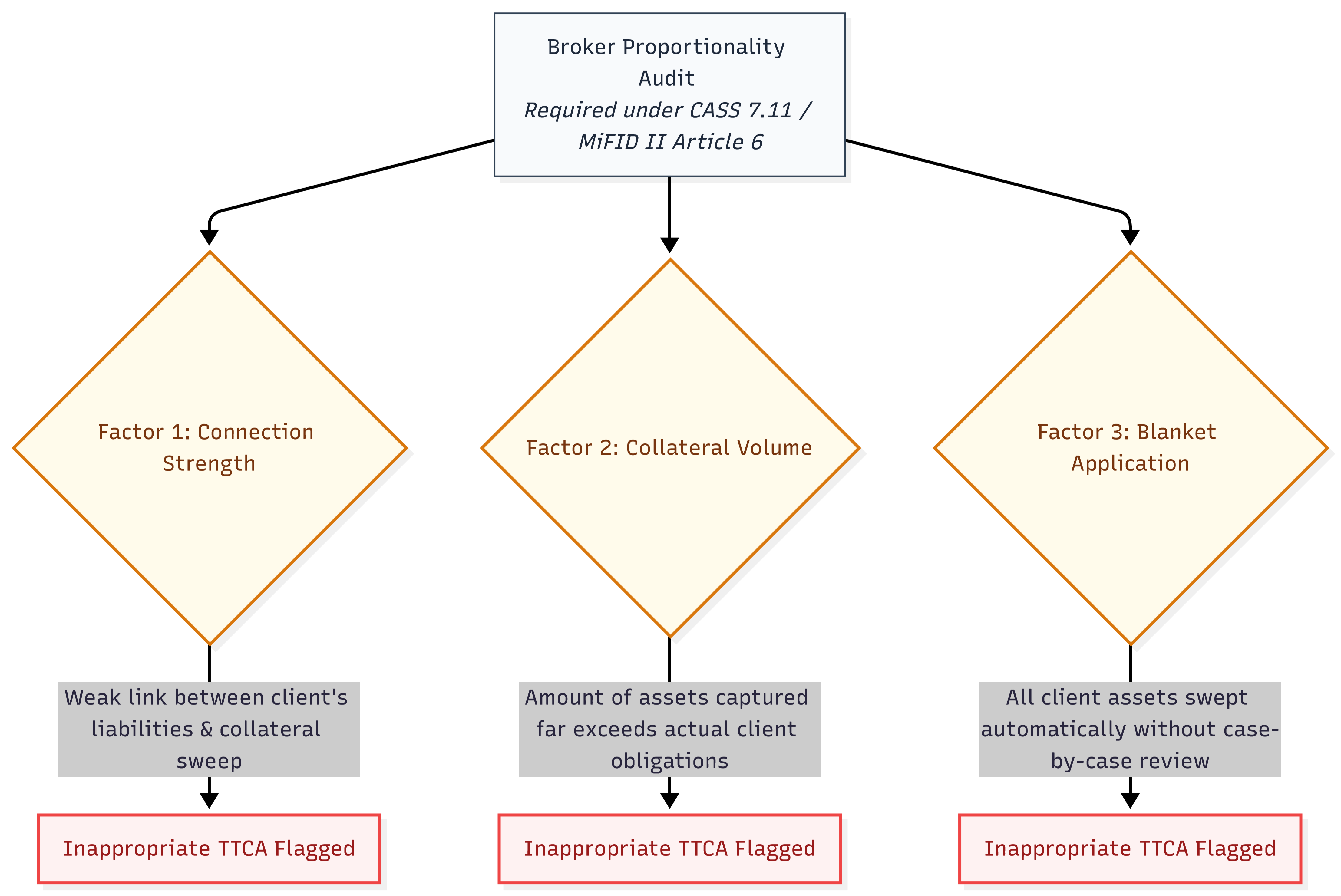
Article 6 of Commission Delegated Directive 2017/593 is headed “Inappropriate use of title transfer collateral arrangements”. It requires investment firms to properly consider, and be able to demonstrate that they have considered, the use of TTCAs in the context of the relationship between the client’s obligation to the firm and the client assets subjected to the TTCA. That is the regulatory spine. A broker cannot satisfy Article 6 by simply saying, “This client is professional, therefore we take all their collateral under the TTCA because that is our blanket rule in the User Agreement”. The broker has to consider whether the TTCA makes sense relative to the client’s actual obligations and be able to show this to the regulator.
Article 6 sets out three factors:
- The first is whether there is only a very weak connection between the client’s obligation to the firm and the use of the TTCA, including whether the likelihood of the client’s liability is low or negligible.
- The second is whether the amount of client funds or instruments subject to TTCA far exceeds the client’s obligation, or is even unlimited if the client has any obligation at all.
- The third is whether all client financial instruments or funds are made subject to TTCA without consideration of what obligation each client has to the firm.
The UK: Retail Protection vs. Professional Collateral Treatment
We have already used the United Kingdom as an example above, but let’s take a more comprehensive look at what the UK framework looks like for TTCAs.
Client Re-Classification
For starters, the FCA makes it clear that a broker is not allowed to assign professional status to a client willy-nilly. Under COBS 3 client categorisation, an elective professional client must satisfy qualitative and quantitative conditions; the client must state in writing that it wishes to be treated as professional, the firm must give a clear written warning of the protections and investor compensation rights the client may lose, and the client must state in a separate document that it is aware of the consequences of losing those protections.
TTCA Limitations
For client accounts where the use of TTCA is legal, it must still be used within the limits of the FCA framework. CASS 7.11.4A requires the firm to properly consider and document the use of TTCAs in the context of the relationship between the client’s obligation and the money subject to the TTCA. It also requires the firm to be able to demonstrate compliance. The FCA factors include whether the connection between the client’s obligation and the TTCA is weak, whether the amount of money subject to TTCA exceeds the client’s obligations, and whether the TTCA applies to money without regard to each client’s actual obligation.
This is not a box-ticking exercise. The firm has to consider proportionality. If a client has a modest margin obligation, taking title to all cash and all assets with no cap may be hard to justify. If a client’s liabilities are merely contingent, unlikely, or otherwise remote, taking broad title over collateral may be weakly connected to the broker’s actual credit exposure. If the broker applies TTCA automatically to all professional clients, regardless of exposure, the arrangement may conflict with the regulatory expectation that the client’s actual obligations be assessed.
The FCA has shown clear concern about misuse. In its 2020 Dear CEO letter on inappropriate use of TTCAs, the FCA told wholesale brokers that it had identified examples of inappropriate TTCA use amounting to CASS compliance failures. The FCA warned that clients subject to inappropriate TTCAs may experience a shortfall or delay in having assets returned from the general estate rather than benefiting from CASS protections. The FCA letter is important because it addresses the exact professional-market assumption that clients can look after themselves. Professional clients may be more sophisticated, but firms still have CASS obligations. A broker cannot escape those obligations, and brokers are not allowed to apply TTCA without assessing whether the arrangement is connected to the client’s actual obligations.
TTCAs Must Be In Written Form
CASS 7.11.3 requires the TTCA to be a written agreement made on a durable medium. It must cover the client’s agreement to transfer full ownership of money to the firm, the terms under which ownership transfers back, and termination terms.
Hence, the danger is not invisible; it is stated in the contract. The problem is that many traders sign the contract while chasing higher leverage and then act surprised when the legal effect behaves exactly as written.
Collateral Rules In CASS 3
CASS 3 contains rules for collateral.
For safe custody assets, there is a big difference between bare security and TTCA. Under a bare security interest, the asset continues to belong to the client (unless the client defaults). Under a TTCA, the client transfers legal title and associated rights.
When a firm has only a bare security interest (without rights to hypothecate) in the client’s asset, the firm must comply with the custody rules or client money rules as appropriate, under CASS 3.1.301/11/2007R.
TTCA And Proportionality: Understanding The FCA’s July 2020 Dear CEO letter
As discussed above, brokers operating under the FCA rulebook are not allowed to put whatever they feel like in a TTCA contract just because the trader is classified as professional. TTCAs are allowed, but there are constraints.
And these constraints are not a paper tiger. The FCA is monitoring firm behaviour. A clear example of this is the Dear CEO letter sent out in July 2020, mentioned above.
A Dear CEO letter is a supervisory communication issued by the FCA to regulated firms when it needs to highlight significant issues that require the prompt attention of the CEO or other senior management. It is a way for the FCA to communicate significant supervisory concerns, explain its expectations, and tell senior management to review and (when necessary) take action. But the Dear CEO letters are not new legislation. Dear CEO letters are an important supervisory tool, but they do not create new legislation or new rules. Rather, they communicate the FCA’s interpretation of, and expectations under, the existing regulatory framework.
In the July 2020 Dear CEO letter, the FCA expressed concern about the inappropriate use of title transfer collateral arrangements (TTCAs). It was sent to FCA-authorised brokers in wholesale financial markets, including clearing brokers and prime brokers, that held clients’ cash or securities as collateral. It was issued because the FCA had identified firms using title transfer collateral arrangements (TTCAs) in ways that breached the Client Assets Sourcebook (CASS).
The central message in the letter is that TTCAs are lawful only when used appropriately and proportionately. The FCA emphasises that a TTCA is an exception to the normal client asset protection regime. When assets are transferred under a valid TTCA, they cease to be protected as client money or custody assets under CASS because legal title passes to the firm. This means firms must be able to justify why a TTCA is appropriate in each case.
In the letter, the FCA says it had recently identified several examples of inappropriate practice, including:
- Holding money or assets under a TTCA without meeting the requirement to consider client obligations.
- Holding all of a client’s money or assets under a TTCA in the absence of a present, future, actual, contingent, or prospective obligation to the firm.
- Holding an inappropriate amount of money or assets under a TTCA compared to that client’s present, future, actual, contingent, or prospective obligations.
- Moving an increased amount of collateral from a segregated (CASS) to a TTCA (non-CASS) environment without a corresponding documented consideration demonstrating a connection between the collateral taken and the relevant client obligation.
In the letter, the regulator reminds firms that they must continually monitor whether a TTCA remains appropriate. If a client’s secured obligations decrease or disappear, firms should promptly return excess collateral or restore it to CASS protection where required. The decision to use a TTCA is therefore not a one-off exercise but requires ongoing review.
A major concern underlying the letter is client protection in the event of insolvency. Assets transferred under a TTCA belong to the firm while the arrangement is in force. If the firm fails, the client generally has a contractual claim for the return of equivalent assets, but may rank as an unsecured creditor rather than benefiting from the segregation and protections available under the CASS regime. This can result in delays or losses if the firm’s estate is insufficient. The FCA regarded inappropriate use of TTCAs as particularly concerning given the heightened risk of firm failures during the COVID-19 period.
Overall, the letter is a supervisory warning that firms must use them only where justified by genuine client obligations, must keep their use under review, must document properly, and must not use TTCA as a routine mechanism for bringing client assets outside the CASS protection regime.
Why Is The FCA Concerned?
A major concern underlying the July 2020 letter, and the overall TTCA regulation under FCA, is client protection in the event of insolvency.
Consider a simple example. A professional trader in the UK holds £500,000 cash with a broker and signs TTCA terms. The trader has open positions requiring £80,000 margin. But the broker takes title to all £500,000. If the broker remains solvent, the trader’s platform shows equity, margin, and free funds. If the broker fails, the trader does not have £500,000 in a segregated client money pool. The trader will instead have an unsecured claim against the broker for the balance due after close-out and netting. If the general estate, for instance end up paying 35p in the pound, the trader gets 35% of £500,000 back (or even less due to close out and netting).
A narrower security interest would have produced a different risk profile. If the trader had retained ownership and the broker merely had security over £80,000 or another appropriate collateral amount, the residual money would have belonged to the client, and client segregation rules would have applied.
This is why the appropriateness test matters. The broker should not use TTCA simply because it is convenient for the broker. It should be tied to the client’s obligations. If the client has no meaningful obligation or only a small one, sweeping all cash and assets into TTCA is disproportionate. If every professional client is put into the same title transfer structure regardless of product, exposure, collateral amount, and trading pattern, the arrangement starts to look like a funding shortcut rather than a risk control.
The FCA’s 2020 letter makes that concern plain. The regulator said firms should review TTCA use and gave examples of inappropriate practice. The letter warned that improper use could harm clients in insolvency because they may face delay or shortfall from the general estate instead of CASS protection.
Dubai (DIFC): Retail Protection Vs. Professional Collateral Treatment In A Tier 2 Jurisdiction
Unlike the UK and the EU membership countries, Dubai is typically considered a Tier 2 location when it comes to trader protection.
While there is no official international classification of regulators into “Tier 1”, “Tier 2”, and “Tier 3”, this industry shorthand is useful when it is necessary to quickly give traders a general idea of what to expect when it comes to regulatory oversight, investor protection, and restrictions. It’s considered ‘yellow tier’ in DayTrading.com’s regulatory bandings.
Dubai is known as a Tier 2 jurisdiction when it comes to trader protection, but this does not mean that brokers here are unregulated or that trader protection rules do not exist. Firms are still required to be authorized by the Dubai Financial Services Authority (DFSA) and follow prudential requirements and conduct of business rules. There is also ongoing regulatory supervision.
The distinction is one of regulatory approach rather than the absence of regulation. Compared with the UK FCA and the MiFID II framework in the European Union, the Dubai regime generally adopts a more flexible model in certain areas. This provides firms and market participants with greater commercial freedom, but it also means that some of the trader protection measures familiar to UK and EU clients are absent, less extensive, or applied differently.
Before opening an account with a Dubai-regulated broker, traders should understand how client money is held, whether title transfer collateral arrangements are used, what protections apply in the event of the broker’s insolvency, and whether any investor compensation scheme is available. A broker may be reputable and properly regulated in Dubai, yet still offer a different level of regulatory protection from that available under the UK FCA or the EU MiFID II regime. Understanding those differences is an important part of assessing counterparty risk.
DFSA And DIFC
When a broker is marketed as “based in Dubai”, it typically means that it is based in the Dubai International Financial Centre (DIFC). DIFC is a special financial free zone in Dubai that has its own legal and regulatory system, separate from the rest of the United Arab Emirates (UAE). It was established to create an internationally appealing financial centre based largely on common law principles.
The key institutions in the DIFC are:
- The Dubai Financial Services Authority (DFSA)
This is the financial regulator responsible for financial firms operating within the DIFC. It is not the same as the UAE Securities and Commodities Authority (SCA). - The DIFC Courts
This is a court system applying DIFC law, based largely on English common law principles.
Collateral And TTCAs Under DFSA
Collateral
A financial firm regulated by the DFSA may hold collateral from clients, and the DFSA Conduct of Business Rules contain detailed requirements on disclosure, custody, segregation, and treatment of collateral. They require firms to explain how collateral will be held, whether it will be registered in the client’s name, whether equivalent rather than identical collateral may be returned, and what happens on insolvency.
TTCAs
The DIFC recognises Title Transfer Financial Collateral Arrangements (TTCAs), and the DIFC Financial Collateral Regulations define a TTCA as an arrangement where legal title ownership of financial collateral is transferred to the secured party to secure or cover financial obligations.
Are TTCAs Allowed For Retail Clients?
A DFSA-regulated broker can use a TTCA structure with a retail client because the DFSA does not contain any blanket prohibition. However, whether a particular TTCA is permitted depends on the structure of the arrangement and the DFSA rules that apply to the firm’s client classification, client assets, and collateral arrangements.
The DFSA regulates collateral arrangements through broader client asset and conduct rules. For example, DFSA COB 6.13.4 requires firms holding client collateral to disclose:
- The terms governing how collateral will be held
- Any rights the firm has to realise the collateral
- Whether collateral will be registered in the client’s name
- Whether different collateral may be returned
- What happens in insolvency or another distribution event
That framework is more focused on transparency and safeguarding instead of using a MiFID II-style or UK FCA-style expressed prohibition.
TTCAs In Resolution Scenarios
The DIFC framework specifically recognises and protects TTCAs, including in resolution scenarios. A resolution scenario is a situation where a financial regulator or resolution authority intervenes to deal with a failing financial firm without immediately putting it into ordinary insolvency proceedings. The DFSA Resolution Rules refer expressly to “collateral arrangements, including title transfer collateral arrangements” and provide protections for such arrangements.
DFSA RAR 3.6.2 forms part of the DFSA’s Recovery and Resolution (RAR) framework and addresses the treatment of certain financial arrangements where the DFSA exercises resolution powers over an authorised firm. Its purpose is to provide legal certainty and protect the operation of important contractual arrangements during a resolution process.
The rule is particularly relevant where a resolution authority uses powers to transfer only part of a failing firm’s business, assets, or liabilities to another entity. Without appropriate safeguards, such a transfer could unintentionally disrupt existing contractual rights, including rights arising under collateral, netting, and set-off arrangements.
RAR 3.6.2 therefore, requires appropriate protection for certain arrangements, including collateral arrangements, including title transfer collateral arrangements (TTCAs), set-off arrangements, and netting arrangements.
RAR 3.6.2 should not be misunderstood as providing a form of client asset protection or compensation. It does not:
- Preserve the trader’s ownership of assets transferred under a TTCA
- Convert a contractual claim into a proprietary claim
- Guarantee that collateral will be returned in full
- Give the client priority over other creditors in an insolvency
- Provide the same protection as segregation of client assets
Under a TTCA in DIFC, ownership of the collateral is transferred to the collateral taker. If the broker becomes insolvent, the client may no longer have a claim to specific identifiable assets, but instead may have a contractual claim for the return of equivalent assets, subject to the terms of the arrangement and applicable insolvency law.
RAR 3.6.2 protects the legal effectiveness and continuity of the collateral arrangement. It does not protect the client from the consequences of having entered into that arrangement. That distinction is central when assessing the risks of TTCAs in the DIFC. A rule that protects the enforceability of collateral arrangements may benefit market stability, but it does not necessarily improve the position of the individual client who has transferred title to their assets.
Saint Vincent And The Grenadines: Retail Protection Vs. Professional Collateral Treatment In A Tier 3 jurisdiction
The Financial Services Authority (FSA) is responsible for regulating and supervising non-bank financial services and the international financial services sector in St. Vincent and the Grenadines, including entities such as international business companies (IBCs), international banks, and money services businesses. While the FSA primarily covers non-bank and international financial services, commercial banks in SVG are instead supervised through the Eastern Caribbean Central Bank (ECCB), which is the monetary authority for the Eastern Caribbean Currency Union (ECCU).
What is very important to know is that the SVG FSA does not have any specific licensing regime for brokers and securities dealers. When an online broker says it is “regulated by SVG”, it usually means something much narrower than clients used to more robust regimes might assume. SVG FSA does not license or supervise forex brokers, CFD brokers, or securities dealers as a dedicated regulated activity. A brokerage company incorporated in St. Vincent and the Grenadines is a registered business entity among other business entities. It is not subject to broker-specific prudential requirements, securities conduct rules, client-asset protections, investor compensation arrangements, or ongoing supervision comparable to regimes such as the FCA (UK), SEC/FINRA (USA), or DFSA (DIFC).
A broker might say it is an “SVG-regulated broker” when the practical meaning is closer to “our company is registered in SVG”.
Collateral, Client Money, And Client Assets
Above, we looked at the legal situation for brokers regulated by the DFSA in Dubai. The situation for a broker operating from St. Vincent and the Grenadines is very different, and this is something traders should take into account before handing any money or assets over.
A firm that is licensed and supervised by the DFSA in Dubai operates under a detailed financial-services regulatory regime that includes specific conduct-of-business, client asset, custody, segregation, and collateral-handling rules. By contrast, SVG and the FSA do not have any equivalent regulatory framework for online brokers or securities dealers, so there is no comparable rulebook imposing broker-specific collateral requirements. The FSA does not have a securities-broker licensing framework comparable to the DFSA’s that sets out detailed rules for how an online broker must hold, protect, segregate, disclose, or return client collateral.
This means that a brokerage company incorporated in SVG is not subject to any specific broker legislation requiring segregation of client money and client collateral from the firm’s own assets, specific custody arrangements, disclosure of whether collateral is held in the client’s name, rules on re-use (rehypothecation) of client collateral, rules on returning equivalent versus identical collateral, or detailed insolvency treatment disclosures.
Because of this, contractual terms become very important. For an SVG-incorporated online broker, the treatment of margin, collateral, and client assets will usually depend heavily on the broker’s client agreement, including account terms and conditions.
TTCAs
In SVG, there is no dedicated financial collateral regime for brokers, investment firms, or online trading platforms comparable to the UK, EU, or DIFC frameworks. SVG does not have a specific statutory framework that defines and regulates title transfer financial collateral arrangements (TTCAs). Collateral arrangements, including TTCAs, are generally contractual.
When an SVG-incorporated broker uses a TTCA, the exact legal effect of that contract depends on a variety of factors, including what the client-broker contract says about governing law and jurisdiction.
If an SVG broker’s User Agreement says something like “all margin and collateral are transferred to the broker on a title-transfer basis”, the trader should understand that this may mean that the broker becomes the legal owner of all collateral, that the client only has a contractual claim for repayment or return of equivalent assets, and that collateral can be exposed to the broker’s insolvency risk, depending on the legal structure and applicable law.
Are TTCAs Allowed For Retail Clients?
There is no specific SVG rule that prohibits or expressly permits Title Transfer Financial Collateral Arrangements (TTCAs) with retail clients.
TTCAs In Broker Insolvency Cases
There is no well-established SVG case law or dedicated SVG financial-collateral legislation confirming how TTCAs used by online brokers would be treated in a broker insolvency scenario.
That is an important difference from jurisdictions such as the DIFC, UK, and EU member states, where legislation and case law provide greater certainty on issues such as whether title transfer is effective against an insolvency practitioner, how collateral can fall into the secured party’s estate, whether the collateral provider has only a contractual claim, and whether close-out netting and enforcement rights survive insolvency.
The outcome in St. Vincent and the Grenadines would likely depend on the applicable law, the terms of the parties’ contract, and general principles of contract, property, and insolvency law. It is also important to remember that user agreements can contain governing law, jurisdiction, and dispute resolution clauses, which can affect how contractual disputes are determined. The effect of such clauses in an insolvency proceeding can be difficult to gauge in advance, as they may be limited by the mandatory insolvency laws in SVG.
TTCA Evaluation
Due Diligence Questions Before Accepting TTCA Terms
Professional status can be useful for genuine professionals. But no trader should accept TTCA terms because the leverage looks attractive. Read the agreement. Ask what is transferred. Ask what remains protected. Ask what happens in broker insolvency. Ask whether excess collateral can stay outside TTCA. If the broker cannot explain the structure clearly, do not donate your balance sheet to their balance sheet in exchange for an unsecured claim.
Examples Of Pertinent Questions
Start with classification. Learn about which classes are relevant in this jurisdiction, and how they differ from each other when it comes to TTCA. There might, for instance, be different rules for retail clients, elective professional clients, per se professional clients, and eligible counterparties. Before you proceed, find the answers. Which category will I be placed in? Which protections would I lose? Can I request reclassification back to retail status in the future?
Then ask about the scope for the TTCA that would apply to your account. Which assets are subject to TTCA? Cash only? Securities only? All collateral? Excess cash? Unrealised profit? Is the TTCA applied automatically on receipt, or only when margin is required? Is there a cap tied to actual obligations? Can excess collateral be held outside TTCA as client money or custody assets?
Next, ask about the purpose. What obligation is the TTCA securing? Is the obligation actual, contingent, or prospective? How likely is it to arise? How does the amount taken under TTCA relate to the exposure? If the relationship manager cannot explain it, ask compliance. If compliance cannot explain it, that is a useful answer.
Ask about ownership and insolvency. Once assets are transferred, do they become the broker’s absolute property? Will they be segregated? Will money be part of the client money pool or the general bankruptcy estate? If the broker enters insolvency, do I have a proprietary claim or an unsecured contractual claim? Is there any security granted back to me, and if so, where is it documented and how is it perfected? In this context, “perfected” means that a security interest has been properly created, legally effective, and made enforceable against third parties, e.g. other creditors, an insolvency practitioner, or a court. A security interest is not necessarily effective simply because a contract says one exists. Perfection is the process by which the security interest obtains legal priority and protection. The exact steps required to perfect security depend on the type of asset, the governing law, and jurisdiction.
Ask about reuse. Can the broker rehypothecate, pledge, lend, sell, or otherwise use the assets? Are there limits? Are assets used to support the broker’s clearing or hedging obligations? Are they transferred to affiliates or third-party counterparties? Are they held where the company is headquartered or in a foreign country? Does the group structure expose the client to another entity’s insolvency?
Ask about return mechanics. When are equivalent assets returned? How fast can excess collateral be moved back to protected treatment? What happens after all positions are closed? Can the client terminate the TTCA without closing the whole account? Does termination require broker consent? Is there a waiting period?
Ask about reporting. Will statements clearly identify which assets are subject to TTCA and which remain client money or custody assets? Does the firm report TTCA balances separately? Are valuations shown gross or net of liabilities? Does the statement distinguish legal ownership from economic exposure, or does it just show one comforting number?
Ask about compensation. Is some type of statutory protection available if the firm fails, e.g. the UK FSCS? Does that scheme treat the claim differently if money and/or assets were subject to TTCA? Compensation scheme outcomes depend on specific facts, so vague reassurance is not enough. “You may be covered” is not the same as “this remains protected client money under this specific scheme.”
Ask about alternatives. Can the broker offer a security interest instead of a title transfer? Can collateral be limited to the required margin? Can excess cash stay segregated? Can the account be run under retail status with lower leverage?
Finally, can another broker provide the same market access without TTCA?
Learn To Spot The Signs In Account Agreements
The first phrase to look for is “transfer full title” or “transfer full ownership.” If the agreement says money, securities, or collateral become the absolute property of the broker, the client should assume standard regulatory client money or custody protections may not apply to those assets, since ownership is transferred.
The second phrase is “not client money” or “will not be held in accordance with client money rules.” It means the funds are outside the client money pool.
The third phrase is “equivalent assets” or “equivalent amount.” Under a title transfer, the broker may owe equivalent money or securities, not the identical asset. That is normal for title transfer structures, and it matters in insolvency. A right to equivalent assets is a claim. It is not the same as continuing ownership of a particular segregated asset.
The fourth phrase is “right to use,” “rehypothecate,” “pledge,” “charge,” “lend,” “dispose of”, or “deal with as our own”. These words tell the client that the broker may use the asset in its own business. The asset has ceased to belong to the client and becomes the firm’s asset, and the firm will use it accordingly.
The fifth phrase is “all money” or “all assets” in connection with title transfer. Some regulators have challenged this approach, even for professional accounts, but it remains legally permissible in many jurisdictions. In the European Union, Article 6 of the MiFID II Delegated Directive (EU) 2017/593 of 7 April 2016 requires firms to consider whether the use of TTCAs is appropriate in the context of the relationship between the client’s obligations and the client assets subject to the TTCA. In particular, firms must consider whether all client financial instruments or funds are made subject to TTCAs without consideration of each client’s specific obligations to the firm. A blanket clause may be commercially convenient for the firm, but some regulators have begun to require detailed justification.
In this context, it is also good to look for “unlimited obligations” or other types of wording that give broad coverage of present, future, actual, contingent, or prospective liabilities. Some breadth is built into the definition of TTCA, but unlimited collateral capture should make the client ask how the firm has assessed proportionality. If the trader’s realistic exposure is limited, why does the broker need title over everything?
The next phrase is “set off”. Set off allows amounts owed by the broker and client to be netted. Set off can be useful in insolvency, but it can also reduce what the client receives if the broker asserts claims against the client. The details matter.
And if multiple companies in a brokerage group fail, questions arise, such as:
- Are claims calculated separately against each entity?
- Can obligations between group companies be netted?
- Does the insolvency regime recognise group-wide netting arrangements?
These issues can be highly jurisdiction-specific, and if more than one jurisdiction and/or governing law is involved, the case becomes even more complex.
Another important phrase to look for is “termination of TTCA”. How can the TTCA be terminated? How can it be terminated by the client? By the broker? If the agreement does not give the client a clean path to terminate TTCA or move excess collateral back into client money treatment, that is concerning. In the UK, the FCA requires written terms covering how ownership transfers back and how the arrangement terminates, but many other jurisdictions are less stringent.
Finally, look out for phrases along the lines of “we may determine”. A certain degree of broker discretion is necessary in margin contexts, but broad discretion over collateral classification, transfer, use, and return should be read carefully. Discretion plus title transfer plus high leverage is a spicy dish.