





Price feed latency arbitrage is a trading strategy that exploits the short delay (latency) between when an asset’s “true” market price changes and when that updated price reaches another trading venue, broker, or pricing system. For brokers that act as market makers, latency arbitrage can create losses because they’re effectively offering outdated prices. As a result, many brokers have systems in place to detect and counteract latency arbitrage strategies. Brokers can, for instance, reject or reprice trades (“last look”), and cancel trades deemed to exploit stale quotes. They can also prevent latency arbitrage by widening spreads during volatile periods, and reduce the risk of latency in the first place by investing in better infrastructure. Some brokers explicitly prohibit latency arbitrage in their terms of service.
Virtual dealer plugins and latency protection systems are technologies used by some brokers to manage how trader orders are executed. Their purpose can range from reducing technical risk to preventing strategies that exploit delayed pricing. Their specific behavior depends on how the broker configures them.
Virtual dealer plugins and latency protection systems sit in a difficult place. Brokers genuinely need tools to defend against stale-price latency arbitrage, especially around high-impact news and in fast-moving FX markets. A short server-side delay, bridge recheck, or price validation rule can be legitimate if it is disclosed, symmetrical, monitored, and applied under a clear policy. But the tools and routines can also be abused or used in a non-disclosed manner. An artificial delay can create forced slippage, requote logic can block profitable fills, group settings can punish profitable traders, and asymmetric execution can let the broker keep price improvement while passing losses to traders.
In many jurisdictions, there is a point where these types of behaviors can cross a line where it violates applicable regulations. Examples of well-known cases are Enfinium, FXDD, and FXCM.
The fair question is not whether a broker uses virtual dealer plugins and latency protection systems. Most serious trading infrastructure uses server-side controls of some kind. The fair question is how those controls treat price movement between order and fill. If slippage works both ways, records are kept, policies are clear, and execution data supports the model, the broker has a defensible system. If delay appears only when the trader would benefit, then the broker is not offering a fair trading environment.
Latency Arbitrage In Retail FX And CFDs
Latency arbitrage takes place when a trader exploits a situation where a broker’s displayed price is stale relative to a faster wholesale, exchange, institutional, or aggregated reference price. Instead of forecasting the market, the trader is attempting to profit from the time gap between one price source and another.
In retail FX and CFD trading, the gap can exist for several reasons. The broker may stream prices from one or more liquidity providers. Those prices may pass through an aggregator, bridge, pricing engine, mark-up layer, and trading server before appearing on the trader terminal. The trader may use a faster price feed from another broker, exchange-traded futures, an institutional data source, a VPS close to a price server, or a low-latency news feed. When major news hits, prices can move faster than the retail platform can refresh cleanly. In quiet markets, the gap may be tiny. When there is a central bank surprise or similar event, the gap can become tradable for a few milliseconds or even seconds.
A latency arbitrage trader is looking for that gap. If the faster reference market jumps higher but the broker’s EUR/USD offer is still old, the trader buys the stale offer. If the broker fills the trade at the stale price and then tries to hedge in the live wholesale market, the broker may be forced to buy at a worse price. The broker suffers unless it can internalize the risk, reject the order, requote, delay processing, or apply slippage. This is why brokers dislike latency arbitrage. It is not normal directional trading. It is not the trader taking a view on EUR/USD over the next hour. It is the trader attempting to trade against the broker’s technology delay. The broker is not being paid a spread for market risk; it is being picked off for having a slower price update path.
The problem is sharper in OTC markets because there is no single central order book for retail spot FX or many CFD products. A broker’s price is usually derived from external references plus a mark-up, not pulled from one official exchange book. Slippage, rejection, and requote rules therefore matter more than many traders realize. The CFTC’s FXDD press release explains the situation well. In essence, a customer clicked a price shown on screen, but the price could change or “slip” between the click and the time the broker filled the order. The broker’s slippage parameters then determined whether to fill or reject the order. According to the CFTC Order, FXDD used asymmetrical slippage parameters on its principal trading platform, meaning that the system favored FXDD over its customers in slippage situations.
A broker therefore faces a genuine execution control problem. If it fills every order at every stale quote, it invites latency arbitrage. If it rejects too many orders, traders get poor execution. There are also actions that can be tempting, but go against regulation in many jurisdictions, such as adding delay to every order without disclosure, passing negative slippage but keeping positive slippage, or using delay only against profitable traders (targeted execution degradation).
Virtual Dealer Plugins
What Is A Virtual Dealer Plugin?
A virtual dealer plugin is software that sits between a trader’s order and the broker’s execution engine. Instead of sending every order directly for execution, it can apply predefined rules.
Depending on the configuration, the virtual dealer plugin can, for instance:
- Introduce a small execution delay (for example, 100–500 milliseconds).
- Reject an order if the market has moved beyond a set threshold.
- Requote the price (ask the trader to accept or reject a new price).
- Automatically approve or reject orders based on market conditions.
- Apply different handling to profitable scalping or arbitrage strategies.
Brokers use these systems to reduce losses from stale quotes, protect against technical issues during fast markets, improve pricing consistency, discourage latency arbitrage and certain forms of ultra-short-term trading, and generally manage execution risk.
Some traders argue against virtual dealer plugins, since they can increase slippage, delay executions, reject profitable trades more often than losing ones (if configured to do so), and make scalping strategies less effective.
A virtual dealer plugin is not the same thing as a latency protection system, since a virtual dealer plugin is a broader order-management tool that can delay, filter, or modify order handling according to configured rules. A latency protection system is more narrowly focused on preventing execution at stale or delayed prices. A broker may use one, both, or neither, depending on its trading infrastructure and business model. In modern institutional trading systems, many of these protections are built directly into the execution platform rather than existing as separate “plugins”.
The virtual dealer plugin (fully integrated or actually a plugin) sits behind the retail trading interface. It is server-side software used by a broker to automate parts of the order handling process that a human dealer might otherwise control manually. The trader does not click a “virtual dealer” button or see this plugin. They place the order and the order enters the broker’s server stack, where a plugin, bridge, risk engine, or dealing rule may decide how the request is handled, depending on the exact broker setup.
Use And Abuse
A virtual dealer-style plugin can perform a price validation function. It receives the incoming trader order, waits for a configured period, checks whether the current broker or wholesale price has moved beyond the permitted deviation, and then accepts, rejects, requotes, or applies slippage according to rules.
The delay might be fixed, randomized, or conditional. A broker might apply it only to certain symbols, account groups, order sizes, high volatility periods, or trading strategies.
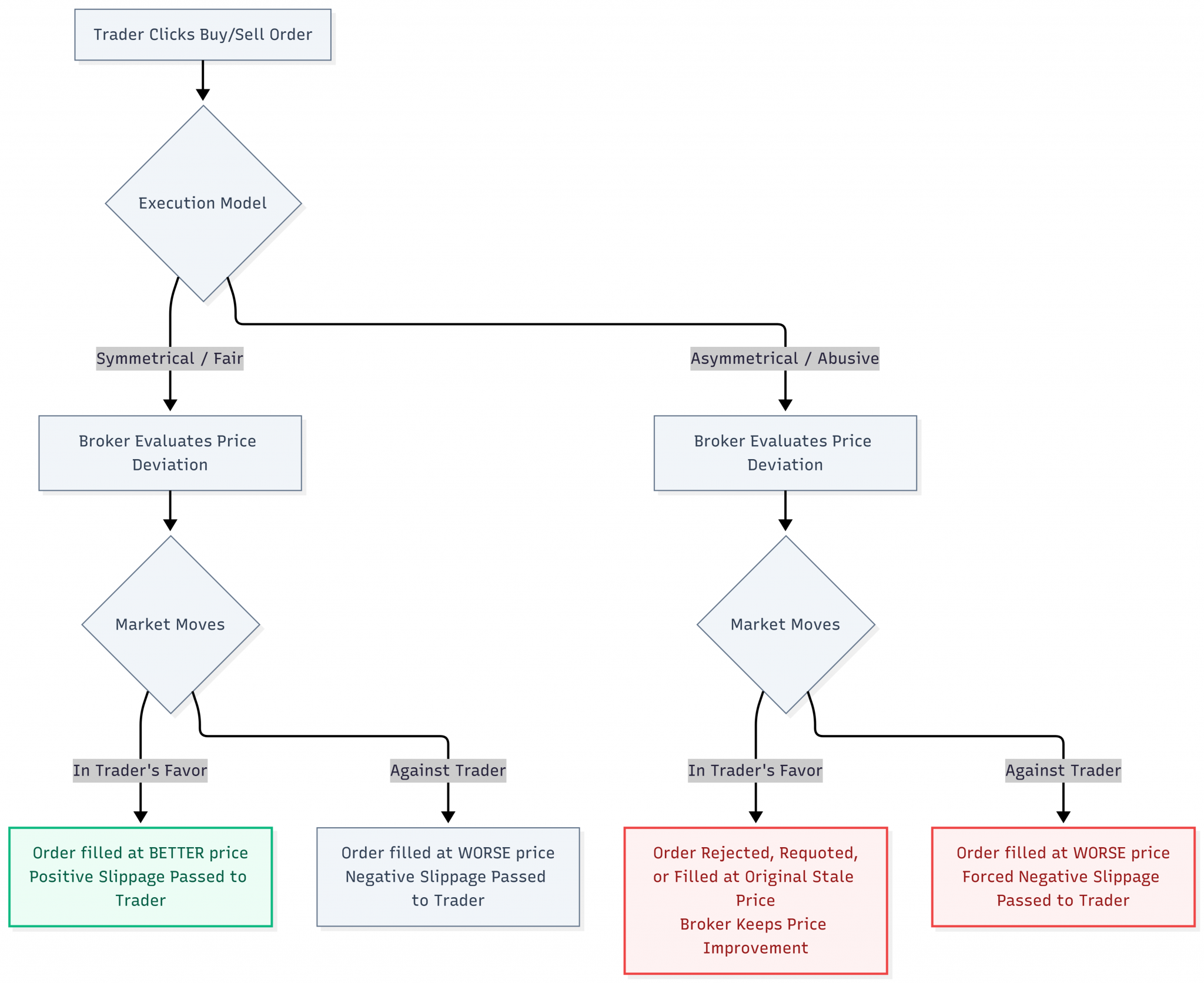
The timing range is not universal. It depends on the tool and configuration. In modern bridge language, it is possible for a protective delay to be very short, e.g. 100 to 500 milliseconds, when the aim is to let the bridge check the live wholesale price before committing to a fill. But there are examples from the past where brokers implemented much longer delays, e.g. 1-10 seconds.
The plugin gives the broker a pause where the broker can ask whether the clicked price is still valid. If the market has moved against the broker during the pause, the broker may reject or requote. If the market has moved in the broker’s favor, the broker may fill at the old price unless its rules require price improvement to be passed to the trader. A clean version of the process is symmetrical. If the market moves against the trader by more than a defined tolerance, the order may be filled with slippage, rejected, or requoted under disclosed terms. If the market moves in the trader’s favor by the same tolerance, the trader receives price improvement or the same logic applies in a fair way. The trader may still dislike the outcome, but the rule is not rigged in one direction.
An asymmetrical version can quickly become abusive. If the price improves for the trader, the broker rejects the order or fills at the original price and keeps the improvement. If the price worsens for the trader, the broker fills the order at the worse price or lets the trader absorb the movement. The CFTC’s FXDD action on asymmetrical slippage parameters described exactly this type of unfair handling. The broker, FXDD, rejected orders when price slipped more than two pips in the customer’s favor, but filled at the original price when slippage favored FXDD.
A virtual dealer plugin can also be used for certain operational controls. It can simulate manual dealing, check maximum order size, apply group rules, manage high volatility conditions, disable trading around news, or route suspicious flow for review. A broker with a B-book or hybrid book has real market exposure to stale-price traders. It is not unreasonable to protect the firm from being systematically picked off. But in order to maintain fairness, protection should be disclosed, symmetrical, monitored, and consistent with the broker’s execution policy.
Actual Virtual Dealer Plug-Ins Have Become More Unusual, But The Control Mechanisms Are Still There
Are virtual dealer plug-ins still used by retail brokers? Yes, but not as much as before.
The Virtual Dealer Plugin, originally associated chiefly with the MetaTrader 4 platform, became widely used and discussed in the retail FX world in the 2000s and early 2010s. Today, many retail brokers are still implementing this type of execution logic, but not through the actual MetaQuotes Virtual Dealer Plugin. Instead, they use server-side risk engines, liquidity bridge logic between broker and LPs, smart order routing systems, and external liquidity provider rules (especially “last look” pricing). So the functionality is still here, but the classic “plugin” is much less common in modern architectures.
Brokers have moved away from the classic plug-in due to a combination of reasons. Many are now using complex hybrid setups involving multiple liquidity providers, ECN/STP routing, and external matching engines. That makes execution control more distributed rather than centralized in a single plugin. Competition and regulation have also pushed many brokers toward more transparent execution practices. Heavy-handed use of requotes or asymmetric slippage controls is less acceptable in many retail markets today, especially under stricter oversight regimes. Third, infrastructure improvements such as colocation, faster pricing engines, and better liquidity aggregation reduce the need for aggressive intervention, at least in normal conditions. If pricing is more synchronized, there is less need to intervene in trades after submission.
Having execution logic between client orders and liquidity is still very much a thing, but it has become more distributed, more sophisticated, and less dependent on a single plug-in.
It should also be noted that the term “virtual dealer plug-in” has become a bit tainted, and many brokers therefore prefer to describe their execution logic using other terms, even if they are using a traditional virtual dealer plug-in. You might, for instance, come across terms such as risk management plugin, execution filter, latency protection module, news protection setting, or dealer automation. This can refer to a virtual dealer plug-in or to some other type of solution, and you need to scratch the surface to find out.
With that said, if a tool or mechanism is abusive to traders, the economic effect is the same even if it is achieved through some other way than the classic virtual dealer plug-in.
Understanding The Broker’s Legitimate Risk Problem
A broker streaming retail FX and CFD prices is not simply displaying the interbank market to traders. It is running a risk engine. It may act as principal. It may internalize flow. It may hedge net exposure through a bridge. It may warehouse risk. It may route certain traders or orders externally and retain others internally. In all of those models, stale price execution can hurt the broker.
Take a simple example. A broker streams GBP/USD at 1.27000 by 1.27002. A UK inflation print hits. The wholesale market jumps to 1.27120 by 1.27135. The broker’s platform price updates late and still shows 1.27002 for a fraction of a second. A latency trader buys 20 lots at 1.27002. If the broker must honor the stale price and hedge at 1.27135, the broker is immediately down 13.3 pips before even considering spread, depth, and execution fees.
This is the core economic defense for latency controls. A broker should not be required to sell unlimited size at a price that no longer exists in the market just because the platform display lagged. Exchange markets solve this through matching rules, order book priority, collars, halts, limit orders, and visible liquidity. OTC retail FX solves it through contracts, execution policies, price checks, last look, slippage controls, and broker discretion. That is less transparent, and that is the problem.
Institutional FX also has related concepts. Dealers stream prices subject to credit, size, latency, last look, and relationship terms. Last look itself is controversial, but the rationale is familiar. A dealer checks whether the requested trade is still valid before accepting it. The Global Foreign Exchange Committee’s FX Global Code says that market participants using last look should be transparent about its use and should not use information from last look requests in ways that disadvantage the trader. Retail virtual dealer logic is not the same as institutional last look, but both sit in the same family of execution validation controls.
News trading makes the broker’s problem worse because price movement is clustered. At 8:30:00 New York time on a payrolls release, thousands of systems may fire at once. Liquidity providers may pull depth, widen spreads, and reject trades. The broker’s bridge may receive stale ticks. The trading server may queue orders. The platform may show prices that were technically current a moment ago but commercially dead now. A trader clicking during that moment thinks they accepted a displayed price. The broker thinks the trader attacked a stale quote. The trader wants the broker to honor the quote. The broker wants to avoid being picked off. This is when factors such as disclosed execution model, order type, the trader’s tolerance settings, the broker’s hedge process, and whether positive and negative slippage are treated symmetrically become very important.
A broker can protect itself without cheating. It can widen spreads during known news events. It can mark quotes as indicative. It can reject orders when price is outside a disclosed tolerance. It can apply maximum deviation rules equally in both directions. It can pass positive and negative slippage according to clear order type logic. It can disclose that market orders provide execution certainty but not price certainty. It can limit trading during abnormal market conditions. The abuse begins when controls are hidden, targeted, one-sided, or altered without disclosure.
How The Delay And Bridge Check Works
Retail Execution Path
The retail execution path involves more steps than the trader observes. The trader terminal sends an order request to the broker’s trading server, which first performs validation checks such as account status, margin availability, symbol settings, trading hours, order size, and order type.
After validation, the order enters the execution engine, where a dealer module, pricing logic, or plugin layer may introduce processing delays or execution rules. The system then evaluates current market data, available liquidity (internal and external), and the broker’s risk exposure.
At this stage, the server makes a routing decision. Depending on the broker’s execution model and current conditions, the order may be:
- rejected (fails validation or risk rules),
- requoted (price no longer valid under execution rules),
- filled internally (matched against internal liquidity or risk-managed within the broker),
- or accepted for external execution, meaning the broker routes or hedges the resulting exposure in the external market.
Importantly, “acceptance” does not itself imply internal completion; it marks that the order has entered the execution system. If the broker is not internalizing the position or cannot offset it internally, acceptance is followed by hedging logic, where the broker offsets the risk with external liquidity providers or prime-of-prime venues.
Decision Window
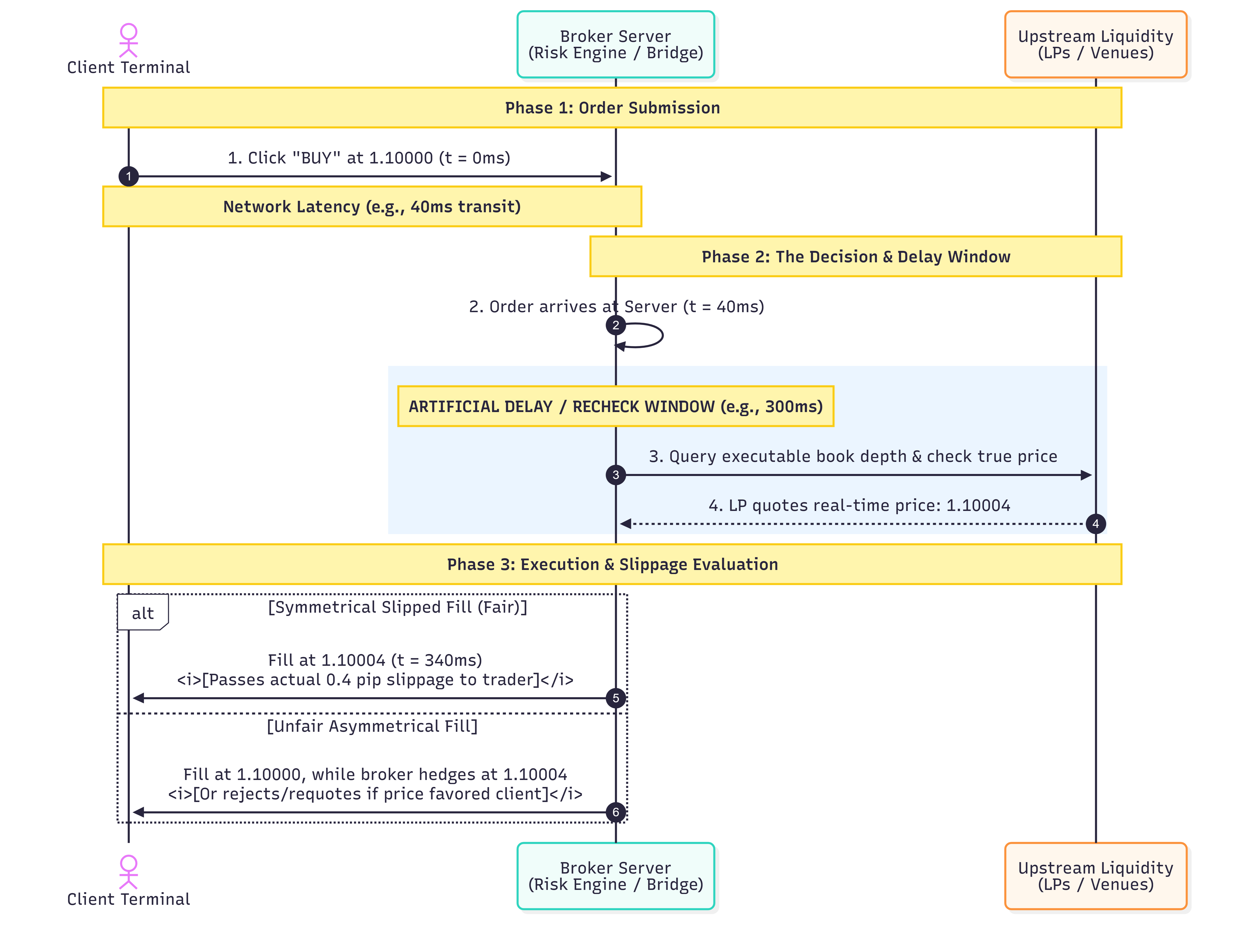
The delay creates a decision window. During that window, the broker can compare the trader’s requested price with the current executable price available inside the broker’s own environment. If the difference is within tolerance, the order may be filled. If the difference is outside tolerance, the order may be rejected, requoted, or filled at the current price depending on order type and execution policy.
A simplified market order check can work like this: The trader clicks buy at 1.10000. The order reaches the broker after 40 milliseconds. The plugin applies a 300 millisecond delay. During that delay, the bridge checks current liquidity. The broker’s current offer is now 1.10004. If the trader has allowed four tenths of a pip deviation, the order might fill at 1.10004. If the tolerance is tighter, the order may be rejected or requoted. If the current offer is 1.09996, the fair system should either fill at the better price or apply the exact price improvement rule disclosed in the execution policy. The unfair system fills at 1.10000 and keeps the improvement, or fills in violation of the disclosed execution policy.
Why Order Types Make A Difference
A limit order should generally fill at the limit price or better, not worse. A stop order becomes a market order once triggered and may slip negatively in fast conditions. A market order prioritizes execution over exact price. A “market range” or maximum deviation order allows the trader to specify how far from the requested price the fill may occur. These differences matters and slippage is not automatically abusive. Some slippage is just the cost of trying to execute in a moving market.
The Role Of External Liquidity
The bridge check is connected to external liquidity. If the broker is an STP or hybrid broker, it may want to know whether an upstream liquidity provider will accept the hedge. If the retail trader buys, the broker may need to buy from a liquidity provider. If the liquidity provider has already moved, the hedge price is worse. If the liquidity provider rejects due to last look, the broker may be left with exposure it did not want. A short artificial delay can therefore give the broker time to test whether the external price is still real.
Fair Use Of The Decision Window
The protective delay is designed to prevent stale quote fills that the broker cannot hedge fairly. A retail broker operating with narrow spreads and fast-moving external prices needs some method of handling the gap between displayed quote and executable hedge price.
The problem is that the delay can also be used as a weapon against the trader. In a fast market, 300 milliseconds can be enough for price to move through the trader’s requested level. A broker that delays only certain traders, only profitable accounts, only news trades, or only orders that would hurt the broker can tilt outcomes. A broker that delays all orders during volatile conditions and applies symmetrical slippage is not the same as a broker that delays only winners.
There is also a queuing issue. During heavy news, order requests may queue at the server. Some delay is not deliberate. It may be caused by load, network congestion, liquidity provider throttling, or platform stress. Traders should not assume every slow fill is a deliberate delay (decision window). The more useful question is statistical. Does delay correlate with adverse trader outcomes more than it should? Are positive and negative slippage passed through asymmetrically? Do rejected trades mostly occur when the trader would have benefited? Are delays targeted by account group? Do trading logs support the stated policy?
Where Legitimate Protection Crosses The Line Into Abuse
Not every virtual dealer configuration is fraudulent, but the tool sits at a very sensitive moment in the client relationship: the moment between order and execution. As we have already discussed above, abusive practices are often linked to asymmetry and selection, often combined with a lack of disclosure or not honoring the disclosed policy. A broker can protect itself from stale prices in a fair way. But some brokers will step over this line and use the tools at their disposal in an unfair way.
Asymmetrical Slippage
The cleanest abuse pattern is asymmetrical slippage. If the price moves against the trader, the trader gets the worse fill. If the price moves for the trader, the trader does not receive the improvement. The broker keeps the good movement and passes on the bad movement. This can be done through slippage settings, requote rules, delayed execution, or bridge logic.
The CFTC’s FXDD case is the textbook example. The CFTC press release on FXDD’s MT4 slippage settings said the firm rejected orders when price slipped more than two pips in the customer’s favor, but filled orders at the original price when the same kind of movement favored FXDD. The result was more than 24,900 customer accounts deprived of about $1.8 million.
Forced Negative Slippage
The broker delays the order, rechecks price, then fills only at the worst price observed during the delay window or applies a rule that systematically chooses a worse fill within a permitted range. This can be presented as “market movement”, but that is not true if the fill rule has been constructed to maximize broker advantage by creating forced negative slippage.
Artificial Requoting (Asymmetric Requoting)
Another well-known abuse pattern is artificial requoting. A requote is not inherently abusive. If the market price has moved and the original price is no longer available, the broker may ask the trader to accept a new price. Abuse appears when requotes happen mostly when the price would benefit the trader, while adverse moves are filled without giving the trader the same choice. Once again, we are dealing with asymmetry.
Unfair Group Targeting
A fifth abuse pattern is unfair group targeting. Broker platforms allow traders to be assigned to groups. Groups can differ by spread mark-up, execution rule, leverage, symbols, commission, and other conditions. A broker may place high-frequency traders, profitable scalpers, or suspected arbitrage accounts into a group with slower execution or tighter rejection rules. There can be a legitimate risk basis for monitoring toxic flow. But there is also a clear risk of punishing skill or profitability with worse execution. The main question is whether the broker can justify the segmentation under disclosed terms and best execution obligations.
Distortion Of Stop And Limit Handling
A fair system should treat order types correctly. Stop orders may slip because they become market orders after trigger. Limit orders should not fill worse than the specified limit. If a broker’s system allows stop losses to slip heavily in the broker’s favor while profit-taking limits rarely receive improvement, the distribution deserves examination. It may be explained by order type, liquidity, and volatility. Or it may show an execution design that unfairly favors the house.
Stop orders and limit orders are different types of instructions, so they are expected to behave differently in real market conditions. A stop order is designed to protect against losses or enter a trade once a certain price is reached. When the stop price is triggered, the order typically becomes a market order, meaning it is executed at the best available price. If the market is moving quickly or there is limited liquidity, the next available price may be worse than the trigger price, resulting in negative slippage. In other situations, the next available price may be better, producing positive slippage. A fair execution system should allow for both outcomes, depending on actual market conditions.
A limit order works differently. It instructs the broker to execute only at the specified price or at a better one. For example, if a trader places a take-profit limit order at 1.1050, the order should never be filled at a price below that. It may execute exactly at 1.1050 or at a more favorable price if better liquidity is available, but it should not execute at a worse price. The trade-off is that there is no guarantee the order will be filled if the market never reaches the specified price.
Because of these differences, some variation in execution quality between stop orders and limit orders is expected. Stop losses are often triggered during periods of increased volatility, when prices can move rapidly, and available liquidity may be limited. Take-profit limit orders, by contrast, are frequently filled under more stable conditions. These factors can naturally produce different slippage patterns.
The situation becomes suspicious if the distribution of outcomes consistently favors the broker. For example, if stop-loss orders almost always receive negative slippage while positive slippage is extremely rare, and take-profit limit orders almost never receive price improvement even when better prices appear to have been available, the execution pattern deserves closer examination. Such results may still be explained by genuine market conditions, but they may also indicate an execution model that selectively passes unfavorable price movements to traders while retaining favorable ones for the benefit of the broker.
When assessing execution quality, it is important to examine the overall pattern across a large number of trades rather than relying on isolated examples. A fair execution system should produce outcomes that are broadly consistent with prevailing market conditions, allowing both favorable and unfavorable slippage where appropriate rather than exhibiting a persistent bias in the broker’s favor.
Abusive Post-Trade Cancellation
Post-trade cancellation of orders is another tool that can be used fairly, but also opens up for abuse. Post-trade cancellation (sometimes called a trade bust or trade nullification) is the practice of canceling a trade after it has already been executed. In legitimate circumstances, it serves an important purpose by correcting transactions that should not have occurred. However, because it allows an executed trade to be reversed, a fair broker will only use it sparingly and according to clear, transparent rules.
A fair use of post-trade cancellation is one that is based on objective, predefined criteria, and does not care whether the trade benefited the broker or the trader. For example, a trade may be canceled because of a demonstrable technical failure, an obvious pricing error (often referred to as a “manifest error”), a system malfunction, or an exchange decision that invalidates the underlying transaction. In these situations, the cancellation is intended to restore the position that would likely have existed had the error not occurred. The broker fills a trade, then later cancels it under a “manifest error,” “off-market price,” “latency arbitrage”, or “abusive trading” clause.
Abuse typically consists of the broker canceling a trader’s profitable trades, while not canceling losing trades executed under the same conditions. Again, asymmetry that benefits the broker is the smell test.
Lack Of Proper Record Keeping
Sometimes, an abusive practice is combined with improper record keeping, and strict regulators are therefore known to crack down on insufficient record keeping in itself. “The financial regulator cannot prove we hurt any trader, because we don´t keep proper records” is not a good defense.
ASIC’s Enfinium notice explains that ASIC was concerned about controls on the MT4 platform and the use of the plug-in Virtual Dealer. Among other things, ASIC found that the Virtual Dealer had been changed 271 times between 2010 and 2013 without records of those changes.
The Enfinium case shines a spotlight on Enfinium’s lack of proper record keeping, instead of only looking at proved trader harm. For ASIC, the lack of records meant it could not identify whether the use of the plug-in had negatively affected traders. That is an important regulatory point. If a broker has a tool that can disadvantage traders, and it changes the settings hundreds of times without records, the situation is already serious. A broker should not benefit from being sloppy with the record keeping that could have revealed broker misconduct.
Slippage, Requotes, And Asymmetric Execution
Above, we have already mentioned asymmetric execution several times, so let’s take an even deeper dive into this subject.
Slippage
Slippage is the difference between the expected price and the executed price. It can be positive or negative. Positive slippage gives the trader a better price than requested. Negative slippage gives the trader a worse price. The concept is not suspicious by itself. Markets move. Liquidity changes. Orders take time to reach the server and be processed.
The forex information platform BabyPips explains that asymmetric slippage occurs when a broker handles orders differently depending on whether the market moved in the trader’s favor or against the trader. BabyPips also notes that slippage itself is a normal feature of fast-moving markets and may work either for or against the trader. This distinction is important. Slippage is an expected consequence of market dynamics, whereas asymmetric slippage refers to a systematic bias in execution.
A fair market execution model should allow both sides of slippage where the order type permits it. If a market order can fill worse when the market moves against the trader, it should also be capable of filling better when the market moves in the trader’s favor. If a limit order can improve, that improvement should not be quietly capped unless disclosed and justified. If a stop order slips, the broker should be able to explain why the fill reflects market depth and timing rather than a one-sided rule.
Some brokers now publish slippage data. FXCM’s public slippage statistics page, for example, distinguishes positive and negative slippage, and explains that market orders prioritise execution certainty while some order types provide more price certainty. Of course, a broker’s own statistics and publishing are not independent proof, and it must be evaluated against a backdrop of broker reputability and how the broker is supervised. In jurisdictions with lax trader protection, a broker is more likely to get away with publishing false or deliberately misleading slippage information.
Requotes
In instant execution, the trader sees a specific price on the platform and accepts it. If that price is no longer available, the broker may reject the order and offer a new price. This is known as a requote.
Requotes are typical of instant execution models, as they work differently than market execution models. In market execution, the trader is generally accepting execution at the available market price, subject to any tolerance. Therefore, slippage is more visible in market execution models, and requotes are more common in instant execution models.
A virtual dealer delay can convert price movement into either requotes or slippage depending on setup. The broker can delay, check the price, then reject and requote if the price moved outside tolerance. Alternatively, it can delay and fill at the new price, creating slippage. A fair and reliable system operates according to disclosed policy and documents when each happens. A sketchy system changes the treatment depending on whether the broker or trader benefits, and might even try to hide it through sloppy record-keeping.
MetaTrader Environments
The term virtual dealer plugin is most strongly associated with MetaTrader environments, especially the MT4 trading platform. With the MetaTrader trading platforms, the trader terminal comes from the MetaQuotes company, while the server environment is controlled by each individual brokerage company, and that server environment can include plugins, bridges, administrator tools, group settings, symbol settings, execution rules, and reporting tools.
Two traders can both be using the MT4 platform for their trading, but get different execution outcomes because they have signed up with different brokers. MT4 with Broker A is not the same execution environment as MT4 with Broker B. One broker may route orders through a bridge to external liquidity. Another may internalize most flow. One may use symmetrical slippage. Another may apply group-specific delays. One may have strong governance and audit logs. Another may allow managers to alter settings with weak supervision. The terminal looks the same, but the back end does not.
It is important that traders understand this and refrain from assuming that a well-known platform brand will ensure high-quality and uniform execution. MT4 is a trading platform. The broker’s server configuration, liquidity route, bridge, order execution policy, and risk controls decide the trade outcome. A clean MT4 broker and a dirty MT4 broker can both show the same chart window. The difference is inside the server logs.
MetaQuotes states that the MetaTrader 4 Server API allows brokers to develop server plugins with broad capabilities, including management of server parameters, order and customer base, and processing trade requests. Of course, that public documentation does not say “use this to mistreat clients”. It simply says the platform supports server-side extension.
Server-side control is not inherently bad. As discussed above, brokers need tools to manage margin, prevent obvious stale-price abuse, stop order flooding, handle symbol configuration, protect against toxic flow, and maintain system stability. A broker that cannot protect itself from latency arbitrage may widen spreads for everyone or stop offering tight execution, which would be more negative for the average retail trader. The issue is fairness, and with that comes the need for auditability. Who can change the plugin settings? Are changes logged? Is there a second approval? Are high-risk settings reviewed by compliance? Are traders told when execution delay may be applied? Are slippage distributions reviewed by account group? Are profitable traders receiving worse execution without a defensible risk reason? Are manual changes possible without a trace? Those answers matter more than whether a broker is using a virtual dealer plug-in.
What About MT5?
While virtual dealer plugins are not exclusive to MT4 in the MetaTrader environment, it is much more strongly associated with MT4 than MT5. Brokers can achieve similar things for the MT5 platform, but they typically use other methods. MT4 became a dominant retail FX platform in the 2000s–2010s, and many broker dealing desk tools were built around its plugin architecture.
With MT5, the server architecture is instead based on MQL5 and a newer trade server model. Many broker-side execution controls are built into the MT5 platform’s core or liquidity bridge systems, and not marketed as “Virtual Dealer Plugins”. For MT5, price feed latency arbitrage is typically combated using server configuration tools, liquidity bridge systems (e.g. LP routing logic), execution rules defined at the broker server level, and risk management modules integrated into the trading server.
Regulatory Cases: Enfinium, FXDD, And FXCM
The Enfinium Pty Ltd Case (Australia)
The Enfinium case is frequently cited whenever traders discuss MetaTrader’s Virtual Dealer plug-in, execution delays, and the possibility of broker manipulation.
Enfinium Pty Ltd operated as an Australian retail foreign exchange broker using the MetaTrader 4 (MT4) platform, and it had access to MetaQuotes’ Virtual Dealer plug-in. The Virtual Dealer Plug-in (sometimes called Virtual Dealer Plugin, Virtual Dealer, or VDP) was an official MetaTrader 4 server plug-in developed and distributed by MetaQuotes Software Corp. It was one of several server-side plug-ins available to brokers operating MT4. The plug-in itself was not illegal under Australian rules. It was designed primarily as a risk management tool for market makers, allowing brokers to configure how orders were handled under particular market conditions. The software itself did not determine how it was actually used. That depended on how the broker configured it.
The ASIC Investigation
When ASIC investigated Enfinium Pty Ltd, it examined the firm’s use of the MetaQuotes Virtual Dealer plug-in and related controls over the period from January 2010 to July 2013. The investigation focused primarily on whether Enfinium maintained adequate governance, supervision, and record-keeping around the configuration and use of the plug-in.
ASIC has not publicly disclosed when the investigation itself commenced. The existence of the investigation was not announced while it was underway, and there was no public disclosure to traders at the time that ASIC was reviewing Enfinium’s execution systems.
ASIC’s findings were published on 16 February 2015, after Enfinium had already entered external administration on 1 October 2014, been wound up by creditors on 6 November 2014, and ceased carrying on a financial services business. On 16 February 2015, ASIC also announced that it had cancelled Enfinium’s Australian Financial Services (AFS) licence. Importantly, ASIC stated that the licence was cancelled because Enfinium had ceased carrying on a financial services business. It was thus not a penalty arising from proven misconduct.
In its findings, ASIC identified significant deficiencies in Enfinium’s controls and record-keeping. Among other issues, the regulator noted that Enfinium had made 271 configuration changes to the Virtual Dealer plug-in without maintaining adequate records explaining who made the changes, why they were made, or what parameters had been altered. ASIC also found weaknesses in staff supervision, training, and system access controls, including excessive “Manager” level access within MetaTrader 4. From a governance perspective, these issues reflected weak internal controls over software capable of affecting order execution.
Critically, ASIC stated that due to a lack of adequate records concerning changes to the Virtual Dealer plug-in, the Commission was unable to determine whether any execution delays had adversely affected clients. In other words, because configuration and change logs were incomplete, ASIC could not reconstruct how the plug-in had been set at different points in time, nor assess whether its use had resulted in client detriment or not.
As a result, while ASIC identified serious compliance and control deficiencies, it did not conclude that client harm from execution delays had been established, nor did it base the cancellation of Enfinium’s licence on proven execution abuse.
Aftermath, And Why This Case Is Important
We cannot know how ASIC would have acted against Enfinium if the company had not entered external administration during the course of ASIC’s investigation.
The investigation identified serious deficiencies in governance, record-keeping, and risk management surrounding software capable of influencing trade execution. Those findings reflected poorly on the firm’s compliance systems, but the ultimate regulatory outcome was not determined through a completed enforcement process, as Enfinium ceased carrying on a financial services business before any such conclusion could be reached.
The Enfinium case is not proof that the Virtual Dealer plug-in was used to manipulate customers. Neither is it proof that the software was used in a fair manner. Instead, it demonstrates something equally important. Software capable of introducing execution delays requires rigorous governance, comprehensive audit logs, and strong internal controls. Without those safeguards, neither the broker nor the regulator can later demonstrate precisely how customer orders were handled. The Enfinium investigation therefore stands as a cautionary case about governance rather than a proven case of execution manipulation.
For retail traders studying execution quality, latency arbitrage, and virtual dealer technology, the Enfinium case should be understood as an example of why auditability matters. The investigation highlights the risks created when brokers operate complex execution systems without maintaining records sufficient to demonstrate that those systems are being used fairly. It does not establish that Enfinium manipulated client execution, nor does it show that ASIC withdrew the firm’s licence because of such conduct. Rather, it shows how inadequate governance can leave both regulators and brokers unable to answer the most important question of all: what actually happened to the client orders?
The FXDD Case (United States)
The FXDD case of 2013 shows how slippage parameters can be used unfairly even without focusing on the virtual dealer. The Commodity Futures Trading Commission (CFTC) said FXDD used asymmetrical slippage parameters on its principal trading platform. According to the regulator, the firm rejected customer orders when the price moved more than two pips in the customer’s favor, but filled customer orders at the original price when the price moved more than two pips in FXDD’s favor. The CFTC ordered restitution and penalties after more than 24,900 accounts were affected.
The enforcement action involving FXDD is often cited in discussions about execution quality, slippage rules, and how retail FX dealing desks can structure order handling in ways that materially affect outcomes for traders.
The Core Issue
According to the CFTC’s findings, slippage rules were applied asymmetrically on FXDD’s principal trading platform. The CFTC alleged that FXDD’s system handled similar price movements differently depending on whether the outcome benefited the customer or the firm.
According to the CFTC Order, FXDD used asymmetrical slippage parameters. Based on these parameters, FXDD rejected a trader’s order when the price slipped more than 2 pips in the trader’s favor (and instead re-quoted the customer the new, less favorable price), but filled a trader’s order at the original price if the price slipped in the broker’s favor by more than 2 pips. As a result, FXDD benefited from slippage of more than 2 pips in its favor, but did not allow its traders to benefit from similar price changes in their favor.
The CFTC’s enforcement position was not simply about technical architecture, but about whether the actual execution outcomes matched what customers reasonably expected based on disclosures and market norms. The CFTC characterized FXDD’s handling of slippage as inconsistent with fair execution standards when applied systematically across a large customer base. The investigation revealed that more than 24,900 accounts were affected by FXDD’s slippage handling.
Lack Of Supervision
FXDD was also criticized for failing to take appropriate governance steps. According to the CFTC, the FXDD did not employ an adequate supervisory system and did not diligently supervise its personnel. If it had, the firm would have discovered these problems with the integrity of trades on the platform and would have had the opportunity to correct them before more than 24,900 customer accounts were deprived of $1,828,261.
Enforcement Action
The CFTC Order required FXDD to make full restitution of $1,828,261 to FXDD’s current and former customers that were harmed by the violation, and also imposed a $914,131 civil monetary penalty against FXDD.
The press release in September 2013 also noted that FXDD would pay a penalty of $914,131 to the National Futures Association (NFA) as well, to settle the NFA’s charges arising from the same misconduct. In addition, the CFTC order required FXDD to cooperate with the NFA in connection with the NFA’s review of FXDD’s compliance with its restitution obligation.
Why This Case Is Important
The FXDD case highlights how execution controls can be applied in a way that creates directional bias in fills, and how adequate supervision is necessary to promptly detect and rectify such bias. Execution logic can introduce directional bias through asymmetrical slippage handling even without obvious manual intervention or overt manipulation, and proper governance within the brokerage company is needed to catch and stop this.
The FXCM Case (United States)
The FXCM case shows execution fairness concerns at large scale. In their press release in October 2011, the U.S. Commodity Futures Trading Commission (CFTC) said FXCM failed to supervise handling of customer accounts with respect to price changes between order placement and execution. Customers did not receive the benefit of favorable price movements but did suffer detrimental movements.
The Core Issue
According to the CFTC, Forex Capital Markets LLC (FXCM) failed to supervise diligently its personnel’s handling of more than 57,000 customer accounts that traded on FXCM’s forex trading platforms.
According to the CFTC order, from at least June 18, 2008, until December 17, 2010, FXCM failed to supervise the handling of customer accounts diligently with respect to changes in price between order placement and execution on both market orders and margin liquidation orders. CFTC found that FXCM’s failure prevented its customers from receiving the benefit of price movements in customers’ favor, but allowed its customers to suffer detrimental price movements.
Just as in the FXDD case (see above), the firm was also criticized for failing to take appropriate governance steps. According to the CFTC, the broker would have discovered the trade integrity problems, and would have had the opportunity to correct them, if the firm had supervised its personnel diligently.
Enforcement Action
The CFTC required FXCM to pay a total of $8,261,937 in restitution to its customers and former customers, and also pay a $6 million civil monetary penalty.
The firm was also ordered to retain, at its own expense, a monitor for three years. The monitor would monitor the firm’s trade execution practices and policies for slippage, and the firm’s compliance with its restitution obligation.
In the same October 2011 press release, the CFTC also noted that on August 12, 2011, the National Futures Association (NFA) issued a Decision imposing a $2 million monetary sanction against FXCM in settlement of an NFA action (NFA Case No. 11-BCC-016) involving some of the same practices identified in the CFTC order.
Why This Case Is Famous
This case is famous not only because it shows the CFTC and NFA investigating and reacting to unfair slippage practices, but also because the case involved so many clients, and the combined restitution, civil penalty, and monetary sanction against FXCM exceeded $16 million.
The restitution was relatively large for retail forex cases at the time (early 2010s), as many cases from that period involved no restitution at all, or a restitution significantly smaller than the well over $8.2 million FXCM had to pay. The FXCM case involved over 57,000 customer accounts, and the harm was framed as systemic execution impact rather than isolated errors. FXCM’s restitution sits in the upper tier for retail FX restitution at that time, mainly due to customer base size and aggregate slippage impact.
The $6 million CFTC civil penalty was high but not extreme for the early 2010s. At the time, the penalty in larger systemic enforcement cases often ranged from $5 million to $15 million or more, but those cases typically involved broader violations such as widespread risk management failures, segregation issues, or firm-wide compliance breakdowns rather than execution-specific issues like pricing between order placement and execution. The fact that FXCM was slapped with a $6 million civil penalty for mishandling slippage garnered quite a lot of attention.
For the NFA, the $2 million sanction against the FXCM was relatively large, as the NFA at the time typically issued sanctions below $500,000 for routine cases and up to $1 million for serious compliance issues. In 2011, a $2M NFA sanction was not unprecedented within the wider NFA environment, but definitely top-tier for retail FX dealers.
How Traders Can Detect Poor Execution
Records
A trader cannot easily prove virtual dealer abuse from one bad fill. Fast markets produce bad fills naturally. A broker can have genuine liquidity problems during news. Internet latency, VPS location, platform load, and order type can all explain execution differences. The better approach is therefore to build a record.
The first useful record is the platform journal and trade log. Good log software will be able to show order send time, acceptance, requote messages, off quotes, execution time, and server response. Logs are better than memory and help us detect and determine patterns. A trader who complains “my broker always slips me” without logs has a feeling. A trader with hundreds of timestamped orders has evidence.
The second useful record is an independent price reference. If the trader is claiming stale quote abuse or artificial slippage, they need a reference feed. That could, for instance, be another broker’s tick data, futures market data, a paid FX feed, or a recorded institutional reference. The reference must be time synchronised. A one-second clock error can ruin the analysis.
The third useful record is slippage distribution. Over many trades, does the trader receive both positive and negative slippage? Does the pattern change during news? Does it change after profitability improves? Does one account group experience more delay than another? Do limit orders receive improvement when they should? Are market orders filled symmetrically within stated tolerance? This is where statistics matter more than screenshots.
The fourth useful record is execution timing. Measure the time between order submission and server response. A constant 300 millisecond response time may suggest a deliberate delay. But it may also reflect network, bridge, or processing architecture. A better signal is conditional delay that favors the broker and punishes the trader. That pattern deserves attention.
Compare With The Broker’s Execution Policy
The broker’s execution policy should explain order types, price source, slippage, requotes, maximum deviation, abnormal market condition rules, and whether the broker acts as principal. If the policy says market orders may receive positive and negative slippage, but the trader’s data shows negative slippage only, that is suspicious. If the policy gives the broker broad discretion to cancel trades for latency arbitrage, it is not a suitable broker for your latency arbitrage strategy.
Get Help From The Relevant Financial Authority
If you suspect foul play, you can contact the applicable financial authority and tell them what you have observed. Depending on the jurisdiction, financial authorities have stronger or weaker powers (and willingness and practical resources) to investigate brokers.
In jurisdictions with strong trader protection rules, the financial authorities typically take suspected execution abuse very seriously.
From Infrastructure To Execution Integrity: How Brokers Can Reduce Slippage, Eliminate Requotes, And Diminish The Need To Fight Latency Arbitrage
At its core, a broker is not just a price intermediary, but a real-time execution system that must constantly synchronize two fast-moving environments: the market and the trader’s trading terminal. When that synchronization is not fast enough, traders see slippage and requotes, and the broker is exposed to latency arbitrage strategies. However, it is often possible to improve the synchronization through investments in infrastructure, which in turn can reduce the broker’s need for defensive “intervention-style” mechanisms to keep the latency arbitrage traders away. With that said, it is not possible to create a system that is immune to price mismatches, not even for a broker with very deep pockets.
Slippage and requotes are direct indicators of how closely a broker’s internal systems track live market conditions. Slippage occurs when the execution price differs from the requested price, typically because the market moved between the time the order was placed and the time it was filled. Requotes occur when the broker cannot execute at the requested price and instead returns a new price to the trader. Both are symptoms of latency, e.g. in receiving market data, processing orders, routing them to liquidity providers, or confirming execution. There can also be latency in parts of the chain that are out of the broker´s control, e.g. within the trader’s own setup and in the connection between the trader´s device and the broker’s server.
At a surface level, slippage and requotes appear to be driven by volatility. While volatility certainly increases the frequency of price changes, it is not the root cause of execution inconsistency. The true determinant is the broker’s ability to minimize the time gap between three critical events: the moment the trader sees a price, the moment the broker internalizes that price, and the moment the order is executed in the external market. Even a few milliseconds of delay in this chain can create a mismatch between expected and actual execution conditions.
This is where infrastructure investment becomes decisive. A broker that operates with outdated routing systems, geographically distant servers, or inefficient liquidity aggregation will naturally experience more frequent divergence between quoted and executable prices. By contrast, brokers that invest in better infrastructure can significantly reduce network latency.
Examples Of Improvement Points
Colocation
The classic type of colocation is to place the broker’s servers that handle order routing and market data physically inside or very near the data centers of exchanges or liquidity providers. If the servers are located far away, data has to travel over long network routes. If the servers are hosted in the same facility or the same high-speed network environment as the market venues they connect to, the distance becomes much shorter.
So, for example, if liquidity is coming from major FX or CFD liquidity providers, a broker might host its execution servers in a data center where those providers also have servers. That reduces the physical and network distance between market price updates arriving from liquidity providers, the broker’s pricing engine, and the order execution back to those providers.
Execution Engine
Execution engines play a critical role. Modern low-latency matching systems are designed to process incoming orders with minimal computational overhead, often using optimized FIX protocol gateways and pre-validated risk checks. When these systems are slow or overloaded, orders queue internally, creating a lag between intent and execution. By streamlining these processes, brokers reduce internal bottlenecks and ensure that orders are passed to liquidity providers while market conditions still closely match the trader’s expectation at the time of order submission.
Liquidity Aggregation
Liquidity aggregation is another essential component. Many brokers rely on multiple liquidity providers (LPs). Each LP can have slightly different pricing, depth, and latency characteristics. Without sophisticated aggregation, a broker may display a composite price that is already partially outdated by the time a trader sees and reacts to it. Smart order routing systems help solve this by continuously evaluating available liquidity across venues and directing orders to the fastest and most reliable sources in real time. This reduces both execution uncertainty and the frequency of price rejection, which in turn lowers requote rates.
Stale Quotes And Latency Arbitrage
All of these improvements converge on a single outcome: the reduction of stale quotes. A stale quote is essentially a price that no longer reflects the true executable market condition at the moment the trader acts on it.
Latency arbitrage strategies depend on exploiting stale quotes. If one participant can see a price change faster than another, they can trade against the slower participant before their system updates. In broker-trader contexts, this typically manifests when a trader rapidly executes trades based on price movements that the broker has not yet fully synchronized with external liquidity.
When a broker’s infrastructure is slow, this time asymmetry becomes predictable and exploitable. Traders using high-speed connections or co-located systems can consistently “pick off” outdated prices before they are corrected. The broker is then forced into a defensive posture, absorbing losses or implementing protective mechanisms to limit exposure to toxic flow. These mechanisms often include requotes, execution delays, partial fills, spread widening during volatility, or even manual or semi-automated trade intervention systems. This is where the virtual dealer plugins discussed above can be used to manage execution risk by introducing conditional logic into order handling, effectively deciding when to accept, reject, or reprice trader orders based on market conditions.
However, reliance on this type of intervention layer is just a workaround that does not attack the root of the problem: latency. They do their job, but they also introduce friction into the trading experience. They are perceived with suspicious by traders and regulators because they reduce execution transparency and consistency. More importantly, they are reactive systems. They attempt to mitigate the consequences of stale pricing rather than eliminating the conditions that create it.
When brokers instead invest in high-performance infrastructure, the necessity for such intervention declines. As execution speed improves and market data synchronization becomes tighter, the window of opportunity for latency arbitrage narrows significantly. If a broker’s pricing engine updates nearly in real time with external liquidity, the gap that arbitrage strategies rely on begins to disappear. Trades are either executed at prices that accurately reflect current conditions or are rejected only in genuinely exceptional circumstances where liquidity has truly vanished rather than merely shifted in microseconds.
This shift can change a broker’s operational philosophy. Rather than actively policing for toxic flow through intervention tools, the broker can rely more on structural fairness, ensuring that all participants are interacting with a pricing system that is already aligned with the broader market. In such an environment, the need for virtual dealer-style plugins is reduced not because risk disappears, but because the underlying asymmetry that creates that risk is minimized.
Another important effect of improved infrastructure is the stabilization of hedging operations. Many brokers offset trader positions with external liquidity providers. When execution is slow or inconsistent, hedging can occur at prices that differ significantly from trader fills, creating exposure. Faster execution ensures tighter alignment between trader orders and hedge execution, reducing P&L variance and further diminishing the need for protective interventions at the execution layer.
Improvements in infrastructure can be very costly, and the pros and cons need to be evaluated carefully. It should be noted, however, that over time, improvements can compound. When better infrastructure leads to better price accuracy, it can result in a reduction of execution disputes, which leads to lower operational overhead. The broker may also be allowed to simplify their execution stack further. In contrast, brokers that rely heavily on intervention tools can find themselves in a cycle where structural inefficiencies must be continuously managed through increasingly complex rule-based systems, and they are also costly in various ways.
Ultimately, the relationship between infrastructure and latency arbitrage can be inverse. The more gaps in market synchronization, the more the broker must rely on defensive mechanisms to manage those gaps. The more a broker manages to actually reduce those gaps, the less necessary those defensive mechanisms become. In that sense, infrastructure investments can be a strategic shift away from managing latency risk and toward eliminating it at the source.