




Reddit and X are full of people celebrating that alchemy is finally real in the wake of Marathon Fusion’s announcement that it turned mercury into gold. However, turning mercury into gold is not alchemy; it is real nuclear physics that we have known about for a long time. This has not stopped traders from hopping on the bandwagon. Turning a laboratory announcement into a forecast of collapsing gold prices in a leap the evidence does not support.
In my view, this is no convincing foundation for predictions of gold’s collapse. Gold is an accumulated store of wealth, and the finite expansion of gold stock that Marathon Fusion’s announcement could lead to if commercialized can not abolish its scarcity. William BergAuthor
The latest artificial gold story has arrived with the usual prediction: gold will go the way of laboratory diamonds, scarcity will disappear, and anyone holding bullion should worry. This conclusion lacks grounding in reality.
On 21 October 2026, Marathon Fusion announced that it had turned mercury into stable gold and claimed to have beaten CERN’s gold-production record by a factor of 10. Public reporting of the announcement identified no disclosed gold mass or cost per gram. A claim about producing atoms has become a story about flooding a market. The missing step is an industry capable of delivering the metal reported on in the announcement.
No, this announcement does not give us a credible reason to expect an artificial gold supply shock. A laboratory result can be scientifically useful without threatening the bullion market. To establish the latter, somebody must show repeatable output, recoverable gold and a commercially workable cost. A production record supplies none of those answers by itself. The gold market trades metal and expectations about metal. Confusing the two makes a dramatic headline, but a poor argument.
What The Claimed Discovery Actually Means
Marathon Fusion’s announcement did not introduce a new scientific principle. It offered a glimpse into the company’s experiments and method, alongside a claimed gold-production record.
Scientists have known that nuclear reactions can turn mercury into gold for a long time. Marathon’s claimed advance concerns how that transformation is achieved. Alchemy through nuclear physics has been practically possible for almost a hundred years. A paper was published in 1941 on producing gold from a mercury isotope and Gold nuclei had already been produced in experiments using CERN’s Super Proton Synchrotron more than two decades ago, with relevant research published in 2002 and 2004. Marathon did not discover that nuclear transmutation can make gold.
The question is whether Marathon Fusion’s process can produce recoverable gold at a commercially viable cost. Its announcement has not established that, and the little information that is provided suggests that such is not the case.
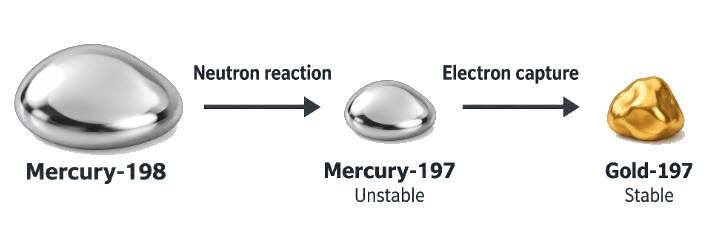
Marathon’s proposed route starts with mercury-198. A fast neutron drives a reaction that leaves mercury-197, which then decays into gold-197. During that decay, electron capture changes a proton into a neutron, reducing the atomic number from mercury’s 80 to gold’s 79. The resulting gold is real. But its nucleus came from existing material, processed using a neutron source and equipment. Nothing has been conjured out of empty space. Marathon’s reaction pathway; technical paper.
Why Laboratory Diamonds Are A Poor Comparison
Lab-grown diamonds use abundant carbon and do not require nuclear transmutation. Artificial gold produced using Marathon’s proposed method requires mercury-198, a much more limited resource, and nuclear transmutation.
A diamond is carbon arranged in a crystal structure. Manufacturers can grow that structure using high pressure and temperature, or deposit carbon from a gas through chemical vapour deposition. The carbon atoms remain carbon. The Gemological Institute of America explains that laboratory diamonds have essentially the same chemical and physical properties as natural diamonds, and documents their entry into commercial jewelry production. This is an established manufacturing process with products people can buy. It does not require turning a different element into carbon, and carbon is readily available in enormous quantities.
Gold presents a different task. Reshaping mercury, heating it or changing its chemical bonds will not turn it into gold; the nucleus must change. Mercury is also a product with a limited availability. A successful diamond factory therefore tells us nothing about the cost of running that nuclear process. The useful lesson from diamonds is that a manufactured substitute can compete once factories supply it at an attractive price. Applying that lesson to gold requires evidence of economical gold manufacturing. Calling both products “lab-made” does not provide it. The label describes where something happened, not what it cost.
10 Times A Record Does Not Establish Profitability
The announcement does not provide enough information to assess how efficiently the process currently produces gold or whether it is commercially viable.
The much-repeated factor of 10 needs particular care. Beating a production benchmark is not the same as being 10 times more energy efficient, 10 times cheaper or profitable. A rate needs a time interval; an efficiency needs an input. Without the corresponding measurements, the multiplier cannot answer the commercial question. Producing more atoms could involve more equipment, more energy or a different experimental setup. Those possibilities do not invalidate the science. They do invalidate the shortcut from “10 times” to cheap bullion.
CERN’s numbers show why scale matters. Its analysis estimated that the four major Large Hadron Collider experiments created about 86 billion gold nuclei during 2015–2018. That sounds enormous until it is expressed as mass: 29 picograms, or 0.000000000029 grams. The nuclei then fragmented when they struck accelerator components. These were physics results, not gold deliveries. CERN also reported a peak rate of about 89,000 gold nuclei per second at ALICE. Its cumulative mass and instantaneous rate are different measures, and neither should be multiplied by 10 and passed off as Marathon’s undisclosed yield.
For perspective, Forbes reported in 2012 that the LHC’s annual operating budget was approximately $1 billion. At the gold price cited here—$4,057.67 per troy ounce—covering a $1 billion annual bill through gold sales would require approximately 7.67 tonnes of saleable gold. CERN is not built to produce gold, and it is likely to have sensors and scientific equipment that are not needed for industrial gold production. A gold “factory” could likely operate more cheaply. But the examples illustrate the enormous distance between detecting gold nuclei in an expensive experiment and producing enough recoverable metal to pay the bills.
William BergAuthorMarathon’s announcement does not establish profitable production. An exact loss per gram would require costs the announcement does not provide. The broader commercial test is straightforward: can the saleable output pay for the input, energy, equipment and operation required to produce it?
Science can justify spending a great deal to make a tiny amount of something. A gold business must eventually justify the spending with revenue. A better atom count is progress, but it is not an income statement. It does not even provide enough information to see it as a starting point for future improvements that might make it profitable. Marathon has published projections. It has not demonstrated profitable commercial production.
Gold Is Supposed To Help Pay For Fusion
The goal is to make fusion power plants more viable by developing alternative income streams, not to develop a method to make stand-alone gold factories.
Marathon describes gold as a co-product that could improve the economics of fusion power. Its proposal uses mercury in a reactor’s surrounding blanket, where neutron reactions would support both fuel production and gold production. The company projects additional revenue alongside electricity. That is a plan to make an expensive energy system more attractive, not evidence that a standalone gold factory has beaten mining on cost. Even if the proposed extra revenue is achieved, revenue still has to cover costs before it becomes profit.
Medical isotopes offer Marathon another potential route to revenue. The company is researching ways to produce actinium-225, lead-212 and terbium-149 for targeted cancer treatments, where radioactive material delivers radiation to cancer cells. These applications can put small quantities of material to valuable use, making them a possible early market for fusion technology. Commercial gold production demands a different scale: a process must deliver enough saleable metal to cover its costs. Success in supplying medical isotopes would therefore be an achievement for the business, without establishing that cheap artificial gold is around the corner.
A separate research preprint, revised in March 2026, models isotope production using fusion devices that have not reached energy breakeven. Its argument is that selling valuable isotopes could support early commercial applications before electricity generation becomes viable. That is a proposed business pathway, not proof of realized margins. It also explains why an experiment can matter to fusion development without adding a meaningful quantity of gold to the market. Medical isotopes may provide an earlier source of revenue, but gold remains part of the larger power-plant proposal.
The possibility of producing different valuable metals in the same process has a profound impact on the possibility of reaching profitability, especially if combined with power production, but does not imply production values large enough to affect global gold prices.
Put The Proposed Output Beside The Existing Market
Each potential gigawatt fusion power plant would have a limited effect on global gold production. It would equal about 0.054% of global mining in 2025.
Marathon’s 2025 simulations projected roughly two tonnes of gold annually per gigawatt of thermal fusion power. That is a modelled future output, not the quantity demonstrated in October. Thermal power must also be distinguished from electrical output.
The World Gold Council’s January 2026 report estimated 2025 mine production at 3,671.6 tonnes, and total supply, including recycling and net producer hedging, at 5,002.3 tonnes. Its separate stock estimate put gold already above ground at approximately 222,600 tonnes at the end of June 2026. These measures answer different questions: annual flows show what enters the market, while the accumulated stock shows how much gold already exists outside the ground.
| Comparison | Two tonnes of gold would represent |
|---|---|
| Estimated 2025 mine production | About 0.054% |
| Estimated 2025 total supply | About 0.040% |
| Gold above ground at the end of June 2026 | About 0.0009% |
Calculated from the cited figures, assuming the proposed annual output is achieved.
Those numbers describe one hypothetical gigawatt of thermal fusion capacity. A large fleet could change the arithmetic, but this announcement establishes neither that fleet nor its production costs. Nor can a percentage of existing stock, by itself, predict the price response: prices respond to marginal buying and selling and are not always rational. Even the proposed plant output is small beside current annual supply, while the reported experiment has not established commercial deliveries at all.
There is also a gap between making gold nuclei and supplying usable metal. Marathon’s study models radioactive contaminants in the product mixture and estimates around 13.7 years of cooling to meet one selected activity threshold under its assumptions. Cleaner feedstock could shorten that delay. The number is not a universal waiting period for all artificial gold, but it illustrates a cost that atom-count headlines leave out: some output may need storage before sale.
A Thought Experiment About Global Electricity Production
Take annual global electricity generation of approximately 31,747 TWh as the starting point. This is electricity, not total energy consumption. Suppose all of it came from gold-producing fusion plants operating continuously without interruption. Using the 40% conversion of heat into electricity assumed in an illustrative calculation in Marathon’s paper, supplying that electricity would require approximately 9,060 gigawatts of thermal fusion power. At the proposed yield of two tonnes per thermal gigawatt per year, that would produce approximately 18,120 tonnes of gold annually. These calculations assume the modeled yield can be achieved and sufficient feedstock is available.
| Share of global electricity from these plants | Modeled annual gold production | Percentage of existing above ground gold stock |
|---|---|---|
| 100% | Approximately 18,120 tonnes | 8.14% |
| 10% | Approximately 1,812 tonnes | 0.81% |
Calculated using a fixed electricity-generation baseline, 40% heat-to-electricity conversion and Marathon’s modelled gold yield. Stock percentages use 222,600 tonnes of above-ground gold.
Even a 10% share of global electricity production would represent a major commercial achievement. Under these assumptions, it would generate approximately 1,812 tonnes of gold annually, adding about 0.81% to existing above-ground stocks. Comparing that output with annual supply makes it appear more dramatic, but gold is an accumulated financial asset whose market extends far beyond newly produced metal.
Existing holders’ willingness to retain or sell gold, and investors’ expectations about its future scarcity, matter greatly. Faster stock growth could influence those expectations, but these production figures alone provide no basis for predicting a gold-market crash. Although this might affect the value of gold, it would not be enough to totally devalue gold. The price might go down, but it will remain a valuable asset even with this additional supply.
This is a scale illustration, not a deployment forecast. The example assumes 100% active power plants, no increase in power consumption and no other disturbances that are bound to occur under real-world conditions. These assumptions are unrealistic, but help simplify the example without having a material effect on the outcome.
We cannot assume that artificial gold production will ever be profitable without the commercialization of the power produced during the process. If such a technique could ever be developed, it could have a larger effect on the gold price but would be limited by input availability and a gold price high enough to justify the production of gold.
Mercury Is A Constraint
Mercury-198 resources limit the maximum theoretical effect Mararthons’ artificial gold method can have to a 26.5% increase in gold supply. The realistic impact is smaller.
We have repeatedly seen the claim that mercury constraints limit the feasibility of artificial gold production using this method. This claim has some merit but is often overblown. The global mercury reserves do limit how much gold can drop, but there is still enough mercury to have a significant impact on gold prices.
Input comparisons need consistent definitions. The World Gold Council lists approximately 114,400 tonnes of gold resources and 61,000 tonnes of gold reserves, while separately noting the USGS reserve estimate of approximately 66,000 tonnes. USGS’s 2026 mercury summary gives approximately 600,000 tonnes of mercury resources, with no quantitative global reserve estimate. This does not indicate how much of this can be mined in a commercially viable way. The fact is that combined global gold reserves and resources are smaller than mercury resources, and there is enough mercury to have a significant impact on gold prices if all mercury were mined and converted into gold.
The isotope requirement does impose a practical constraint. Mercury-198 accounts for approximately 10.04% of natural mercury atoms, according to the Commission on Isotopic Abundances and Atomic Weights. A process centered on that isotope needs suitable feedstock; a tonne of ordinary mercury is not a tonne of mercury-198. Enrichment separates the desired atoms from the others; it does not create an unlimited supply of them.
The lack of mercury is likely, falsely, derived from the limited amount of mercury that is mined each year. The 2025 USGS publication estimated production at approximately 1,200 tonnes in 2024. Its 2026 edition reports approximately 210 tonnes for 2025, excluding US production, and revises the 2024 estimate to 212 tonnes. These are dated estimates of mine production, not an inventory of all available mercury, including existing stocks and recycled material. The current production number does not reflect potential mercury mining if artificial gold production increased demand. Mercury production is also heavily regulated through international law through the Minamata Convention. It bans the establishment of new primary mercury mines. Mercury mining could be increased if laws were changed and there were a commercial incentive to mine it.
Using the 1,200 tonnes of mercury reported as mined in 2024 as an example, we can see that 1,200 tonnes of mercury would yield 119 tonnes of mercury-198 that could be converted into 118 tonnes of gold if processed using Marathon’s method. This would only increase yearly gold production by 3.2% if all mercury were used for producing gold. I do not deem this to be enough to have a significant impact on gold prices since it is a small change in annual production and a minuscule percentage of 0.053% of total mined gold. The effect on the total gold supply would be negligible. It will, of course, have an effect over time, but it is not enough for us to see a large immediate revaluation of gold. If we look at the 210 tonnes of mercury that were mined in 2025, we would see an even smaller effect. That mercury could yield 21 tonnes of gold, about 0.57% of yearly gold output.
Gold output from mining has grown from 3,560.7 tonnes to 3,671.6 tonnes between 2021 and 2025. This means that the increase in mining has had a similar effect on supply to what artificial gold would have at current levels of mercury mining.
The finite feedstock is not proof of permanent price immunity. As a rough theoretical calculation, 600,000 tonnes of mercury with natural isotope composition contains enough mercury-198 to yield about 59,000 tonnes of gold if every relevant atom could be recovered and converted. That assumes complete extraction and conversion, ignores costs, and supplies no production timetable. It is not a forecast or an absolute ceiling on other nuclear routes. It does show why “there is not enough mercury for gold prices ever to be affected” is the wrong argument. The barriers that matter today are affordable production and delivery, not an unsupported abundance ratio.
However, there is a grain of truth in the statement since the amount of mercury in the world limits the effect artificial gold could have on gold prices. Even if all mercury-198 were converted to gold, it would only be 59,000 tonnes of gold compared to the 222,600 tonnes already mined. It is enough to affect the price but not enough to devalue gold since it is only a 26.5% increase in the global gold supply. If we assume that investors remain willing to allocate the same monetary allocation to gold, then this would imply approximately a 21% lower price per ounce. This decrease in value would not come at once but would be spread over a long period as the technology is adopted, and if we assume that gold continues the same trajectory that it kept in recent years, then this would not cause a drop in gold prices but rather merely a reduction in gains.
It is unrealistic to assume that all of the world’s Mercury-198 could ever be mined and converted to gold, but I still included it as a theoretical limit. Realistically speaking, we are unlikely to ever mine anywhere near that.
I find it unlikely that artificial gold produced using this method would have an effect on the gold price that could be clearly distinguished from other market influences, even if the theoretical maximum under the resource assumptions discussed above were produced. We are talking about an addition equivalent to 26.5% of today’s above-ground gold stock, produced over a period that I expect would stretch to 20–30 years or more. I expect other factors to have a larger impact on the gold price than the influx of artificial gold. I am not saying that it does not matter. I am saying that I do not expect its effect to be clearly separable from the other factors influencing the price.
William BergAuthorArtificial gold might come to have a depreciative function but will not cause gold to fall like diamonds have fallen due to artificial diamonds.
Investors Are Worried For Nothing
Artificial gold raises an unsettling possibility for investors: that something scarce today could become easier to manufacture tomorrow, weakening its value long before new supply reaches the market. Gold fell 2% intraday to $4,057.67 per ounce on 22 October, the day after Marathon’s announcement. That timing alone does not establish that the announcement caused the decline; Reuters linked the sell-off to oil prices, inflation concerns and the outlook for interest rates.
Still, the fear surrounding artificial gold is easy to understand. Investors price in the future, and uncertainty about future scarcity can provoke selling even when no additional bullion is available.
In my view, this is no convincing foundation for predictions of gold’s collapse. Gold is an accumulated store of wealth, and a finite expansion of its stock does not abolish its scarcity.
William BergAuthorFor investors still worried that this announcement signals an approaching collapse in gold prices, that fear runs far ahead of the facts. Marathon has not demonstrated a commercially viable source of cheap gold, and its projected industrial output remains a model rather than an operating business. The unresolved questions concern whether production can scale economically and when saleable metal could reach buyers. Uncertainty leaves room for technological progress; it does not make a future supply glut inevitable, and the global mercury-198 supplies limit the possible dilution of the gold supply to 26.5%, which, as earlier explained, would imply an approximately 21% reduction in the value of gold assuming unchanged monetary assignment to gold. This dilution would happen over decades, not years. The US Department of Energy’s current roadmap targets a fusion pilot power plant in the mid-2030s, and I consider it safe to assume we have to expect it to take at least a decade, likely more, between the pilot project and widespread adoption and construction of fusion power plants.
Treating this experiment as the beginning of gold’s collapse allows fear to dictate your actions over a project that, as shown above, is likely to have a limited effect on gold prices even if they are able to turn the discovery into a commercial success. That is something Marathon’s fusion discovery has yet to prove.
All current indicators show that this will have a limited effect on the gold supply even if it becomes commercially viable, and the theoretical dilution remains low. I, therefore, see no reasons for investors to worry about artificial gold unless some other major discovery is made with another production method using another precursor. Still, those interested in trading gold should remain tuned in to such developments, even if they sometimes turn out to be noise.