





Brokers with guaranteed stop loss features should be on the list of potential platforms for investors looking for limited risk trading. This built-in risk management function is a great way to negate the possibility of excessive losses when speculating on complex instruments.
This guide to brokers with guaranteed stop loss functionality explains how it works, its benefits and how it holds up against other risk management techniques. We have also listed the best brokers with guaranteed stop loss orders in 2026.
Best Brokers With Guaranteed Stop Loss
-
- Demo account
- Regulator: ASIC, CySEC, FSCA, BVI FSC
- Platforms: Web Platform, MT4, MT5, TradingCentral
-
- Demo account
- Platforms: WebTrader, App
- Min. deposit: $100
81% of retail CFD accounts lose money. -
- Demo account
- Min. deposit: $0
- Min. trade: 0.01 Lots
-
- Demo account
- Regulator: FCA, ASIC, CySEC, SCA, SCB, CMA-Kenya
- Platforms: Web Platform, MT4, TradingView




Learn how we test brokers and why you can trust our ratings.
Here is a summary of why we recommend these brokers in October 2026:
- Markets.com 4.4/5 Established in 2008, Markets.com is a long-standing, multi-regulated broker with oversight from the CySEC and FSCA. It offers unique features to track hedge fund moves and insider trades, while providing stock signals to alert traders to market opportunities. Its choice of accounts (Classic to Professional) caters to all levels of active trader. 72.3% of retail accounts lose money.
- Plus500 4.1/5 Established in 2008 and headquartered in Israel, Plus500 is a prominent brokerage that boasts over 25 million registered traders in over 50 countries. Specializing in CFD trading, the company offers an intuitive, proprietary platform and mobile app. It maintains competitive spreads and does not charge commissions or deposit or withdrawal fees. Plus500 also continues to shine as one of the most trusted brokers with licenses from reputable regulators, including the FCA, ASIC and CySEC.
- IG 4.8/5 Founded in 1974, IG is part of IG Group Holdings Plc, a publicly traded (LSE: IGG) brokerage. The brand offers a top-tier selection of 17,000+ markets, with a range of user-friendly platforms and investing apps. For 50 years, IG has maintained its position as an industry leader, excelling in all key areas for traders.
- Capital.com 4.0/5 Established in 2016, Capital.com initially focused on CFDs across forex, indices, stocks, commodities, and crypto, aimed squarely at active traders. Over the years it has added more instruments, obtained multiple regulatory licenses, improved its charting tools, and introduced an 1X account that lets you trade without using margin (borrowed funds), now catering to a diverse mix of traders worldwide.
Community Sentiment
See how users rate these brokers based on the average customer ratings submitted on DayTrading.com, plus ratings from Trustpilot, the Apple App Store and Google Play.
| Broker | Our Users' Rating | Trustpilot Score | Trustpilot Reviews | iOS App Rating | Android App Rating |
|---|---|---|---|---|---|
| Markets.com | 1258 | ||||
| Plus500 | 20176 | ||||
| IG | 10208 | ||||
| Capital.com | 15220 |
Markets.com
Markets.com is best suited to retail investors who trade frequently but don’t want to calculate commissions, thanks to its spread-only pricing (EUR/USD around 1.3 pips). It especially appeals to short-term traders who value fast execution, flexible asset choice spanning 2,200+ instruments and proprietary tools like hedge fund confidence indices and insider trade alerts.
 Christian Harris, Reviewer
Markets.com quick facts
- Demo Account
- ✔Yes
- Instruments
- CFDs, Forex, Stocks, Commodities, Indices, Crypto, ETFs, Bonds
- Regulator
- ASIC, CySEC, FSCA, BVI FSC
- Platforms
- Web Platform, MT4, MT5, TradingCentral
- Minimum Deposit
- $200
- Minimum Trade
- 0.01 Lots
- Account Currencies
- USD, EUR, GBP, AUD, ZAR, SEK, NOK, DKK, CHF, PLN, CZK
Pros
- Switching between the proprietary web platform (great for alerts and quick analysis) and MT5 (strong for algorithmic EAs) was smooth in our tests; positions synced across desktop, web, and mobile without gaps or re-quotes.
- Markets.com provides commission-free trading on most assets with spreads starting from around 0.6 pips on major forex pairs, making it cost-effective for casual traders.
- Markets.com’s Hedge Fund Confidence and Insider Trading tools pulls SEC filings into the dashboard within 24 hours of disclosure, helping to spot fund moves and C-suite buys before most retail newsfeeds updated.
Cons
- Inactivity charges kick in after just 3 months, while variable spreads are wider than top ECN brokers during testing, which may deter day traders and high-frequency traders.
- While CySEC and FSCA oversight is solid, the SVGFSA and BVIFSC entities offers 1:500 leverage under a light-touch framework, meaning protections like compensation schemes and strict conduct rules lag behind the strictest regulatory standards.
- The proprietary web platform felt a bit basic once we pushed into advanced charting with fewer drawing/indicator options than full TradingView or MetaTrader.
Plus500
Plus500 offers a super-clean experience for traders with a CFD trading platform that sports a modern design and dynamic charting. That said, the broker’s research tools are limited, fees trail the cheapest brokers, and there’s room for enhancement in its educational resources.
Christian Harris, Reviewer
Plus500 quick facts
- Demo Account
- ✔Yes
- Instruments
- CFDs on Forex, Stocks, Indices, Commodities, ETFs, Options, Crypto
- Regulator
- FCA, CySEC, EFSA, ASIC, FMA, FSCA, MAS, ISA, FSA, DFSA, SCA, JFSA, SCB, CIRO, BAPPEBTI, OJK, BI
- Platforms
- WebTrader, App
- Minimum Deposit
- $100
- Minimum Trade
- Variable
- Account Currencies
- USD, EUR, GBP, AUD, ZAR, CZK
Pros
- In 2025 Plus500 added new share CFDs in emerging sectors like quantum computing and AI, offering opportunities in stocks like IonQ, Rigetti, Duolingo, and Carvana
- The customer support team continue to provide reliable 24/7 support via email, live chat and WhatsApp
- The broker offers low commission trading on a diverse range of markets, minimizing additional fees while appealing to established traders
Cons
- Compared to some competitors, especially IG, Plus500’s research and analysis tools are limited
- The absence of social trading means users can’t follow and replicate the trades of experienced traders
- Algo trading and scalping are not supported, which may deter some day traders
IG
IG continues to provide a comprehensive package with an intuitive web platform, best-in-class education for beginners, advanced charting tools bolstered by its recent TradingView integration, real-time data, and robust trade execution for experienced day traders.
Christian Harris, Reviewer
IG quick facts
- Demo Account
- ✔Yes
- Instruments
- CFDs (not in US), Forex, Stocks, Indices, Commodities, ETFs, Futures, Options, Crypto, Spread Betting (UK only)
- Regulator
- CFTC, NFA, FCA, BaFin, ASIC, FINMA, MAS, JFSA, FMA, DFSA, BMA, CONSOB
- Platforms
- Web, L2 Dealer, MT4, TradingView, AutoChartist, TradingCentral, ProRealTime
- Minimum Deposit
- $0
- Minimum Trade
- 0.01 Lots
- Account Currencies
- USD, EUR, GBP, CAD, AUD, JPY, ZAR, SEK, DKK, CHF, HKD, SGD
Pros
- IG offers an extensive collection of professional and engaging educational resources, including webinars, articles, and analysis.
- The ProRealTime advanced charting platform is free as long as certain modest monthly trading activity requirements are met.
- As a well-established broker, IG operates under strict regulatory guidelines in multiple jurisdictions, maintaining a high level of trust.
Cons
- IG has discontinued its swap-free account, reducing its appeal to Islamic traders.
- Beginners might find IG’s fee structure complex, with various fees for different types of trades or services, potentially leading to confusion or unexpected charges.
- IG applies an inactivity fee of $12-$18 per month after 2 years, deterring casual investors.
Capital.com
Capital.com is a great match for day traders with its thousands of CFDs, SmartFeed providing tailored market updates, and TradingView charts for advanced technical indicators paired with Capital.com’s fast and reliable order execution.
Christian Harris, Reviewer
Capital.com quick facts
- Demo Account
- ✔Yes
- Instruments
- CFDs on Forex, Stocks, Indices, Commodities, ETFs, Crypto
- Regulator
- FCA, ASIC, CySEC, SCA, SCB, CMA-Kenya
- Platforms
- Web Platform, MT4, TradingView
- Minimum Deposit
- $20
- Minimum Trade
- 0.01 Lots
- Account Currencies
- USD, EUR, GBP, AUD, SEK, NOK, DKK, CHF, HKD, PLN, CZK, AED, HUF, MXN
Pros
- The Capital.com app performed excellently during testing, with smooth orders, trade management and alerts, while it sits among the highest rated trading apps on the App Store for iOS users.
- Capital.com offers a unique 1X CFD account option that lets you trade without leverage, though market risk still exists. This is great for beginners or cautious day traders who want exposure without the risks of margin or overnight fees, something few CFD brokers provide. Availability depends on jurisdiction.
- Capital.com enhanced the mobile trading experience in 2026 with an AI assistant, live trading analytics, and a more customizable home screen with cleaner watchlists.
Cons
- Capital.com offers primarily a standard CFD account and a professional account (subject eligibility) with higher leverage, but it lacks ECN/raw spread accounts or tiered pricing, which can limit trading flexibility for high-volume scalpers.
- While Capital.com supports MT4, it lacks MT5 integration, limiting access to advanced trading features, including additional timeframes, indicators, and order types.
- The broker’s research resources focus on educational content and in-house analysis but do not currently include third-party tools such as Trading Central, Autochartist, sentiment indicators, and professional-level screeners that some top competitors offer.
What Is A Guaranteed Stop Loss?
A guaranteed stop loss (GSL) is a risk management tool designed to protect clients against large losses. Complex speculation like CFD trading can be highly risky, so traders need effective management systems to minimize their costs and keep their net profits high. Two common issues with retail CFD and derivatives trading are gapping and slippage, each of which can quickly cause losses much larger than expected.
Gapping refers to when the price of an asset suddenly moves from one price to another in a highly volatile market. This typically occurs in the wake of major world events and economic news. Slippage, on the other hand, is the difference between the expected execution price and the actual execution price. When the market is volatile, both positive and negative slippage can occur.
A regular stop loss order would limit your losses to a certain level if the markets move against you. However, in the event of significant gapping, your broker may not be able to close your position at the desired price. This would result in a greater loss than calculated when the order was placed. But brokers with guaranteed stop loss orders (GSLOs) will absorb this price difference, returning the expected loss to their clients.
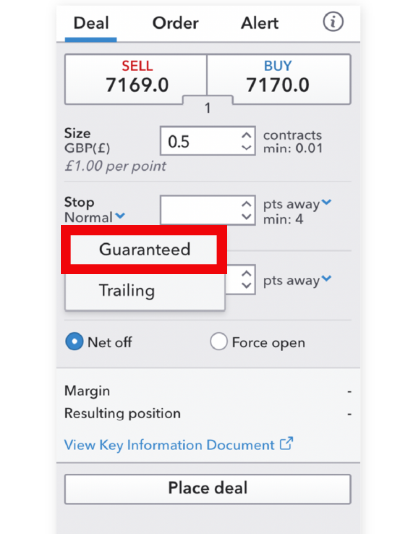
Example
Below is an example to demonstrate how brokers with guaranteed stop loss orders work:
Suppose an investor buys 1,000 shares of BP for £10, a position size of £10,000. They then place a guaranteed stop loss 5% below the entry stock price.
Suddenly, the market gaps and experiences a quick bearish jump, the new stock price becoming £8.25. When this happens, investors without a stop loss may rush to sell, likely seeing a further price drop, thus a more significant loss. Those with regular stop loss orders would see their positions closed at £8.25. However, using brokers with guaranteed stop loss orders would have resulted in a closing point of £9.50.
Doing some maths, the investor has saved the difference between its guaranteed exit value and the market price the asset dropped to. This comes out to £9.50 – £8.25 = £1.25 per share or £1,250 in total.
Guaranteed Stop Loss Vs Other Risk Management Systems
Guaranteed stop loss orders are useful but they are not the only risk management tool available. Our trading experts have found that using a combination of different approaches is often best.
Take Profit Orders
A take profit order is a limit order whereby the trader specifies the profit at which they want to close a position. If the price reaches the limit, the broker will automatically close the trade. This protects investors against a sharp, unexpected downturn before they have time to close their profitable trade. This can improve net profitability and helps traders remain objective, preventing emotions like fear or greed from driving decisions.
Hedging
Hedging is another means of managing risk. It works by offsetting investment losses through positions that oppose the primary one. This acts as a kind of insurance, so you do not see such a negative impact if the market does not go your way.
While hedging does not protect against all losses, the impact of major downturns is reduced. A hedge position creates an effective risk management tool but also reduces potential profits.
There is also an added cost, known as the premium, to protect your assets in this way.
Trailing Stop Orders
For risk-effective management, find a broker that gives both trailing and guaranteed stops and pair them. Trailing stops describe an order type whereby the stop loss price is not fixed to one amount but as a percentage below the market price. This means that, if the asset value increases, the trailing stop also rises. Once the value starts dropping, the trailing stop remains fixed and the investor is always protected by the same difference. This ensures traders can lock in profits when prices rise without closing the position.
How To Use A Guaranteed Stop Loss
See the following top tips for using brokers with guaranteed stop loss orders when investing and trading:
- Ensure the broker only charges a premium for implemented guaranteed stops
- Consider whether these are necessary as active monitoring can reduce their benefits
- Remain aware of what charges are implemented on each order and check that the cost is worthwhile
- Check the minimum distance that brokers with guaranteed stop loss orders support and whether this negates any significant benefit of the order type
- Some brokers with guaranteed stop loss orders allow them to be modified after the fact, which could be taken advantage of to act like a trailing stop order
Benefits Of Brokers With Guaranteed Stop Loss
Prevents Major Losses
The major benefit of using guaranteed stop loss orders is that they prevent you from losing excessive amounts of money in your trades. In highly volatile markets, brokers with guaranteed stop loss orders protect investors from gapping events, ensuring that the expected risk is the maximum taken on.
When you set a guaranteed stop loss, you agree to what you are comfortable losing; there is no way to lose more than this.
Hands-Off Trading
Guaranteed stop loss trading is perfect for those who cannot monitor their positions all the time. When a stop loss is set, there is no need to watch market fluctuations closely because your trade will exit automatically.
If you do not want trading to be a full-time job, then setting a guaranteed stop loss could be a sensible option.
Objectivity
Implementing a guaranteed stop loss allows you to be more objective with your trades. When monitoring stocks yourself, you may be motivated by emotions and the hope that the market will change. This kind of mentality can lead to further, more significant losses. With investments that are exited automatically, no emotional drivers enter into the equation.
Drawbacks Of Brokers With Guaranteed Stop Loss
Minimum Stop Distance
Brokers set a minimum stop distance with guaranteed stop losses. This is the minimum distance the stop loss can be from the current market price. This minimum changes according to expected volatility and gets wider the more volatile the market gets. If this minimum is too large, it can result in a guaranteed stop loss order that is not particularly protective.
Premiums
Brokers often charge a premium for investors to use a guaranteed stop loss, which is triggered when the stop loss is met. It tends to be small but varies between brokers, so choose one with a lower premium. You can also close a position before the stop loss is triggered to avoid paying the premium at all.
Short Term Fluctuations
Setting your guaranteed stop loss close to the current price minimizes losses and is a safe way to trade. However, it also means that short-term fluctuations in stock prices, for example, can trigger it and exit your trade unnecessarily. The key is to set your stop at an amount that allows some fluctuation while still minimizing your risk.
How To Compare Brokers With Guaranteed Stop Loss
Choosing brokers with guaranteed stop loss orders is a useful way to limit risk, though it is not the only comparison factor. We have produced a summary guide below on some of the other features that may influence your decision. Alternatively, check out our list of the best brokers with guaranteed stop loss functionality.
- Fees: Beyond a direct comparison of the premiums for the titular order type, several trading fees can impact your net profits. Additional charges may be levied on deposits and withdrawals, currency conversions, spreads, commissions, inactivity and accounts.
- Assets: Not all brokers with guaranteed stop loss orders will offer every financial instrument, so check that your desired markets are covered by a firm’s services. You do not want to open an account, deposit your money and then find out that the crypto options you want to speculate on are not available.
- Regulation: Regulatory bodies like the FCA, SEC and ASIC operate independently to ensure the financial markets remain fair and investors are not scammed. Brokers with guaranteed stop loss orders regulated by such agencies will ensure that client funds are held separately from their own, they do not mislead customers and they operate transparent pricing and business models.
- Customer Service: Customer support can make a huge difference in your overall trading experience and sometimes even your profits. If any technical issues are preventing you from placing or closing positions, you may end up losing money. Check that your potential brokers with guaranteed stop loss orders have customer support teams that speak your language and are readily accessible by your preferred contact method.
- Payment Methods: It is important to ensure that you can deposit and withdraw money from your brokerage account via a convenient method. For example, you do not want to have to open an account with an offshore e-wallet just to take out your money, you may just want a direct wire transfer to your bank account.
Bottom Line
Brokers with guaranteed stop loss orders offer their clients an opportunity to set in stone the risk taken on by any position. These order types can also reduce substantial losses caused by large fluctuations in the market or emotion-based trading decisions. We have found that the optimal way to use brokers with guaranteed stop loss orders is to set them at a limit that minimizes loss but does not risk early exit due to small, short-term volatility. Our experts also recommend using a range of risk management approaches in combination to best maximize net profits.
See our list of the top brokers with guaranteed stop loss functionality to get started.
FAQs
What Are Brokers With Guaranteed Stop Loss?
Guaranteed stop losses protect your open positions by making sure that they are exited if the market falls below a preset point. This means that, regardless of any significant volatility and gapping, you would not face an unexpected loss.
What Is A Guaranteed Stop Premium?
If your guaranteed stop is triggered by the market falling past the point that you set your stop at, then the broker will charge you a fee known as a premium for using the service.
Are Brokers With Guaranteed Stop Loss Orders Good?
Guaranteed stop losses are useful in volatile market conditions as prices can rise and fall very quickly, sometimes faster than platforms can follow. When a guaranteed stop loss is in place, you will never lose more than anticipated when the position was opened.
Should Beginners Use Brokers With Guaranteed Stop Loss Orders?
When used correctly, guaranteed stop losses are a great way for beginners to make trades without taking excessive risks. At any level of investing, they are effective in minimizing losses.
Do I Have To Pay Brokers With Guaranteed Stop Loss?
You will only pay for the guaranteed stop loss if it is triggered by the market falling to or below that point. If you exit the trade before that happens or the market does not fall, you will not pay to use the guaranteed stop loss.