
Best Brokers For AI Agent Trading In 2026: Platforms With Autonomous Trading Tools Tested



A growing number of brokers are introducing ‘AI agents’ for trading. Unlike AI tools that act as research assistants – supporting with tasks like providing market summaries – near- or fully autonomous agents execute trades and run strategies with little to no intervention. Yet we remain sceptical having put AI agents through their paces, with some concerns about their quality and guardrails. That’s why only a select few providers made our list of top brokers with AI trading agents.
Top 5 Brokers For AI Agents
Based on our hands-on tests, these 5 brokers have the best AI trading agents:
-
1
 Interactive Brokers
 -
2
 eToro USAeToro USA LLC and eToro USA Securities Inc.; Investing involves risk, including loss of principal; Not a recommendation
 -
3
 OKX
OKX -
4
 Moomoo
 -
5
 Coinbase
Why Are These Brokers The Best For AI Agents?
Here's a rundown of why these AI agent brokers top our rankings:
- Interactive Brokers is the best broker for AI agent trading in 2026 - Interactive Brokers has a near-autonomous agent that performed excellently during testing. While it won’t automatically execute trades like some other providers in this list, it connects IBKR accounts to supported AI platforms (ChatGPT, Claude, Grok, Gemini coming) without an API key or password, and can analyze portfolios, generate insights and draft trade instructions. We found it particularly useful for identifying correlated assets within a portfolio and acting as an economic calendar on steroids - identifying upcoming earnings announcements in major US stocks that could affect existing positions. The ability to create repeatable instructions and processes also make it especially valuable for high-volume, short-term traders. Agent details: Trades? Partly - drafts trade instructions. API/MCP? MCP. Approval? Yes, every order. Minimum? No extra fee. Safeguard? No credential sharing; client approval before submission.
- eToro USA - eToro has one of the most beginner-friendly routes for traders in the US wanting to try AI agents. You could prompt an agent with something like ‘build a diversified AI and semiconductor basket,’ review the proposed mix of US stocks and ETFs, then approve the allocation before it places trades. The real appeal is eToro’s simple, social-investing setup: you can track the agent portfolio separately, monitor net value and P&L, and cancel or adjust trades if the strategy drifts, and all from a few taps in the app. Agent details: Trades? Yes. API/MCP? API. Approval? No, once configured. Minimum? $200. Safeguard? Separate portfolio, scoped permissions.
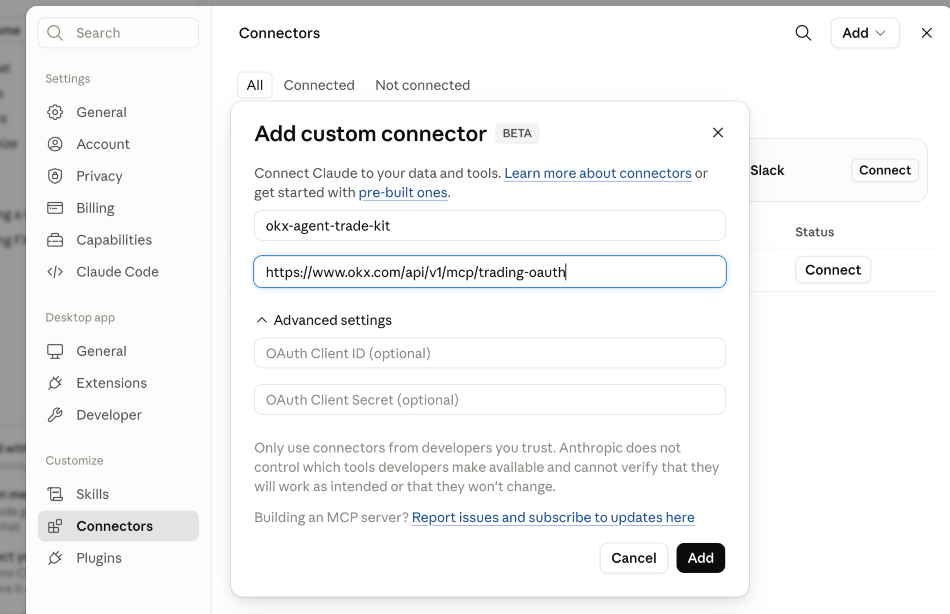
- OKX - OKX has a solid AI agent for serious crypto traders. Its Agent Trade Kit is comprehensive, allowing users to analyze crypto portfolios and execute complex strategies across spot, options, perpetual futures and other derivatives. The setup was more cumbersome than some brokers we tested, but once configured, the capabilities were robust and come with the familiar OKX interface and feel. Strong use cases include tracking and acting on crypto candlestick patterns and running strategies that require advanced orders, such as one-cancels-the-other and grid bots. Spot crypto traders can also use the agent for simple tasks like ‘Buy $X worth of BTC with a stop loss at $Y’. Agent details: Trades? Yes. API/MCP? MCP/CLI. Approval? Permission-dependent. Minimum? 10 USDT. Safeguard? Clear permissions.
- Moomoo - Moomoo earned a place in our list for its AI agent features that pair well with its extensive equity coverage across US, Hong Kong, China, Singapore and Japan. No API required, its Moomoo Skills fetches live broker data and trading tools directly into agents like Claude Code, Cursor and OpenClaw. Where it performed well in testing was for research tasks - using natural language to analyze tick data and digest stock announcements. E.g. you can ask the agent to scan a technology stock watchlist for equities with negative news but improving sentiment. Every trade still needs manual confirmation, which makes it less hands-off than alternatives like eToro but safer for traders who don’t want to give up final control. Agent details: Trades? Yes. API/MCP? Skills. Approval? Usually manual. Minimum? $0. Safeguard? Clear permissions and human oversight.
- Coinbase - Coinbase is one of the top AI agent brokers for active crypto traders. Coinbase for Agents connects an external AI agent directly to a Coinbase account, letting it trade and perform various tasks within user-defined limits. The ‘AI chat’ is a nice touch, but in our tests the key selling point is the smooth execution across spot crypto and derivatives with actions like buying dips and rebalancing volatile crypto portfolios. You can give it simple instructions like ‘Move me toward 50% BTC, 25% ETH, 15% SOL and 10% emerging tokens, only buying after 5% pullbacks.’ It’s particularly useful for crypto traders interested in emerging tokens because Coinbase offers such a huge and growing universe of hundreds of altcoins. Agent details: Trades? Yes. API/MCP? MCP/CLI. Approval? Limit-dependent. Minimum? $0 deposit, $2 trade. Safeguard? User-set limits and permissions.
Compare AI Agent Brokers In Core Categories
Consider providers side-by-side in the areas that matter most to traders wanting to deploy agentic tools:
| Broker | AI Features | ChatGPT Integration | API Access | Trust Rating |
|---|---|---|---|---|
| Interactive Brokers | ✔ | ✔ | ✔ | / 5 |
| eToro USA | ✔ | ✘ | ✔ | / 5 |
| OKX | ✔ | ✔ | ✔ | / 5 |
| Moomoo | ✔ | ✘ | ✔ | / 5 |
| Coinbase | ✔ | ✔ | ✔ | / 5 |
How Secure Are The Best AI Agent Brokers?
Using a firm's AI agent requires immense trust. Here’s how our top brokers facilitate secure trading:
| Broker | Trust Rating | Guaranteed Stop Loss | Negative Balance Protection | Segregated Accounts |
|---|---|---|---|---|
| Interactive Brokers | ✘ | ✘ | ✔ | |
| eToro USA | ✘ | ✘ | ✔ | |
| OKX | ✘ | ✘ | ✘ | |
| Moomoo | ✘ | ✘ | ✔ | |
| Coinbase | ✘ | ✘ | ✔ |
Are The Top AI Agent Trading Brokers Good For Beginners?
We looked at AI agent setup guides, demo accounts, and beginner-friendly features to see which brokers best support newer traders:
| Broker | Demo Account | Minimum Deposit | Minimum Trade | Education Rating | Support Rating |
|---|---|---|---|---|---|
| Interactive Brokers | ✔ | $0 | $1 | ||
| eToro USA | ✔ | $50 | $10 | ||
| OKX | ✔ | 10 USDT | Variable | ||
| Moomoo | ✔ | $0 | $0 | ||
| Coinbase | ✘ | $0 | $2 |
Are The Top AI Agent Trading Platforms Good For Experienced Traders?
Advanced traders need strict control over AI agents, real-time analytics, automation, and reliable execution. Here’s how our top providers excelled for advanced traders:
| Broker | Automated Trading | VPS | AI | Pro Account | Leverage | Low Latency | Extended Hours |
|---|---|---|---|---|---|---|---|
| Interactive Brokers | TWS API | ✘ | ✔ | ✘ | 1:50 (major forex pairs), 1:2-1:4 (equities) | ✔ | ✔ |
| eToro USA | ✘ | ✘ | ✔ | ✘ | - | ✔ | ✔ |
| OKX | ✔ | ✘ | ✔ | ✘ | - | ✔ | ✘ |
| Moomoo | Moomoo OpenAPI | ✘ | ✔ | ✘ | 1:2 | ✔ | ✔ |
| Coinbase | Algo trading via Coinbase Advanced API | ✘ | ✔ | ✘ | - | ✔ | ✘ |
Compare Detailed Ratings Of Top AI Agent Brokerages
Find out how the leading AI agent providers performed across critical areas in our assessment:
| Broker | Trust | Platforms | Assets | Mobile | Fees | Accounts | Research | Education | Support |
|---|---|---|---|---|---|---|---|---|---|
| Interactive Brokers | |||||||||
| eToro USA | |||||||||
| OKX | |||||||||
| Moomoo | |||||||||
| Coinbase |
Compare Trading Fees
AI agents don't generally come with additional start-up costs, but active traders in particular still need low transaction fees:
| Broker | Cost Rating | Fixed Spreads | Inactivity Fee |
|---|---|---|---|
| Interactive Brokers | ✘ | $0 | |
| eToro USA | ✔ | $10 | |
| OKX | ✘ | $0 | |
| Moomoo | ✘ | $0 | |
| Coinbase | ✘ | $0 |
Community Sentiment
See how users rate these brokers based on the average customer ratings submitted on DayTrading.com, plus ratings from Trustpilot, the Apple App Store and Google Play.
| Broker | Our Users' Rating | Trustpilot Score | Trustpilot Reviews | iOS App Rating | Android App Rating |
|---|---|---|---|---|---|
| Interactive Brokers | 5520 | ||||
| eToro USA | 32190 | ||||
| OKX | 1798 | ||||
| Moomoo | 752 | ||||
| Coinbase | 23231 |
How Popular Are The Top Trading Platforms With AI Agents?
AI agent trading is gaining traction, so we looked at which providers are attracting the most clients:
| Broker | Popularity |
|---|---|
| Coinbase | |
| OKX | |
| Moomoo | |
| Interactive Brokers | |
| eToro USA |
Why Use Interactive Brokers's AI Agent?
"Interactive Brokers is one of the best brokers for advanced day traders, providing powerful charting platforms, real-time data, and customizable layouts, notably through the new IBKR Desktop application. Its superb pricing and advanced order options also make it highly attractive for day traders, while its diverse range of equities is still among the best in the industry."
Christian Harris, Reviewer
Interactive Brokers Quick Facts
| Demo Account | Yes |
|---|---|
| Instruments | Stocks, Options, Futures, Forex, Funds, Bonds, ETFs, Mutual Funds, Cryptocurrencies |
| Regulator | SEC, FINRA, CFTC, NFA, CIRO, FCA, CBI, ASIC, SFC, SEBI, JFSA, MAS |
| Platforms | Trader Workstation (TWS), IBKR Desktop, GlobalTrader, Mobile, Client Portal, AlgoTrader, OmniTrader, TradingView, eSignal, TradingCentral, ProRealTime, Quantower |
| Minimum Deposit | $0 |
| Minimum Trade | $1 |
| Account Currencies | USD, EUR, GBP, CAD, AUD, INR, JPY, SEK, NOK, DKK, CHF, AED, HUF |
Pros
- The TWS platform has clearly been built for intermediate and advanced traders and comes with over 100 order types and a reliable real-time market data feed that rarely goes offline.
- Interactive Brokers was named 'Best US Broker' for 2025 by DayTrading.com, recognizing its long-standing commitment to US traders, ultra-low margin rates, and global market access at minimal cost.
- Interactive Brokers has launched a unified interface that integrates prediction markets across three top exchanges: Kalshi, CME Group, and ForecastEx, with products where users can trade yes/no contracts on political, economic, and climate events, with fixed $1 payouts per contract, 24/6 market access, and interest on eligible held positions.
Cons
- You can only have one active session per account, so you can’t have your desktop program and mobile app running simultaneously, making for a sometimes frustrating trading experience.
- TWS’s learning curve is steep, and beginners may find it challenging to navigate the platform and understand all the features.
- Support can be slow and frustrating based on tests, so you might find it challenging to reach customer service representatives promptly or encounter delays in resolving issues.
Why Use eToro USA's AI Agent?
"eToro remains a top pick for traders looking for leading social investing and copy trading services. With a low deposit, zero commissions and an intuitive platform, the broker will meet the needs of newer day traders."
Jemma Grist, Reviewer
eToro USA Quick Facts
| Demo Account | Yes |
|---|---|
| Instruments | Stocks, Options, ETFs, Crypto |
| Regulator | SEC, FINRA |
| Platforms | eToro Trading Platform & CopyTrader |
| Minimum Deposit | $50 |
| Minimum Trade | $10 |
| Account Currencies | USD |
Pros
- The low minimum deposit and straightforward account opening process means beginners can get started quickly
- A free demo account means new users and prospective day traders can try the broker risk-free
- Investors can access Smart Portfolios for a more hands-off approach, covering a range of sectors and markets such as renewable energy and artificial intelligence
Cons
- There's no MetaTrader 4 platform integration for traders who are accustomed to using third-party charting tools
- There's a narrower range of day trading instruments available compared to competitors, with only stocks, ETFs, options, and cryptos
- eToro USA was fined $1.5 million by the SEC in 2024 related to unregistered crypto offerings
Why Use OKX's AI Agent?
"OKX is a top pick for crypto traders looking for emerging coins and crypto projects to invest in. Traders can also make use of the broker's copy trading service and automated bots."
William Berg, Reviewer
OKX Quick Facts
| Demo Account | Yes |
|---|---|
| Instruments | Spot, Futures, Swaps, Options, X-Perps |
| Regulator | FinCEN, VARA |
| Platforms | AlgoTrader, Quantower |
| Minimum Deposit | 10 USDT |
| Minimum Trade | Variable |
| Account Currencies | USD, EUR, GBP, INR, JPY, SGD, RUB, AED, SAR |
Pros
- Traders can access historical market data for spot and futures combining OHLC data, aggregate trades and trading history
- In 2025, OKX secured a MiFID II license, enabling it to offer regulated derivatives products across Europe, providing peace of mind
- OKX has 50 million global clients and a license from the Dubai Virtual Assets Regulatory Authority
Cons
- The broker's platform and features may be complex for novices
- In 2025 OKX agreed to pay over $500 million in penalties for violating AML laws in the US
- The firm offers limited regulatory oversight, though this is common among crypto exchanges
Why Use Moomoo's AI Agent?
"Moomoo remains an excellent choice for new and intermediate stock traders who want to build a diverse investment portfolio. What really stands out is the broker's user-friendly app and the low trading fees."
Moomoo Quick Facts
| Demo Account | Yes |
|---|---|
| Instruments | Stocks, Options, ETFs, ADRs, OTCs |
| Regulator | SEC, FINRA, SIPC, MAS, SFC, ASIC, FMA, CIRO, CIPF, JFSA, SC |
| Platforms | Desktop Platform, Mobile App |
| Minimum Deposit | $0 |
| Minimum Trade | $0 |
| Account Currencies | USD, CAD, AUD, JPY, MYR, HKD, SGD, CNY |
Pros
- Moomoo is a Member of FINRA and the Securities Investor Protection Corporation (SIPC), adding another level of security for prospective clients
- The Moomoo AI assistant, found in the desktop software and app, provides genuinely useful market insights to inform active traders
- Moomoo's analytics and insights are impressive and detailed compared to other brands
Cons
- Moomoo has faced multiple regulatory penalties in recent years, including fines and orders in 2026 that stopped it temporarily accepting some Japanese and Chinese clients
- There is no negative balance protection, which is a common safety feature at top-tier-regulated brokers
- The account range is narrow compared to other brokerages in its class with no managed portfolios or robo-advisor solutions
Why Use Coinbase's AI Agent?
"Coinbase is ideal for beginners looking for an intuitive platform to buy and sell a wide variety of cryptocurrencies, with robust security and regulatory compliance. However, its fees are higher compared to competitors in our tests, and it’s not as tailored for short-term traders."
Coinbase Quick Facts
| Demo Account | No |
|---|---|
| Instruments | Crypto, Stocks, ETFs (US only), Pre-IPO Perpetual Futures (non-US) |
| Regulator | CSSF, CBI, CySEC, BaFin, MAS, OSC, ASIC, BMA |
| Platforms | Coinbase, Advanced Trade, Wallet, NFT, TradingView |
| Minimum Deposit | $0 |
| Minimum Trade | $2 |
| Account Currencies | USD, EUR |
Pros
- Coinbase supports 240+ cryptocurrencies, including Bitcoin (BTC), Ethereum (ETH), Solana (SOL), and more recently listed altcoins like $Trump, giving early access to emerging tokens.
- Coinbase Advanced bolstered its leveraged trading offering with a suite of new futures products in 2025, including Ripple (XRP), Natural Gas (NGS), and Cardano (ADA), providing accessible ways to trade, hedge, or diversify.
- There are platforms for all levels: beginners can use the simple Coinbase app, while Advanced Trade provides lower fees and pro-level tools.
Cons
- There are woeful research tools; Advanced Trade has TradingView charts but lacks features like news feeds, economic calendars, and AI market insights.
- Frustrating customer support during testing, with most help options hidden behind login, making it tough for locked-out users or non-account holders to get assistance.
- Received regulatory enforcement actions, including the CBI fining Coinbase Europe Limited €21.46M in November 2025 for AML and CFT failures relating to 30M+ transactions being unmonitored.
How We Chose The Best Brokerages For Agentic Trading
We followed a three-step process:
- We checked whether every firm in our database of 143 brokers offers AI agents or similar tools, leaving us with a shortlist of 15 trading providers.
- We investigated whether, from our shortlist, they offered near or fully autonomous agents rather than AI-powered research trading assistants that couldn’t actually execute trades. This left us with fewer than 10 brokers that offer genuine AI agentic trading, representing around 8% of our total directory.
- We opened accounts and ran hands-on tests of each brokerage’s AI agents, assessing the range of tasks they can perform, how easy they were to set up, how reliable they were, and crucially, the level of safeguards you can put in place as a user. We documented our findings for each broker and then ranked them by their ratings.
How AI Agents Work
AI agents are nearly or fully autonomous tools that can work largely independently to perform core trading activities.
At some firms we’ve tested, AI agents are given their own dedicated trading account with set capital to monitor assets and make buy and sell orders with minimal intervention. At other brokers, they work within the main account area, performing tasks such as rebalancing portfolios in line with the account holder’s specified product mix and risk appetite.
From a technical standpoint, the ‘agent’ element means they can plan or act on your behalf. For example, they may be able to call a market data API, run a backtest in Python, query an LLM for a summary of a Fed announcement, size a position, calculate potential stop-loss levels, and submit a market, pending or other type of order through a broker’s API.
What To (And Not To) Use An AI Trading Agent For
Drawing on our testing experience, we’ve compiled a list of 10 sensible use cases for active traders:
| Use Case | What To Use An AI Agent For | What Not To Use It For | Sensible Example |
|---|---|---|---|
| Trade execution | Automatically placing trades when predefined strategy and risk conditions are met. | Giving the agent unrestricted authority to trade any asset, at any size, at any time. | An agent places a marketable limit order for up to $500 of SPY only when the strategy signal is triggered, the bid-ask spread is below 0.03%, and the trade fits the user’s daily risk limit. |
| Stop-loss and exit management | Automatically managing exits using stop-loss, take-profit, trailing-stop, or time-based rules. | Letting the agent widen stops, cancel exits, or hold losing trades simply because the trade is moving against it. | An agent exits a QQQ day trade if price falls 0.6% from entry, reaches a 1.2% profit target, or remains flat after 45 minutes. |
| Position sizing | Calculating trade size from account equity, volatility, stop distance, and maximum loss per trade. | Allowing the agent to increase position sizes after losses to try to win money back. | An agent risks 0.5% of account value on a short-term NVDA trade by adjusting share size based on the distance between the planned entry and stop-loss. |
| Risk shutdowns | Pausing or disabling trading when drawdown limits, volatility spikes, or abnormal execution conditions appear. | Allowing the agent to keep trading through broken data or extreme spreads. | An agent stops opening new trades for the day after five consecutive losses or a 2% account drawdown, even if fresh signals appear. |
| Order type and routing discipline | Selecting safer order types such as limit, stop-limit, bracket, or trailing orders based on strategy rules and market conditions. | Using aggressive market orders in illiquid stocks or cryptos where slippage can overwhelm the expected profit. | An agent submits a bracket order for a small-cap trade with a defined entry limit, stop-loss, and profit target before the position is opened. |
| Signal scanning | Scanning live markets for short-term setups such as breakouts, reversals, unusual volume, or moving-average conditions. | Treating every AI-generated signal as a guaranteed trade entry. | An agent scans liquid US stocks every minute and flags AMD only if it breaks above its 20-minute high on volume at least twice its recent average. |
| Momentum trading | Executing predefined momentum strategies when price, volume, liquidity, and market conditions align. | Chasing a stock after a large move without checking spread, slippage, or exhaustion risk. | An agent opens a small position only after a stock breaks above pre-market resistance, volume expands, and the spread and/or commission remains tight enough for the strategy. |
| Mean-reversion trading | Running short-term mean-reversion strategies when price moves unusually far from VWAP, a moving average, or another benchmark. | Blindly buying every dip in a falling stock or averaging down without a stop. | An agent considers a long trade when a liquid ETF trades 1.8% below intraday VWAP, but only if volume, spread, and broader market conditions remain stable. |
| News reactions | Classifying confirmed news, earnings updates, or macro releases before allowing them to influence a trading setup. | Trading instantly on unverified headlines, rumours, or social-media posts. | An agent detects confirmed guidance news on a semiconductor stock, then waits for volume confirmation and acceptable spreads before allowing an entry. |
| Trade journaling | Automatically logging signals, entries, exits, slippage, and rules for later review. | Using the journal to rationalise random trades that were never part of the strategy. | An agent records that a TSLA breakout trade triggered correctly, but the fill was 0.18% worse than expected because the spread widened before execution. |
Guardrails To Follow
While retail investors increasingly have access to autonomous trading agents like their institutional counterparts, it’s important to remember they don’t necessarily have the same level of training, qualifications or risk management processes. Therefore, before giving any AI agent the green light, there are some basic checks we recommend retail traders follow, or at the very least consider:
- Will the AI agent trade in its own account or capital allocation to prevent damaging your manual portfolio?
- Can you control which markets and industries it trades in, as volatile asset classes like crypto bring heightened risk, while Muslim traders may want to avoid stocks in haram industries like alcohol and tobacco?
- How do you set up notifications to be alerted via email, text or in-app when the agent places and closes a trade?
- Is there an easy-to-access kill switch to immediately disconnect an agent (especially important if it’s running high-volume short-term strategies where losses can accumulate quickly)?
AI agents are still relatively new on retail investing platforms. We’ve seen them make mistakes, hallucinate, misread instructions, and overtrade. So start with small allocations, use strict limits, and monitor their activity closely.
Regulatory Considerations
AI trading agents remain subject to existing retail-investor protections, even where dedicated AI rules have not yet been introduced.
In the US, liability and oversight for autonomous AI trading remain unsettled, with existing securities and broker-dealer rules continuing to apply.
In the UK, the FCA’s 2026 Mills Review confirmed that firms using AI remain subject to existing frameworks such as the Consumer Duty and Senior Managers & Certification Regime (SM&CR).
In the EU, firms using AI for retail investment services remain subject to MiFID II, including requirements to act in clients’ best interests and maintain appropriate governance and controls.
In Australia, ASIC has warned that increased AI use must be supported by appropriate governance, cyber resilience and risk controls.
For retail traders, the main takeaway is that using an AI agent does not remove the protections and responsibilities that normally apply to regulated investment services, although regulation of highly autonomous trading remains an evolving area.
FAQs
Can AI Agents Legally Trade For Me?
In most regions, yes. However, regulators may bring in tighter regulations to curb how these tools can be marketed and deployed by brokerages. As is often the case, regulators are some way behind innovative trading technologies.
Are AI Trading Agents Safe?
Not inherently. Just like with manual trading, you should expect that AI trading agents can and will incur losses. They are not a shortcut to wealth. A careful plan and oversight are still required.
Which Broker Has The Best AI Agent For Beginners?
eToro has the best AI trading agent from our tests. The access via a simple WhatsApp conversation makes it incredibly straightforward for less tech-savvy traders and newer investors to get to grips with.
Can An AI Agent Trade Crypto Futures?
Yes, but it depends on your location and choice of broker. Good brokers that do allow AI agents on crypto include Coinbase, Bybit and OKX.
What Is MCP In AI Agent Trading?
MCP stands for Model Context Protocol. It is an open standard that connects AI agents to external tools, data sources, and systems through a common interface, rather than building a separate custom integration for every broker, exchange, news feed, or analytics tool. Anthropic introduced MCP in November 2024.
Do AI Agents Need API Keys To Trade?
Most do in our experience. However, some work without APIs, such as Moomoo.