GO Markets Introduces 50% Credit Bonus
GO Markets is bolstering clients' trading power through a 50% bonus, offering up to $10,000 in trading credit which can be converted into cash rebates as you trade.
 Not Available



Trading with a broker’s welcome bonus or using an ongoing promotion can give your account a boost. However, incentives must be used correctly otherwise there’s a risk of overtrading. Equally, terms and conditions must be understood, as wagering stipulations often require active trading.
We’ve opened 141 brokerage accounts and recorded more than 210 bonuses and trading promotions. We’ve combed through the T&Cs of each offer, reading over 45,500 words – looking for hidden turnover requirements and unfair rules. Only brokers with offers that had transparent T&Cs made our lists below.
From our assessment of their trading offers, these brokers have the best trading bonuses for new clients:






Compare the size of bonuses, review the key conditions, and check the deal is the right fit for your needs:
| Broker | Bonus | Key T&Cs | Bonus Is Best For |
|---|---|---|---|
| eToro USA | Invest $100 and get $10 | No wagering. A $10 crypto bonus for buying/investing $100 worth of crypto, not a cash trading bonus. Subject to US-state eligibility and terms. | Crypto beginners who were already planning to make a small first crypto purchase |
| Plus500US | Welcome Deposit Bonus up to $200 | No wagering. Applies only to futures trading. Bonus is commission credit that cannot be withdrawn. | Active futures traders |
| FOREX.com | VIP status with up to 10k+ in rebates - T&Cs apply. | Must deposit at least $250 within 14 days of opening an account. Bonus is 20% of total deposits made within the first 14 days, capped at $5,000. To receive the funds, traders must meet a trading volume requirement within 60 days. For a $1,000 bonus, typically need to place 40 qualifying trades. | High volume forex traders looking for extra trading credit. |
| Moomoo | Get up to 15 free stocks worth up to $2000 | No wagering. Promotion is tied to net deposit thresholds and holding asset period. A $100 net deposit earns 5 draws, and maintaining $100 average assets for 60 days unlocks them; higher deposits unlock more draws. | New US investors who can fund and hold assets for the required period and value stock rewards over trading credits. |
| Firstrade | Deposit Bonus Up To $4000 | Must fund account within 30 days of opening. Bonus tiers range from $50 to $4,000 based on deposit size (e.g., $1.5M+ for the max reward). Assets must remain in the account for at least 12 months, excluding market losses, or the bonus may be clawed back. | Long-term investors or retirees looking to consolidate large portfolios into a commission-free solution. |
| Nexo | Loyalty scheme with various bonuses, plus referral program and bonus paid to lenders on credit line | You have to deposit $5,000+ in digital assets within 15 days of sign-up and maintain that average balance for 30 days. Referral bonuses are often paid as a 1% BTC reward (up to $5,000) split between parties and distributed in 12 monthly instalments. Best loyalty rates require holding 10% of your portfolio in Nexo tokens. | Crypto enthusiasts wanting to earn yields or take out credit lines without selling their digital assets. |
Note bonuses may not be available in certain jurisdictions due to broker policies and legal restrictions. ‘Green tier’ regulators such as FCA, ASIC and ESMA usually do not allow bonuses. You will not be able to benefit from the protection these regulators offer and claim a bonus. You have to chose one of the two. FCA, ASIC and ESMA regulated trading platforms are not allowed to give you a cash bonus.
As well as welcome bonuses for new clients, many brokers offer ongoing promotions that reward active traders with various perks, such as reduced spreads or other deals that can help save on trading costs. This can make them popular with some frequent traders, such as day traders.
We routinely scan the market to find promotions aimed at existing traders, and after evaluating the offers, their benefits, and any stipulations, these are the best deals available in April 2026. Note that if the promotion is greyed out, this means it is not available in your location.
GO Markets is bolstering clients' trading power through a 50% bonus, offering up to $10,000 in trading credit which can be converted into cash rebates as you trade.
Not Available
Eightcap has re-entered the prop trading arena, and this time the focus is firmly on short-burst, skill-based trading. The broker has launched Day Trader Challenges, a rapid-fire prop trading format built for traders who don’t want multi-week evaluations or marketing fluff.
Not Available
eToro is offering a free share worth $50 when you sign up. It will be one of six stocks hand-picked by DayTrading.com's expert team.
Not Available
InstaForex is running a 100% deposit bonus. Traders can double their first deposit and use promotional funds to speculate on the broker’s 100+ currency pairs. Read on for joining instructions, plus bonus terms and conditions.
Not Available
AAAFX is running a 100% deposit bonus for global clients. Promotional funds are added to client accounts as additional margin. Find out how to claim the welcome bonus and boost your trading funds.
Not Available
Award-winning forex and crypto broker, AAAFx, is offering a free VPS for traders that deposit $5,000. The virtual private server ensures uninterrupted trading operations, lending it to automated investing strategies and trading signals. Read on for the details.
Not Available
To ensure our readers only access fair and transparent trading incentives, we employ a rigorous 3-step forensic audit for every promotion listed on this page. We do not simply aggregate data from broker websites.
There is a wide range of trading promotions available. However, each comes with their benefits and drawbacks, and will suit certain types of traders more than others. Here’s a breakdown of the most popular types of trading offers available at online brokers:
| Bonus Type | Offer Type | How It Works | Pros | Cons | Who It Suits | What To Check |
|---|---|---|---|---|---|---|
| No Deposit Bonus | First-time offer | Broker gives a small bonus with no deposit required after opening and verifying a new account | Lets beginners try a live account with little or no upfront risk | Usually the toughest withdrawal rules and profits may be capped | Complete beginners and cautious traders testing a broker | High trading-volume requirement before profits can be withdrawn |
| Deposit Match Bonus | First-time offer | Broker matches a percentage of your deposit, such as 30% or 50%, usually up to a cap | Can materially increase margin and buying power | Usually not withdrawable as cash and may encourage overtrading | Active traders who were going to fund anyway | Limits can be confusing and maximums vary |
| First Deposit Bonus | First-time offer | Bonus applies only to the first ever deposit, often as a fixed amount | Can offer the strongest upfront incentive | Miss it once and it is gone | New clients ready to fund a real account | Often subject to activation windows and minimum deposits |
| Risk-Free Trade or Loss Refund | First-time offer | Broker refunds losses on a first trade or first few trades, often up to a limit | Can reduce early downside and make trying the platform less intimidating | Refund may be paid as bonus credit rather than cash | Beginners placing small first trades | Only losses may be refunded and the terms are often narrow |
| Free Stock or Free Asset Reward | First-time offer | Broker gives a free share or asset reward after account opening and minimum deposit | Simple and attractive for beginners | Usually limited to certain countries and only for new clients | Beginner investors and stock-focused users | May require funds to remain in the account for a set period |
| Spread Discount or Commission-Free Offer | First-time or ongoing offer | Broker cuts trading costs for a period or product range instead of paying bonus cash | Often more useful than a cash bonus because the value is real and immediate | Savings depend on how much you trade | Cost-conscious active traders | Discounts may only apply to selected instruments or a short period |
| Redeposit Bonus | Ongoing promotion | Bonus is paid on subsequent deposits, often at a lower percentage | Can reward loyal users and add margin over time | May tempt traders to keep adding funds | Existing active clients who top up regularly | Each redeposit may create a new lock-in period |
| Cash Rebate or Reward Points | Ongoing promotion | Trader earns points, cashback, or rebates based on trading volume, later converted into cash or credit | More transparent than many bonuses and rewards existing activity | Benefits high-volume traders more than casual users | Frequent traders like day traders and scalpers | Payout formulas can be complicated |
| Refer-a-Friend Bonus | Ongoing promotion | Existing customer gets a reward for bringing in a new funded client | Can be useful if you already recommend the broker | Usually depends on the friend completing deposit and trading requirements | Existing satisfied clients | Reward is often delayed until conditions are met |
| Loyalty or VIP Bonus | Ongoing promotion | Extra rewards, lower fees, or credits for higher balances or sustained trading activity | Can improve economics for serious traders | Rarely useful for beginners | High-volume and higher-balance traders | The real value may be lower spreads rather than the headline bonus |
| Contest | Ongoing promotion | Limited-time bonus, prize draw, or trading competition tied to an event or campaign | Can add extra value on top of normal trading | Often promotional rather than meaningful and may encourage excessive risk-taking | Experienced traders who would trade anyway | Deadlines, opt-in rules, and prize conditions are easy to miss |
Since we started evaluating brokers in 2017, we have signed up for a wide range of offers, from welcome deposit bonuses and no deposit bonuses to risk-free trades, loyalty rewards, and more. We’ve encountered the challenges that can come with using a trading bonus firsthand – notably strict terms and conditions. There are three key things to look out for:
Lots of bonuses have a ‘turnover’ requirement. This means you need to trade a multiple of the bonus amount before you can request a withdrawal. For example, a “30x turnover” on a $1,000 bonus means you need to trade $30,000. If you are a swing trader, you will likely never clear this bonus.
We have mapped out common turnover levels to show how demanding they may be in practice and which types of traders they may suit most:
| Requirement Level | Wagering Requirement | How Fair Is It? | Example Deposit | Example Bonus | Example Volume Required | Who It Suits |
|---|---|---|---|---|---|---|
| Very Low | 5x bonus | Very fair | $500 | $100 | $500 in trades | Good for beginners and lower-volume traders |
| Low | 10x bonus | Fair | $500 | $100 | $1,000 in trades | Suitable for most normal retail traders |
| Medium | 20x bonus | Reasonable | $500 | $100 | $2,000 in trades | Best for regular active traders |
| High | 30x bonus | Questionable | $500 | $100 | $3,000 in trades | Best only for frequent traders |
| Very High | 40x bonus | Unfair | $500 | $100 | $4,000 in trades | Only works for high-volume traders |
| Extreme | 50x+ bonus | Very unfair | $500 | $100 | $5,000+ in trades | Usually not worth chasing |
We have also seen trading bonuses that expire in a short period, sometimes just 7 days. This can be dangerous because it can push you to over-trade – encouraging bad habits and straying from a disciplined plan, but also running the risk that you lose money.
It may also be part of the T&Cs that you need to meet the volume requirement within the short expiry period. If the volume requirement is high, such as 50x and accompanied with a large bonus, such as $1,000, you may need to trade $50,000 in 7 days, which again runs the risk of you chasing trades and potentially seeing significant losses in a short period.
Some aggressive bonus structures can lead to a negative balance if you lose your initial deposit before meeting the turnover requirement. In these scenarios, the broker may give you two choices: deposit more capital to keep trading toward the requirement, or have the bonus removed.
If the bonus is removed while your account equity is low, your balance can drop below zero, leaving you legally owing the broker money.
Be wary of brokers that combine high turnover requirements with mandatory inactivity fees. Some predatory terms prevent you from closing your account or withdrawing any remaining funds until the turnover is met. If you stop trading to protect your remaining capital, the broker charges an “inactivity fee” every month.
This creates a “hostage” situation where you are forced to either:
Because these fees are often buried in the T&Cs you signed, it can be incredibly difficult to dispute these charges with your credit card provider. In extreme cases, traders have had to cancel their cards entirely to stop the automated billing.
One of the oldest tricks in the book is the Unsolicited Bonus. In this scenario, a broker automatically adds a “welcome bonus” or “deposit match” to your account without your request.
The Trap: The broker include a clause in their T&Cs stating that placing a single trade constitutes a legally binding acceptance of the bonus and all its associated turnover requirements. Once you start trading, you are “locked in,” and you may find it impossible to withdraw your initial deposit until you’ve traded a massive volume (e.g., $100,000 in volume for a $50 bonus).
This is not a problem when registering with green tier brokers. It is mainly a problem with red tier regulated brokers but it is good to be aware of the possible risk when using a yellow tier regulated broker as well.
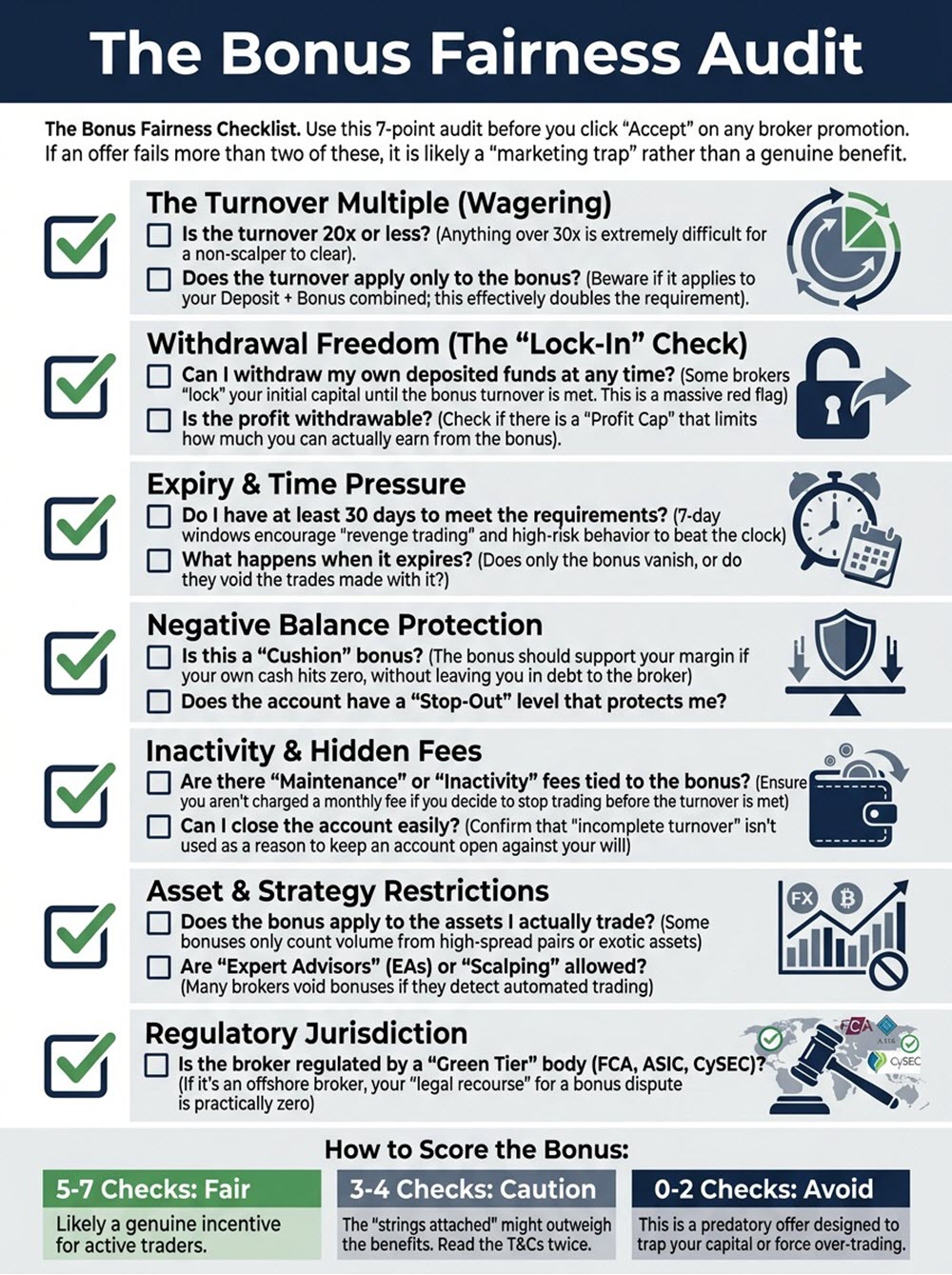
We recommend that you use our bonus fairness checklist to audit any bonus before you sign up with the broker and accept the bonus. We also provide the checklist as a PDF file so that you can download it if you want to print it to use when evaluating bonuses.
We’ve broken down the approach of five major regulators to trading promotions below. In these regions, regulators often argue such incentives encourage over-trading and hide predatory withdrawal requirements. These are all ‘green tier’ bodies in our internal regulator classification system.
‘Green tier’ regulated brokers (FCA, ASIC, NFA, etc) generally face tighter restrictions on how retail trading incentives can be structured or marketed, especially for CFDs and similar high-risk products. Offshore brokers (BVI, VFSC, FSA, etc) face less restrictions, so it’s more common to find high percentage bonuses.
However, if you open an account with an offshore firm for its bonus offer (we never recommend choosing a brokerage based on their trading bonus alone), it’s important to be aware that you could lose important safeguards that are mandated in other jurisdictions, such as access to investor compensation in case of broker insolvency and formal escalation routes in case of disputes concerning, for example, bonus terms and withdrawal restrictions.
To help show you what to look for when assessing a broker’s bonus, we’re going to take you through our findings from digging through the “50% Losable Bonus” from Trive International. This offer is no longer available, but serves as a useful example to show you how we evaluate a bonus’s T&Cs.
On the face of it, the promotion looks attractive: 50% on the first deposit and 20% on redeposits, up to a $2,000 lifetime total. However, we combed through the T&Cs and found a number of concerning rules:
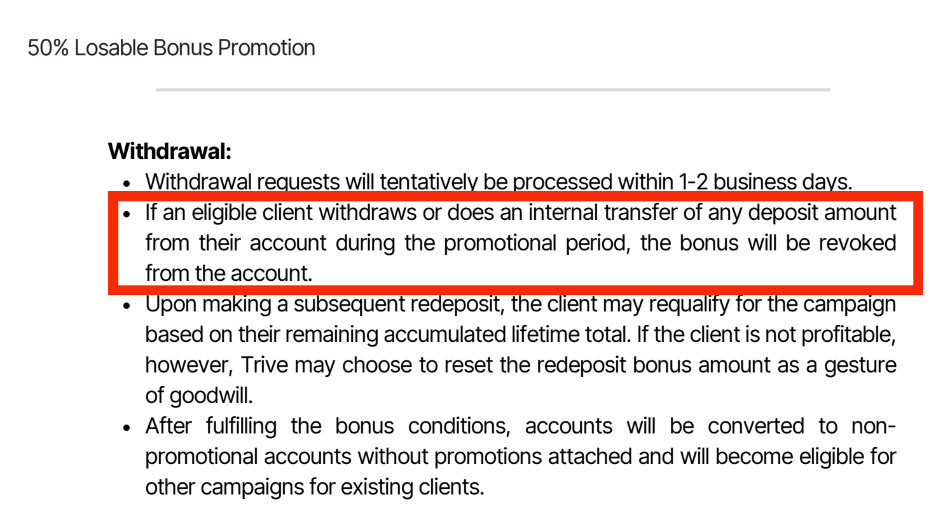
Our conclusion is that this is a highly restrictive bonus: it is non-withdrawable, time-limited, profit-capped, hostile to withdrawals of deposited funds, and subject to broad broker discretion. Those restrictions materially reduce its practical value.
Many trading bonuses come with restrictions that can make them less attractive than they first appear, especially where turnover requirements, expiry deadlines, profit caps, or withdrawal restrictions apply.
That said, it’s impossible to give individual advice, as it comes down to how much money you want to trade with and how long you can wait before you make a withdrawal.
In the long run a trading bonus will not make a huge difference to many traders, and might make things feel more complicated and thus spoil the joy of trading. Only use a bonus if you feel it makes sense to you personally.
Normally you don’t have to accept a bonus deal just because a broker is offering one. You might have to explicitly opt out of a bonus however, so make sure to check the terms and conditions when signing up.
We’ve had instances where we’ve had to go to the broker’s support team and specifically request the bonus is removed from our account. It’s an annoying use of time, but is normally quick if you speak to them on live chat.
While a bonus offer can sometimes sound like free cash with no requirements involved, there are almost always terms and conditions attached. If this wasn’t the case, what would stop dishonest traders from just withdrawing the funds without trading?
Due to regulation in many countries, it can be hard to find brokers with a bonus. However, we have collated all available bonuses and list other kinds of ongoing trading promotions and incentives. Traders looking for a promotional offer should see our our list of brokers with bonus offers. Given the high levels of interest, we have also curated a round-up and specific guide to trading bonuses in South Africa.
Note that using a broker’s bonus offer is not necessarily best for all traders. Always read the terms and conditions, especially what’s required to “clear” the bonus (i.e., what you have to do to receive the full amount).
Not usually. Many bonuses require a “turnover” or “clearing” period. We have noted the turnover requirements of each bonus, where required, in the comparison table at the top of this guide.
It can. Bonuses with high turnovers can bait traders into over-trading to meet a deadline, such as 7 days. Only accept a bonus if it aligns with your existing strategy and risk management plan.