



Cardano is an established crypto token that aims to provide a secure, scalable and sustainable platform for smart contracts and other decentralized finance (DeFi) applications. In this article, we’ve explained all there is to know about this ambitious altcoin, including how to buy it, whether it is a good investment, and how to start trading. We’ve also listed some of the best brokers for trading Cardano.
Cardano Brokers & Exchanges
-
- Crypto Spread: Variable
- Crypto Lending
- Crypto Staking
-
- Platforms: Desktop Platform, Mobile App
- Min. deposit: $0
- Regulator: SEC, FINRA, MAS, SFC, ASIC, CIRO, JFSA, SC
-
- Crypto Spread: N/A
- Crypto Lending
- Crypto Staking
-
- Crypto Spread: Variable
- Platforms: Firstrade Invest 3.0, TradingCentral
- Min. deposit: $0
-
- Crypto Spread: Market
- Platforms: Own
- Min. deposit: $0
-
- Crypto Spread: 0-0.26% average
- Crypto Staking
- Min. deposit: $10





Learn how we test brokers and why you can trust our ratings.
Here is a summary of why we recommend these brokers in October 2026:
- OKX 4.1/5 OKX continues to offer a superb selection of 400+ tokens including Bitcoin and Ripple. You can buy and sell tokens or trade cryptos on margin via derivatives, including perpetual swaps, options and futures. OKX stands out for its low fees, extensive range of tokens and speedy crypto transactions.
- Moomoo 3.2/5 Moomoo added spot crypto trading capabilities with 50+ tokens, including major names like Bitcoin, Ethereum, and Dogecoin. It was also the first US broker to provide SEC-registered blockchain-native shares like Figure Technology Solutions’ FGRD and crypto IPO allocations such as BitGo.
- Nexo 3.9/5 Nexo offers trading on an impressive suite of around 100 tokens, including Bitcoin. Digital assets can be bought, sold and swapped directly on the exchange or traded in over 500 pairs. Digital assets can also be used as collateral for fiat loans or used to generate passive income with the ‘smart staking’ tool.
- Firstrade 4.0/5 Take positions on dozens of leading cryptocurrencies with low fees and 24/7 investing. Traders need just $1 to start speculating on popular tokens like Bitcoin. Clients can also buy cryptos instantly in a few straightforward steps.
- Pionex 3.4/5 Make spot, future and leveraged trades on over 120 cryptocurrencies via Pionex's proprietary platform with built-in trading bots and highly customizable automated trading options. Up to 50x leverage is available on selected crypto perpetuals.
- Kraken 3.9/5 Kraken is a specialized crypto exchange and supports more than 600 cryptocurrencies. These include all of the established tokens like Bitcoin as well as some altcoins. Traders can make trades on spot crypto markets with up to 1:5 leverage or on futures with up to 1:50. Fees are low and the platform is super easy to pick up.
Community Sentiment
See how users rate these brokers based on the average customer ratings submitted on DayTrading.com, plus ratings from Trustpilot, the Apple App Store and Google Play.
| Broker | Our Users' Rating | Trustpilot Score | Trustpilot Reviews | iOS App Rating | Android App Rating |
|---|---|---|---|---|---|
| OKX | 1811 | ||||
| Moomoo | 740 | ||||
| Nexo | - | 18800 | |||
| Firstrade | 53 | ||||
| Pionex | 635 | ||||
| Kraken | 9238 |
OKX
OKX is a top pick for crypto traders looking for emerging coins and crypto projects to invest in. Traders can also make use of the broker's copy trading service and automated bots.
 William Berg, Reviewer
OKX quick facts
- Coins
- 1INCH, AAVE, ACA, ACE, ACH, ADA, AERGO, AEVO, AGLD, AIXBT, ALCX, ALGO, ALPHA, AMP, ANIME, APE, API3, APT, AR, ARB, ARG, ARKM, ARTY, ASTR, ATH, ATOM, AUCTION, AVAX, AXS, BABY, BABYDOGE, BADGER, BAL, BANANA, BAND, BAT, BCH, BERA, BICO, BIGTIME and many more
- Crypto Mining
- ✘No
- Auto Market Maker
- ✘No
- Crypto Spread
- Variable
- Crypto Lending
- ✔Yes
- Crypto Staking
- ✔Yes
- Platforms
- AlgoTrader, Quantower
- Minimum Deposit
- 10 USDT
- Regulator
- FinCEN, VARA
- Account Currencies
- USD, EUR, GBP, INR, JPY, SGD, RUB, AED, SAR
Pros
- X-Perps, added in 2026, provides opportunities on traditional financial assets, including US stocks and commodities
- In 2025, OKX secured a MiFID II license, enabling it to offer regulated derivatives products across Europe, providing peace of mind
- There's an impressive range of blockchain products, including DeFi services, NFTs and games, alongside 400+ established and emerging coins
Cons
- The quality of customer support was inconsistent based on testing
- The firm offers limited regulatory oversight, though this is common among crypto exchanges
- The broker's platform and features may be complex for novices
Moomoo
Moomoo remains an excellent choice for new and intermediate stock traders who want to build a diverse investment portfolio. What really stands out is the broker's user-friendly app and the low trading fees.
 Jemma Grist, Reviewer
Moomoo quick facts
- Coins
- BTC, ETH, SOL, XRP, DOGE, LTC, UNI, SHIB, AAVE, AVAX, BCH, BONK, ADA, DOT, LINK, COMP, OP, MATIC, ARB, CRV, WIF, ETC, PEPE, XLM, XTZ, TRUMP, HBAR, SUI, NEAR, RENDER, TIA, FET, ALGO, ATOM, SEI, FIL, INJ, LDO, GRT, ONDO and many more
- Crypto Mining
- ✘No
- Auto Market Maker
- ✘No
- Crypto Spread
- 0.49% per spot Bitcoin trade (US), 0.3% to 0.39% (Singapore)
- Crypto Lending
- ✘No
- Crypto Staking
- ✘No
- Platforms
- Desktop Platform, Mobile App
- Minimum Deposit
- $0
- Regulator
- SEC, FINRA, MAS, SFC, ASIC, CIRO, JFSA, SC
- Account Currencies
- USD, CAD, AUD, JPY, MYR, HKD, SGD, CNY
Pros
- There are reduced options contract fees from $0.65 to $0
- API Skills provides agentic investing to retail traders, whereby users can connect their personal AI agents like Claude or OpenAI to Moomoo's infrastructure to execute algo strategies in plain natural language
- The broker offers access to extended pre-market trading hours
Cons
- There is no negative balance protection, which is a common safety feature at top-tier-regulated brokers
- Moomoo has faced multiple regulatory penalties in recent years, including fines and orders in 2026 that stopped it temporarily accepting some Japanese and Chinese clients
- The account range is narrow compared to other brokerages in its class with no managed portfolios or robo-advisor solutions
Nexo
Nexo gives crypto traders the capability to trade, invest, lend and borrow digital assets in one place, and it’s especially good for its credit functions that pay out very high yields to lenders. However, its fees are relatively high, although its loyalty program does reward active users with perks like discounted rates on loans.
 Michael MacKenzie, Reviewer
Nexo quick facts
- Coins
- BTC, ETH, NEXO, USDT, USDC, AXS, RUNE, MATIC, DOT, APE, AVAX, KSM, ATOM, FTM, NEAR, BNB, ADA, SOL, XRP, LTC, LINK, BCH, TRX, XLM, EOS, PAXG, UNI, DOGE, MANA, SAND, GALA, SUSHI, AAVE, CRV, MKR, 1INCH, DAI, USDP, TUSD
- Crypto Mining
- ✘No
- Auto Market Maker
- ✘No
- Crypto Spread
- N/A
- Crypto Lending
- ✔Yes
- Crypto Staking
- ✔Yes
- Platforms
- Nexo Pro
- Minimum Deposit
- $10
- Regulator
- SEC & CFTC (via Bakkt)
- Account Currencies
- USD, EUR, GBP
Pros
- Reputable crypto exchange that has been in business since 2018 and has taken some steps toward regulation
- Nexo’s crypto staking and credit features support crypto lending and borrowing, and the yields lenders receive are among the best going
- Value-add tools integrated into the trading platform including social media analysis and newsfeeds by asset
Cons
- High deposit and withdrawal fees for cards and e-wallets will price many traders out of the most convenient payment methods
- High maker/taker fees mean day traders will pay more to trade derivatives than they would at some rival exchanges
- Very few educational resources are available, reducing its appeal to beginners who can find more helpful resources at category leaders like eToro
Firstrade
Firstrade is perfect for beginners looking to trade US stocks with zero commissions. There is a wealth of free education plus premium-quality research, notably through its latest FirstradeGPT tool, plus trading ideas from Morningstar, Briefing.com, Zacks and Benzinga.
William Berg, Reviewer
Firstrade quick facts
- Coins
- ALGO, AVAX, BAT, BTC, BCH, ADA, LINK, ATOM, CRO, CRV, MANA, DOGE, ETH, ETC, FTM, LTC, LRC, MATIC, REN, SHIB, SOL, XLM, SUSHI, GRT, UNI, YFI
- Crypto Mining
- ✘No
- Auto Market Maker
- ✘No
- Crypto Spread
- Variable
- Crypto Lending
- ✘No
- Crypto Staking
- ✘No
- Platforms
- Firstrade Invest 3.0, TradingCentral
- Minimum Deposit
- $0
- Regulator
- SEC, FINRA
- Account Currencies
- USD
Pros
- Improved platform offering in 2025 with Firstrade Invest 3.0, sporting a cleaner interface and faster order entry for active traders across key areas like watchlists and options chains
- Highly trusted US-regulated brokerage and SIPC member
- Enhanced stock trading environment with overnight trading and fractional shares added
Cons
- Visa credit/debit card deposits and withdrawals are not accepted
- No demo/paper trading account at Firstrade, despite them available at over 90% of alternatives we've evaluated
- Firstrade focuses on stocks at the expense of forex, limiting diversification opportunities
Pionex
Pionex is an excellent option for crypto traders with an interest in cutting-edge AI like ChatGPT and automated trading.
William Berg, Reviewer
Pionex quick facts
- Coins
- BTC, LTC, ETH, BUSD, EOS, BTT, TRX, NFT, DOGE, XRP, HT, ALICE, FIL, DOT, JST, AXS, UNI, AAVE, WIN, SUN, CAKE, LINK, BAKE, BCH, ETC, SNX, TFUEL, ADA, PUNDIX, ICP, MDX, FLOW, DODO, MFT, BSV, MATIC, CSPR, SHIB, ATOM, SUSHI and many more
- Crypto Mining
- ✘No
- Auto Market Maker
- ✘No
- Crypto Spread
- Market
- Crypto Lending
- ✘No
- Crypto Staking
- ✘No
- Platforms
- Own
- Minimum Deposit
- $0
- Regulator
- CBI
Pros
- Low spot trading fees compared with other major exchanges at 0.05% maker and taker
- 16+ free integrated trading bots with no coding or programming requirements, which can also be deployed on tokenized U.S. equities and real-world assets, not just cryptocurrencies.
- Expanded to support 280+ tokenized instruments, including U.S. stocks like AAPLX and TSLAX, traditional ETFs, and commodities like Gold with 24/7 trading and USDT settlement
Cons
- Withdrawal fees and limits may apply
- Weak regulatory oversight raises safety concerns
- Limited contact options
Kraken
Kraken will suit traders looking for a diverse list of cryptos including Bitcoin and a good security track record.
William Berg, Reviewer
Kraken quick facts
- Coins
- AAVE, ALGO, ANT, REP, REPV2, BAT, BAL, XBT, BCH, ADA, LINK, COMP, ATOM, CRV, DAI, DASH, MANA, XDG, EWT, EOS, ETH, ETC, FIL, FLOW, GNO, ICX, KAVA, KEEP, KSM, KNC, LSK, LTC, MLN, XMR, NANO, OCEAN, OMG, OXT, PAXG, DOT and many more
- Crypto Mining
- ✘No
- Auto Market Maker
- ✘No
- Crypto Spread
- 0-0.26% average
- Crypto Lending
- ✘No
- Crypto Staking
- ✔Yes
- Platforms
- Kraken App, Kraken Pro, Kraken Futures, AlgoTrader, Quantower
- Minimum Deposit
- $10
- Regulator
- FINTRAC, AUSTRAC, CySEC, CBI
- Account Currencies
- USD, EUR, GBP, CAD, AUD, JPY, CHF
Pros
- 3D secure required
- Kraken Pro offers perpetual futures through a CFTC-regulated venue
- Kraken enables accredited US investors to lock their cash and stablecoins up for fixed periods from 3 to 18 months with competitive fixed APY of up to 7%
Cons
- Slow verification times
- Insider data breach and extortion incident affecting customer data in April 2026
- Slow verification process on Pro account
What Is Cardano?
Cardano is a cryptocurrency with the ticker symbol ADA, named after the mathematicians Gerlado Cardano and Ada Lovelace. Just like other cryptos, it uses blockchain technology to record transaction history.
Founder, Charles Hoskinson, was one of the original creators of Ethereum (ETH) but left the project following a disagreement with co-founder Vitalik Buterin over venture capital investment.
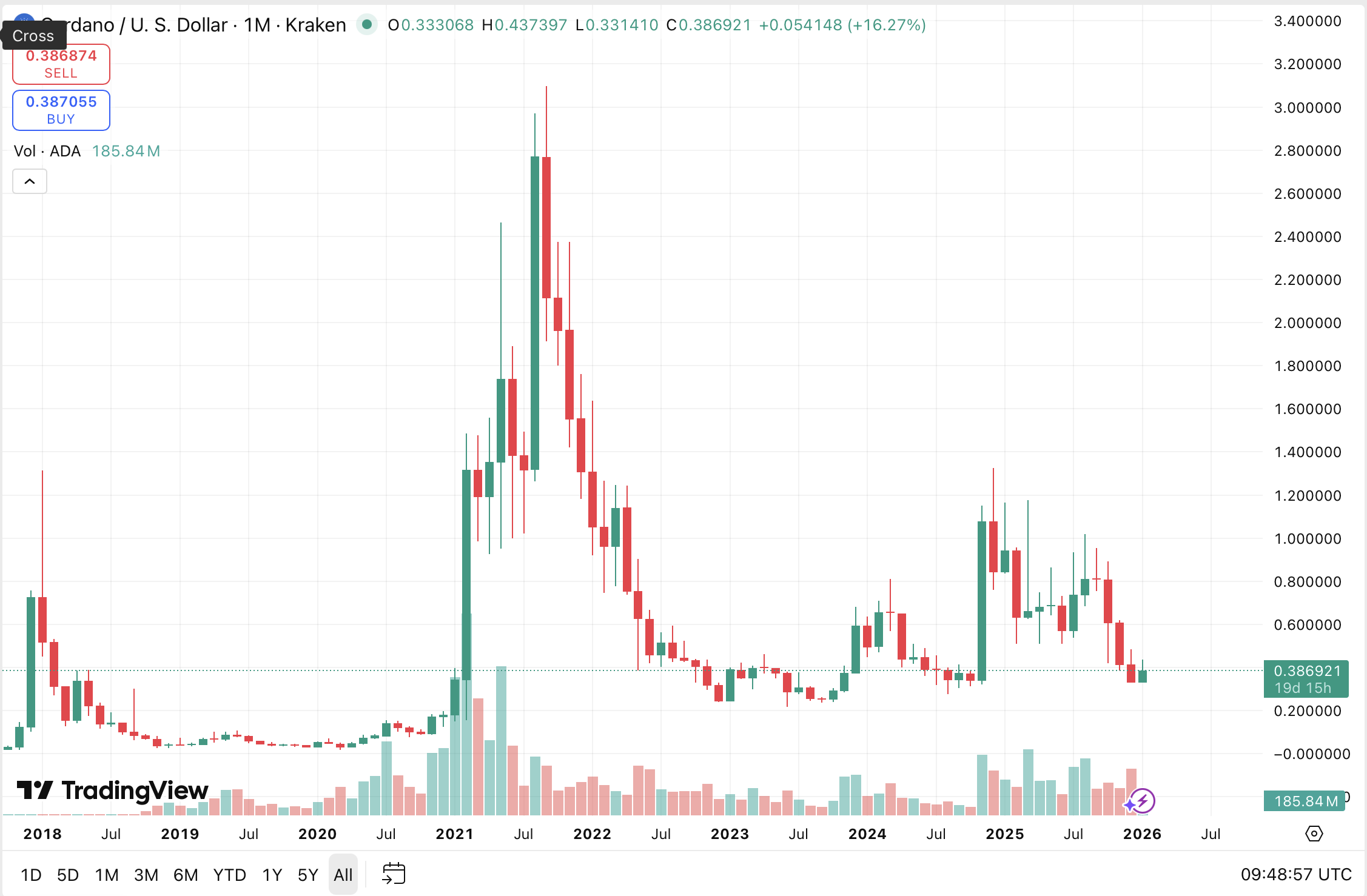
Cardano’s Initial Coin Offering (ICO) ran from September 2015 to January 2017, raising approximately $62 million across four funding stages. The mainnet officially launched on September 27, 2017, with an initial market cap of approximately $600 million. ADA exploded in value in the coming years to reach a market cap in the billions, but like other crypto tokens Cardano is highly volatile and has undergone severe price fluctuations since its launch.
Similar to Ethereum, Cardano’s aim is to run smart contracts which can be developed using the programming language, Javascript. ADA itself is written in Haskell.
Cardano has no official owner. It is a decentralized currency meaning every ADA holder has a stake in the Cardano network. It does not have a white paper, unlike most other altcoins, but instead is the first crypto to be peer-reviewed. It is steered by the Cardano Foundation, an independent Swiss not-for-profit organization that oversees the advancement of the protocol.
The Cardano Foundation set out its mission statement, with the core aim to increase adoption of the network. Cardano is a limited supply coin with a max of 45 billion ADA.
How Cardano Works
Cardano works by using a two-layer system. The first layer is called the Cardano Settlement Layer (CSL) which processes transactions in the ADA cryptocurrency. The second layer is known as the Control Layer, which is used to process the smart contracts.
Underpinning all of this is the Ouroboros algorithm, developed by Input Output Global (IOG) based on peer-reviewed academic research. It is Ouroboros that uses the proof-of-stake protocol to mine coins. This means that rather than everyone mining new blocks all the time, the network elects a few nodes to mine the next block. For this reason, ADA is known as a 3rd generation cryptocurrency.
How To Start Trading Cardano
To start trading Cardano, you’ll need to select a trading broker that offers crypto. Popular platforms listing ADA include eToro and Coinbase. There are a number of brokers that offer CFDs on cryptos which have benefits over owning the underlying asset, such as negating the requirement for an e-wallet to store your funds and are therefore the preferred choice for some traders. It’s worth shopping around for the best fees and features. Check our list for the most reliable Cardano brokers.
Regulated brokers are subject to Know Your Customer (KYC) identity checks. So you’ll often need to provide a form of ID and a photograph before you can trade any substantial amount. Once you’ve been verified, you can purchase Cardano through most payment methods, including wire transfer and credit/debit card.
Broker functionality is also vital. If you’re looking to start day trading Cardano, you’ll need a charting platform that suits your trading style and timeframes, as well as useful research tools and other features you want to use, such as copy or auto trading.
We’ve found TradingView to be a superb platform for day-trading Cardano (ADA), because it integrates research tools, strategy testing and social trading features on an attractive and easy-to-use platform. However many brokers for trading ADA use the time-tested MetaTrader 4 and MetaTrader 5 platforms, and these are still options I rate highly.
Jemma GristAuthorCardano & Regulators
Like other crypto tokens, Cardano has historically existed in something of a grey area for regulators, with the entire crypto sector largely unregulated during its early years.
This has led to some restrictions and some lack of clarity for trading ADA. In the UK, for example, contracts for difference (CFDs) are not available for ADA and other crypto tokens since a 2020 ban by the Financial Conduct Authority (FCA). Meanwhile, crypto exchanges have tended to exist in a regulatory grey area without strong regulatory oversight, though traders will find well regulated crypto brokers on the market.
The legal status of Cardano started to clear up as global regulators caught up with the burgeoning investment in crypto. The US Congress’ 2025 CLARITY act, for example, provided a clearer definition of ADA and other cryptocurrencies as “digital commodities“; in the same year, laws in Pakistan and Vietnam began to lay out regulatory frameworks for trading cryptocurrencies including Cardano.
Pros Of Trading Cardano
- Development – ADA is undergoing constant development to resolve issues that restrict ETH and BTC. The ‘Goguen’ roadmap details vast plans for improvement with the aim of adding the ability to build decentralized applications (DAPPS). This has included the addition of a multi-currency ledger, Native Tokens and NFT marketplace functionality. A 2018 memorandum of understanding with the government in Ethiopia explored the possibility of deploying ADA for use in the coffee and agritech sectors, illustrating the potential use cases of this crypto token.
- Scaleable – Because Cardano uses a POS chain, it is much more scalable than other coins. With Bitcoin, all holders are mining the crypto all the time, making it incredibly resource intensive. The ADA network is different because it nominates a holder to mine during an epoch slot (a period of time). If the holder does not show up or mine, someone else will be reelected instead. ADA owners can increase the likelihood of being nominated to mine by adding their share to a stake pool. In this way, ADA is more environmentally friendly and scalable than competitors.
- The internet of blockchains – Currently, cryptocurrency is limited because while there are numerous coins available, they require an intermediate broker to allow you to exchange them. ADA has released a multi-currency ledger as part of the Goguen update which will allow you to store multiple currencies on one blockchain. This means that exchanging Litecoin (LTC) for Polkadot (DOT) will soon be possible on the Cardano network, making the crypto market as decentralised as possible.
- Governance – Cardano’s fresh take on project governance puts the power in the hands of ADA holders. Individuals with a stake in ADA can vote on the future of the platform. Ideas go through funding rounds as part of Project Catalyst. ADA holders can vote on ideas such as the ability to earn staking rewards from your ADA holdings while also generating yield from DeFi protocols or new blockchain explorers. In this way, Cardano curates an ecosystem where the robustness of the network is put front and centre.
Cons Of Trading Cardano
- Capability – Despite ambitious development plans, Cardano has yet to release many capabilities. Ethereum already has smart contracts, the main focus of ADA’s development. There’s a lot of hype about Cardano being better than the rest, but much of this progress has yet to materialise.
- Traction – Some investors would say that the low price means room to grow. But Cardano has consistently underperformed compared to the top cryptocurrencies by market cap, and newer tokens like Solana (SOL) have amassed huge numbers of users while ADA has remained a relatively small-time player.
Security
Cardano is provably secure, meaning that it has been mathematically proven. This security is guaranteed as long as 51% of the stake is held by honest participants, which are achieved through random leadership selection. However, its reliance on this fact means that it is technically not immune to 51% attacks, like the one that left Ethereum Classic vulnerable in early 2019.
If this happened, the blockchain would have to be forked, which risks losing ledger information. Despite this, an attack of this scale is unlikely. Currently, a 51% stake in ADA would require over $20bn in capital, making it an expensive game for hackers to undertake.
Final Word On Trading Cardano
In conclusion, Cardano is a cryptocurrency with serious ambition. Its aim to resolve the faults that plague Bitcoin and Ethereum make it an attractive proposition for investors. With NFTs, Native Tokens and the so-called ‘internet of crypto’ all in the development pipeline, there’s a lot to be excited about. But it still has some way to go to match the adoption of the top tokens like BTC. Plus, the development of functionality has been slow. So, is Cardano a good investment for traders? That remains to be seen.
FAQ
Is Cardano Better Than Bitcoin?
Cardano developers have worked to overcome many of Bitcoin’s biggest faults. In particular, its proof-of-stake blockchain means reduced environmental impact vs BTC. The altcoin’s ambitions are vast, with smart contracts, native tokens and multi-currency ledgers in the pipeline. But, its market cap is much lower than Bitcoin, suggesting that adoption is not yet sufficiently strong to push it into the top tier.
What Is A Cardano Staking Pool?
A staking pool is a collection of Cardano holders that join together with the aim of being selected to stake the network. Staking is the process of validating transactions on the ADA blockchain. Those that do so can earn a return on their investment and so staking pools help coin holders maximise their returns.
Why Is The Cardano Ticker Symbol ADA?
Cardano’s founders named the ticker symbol after the mathematician Ada Lovelace. Lovelace is widely regarded as the first person to publish an algorithm that intended to be carried out by a machine.
Who Is The Founder Of Cardano?
Cardano was founded by Charles Hoskinson. Hoskinson was one of the co-founders of Ethereum but left following a disagreement about venture capital.
Is Cardano Decentralized?
Yes, Cardano is the world’s most decentralized cryptocurrency with over 21.75 billion ADA staked on the network which represents 69 per cent of its total circulating supply.