




Quick Verdict
CRITICAL ALERT: Gift of Legacy, despite its aggressive claims to the contrary, is a classic peer-to-peer financial pyramid scheme operating globally and preying on the financial vulnerabilities of savers through multiple shifting domains. The platform has been officially blacklisted by the Central Bank of Russia for exhibiting clear Ponzi metrics and flagged by South Africa’s FSCA. It uses sophisticated “gifting matrix” vocabulary to obscure a highly predatory, unsustainable recruitment loop that offers zero retail products or legal consumer protections.
Gift of Legacy operators are openly transparent about how the underlying system functions, explicitly stating that participants earn money solely by recruiting new “gifters” who send cash up the chain. While this structural openness might make it visually difficult for some to categorize it as a traditional hidden scam, what they are describing is a textbook pyramid scheme. It creates absolutely zero underlying commercial value and targets individuals looking for alternative ways to earn money. This inherently predatory nature is why our panel has issued an absolute scam warning against it.
Example of active promotional video:
I strongly advise against participating in or sending funds to Gift of Legacy. The model relies entirely on continuous recruitment to avoid immediate collapse, and independent third-party validation proves that the vast majority of participants in these geometric multiplier structures lose their principal capital. It builds no market value and requires participants to recruit fresh layers of participants to earn any semblance of a return.
 William BergHead Legal Analyst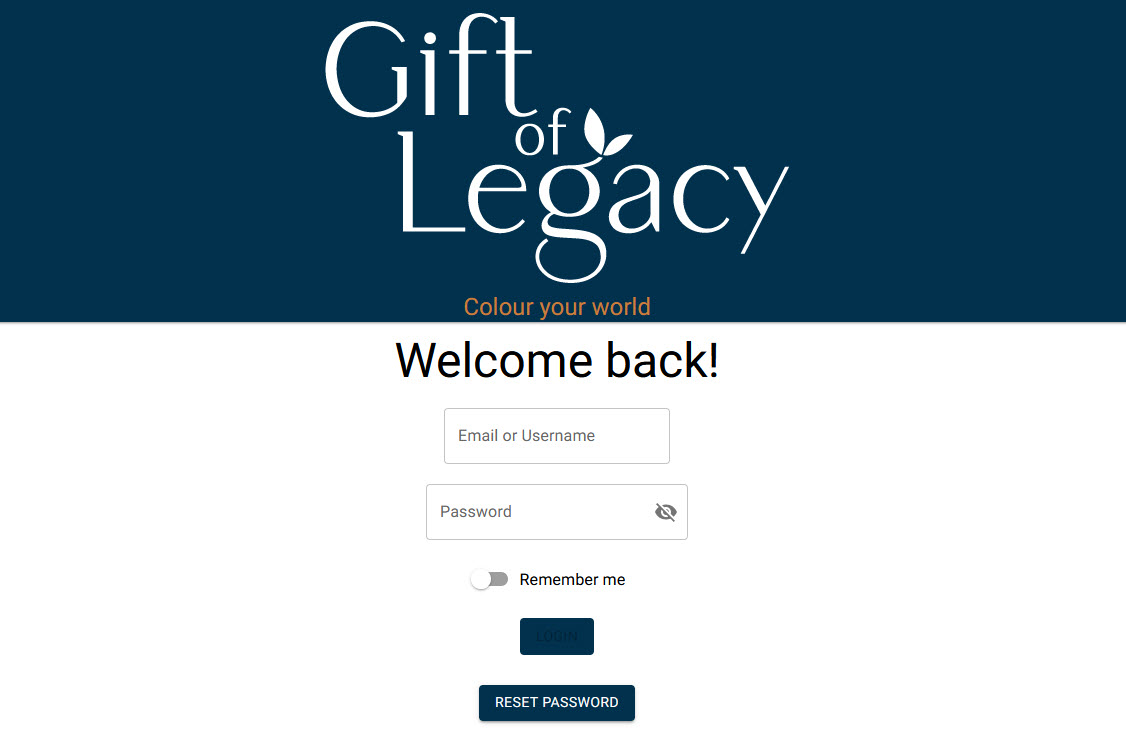
| Safety Metric | Status | Action Required |
|---|---|---|
| Regulatory Status | 🚨 Official Regulator Blacklist / Financial Pyramid Sign | Avoid engaging, recruiting, or depositing capital. |
| Model Integrity | ⚠️ Peer-to-Peer Multiplier Board Architecture | Do not purchase positions or follow recruiting instructions. |
| Overall Risk Score | Critical Risk Factor | Discontinue all promotion across social networks immediately. |
Regulation & Licensing
In this section, we evaluate the underlying legal framework, corporate disclosure model, and authorization status of Gift of Legacy.
South Africa FSCA Press Notice & Fake Verification Claims
The Financial Sector Conduct Authority (FSCA) completed an exhaustive investigation into the operations of Gift of Legacy. They explicitly concluded that the network was conducting an unregistered financial services business. Because the platform’s core mechanics do not provide legitimate financial services as defined under the FAIS Act, the FSCA noted it would refer the matter to other South African regulators and law enforcement arms for sweeping statutory action. The regulatory body documented heavy recruitment rings driving the structure locally and issued an official formal consumer warning.
The formal statement alerts savers that while the matrix frames itself innocently as a personal exchange of gifts among friends, it entirely lacks an approved statutory environment under the Financial Advisory and Intermediary Services (FAIS) Act and directly bypasses legal consumer protection frameworks. Shockingly, our team discovered promotional text loops hosted on prominent e-commerce listings claiming that Gift of Legacy “is the only legitimate gifting platform that is verified by the FSCA in South Africa… confirming it is not a Ponzi or get-rich-quick scheme.” This claim is completely fraudulent and stands in direct opposition to the FSCA’s official regulatory decrees.
Bank of Russia Official Blacklist Registry
The Central Bank of the Russian Federation has maintained a direct public enforcement profile for Gift of Legacy on its list of entities with detected signs of illegal financial market activity since early 2022. The database records explicit tracking parameters including the regional brand label designation (Дары Наследия) and categorizes their interconnected web domains as displaying defined structural characteristics of an illegal financial pyramid.
The Philippine Securities and Exchange Commission (SEC)
The Securities and Exchange Commission (SEC) of the Philippines has regularly targeted peer-to-peer crypto-fueled multiplier models, warning consumers via its official enforcement indices that decentralized matrix structures constitute an illegal distribution of unregistered investment contracts. The SEC’s enforcement arm notes that even if the operators claim they do not directly hold or touch user money because transactions flow peer-to-peer over messaging apps like WhatsApp or Telegram via stablecoins, the geometric progression of the boards constitutes an illegal, unlicensed financial scheme. Promoters, builders, and regional administrators pushing the matrix face severe criminal liabilities and statutory fines.
The Financial Services Regulatory Authority (FSRA) & Regional Watchdogs
Multiple regional cross-border task forces across Latin America and Europe have tracked the platform’s migration patterns across different domain extensions, including .global, .top, and .space. Because the scheme intentionally sweeps through developing economic sectors to target retail savers searching for online income streams, national regulators have continuously flagged the architecture under broad anti-pyramid and anti-money laundering (AML) protocols.
Capital Markets Authority (CMA) And Central Bank of Kenya
While the Capital Markets Authority (CMA) of Kenya does not typically release standalone warning profiles for single peer-to-peer networks, they act in unison with the Central Bank of Kenya (CBK) to issue aggressive umbrella directives. The watchdogs published a sweeping joint public alert warning citizens against participating in unlicensed, decentralized multi-level pooling and online crowdfunding matrices. This directive strips away the “mutual gifting” excuse, confirming that any online pool soliciting capital under the promise of tiered multipliers operating without explicit authorization represents a clear financial offense.
Online Reputation & Digital Footprint
We investigate the online footprint and digital presence of Gift of Legacy across the broader web ecosystem.
Domain Age & Corporate Invisibility
Gift of Legacy operates through an amorphous web of secondary domains of varying development quality. This structure is entirely standard for a pyramid scheme primarily promoted by independent network participants. Promoters also regularly exploit high-authority third-party web domains to publish user-generated “parasite pages” to artificially manipulate organic search metrics. A prime example of this tactic is the fraudulent Amazon listing discovered by our team, which falsely asserts that Gift of Legacy holds valid FSCA regulation.
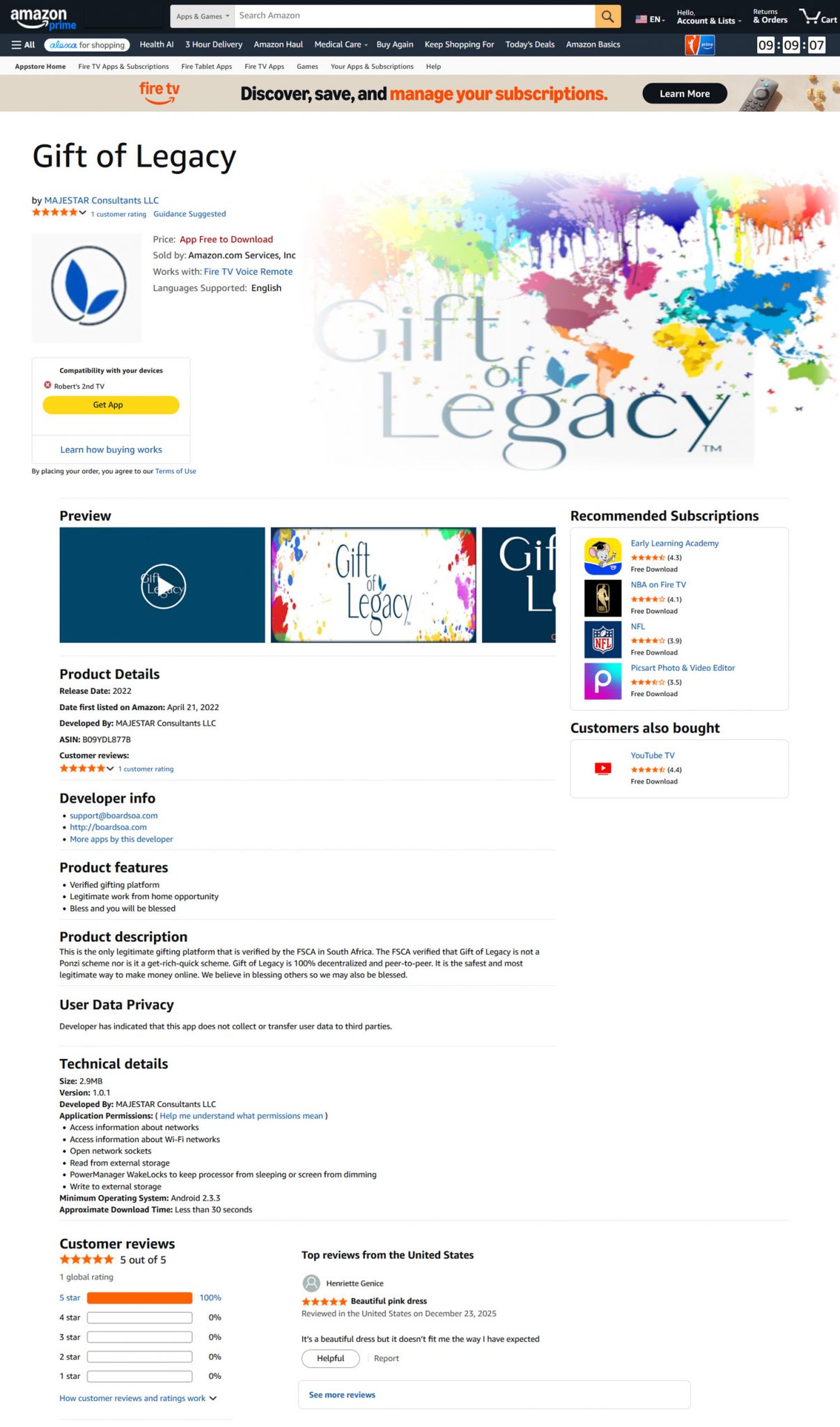
The exact target websites, promotional chat loops, and recruitment methods vary significantly between regional jurisdictions, morphing to align with the local culture and social habits of the active members.
Public Sentiment Dynamics
A broad search reveals an unnaturally high volume of positive public sentiment and coordinated social reviews for Gift of Legacy. This footprint is an artificial byproduct of the scheme’s design; active members are highly incentivized to aggressively promote the matrix to drive the fresh recruitment required to trigger their next board payout. Promoters who stand to profit carry a far higher motivation to publish content than the victims who have lost their entry fees.
Despite this heavily manipulated search landscape, independent financial forums and public consumer complaint boards feature an extensive history of negative user logs and warning reports confirming the underlying mathematical collapse of stalled boards.
The Gifting Matrix Modus Operandi Explained
Gift of Legacy masks its classic pyramid architecture by utilizing psychological re-framing tools. Instead of calling positions “investment tiers,” they use terms like “boards,” and label participants as Givers, Builders, Perpetuals, or Legends. The premise relies on a fixed entry fee that is gifted directly to the person at the center of the board (the Legend).
The Math Problem: For the person at the center to receive their multiplier payout, fresh recruitment must occur at the outer edges of the board. Because this model grows exponentially, it requires a constant influx of human capital. Once localized recruitment slows down or domain blocks occur, the boards stall, leaving the vast majority of users unable to move toward the center, resulting in a total loss of their initial contribution.
Professional Opinion
Gift of Legacy represents a textbook pyramid scheme regardless of their self-crafted designation as a decentralized “gift matrix.” The model purposefully weaponizes sophisticated social engineering to target retail savers who may not fully comprehend why geometric recruitment models are mathematically flawed and incapable of generating authentic wealth. We strongly advise all readers to avoid engaging with this network.
Even if an early participant successfully extracts capital from the board, that return is funded entirely by victimizing secondary layers of participants recruited into the trap. The longer the matrix continues to cycle, the larger the final volume of financially ruined participants becomes. We advise our community to completely reject invitations to join and to do their part in stopping the spread of this operation.
Next Steps if You Have Already Joined
If you have already contributed funds to the matrix, it is crucial to recognize that due to the non-custodial, peer-to-peer nature of the transfers, there are no structural bank frameworks or administrative dispute paths to reclaim your money. Your priority must shift entirely to risk mitigation and consumer defense:
- Cease All Internal Promotion: Refrain entirely from attempting to recruit friends, family, or social media followers into the network. While downstream recruitment is often pushed by operators as the only method to get your entry fee back, doing so simply passes your financial loss onto a new victim within your social circle.
- Document and Share Your Experience: Preserve screenshots of the board structures, coordinator communication handles, and blockchain transaction receipts (TxIDs). Share objective factual details on community warning hubs to counter the aggressive promotional loops run by active builders.
- Escalate to Financial Watchdogs: File an administrative report detailing the operational links, active local domains, and cryptocurrency destination wallets with your local national financial intelligence unit or national cybercrime branch to aid international blacklisting efforts.