
Payment For Order Flow vs. Internalization vs. B-Booking



- Introduction
- Payment For Order Flow (PFOF): Routing Economics And Conflicts Of Interest
- Legal Frameworks
- A Deeper Look At PFOF In The United States
- A Deeper Look At PFOF In The United Kingdom
- A Deeper Look At PFOF In The EU
- Internalization: The Actual Matching and Risk Engine
- B-Booking: Principal Risk, Client P&L And Hybrid Routing
Introduction
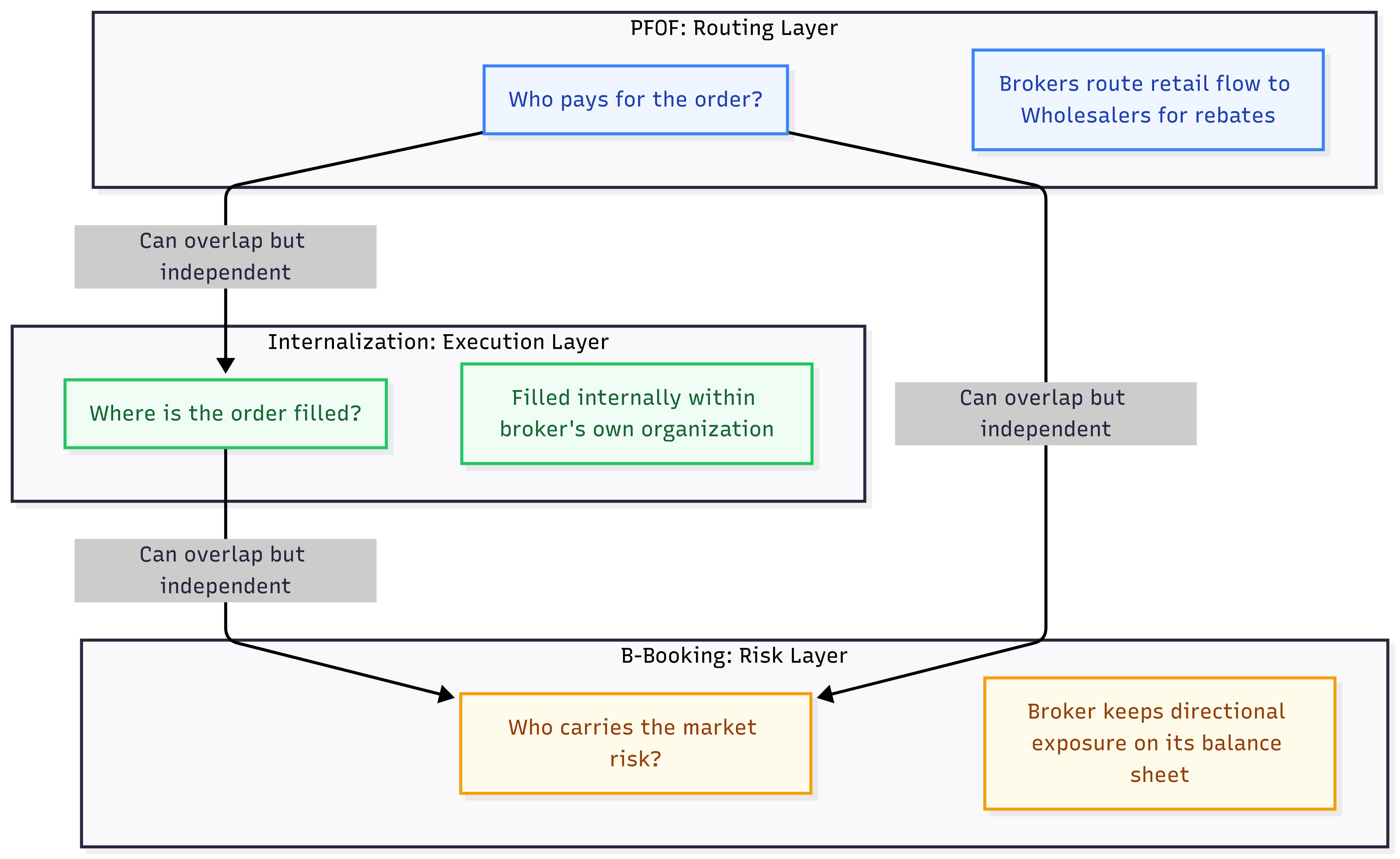
Payment for order flow (PFOF), internalization, and B-booking can overlap in practice, but they describe different aspects of the trading process. PFOF concerns order routing, internalization concerns trade execution, and B-booking concerns who bears the market risk after the trade is executed.
- PFOF is defined by order routing. The key question is: Who is paid to receive the order?
- Internalization is defined by execution. The key question is: Where and how is the order executed?
- B-booking is defined by risk allocation. The key question is:Who bears the market risk after the trade is booked?
The three concepts can be combined in different ways. For example, a broker can receive PFOF while never acting as principal. A market maker can internalize an order while promptly hedging the resulting position, meaning it does not retain the market risk in the manner associated with B-booking. Conversely, an FX/CFD broker can B-book a client’s trade even though there is no exchange routing or PFOF involved. The three concepts are independent. PFOF concerns routing, internalization concerns execution, and B-booking concerns risk retention. A firm may use any one of them, any combination of them, or none at all, depending on its business model.
Payment For Order Flow (PFOF)
Payment for order flow (PFOF) is a routing arrangement, not an execution method. A broker receives compensation (cash, rebates, or other economic benefits) for directing customer orders to a particular market maker, wholesaler, or trading venue.
The broker’s role is to route the order. The receiving firm decides how to execute it. The broker does not become the trader’s counterparty merely because it receives PFOF, although a broker that accepts PFOF could also operate other business lines where it internalizes or principal-trades orders.
The important point is that PFOF itself does not imply principal trading. A firm can both receive PFOF and internalize orders, but those are separate activities.
Internalization
Internalization is an execution method. Instead of immediately sending a client order to an external exchange or liquidity provider, the executing firm fills the order within its own organization. This may involve matching one client against another, executing against the firm’s own inventory, or acting as principal and hedging any remaining exposure externally.
Internalization describes where and how the order is executed, not who ultimately bears the market risk.
B-Booking
B-booking is a risk management model. The broker acts as the trader’s counterparty and retains some or all of the resulting market exposure rather than immediately offsetting it in the external market.
If the trader’s position loses value, the broker benefits from that exposure. If the trader profits, the broker bears the loss, subject to any hedging it performs. B-booking is therefore defined by who carries the market risk after execution, not by the mechanics of execution itself.
Payment For Order Flow (PFOF): Routing Economics And Conflicts Of Interest
Example of how PFOF can work:
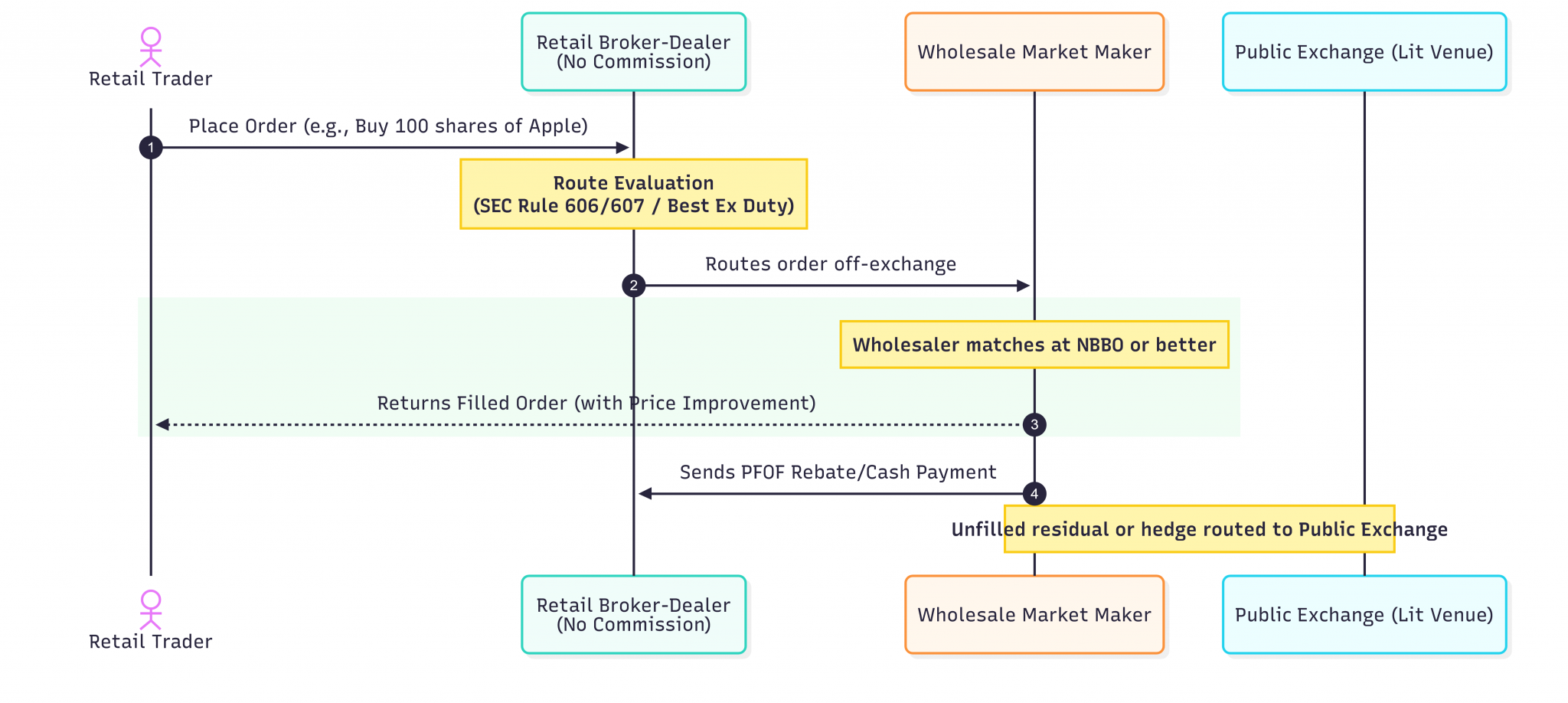
The broker receives a marketable order from a trader. Instead of sending that order to a public exchange, the broker routes it to a wholesale market maker. The wholesaler pays the broker for that flow, then executes the order as principal, often at or slightly inside the national best bid or offer. The broker can advertise low or zero commissions because part of the revenue comes from the wholesaler rather than from a visible client commission.
PFOF is a revenue model for the broker and an order acquisition model for the wholesaler or market maker. Retail order flow is valuable because, on average, it is less informed and therefore less susceptible to adverse selection than institutional order flow. A market maker generally prefers to trade against a retail investor buying 12 shares on a hunch than against a hedge fund executing a large order based on proprietary research or other information.
In equities, the wholesaler’s profit typically comes from spread capture, inventory management, price improvement calibration, and adverse selection control. The wholesaler may fill the order internally, cross it with offsetting flow, warehouse it briefly, or hedge residual exposure. PFOF is the cost of acquiring that flow.
PFOF should not be described as “the broker is trading against you”. Receiving PFOF does not, by itself, make the broker the client’s execution counterparty. Where PFOF is permitted, the counterparty is often the wholesaler or market maker that receives the order. The potential conflict of interest in PFOF arises because the broker is paid to route orders to particular execution venues, creating an incentive that may conflict with its obligation to seek the best available execution for the client.
PFOF creates a routing conflict, not necessarily a principal-trading conflict. Of course, if a broker both accepts PFOF and internalizes or principal-trades some orders, then it can have both a routing conflict-of-interest and a principal-trading conflict-of-interest.
Legal Frameworks
Payment for order flow (PFOF) is regulated differently across jurisdictions. Some jurisdictions permit PFOF (usually subject to disclosure and best execution requirements), while others prohibit or substantially restrict the practice. In some markets, PFOF is not a meaningful feature at all due to market structure, execution conventions, and the absence of a developed wholesale payment-for-order-flow ecosystem.
Examples of how PFOF is treated in different countries:
- United States: PFOF is widely used in the retail equities and options markets. Many retail brokers route customer orders to wholesale market makers, which compensate the broker for that order flow.
- Canada: PFOF is not a common feature of the Canadian equities market. There is no explicit statutory ban, but securities regulation (particularly best execution and conflict-of-interest requirements) combined with market structure, means U.S.-style payment-for-order-flow arrangements are not typically used in practice. Retail orders are generally routed to exchanges or executed through dealer markets rather than sold to wholesalers for payment.
- European Union: PFOF is banned by the MiFIR Article 39a Prohibition of receiving payment for order flow.
- United Kingdom: PFOF is not expressly prohibited by legislation, but the Financial Conduct Authority (FCA) generally considers payments for directing client orders to be incompatible with a firm’s best execution obligations.
- Kenya: PFOF is not a recognized feature of the Kenyan securities market. Trading on the Nairobi Securities Exchange is exchange-based, and there is no established practice of brokers receiving payments for routing retail order flow.
- Australia:PFOF is not expressly prohibited by legislation. However, ASIC’s market integrity rules effectively prevent PFOF arrangements in the equities market by prohibiting payments or benefits that could influence order routing, making PFOF models impractical. ASIC Market Integrity Rules (Securities Markets) 2017 / 2021 Amendments (Rule 5.4B), which explicitly prohibit market participants from offering or receiving payment for order flow in equity securities.
- Japan: PFOF is not a significant feature of the Japanese equities market. Although there is no explicit ban on PFOF, brokers generally execute orders under best execution obligations, and a U.S.-style wholesale market maker model has not emerged.
- India: PFOF is not a feature of the Indian equities market. There is no wholesale market structure that pays brokers for retail order flow.
Today, PFOF is primarily associated with retail equity and equity options markets in the United States, where it remains a significant part of the retail execution model. Outside the U.S., PFOF is generally either prohibited, heavily restricted, or not supported by market structure.
Historically, PFOF did exist in parts of Europe before EU restrictions were tightened in the 2020s. It was most notably seen in Germany, where retail brokers at times received inducements for routing orders to specific execution venues or intermediaries, and in the Netherlands, where similar payment or rebate structures were used in certain retail brokerage models. Smaller-scale or indirect forms of order-routing incentives also appeared in other European markets during earlier phases of electronic trading development.
A Deeper Look At PFOF In The United States
As discussed above, Payment for order flow (PFOF) is a significant feature of U.S. retail equity and listed equity options market structure, and broker-dealers commonly route U.S. retail orders to wholesale market makers that compensate them for that order flow. It is not generally a feature of institutional trading, but it plays an important role in how retail orders are internalized and priced in fragmented U.S. equity markets operating under Regulation NMS.
Unlike many other jurisdictions, the U.S. accepts that retail order flow has value and allows that value to be monetized. Instead of banning PFOF, the U.S. regulatory model aims to control the conflict through rules about best execution, trade-through protection, and disclosure.
The U.S. Securities and Exchange Commission (SEC) does not pretend that PFOF is conflict-free, but it treats the conflict as manageable if the broker can demonstrate execution quality. That is why the US debate typically focuses on price improvement, effective spread, NBBO midpoint comparison, Rule 605 execution quality data, Rule 606 routing data, and whether retail investors really receive enough price improvement to justify the routing economics.
Equities
For equities, the U.S. market is fragmented across exchanges, Alternative Trading Systems (ATS), OTC market makers, and wholesale market makers. Retail brokers can route marketable orders to wholesalers that execute as principals. The wholesaler may pay PFOF to the broker, provide price improvement over the National Best Bid and Offer (NBBO), and report the trade through the required channels. The client sees a fill for a listed equity, but the public exchange may never interact with that order.
Best Execution
While PFOF is legal in the U.S., rules are in place to ensure that the customer still receives best execution.FINRA’s best execution guidance says the obligation applies to firms receiving customer orders, including wholesalers that receive orders from other firms, and a broker cannot simply outsource that duty by routing all flow to another firm without reviewing execution quality.
Disclosure
The U.S. Securities and Exchange Commission (SEC) requires broker-dealers to provide transparency around order handling, execution practices, and payment arrangements through a set of disclosure rules under the Securities Exchange Act of 1934. These rules are designed to ensure that customers can understand how their orders are routed, who may be involved in executing them, and whether any financial incentives could influence that process.
This disclosure framework operates across multiple levels of the client relationship and trade lifecycle. At the time of account opening and on an ongoing basis, broker-dealers must disclose their policies regarding payment for order flow. At the time of trade execution, they must provide confirmation information that includes whether any such payment was received. In addition, firms must publish periodic reports describing their order routing practices and any material relationships with execution venues that may influence routing decisions.
Together, these requirements are implemented through Rule 607 (SEC Exchange Act Rule 607), Rule 10b-10 (SEC Exchange Act Rule 10b-10), and Rule 606 (17 CFR § 242.606), which collectively establish a structured transparency regime around retail order handling in U.S. markets.
FINRA issues interpretive guidance and regulatory notices to its member broker-dealers regarding compliance with these SEC requirements. A notable example with relevance for PFOF is their Regulatory Notice 21-23, where FINRA highlights how Rule 10b-10 requires confirmation disclosure when PFOF has been received, Rule 606 requires quarterly public reports identifying routing venues and discussing material PFOF arrangements, and Rule 607 requires disclosure of payment for order flow policies when accounts are opened and annually after that.
Listed Equity Options
From a regulatory perspective, both equities and listed equity options fall within the scope of Regulation National Market System Rule 606 reporting requirements in the United States, meaning that routing relationships and payment arrangements must be disclosed. However, the economic drivers of PFOF are structurally stronger in options because the market is more fragmented at the contract level and more dependent on professional liquidity providers for continuous pricing.
Listed equity options in the United States operate within a similar economic framework to equities in terms of payment for order flow, but the execution infrastructure differs because options are centrally listed and traded on regulated options exchanges. Retail options orders are typically routed through broker-dealers to wholesale market makers or routing firms.
From a regulatory perspective, listed options are included within the scope of Regulation National Market System Rule 606 (17 CFR § 242.606) reporting requirements. Broker-dealers must therefore include options order routing data in their quarterly disclosures, including information on execution venues and material economic relationships with routing counterparties. These disclosures encompass payment for order flow arrangements as well as other economic incentives that may influence routing decisions, such as rebates, internalization arrangements, or profit-sharing agreements with wholesale market makers.
The disclosure framework for options is aligned with equities in structure but reflects the specific mechanics of options markets, where routing decisions are often concentrated among a smaller number of specialized liquidity providers. Execution quality is therefore assessed not only through price improvement relative to reference prices, but also through contract-level reporting metrics that allow comparison of execution outcomes across routing destinations.
As in equities, these requirements are complemented by best execution obligations under FINRA rules, which require broker-dealers to regularly evaluate the quality of executions received from wholesalers and options market makers. This includes assessing price improvement, fill quality, and routing outcomes across venues to ensure that order handling practices remain consistent with a duty of best execution.
Why Is PFOF More Concentrated In Listed Options Than Equities?
PFOF is economically more concentrated in U.S.-listed equity options than in listed equities because the underlying market structure of options creates stronger incentives for internalization, and wholesale intermediation.
Listed equity options in the United States trade across multiple competing exchanges. While listed options do maintain an NBBO (governed by the Options Order Protection and Locked/Crossed Market Plan), displayed size at any single NBBO tier is often thin because liquidity is fragmented across thousands of individual option series (strikes and expirations). This dispersion of liquidity across the options chain increases the value of retail order flow to wholesale market makers, who can aggregate, internalize, and hedge positions across the broader options complex.
As a result, wholesale market makers and routing firms are often able to monetize retail options order flow through a combination of spread capture, volatility risk management, and hedging across correlated instruments. This creates strong economic incentives to pay for retail options flow, particularly because retail options orders tend to be smaller, more standardized, and statistically more predictable than institutional flow.
In addition, execution mechanics reinforce this structure. Retail options orders are typically routed through intermediaries that aggregate flow before sending it to options exchanges. These intermediaries compete for order flow not only on execution quality, but also on the ability to internalize and manage risk efficiently across the full options surface. This competition supports a more persistent and concentrated PFOF structure than in equities, where deeper displayed liquidity and tighter consolidated pricing reduce the marginal value of internalizing each individual order.
A Deeper Look At PFOF In The United Kingdom
In the United Kingdom, the Financial Conduct Authority´s (FCA´s) May 2012 Guidance on the practice of ‘Payment for Order Flow says that PFOF is unlikely to be compatible with the FCA inducements rule and risks compromising compliance with best execution rules.
The FCA is concerned that PFOF can influence where a broker sends an order for execution.
The FCA guidance also says that it is difficult to see how a firm could justify PFOF as directly benefiting the client, and warns that the client may end up paying the costs indirectly.
In their July 2014 thematic review on best execution and payment for order flow, the FCA remained highly skeptical of PFOF, stating that PFOF can damage the transparency of the price formation process, thus undermining best execution and limiting effective competition in the interests of consumers.
Despite not having an explicit statutory prohibition against PFOF, the UK is often described as a country where PFOF is effectively banned, since the FCA has taken such a restrictive regulatory position, viewing PFOF as generally incompatible with broker obligations relating to best execution, conflicts of interest, and inducements under the UK regulatory framework. In practice, this means that arrangements where a broker receives payment from a third-party execution venue in return for routing client orders are generally not considered consistent with the requirement to act in the client’s best interest. As a result, PFOF structures are not a feature of the UK retail trading market.
A Deeper Look At PFOF In The EU
Within the EU/EEA, PFOF is banned under MiFIR Article 39a. Investment firms acting for retail clients or professional clients must not receive any fee, commission, or non-monetary benefit from a third party for executing client orders on a particular venue or forwarding client orders to a third party for execution on a particular venue.
MiFIR is a Regulation, not a Directive, so it became directly applicable law across the EU when it came into force on 28 March 2024. With that said, Member States that had existing PFOF practices before that date were allowed to apply a transitional exemption until 30 June 2026 for certain domestic client flows. Since 1 July 2026, full prohibition applies across the EU without exceptions.
Before the introduction of MiFIR Article 39a, there was no explicit EU-wide prohibition on PFOF as a distinct practice. Instead, the regulatory framework under MiFID II operated on a principles-based structure focused on inducements, conflicts of interest, and best execution. PFOF arrangements were treated as inducements and were permissible if they could be shown to enhance the quality of the service provided to the client, be properly disclosed, and not impair the firm’s duty to act in the client’s best interests. In addition, firms were required to take all sufficient steps to obtain the best possible result for clients when executing orders, which created a strong supervisory constraint even in the absence of a formal ban.
Because this framework relied on general principles rather than a categorical rule, the treatment of payment-for-order-flow-like arrangements was not uniform in practice across Member States. Some regulators interpreted the rules in a stricter way, effectively limiting such arrangements, while others focused more on disclosure and best execution analysis on a case-by-case basis.
MiFIR Article 39a ended that approach. Instead of relying on inducement analysis and best execution assessments to discipline the practice, it introduced an explicit prohibition on receiving payments or non-monetary benefits from third parties in connection with routing or executing client orders to a particular venue. This moved the regime from a principles-based constraint to a structural ban on PFOF.
Internalization: The Actual Matching and Risk Engine
Internalization is an execution method where the executing firm fills a customer order within its own organization instead of immediately routing it to an external venue such as an exchange or other liquidity provider. This may involve crossing one customer order against another, executing against the firm’s own inventory, or acting as principal on the trade and subsequently hedging any resulting exposure in the external market. Internalization describes where and how execution occurs, but it does not, by itself, determine who ultimately retains market risk, since the firm may either warehouse the risk or offset it immediately through hedging or external execution.
The routing and risk layer
Typically, the firm will run the order through an automated routing and risk layer immediately upon receipt, before any decision about execution venue or internalization is made. This system quickly evaluates factors such as instrument, side, size, order type, liquidity characteristics, client classification, account risk constraints, available internal inventory, and prevailing external reference prices.
The relevant reference price depends on the market structure of the instrument. In exchange-traded equities in the United States, the reference is the National Best Bid and Offer (NBBO), which aggregates the best displayed quotes across protected trading venues under Regulation NMS. In other jurisdictions, the reference is typically a consolidated best bid and offer derived from available lit trading venues. In single-venue markets and markets with a low degree of fragmentation, the primary exchange’s best bid and offer may serve as the reference. In spot foreign exchange and contracts for difference (CFDs), pricing is generally derived from one or more liquidity provider streams and/or internal pricing engines, with the final executable price incorporating the broker’s spread or markup. In institutional foreign exchange trading, pricing may be formed from multiple bank and non-bank liquidity provider streams, electronic communication networks (ECNs), and internal risk or pricing models maintained by the executing firm.
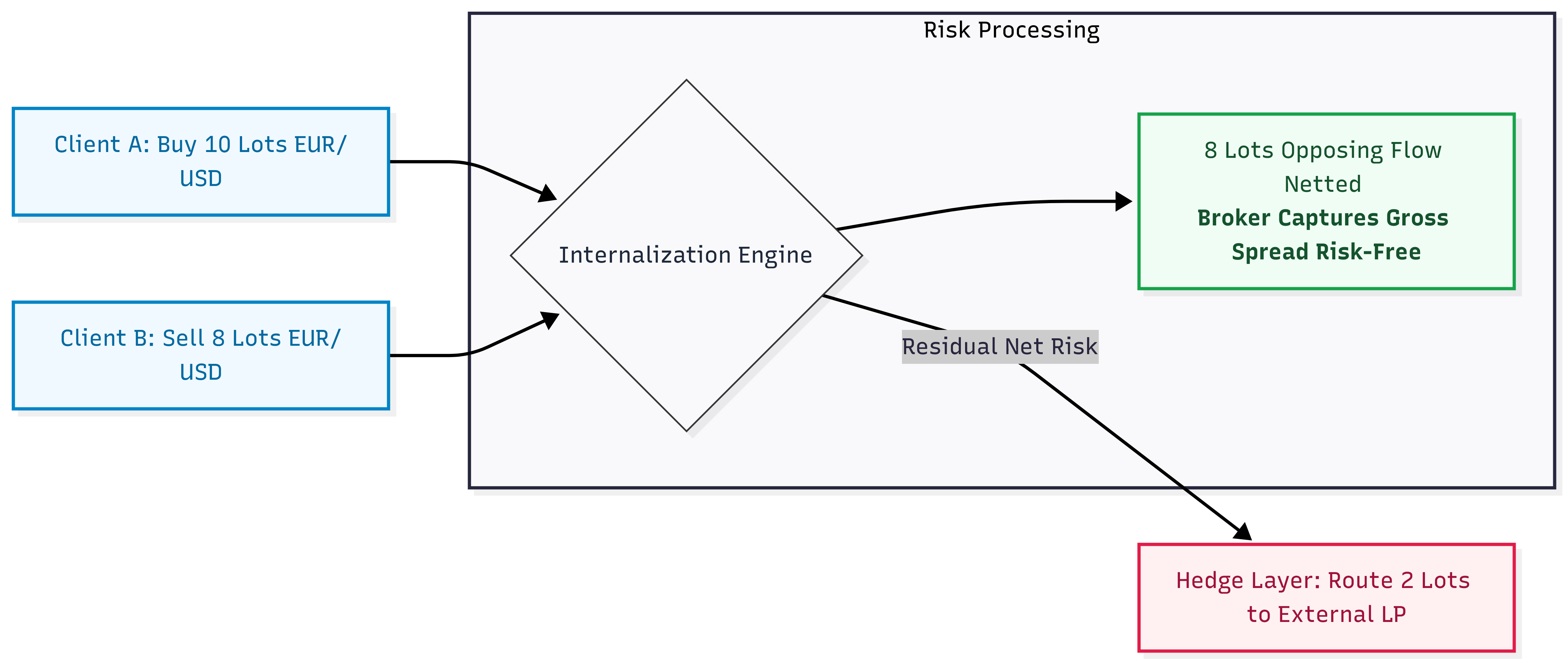
For the firm, a very important question is whether the order can be crossed or filled internally without increasing the firm’s net market exposure. Suppose Client A buys 10,000 units of EUR/USD and Client B sells 10,000 units at almost the same time. If the broker quotes Client A at the offer and Client B at the bid, the two trades offset each other. The broker has no net EUR/USD exposure after the match. It has captured the spread between the two client prices, minus platform, credit, capital and operational costs. This is the cleanest internalization outcome. The firm has acted like the house matching two opposing flows. If both clients receive prices consistent with the broker’s disclosed terms and best execution obligations, the broker’s profit comes from the spread and the avoided external execution cost. The broker does not need to pay an external liquidity provider’s spread on either leg. It has created a private crossing pool from its own flow.
But the matching engine does not need a perfect one for one match to internalize. It works on net risk. If clients collectively buy 100 lots and sell 73 lots in the same instrument, the broker can internalize 73 lots of opposing flow and have 27 lots of residual long or short exposure, depending on direction. That residual may be held, skewed, hedged, or sent to an external liquidity provider. This is where internalization becomes a risk process rather than a simple crossing process. The broker’s system keeps a real time inventory by symbol, tenor, asset class, currency, client group and sometimes toxicity score. It measures net delta, notional exposure, value at risk, margin usage, mark to market P&L and concentration. It may apply thresholds. Below a threshold, the dealer keeps the residual exposure. Above it, the system hedges.
A basic internalization workflow looks like this in practice, though each firm’s implementation differs.
- Client flow hits the broker.
- The order is checked against client limits and product rules.
- The engine checks whether opposing internal flow or firm inventory can fill it.
- If yes, the order is filled internally. The broker updates client positions and internal inventory. If the residual book exceeds risk limits, the hedge layer sends only the net balance to an external liquidity provider, exchange, ECN, ATS or prime broker.
The net balance is of imperative importance. A broker that internalizes does not need to hedge every client ticket one by one. It can aggregate hundreds or thousands of small tickets and hedge only the leftover exposure. This is one of the reasons why internalization can be highly profitable. The broker earns spread on gross client flow but pays external spread and market impact only on net exposure.
In marketing, internalization is commonly described as the dealer fulfilling client orders internally where possible, using opposing client flow to reduce external hedging needs and costs. Matching opposite client trades can remove the need to source liquidity externally and can support more competitive bid-offer prices.
Academic models describe the same process more formally. Dealers can warehouse inflows and wait for offsetting future client orders, or externalize inventory into the market and pay spread, impact and fees. A 2023 Mathematical Finance paper on unwinding stochastic order flow frames this as a central risk book problem: incoming flow can be warehoused and netted against later opposite flow, while externalization reduces risk but adds transaction costs.
Internalization is not the same as B-booking. If a broker matches two customer orders internally, it may have no (sustained) net directional exposure after execution. If it fills a customer order from firm inventory and subsequently hedges the residual risk in external markets, it is internalizing execution without necessarily retaining meaningful client P&L exposure. Only when the firm systematically retains and manages the resulting exposure as a profit-and-loss book instead of treating it as flow to be hedged or offset does the model move toward B-book economics.
Regulation
When we look at internalization and regulation, we need to do so in an asset-class context. In listed equity markets, internalization operates within a framework of consolidated price formation, best execution obligations, and, in many jurisdictions, trade-through or protected-quote rules that reference publicly displayed prices. Within this structure, it is possible to assess execution quality against observable market benchmarks such as the consolidated best bid.
In over-the-counter markets, e.g. spot foreign exchange, internalization generally occurs within a principal-dealer model. Pricing can be formed through liquidity provider streams and internal pricing models, with spreads, mark-ups, and execution policies determined by the dealer. As a result, the relevant regulatory focus shifts to disclosure of execution practices and management of conflicts of interest, including how pricing, slippage, and hedging are handled.
Listed Equities
In listed equities, internalization operates within a broader framework of best execution and trade-through protection rules that exist in many regulated equity markets. These rules generally require trading venues and broker-dealers to avoid executing trades at prices inferior to the best available displayed quotes in the relevant market, where such protected or reference quotes are defined by the local market structure.
For example, in the United States, Regulation NMS includes an order protection rule that requires trading centers to maintain policies reasonably designed to prevent trade-throughs of protected quotations in NMS stocks, unless a defined exception applies. In practice, this means an internalizer generally cannot execute a retail market order at a worse price than the national best displayed bid or offer available across protected venues.
In other jurisdictions with consolidated or reference pricing frameworks, similar best execution obligations and trade-through or price-improvement requirements serve a comparable function, ensuring that internalized execution does not occur at prices inferior to the prevailing best displayed market price.
Other Markets
As explained above, internalization typically operates within different regulatory architectures depending on the asset class. In listed equity markets, execution is embedded in a formal market structure with consolidated or reference pricing and displayed order books. By contrast, in over-the-counter (OTC) markets such as spot foreign exchange and contracts for difference (CFDs), there is typically no single consolidated order book or universally mandated national best bid and offer. Pricing is instead formed through bilateral quoting, liquidity provider streams, and internal dealer pricing models.
The absence of a single protected price reference means that concepts such as regulatory trade-through prevention do not exist in the same form. In OTC markets, regulatory focus is placed more on fairness of execution, disclosure, and conflicts of interest rather than protection of a single consolidated price benchmark.
B-Booking: Principal Risk, Client P&L And Hybrid Routing
B-booking is a risk and execution model in which a broker retains client trading exposure internally rather than fully offsetting it in external markets.
A pure A-book model refers to arrangements in which client orders are routed to external liquidity providers, exchanges, or internal risk-hedging processes such that the broker does not systematically retain directional market risk. In this model, the broker typically earns revenue through commissions, spreads, and/or execution mark-ups. Although conflicts of interest may still exist in routing or execution practices, the broker’s economic outcome is not directly tied to client trading losses or gains.
A pure B-book model is different in that the broker acts as principal to the client trade and retains the resulting market exposure on its own balance sheet, at least initially and sometimes on a persistent basis. In this structure, client losses correspond to broker gains and client gains correspond to broker losses, before any hedging activity is taken into account. Brokers may partially or selectively hedge aggregated exposure, but the defining feature of the model is that the firm can systematically retain net client risk.
The B-book structure creates an inherent conflict of interest because the broker’s revenue is directly linked to client trading outcomes. This does not imply that all B-book brokers engage in improper conduct, nor does it mean the model is inherently unsuitable for all clients. However, it does mean that incentives may be misaligned, particularly in areas such as pricing practices, execution quality, slippage handling, and risk management policies.
These risks can be mitigated through strong regulatory requirements, meaningful broker supervision, and transparency obligations. B-book arrangements are not inherently problematic, but they place even greater importance on broker quality, regulatory oversight, and the robustness of execution and pricing controls.
B-booking is not synonymous with internalization. Internalization is the method for filling or crossing orders within the firm. B-booking is the choice to retain client risk.
The B-Book Model And Spread Capture
The B-book model changes how spread capture interacts with risk. In a pure internalization scenario where customer orders are matched against each other, the broker can earn the bid–ask spread or a portion of it while maintaining little or no net directional exposure, because opposing client flows offset each other. In this case, spread capture is primarily an execution margin, similar to a market maker matching flow internally.
In a B-book model, the broker is not simply matching flow but actively retaining the residual net exposure of client trading. The broker still captures spread and any embedded mark-up in execution prices, but unlike a fully hedged model, it also carries directional risk against client positions. This means the broker’s profit and loss becomes a combination of spread income, client trading losses, and any gains or losses from hedging activity. This creates a path-dependent risk profile. If client flow is statistically loss-making over time, the broker can earn consistent income from spread capture plus net client losses, adjusted for hedging costs. However, if clients are net profitable or exhibit positively skewed performance, the broker can experience losses on the retained exposure unless it dynamically hedges or rebalances its book. In practice, many B-book brokers use partial hedging, selective risk transfer, and internal risk limits to manage this exposure, rather than holding a fully unhedged directional book.
As a result, B-book profitability is not purely a function of spreads, but of the interaction between execution margins, client flow distribution, and risk management effectiveness. This is why B-book models are often described as having an embedded exposure to client trading behavior rather than being purely fee-based execution businesses.
Segmentation And Hybrid Models
B-booking is usually paired with segmentation. The broker does not treat all clients equally. It may, for instance, classify traders by account size, leverage use, win rate, holding period, instrument mix, news trading, latency sensitivity, withdrawal behavior, and P&L history. The flow that appears unprofitable for clients may be kept. The flow that looks informed, fast, or consistently profitable may be A-booked or hedged quickly.
When a broker uses both A-booking and B-booking, it is commonly described as a hybrid model. In such arrangements, client flow may be dynamically allocated between external hedging and internal risk retention depending on factors such as exposure limits, hedging costs, market conditions, and the statistical characteristics of the order flow. In practice, some flow may be systematically hedged with external liquidity providers, while other flow may be internalized. The allocation is typically driven by risk management and execution economics rather than fixed categories such as account size or profitability.
Brokers may also apply different pricing, execution rules, or risk controls across client segments, subject to regulatory requirements, disclosure obligations, and best execution or fair dealing standards in the relevant jurisdiction.