





What Is SAR?
The Investment Bank Special Administration Regime (SAR) is a statutory insolvency framework that applies in the United Kingdom to certain regulated investment firms whose failure could adversely affect clients, financial markets, and financial stability. Unlike the ordinary corporate administration procedure under the Insolvency Act 1986, the SAR establishes a bespoke insolvency process that recognizes the unique risks arising from firms that hold client money or custody assets.
In several important respects, the failure of a broker or other investment firm differs from an ordinary corporate insolvency. Unlike most commercial businesses, investment firms frequently hold a lot of client money, custody assets, margined positions, unsettled trades, collateral, securities, foreign exchange balances, omnibus accounts, and derivative positions on behalf of their customers. Consequently, the insolvency process extends beyond the conventional objectives of preserving value for creditors and distributing the firm’s estate.
For an investment firm, insolvency practitioners must also secure the firm’s books and records, preserve client assets, engage with financial market infrastructure and regulatory authorities, reconcile client money and custody asset accounts, and facilitate the prompt return of client assets in accordance with the applicable legal and regulatory framework. These additional responsibilities reflect the fact that much of the property held by an investment firm in the United Kingdom legally belongs to its clients and not to the firm itself.
In short: A normal administrator’s (insolvency practitioner’s) job is mainly to rescue the company or produce the best result for creditors (including employee creditors). A special administrator has those concerns too, but must also deal with client money and client assets as a statutory priority. The special administration has three core objectives, namely returning client assets as soon as reasonably practicable, engaging with authorities such as the FCA, PRA, Bank of England and Treasury, and rescuing or winding up the firm in creditors’ interests.
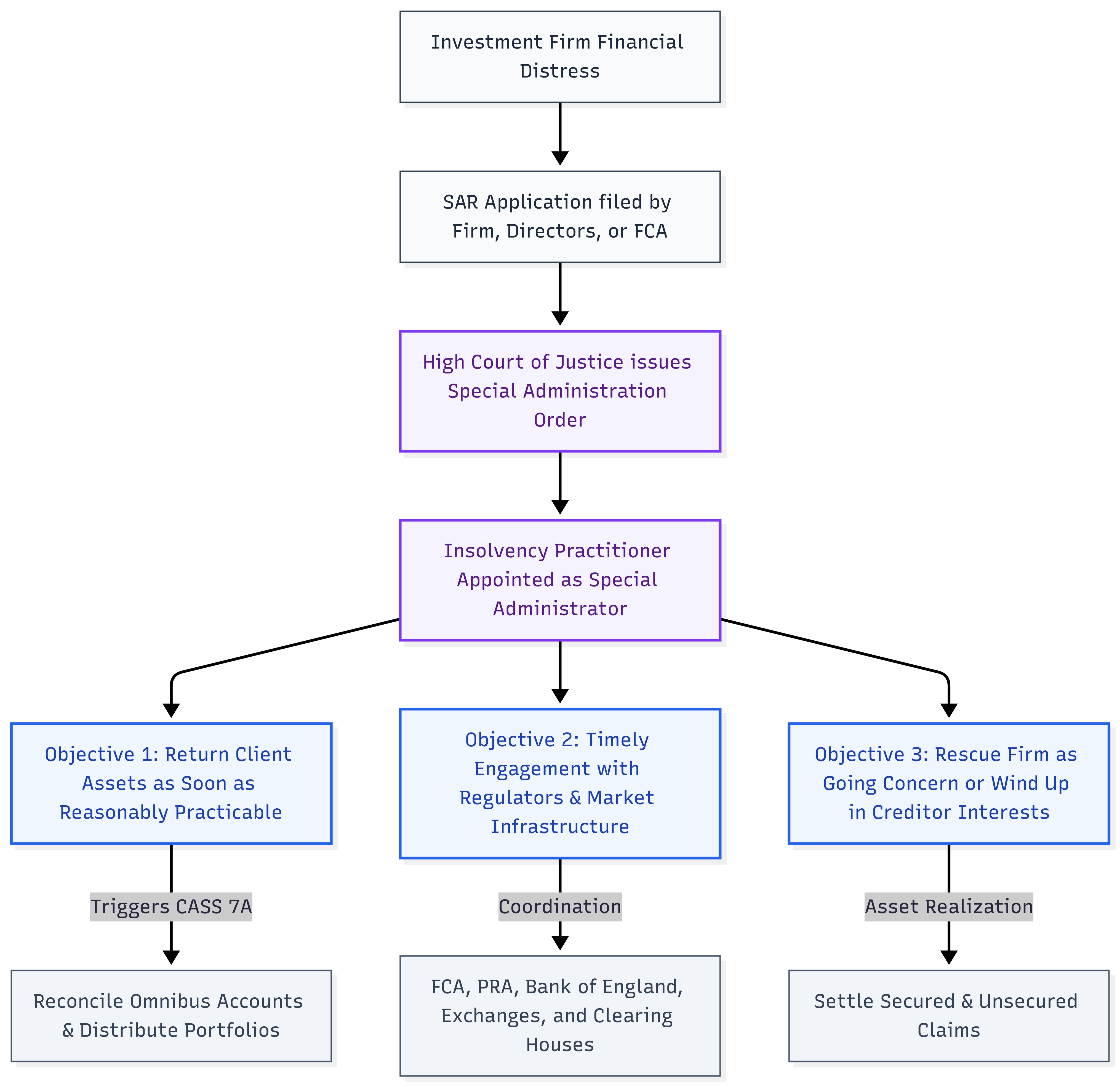
In the United Kingdom, these objectives are reflected in the Investment Bank Special Administration Regime (SAR), which establishes a bespoke insolvency framework for certain investment firms. Depending on the circumstances, the Financial Services Compensation Scheme (FSCS) may also become involved. As the United Kingdom’s statutory compensation scheme of last resort, the FSCS may compensate eligible clients where an authorized investment firm is unable to satisfy protected claims, including cases in which there is a shortfall in client assets. Though FSCS compensation cover isn’t always clear cut.
The SAR is important for investors and traders because investment firms frequently hold client money, financial instruments, and other assets on their behalf. The insolvency of such a firm can prevent clients from accessing their investments for extended periods and may expose them to financial losses and operational disruption. To address these risks, the SAR imposes three statutory objectives on the special administrator:
- To return client assets as soon as reasonably practicable
- To ensure timely engagement with market infrastructure bodies and regulatory authorities
- To rescue the investment firm as a going concern or, where that is not reasonably practicable, to wind it up in the best interests of creditors.
By prioritizing the protection and prompt return of client assets alongside the orderly administration of the failed firm, the regime seeks to maintain confidence in UK financial markets and mitigate the impact of investment firm insolvencies on clients. Understanding the SAR is therefore essential for evaluating the legal protections available to retail investors and traders and assessing the effectiveness of the UK’s insolvency framework for regulated investment firms.
Background
SAR was established after the failure of Lehman Brothers International (Europe) in 2008, as the collapse exposed serious shortcomings in the UK’s ordinary insolvency framework, especially when it came to handling the return of client money and custody assets, reconciliation of pooled client accounts, and coordination with market infrastructure. The lengthy delays experienced by clients in recovering their assets also became a point of contention.
Lehman Brothers International (Europe) entered administration on 15 September 2008, the same day its parent company, Lehman Brothers Holdings Inc., filed for Chapter 11 bankruptcy protection in the United States.
The issues revealed by the failure of Lehman Brothers International (Europe) led the UK Government to review the UK insolvency framework. Following consultations and recommendations, the Investment Bank Special Administration Regime was introduced through the Investment Bank Special Administration Regulations 2011 (SI 2011/245), which came into force on 8 February 2011.
SAR Operates Within The UK’s Broader Financial Regulatory Framework And Involves Several Public Authorities
The Investment Bank Special Administration Regime (SAR) was established by the Investment Bank Special Administration Regulations 2011 (SI 2011/245), made pursuant to the Banking Act 2009.
Subsequent amendments, particularly those introduced in 2017, refined the regime to improve the efficiency and timeliness of client asset reconciliation and distribution, strengthen cooperation with the Financial Services Compensation Scheme (FSCS), and enhance the overall administration of failed investment firms.
The Investment Bank Special Administration Regulations 2011 (SI 2011/245) are supplemented by the Investment Bank Special Administration (England and Wales) Rules 2011 (SI 2011/1301). This is where we find procedural rules governing applications to the court, the conduct of the special administration, creditor meetings, reporting obligations, and other matters of practice and procedure.
The Investment Bank Special Administration Regime (SAR) and the Investment Bank Special Administration (England and Wales) Rules 2011 operate within the UK’s broader financial regulatory framework and involve several public authorities.
The special administration itself is conducted by an insolvency practitioner appointed by the High Court of Justice of England and Wales, with oversight and cooperation involving the relevant regulators. When appropriate, other market infrastructure bodies can also become involved.
Public Authorities
Once appointed by the court, the special administrator must work closely with the applicable authorities while pursuing the statutory objectives of the regime.
- The Financial Conduct Authority (FCA) is the primary conduct regulator for authorized investment firms and plays a central role before and during a firm’s failure, by supervising compliance with prudential and client asset requirements, monitoring risks to consumers, and participating in decisions relating to the commencement of a special administration. Among other things, the FCA is responsible for supervising compliance with the Client Assets Sourcebook (CASS), monitoring firms’ financial resilience and consumer protection obligations, and, where statutory grounds are met, applying to the court for a Special Administration Order. In accordance with the Client Assets Sourcebook (CASS), especially CASS 7A, the FCA works to return client assets when an investment firm fails. The FCA does not run the SAR process (the special administrators do), but it remains a major actor. It can, for instance, request information, seek prioritization of statutory objectives in some circumstances, coordinate with other regulators, and monitor client outcomes.
- The Prudential Regulation Authority (PRA) may be involved where a firm falls within its prudential regulatory remit, particularly in relation to the supervision of capital adequacy, liquidity, and overall financial soundness.
- The Bank of England, acting as the United Kingdom’s statutory resolution authority, is responsible for safeguarding financial stability and operating the resolution regime for certain types of financial institutions, although investment firms that fall under the Special Administration Regime (SAR) are generally dealt with through that insolvency framework rather than the Bank’s bank resolution tools. The Bank of England, acting as the UK’s resolution authority under the Banking Act 2009, does however have an important role where firms fall within the wider Special Resolution Regime or where financial stability considerations arise.
- The Financial Services Compensation Scheme (FSCS) may also participate where eligible client claims arise, and the legislation expressly requires cooperation between the special administrator and the FSCS. The FSCS can become involved where eligible clients may suffer shortfalls, including situations where that shortfall is due to administrative costs. The FSCS explains in its special administrations overview that it may pay eligible customers’ share of transfer costs, cover shortfalls up to the compensation limit, and collaborate directly with administrators. That matters because administration costs can be deducted from the client asset or client money estate in some cases. Clients often assume compensation only applies where money is missing from the estate from Day 1, but the truth is that administrative costs can become part of the FSCS discussion for eligible clients.
Why Should A Retail Trader Or Investor Care About SAR?
The SAR seeks to strengthen investor protection, maintain confidence in UK financial markets, and minimize disruption arising from the insolvency of regulated investment firms. The SAR is significant for retail investors and traders because investment firms commonly hold client money, securities, and other financial instruments on their behalf. If such a firm becomes insolvent, customers may lose immediate access to their assets while competing proprietary and client claims are resolved.
The SAR is a controlled process for a failed investment firm whose client assets and market positions make ordinary administration too crude. Typically, the special administrators step into a situation where speed and certainty pull against each other. On Day 1 of special administration, client portals may still show balances, trading platforms may still hold open positions, and clearing brokers may have margin calls outstanding. At the same time, corporate treasury may be empty, while custodians still hold securities in omnibus accounts and client money sits across several banks and currencies. Investment firm employees may be leaving, while frightened customers are calling and messaging incessantly, trying to find out information about their accounts.
In such a situation, clients typically want immediate access to their money and assets, including the ability to transfer or sell off assets, and quickly empty the trading account. Company creditors want value preserved and to get paid promptly. Regulators want to avoid contagion and market instability, clearing houses want exposure closed, and custodians want clear instructions. The special administrators need to turn all of this into a legal and orderly process.
As special administration commences, the special administrators will step in to take control, stop new damage where possible, engage the relevant authorities, preserve records, freeze trading risk, deal with open positions, and map the client money and custody estate. Open positions are usually closed, transferred, or otherwise neutralized, because the estate cannot keep absorbing market risk while claims are unresolved. One of the reasons why the unwinding of a failing investment firm tends to take time is the need for reconciliation. Omnibus client money and custody pools must be matched to individual entitlements, open positions must be valued, shortfalls must be identified, and claims must be validated. Next, distribution plans may need approval, and FSCS eligibility needs to be assessed. All this can take a lot of time.
Pre-SAR And The Court Appointment
It is unusual for UK investment firms to fail without warning signs that the firm is experiencing significant financial or operational distress. Senior management, regulators, lenders, clearing brokers, and other market participants may already be aware that the firm’s position has become unsustainable. Depending on the circumstances, attempts may have been made to recapitalize the business, secure emergency funding, negotiate a sale, or transfer all or part of the firm’s business to another institution. At the same time, counterparties might be reducing or terminating credit facilities, increasing margin requirements, or closing out trading relationships, placing further pressure on the firm’s liquidity. The firm may continue to operate for a period while these options are explored, before the SAR application is made to the court.
Under the Investment Bank Special Administration Regulations 2011, a SAR application may be made by the investment firm itself, its directors, the Financial Conduct Authority (FCA), certain creditors, or other persons authorized under the legislation, depending on the circumstances of the case. The application is made to the High Court of Justice of England and Wales. If the court finds that the statutory requirements for SAR are met, they will make the order and appoint one or more special administrators. From that point onwards, the management of the investment firm passes from the directors to the special administrators.
Upon appointment, the special administrators immediately assume control of the firm in its existing state. They now control the firm’s operations, including its books and records, information systems, bank accounts, business activities, employee management, communications, and regulatory interactions. Their initial responsibilities typically include securing the firm’s books and records, safeguarding client money and custody assets, preserving electronic systems and accounting records, communicating with employees, regulators, exchanges, clearing houses, and other market infrastructure bodies, and assessing the firm’s financial and operational position. These first actions are critical to preventing further losses, preserving evidence and records, maintaining market confidence, and enabling the timely reconciliation and return of client assets in accordance with the statutory objectives of the SAR.
Appointed Special Administrators Take Immediate Action
Day 1 of Special Administration typically involves a flurry of immediate actions, since the administrators need to secure the premises and remote systems, preserve books and records, and stop unauthorized payments and transfers. They identify open positions, unsettled trades and margin obligations, and begin mapping client money and custody assets. The administrators are now legally in control, and can, for instance, suspend or restrict trading, and decide wether staff are needed to preserve systems and data.
Part of the SAR is to notify clients, employees, regulators, exchanges, clearing brokers, custodians, banks, liquidity providers, insurers, and major creditors. Typically, special communication channels are established for clients and other affected parties, and public announcements are made to reduce the need for each individual to personally try to contact the firm or the administrators.
The special administrators’ early actions will involve market risk management. If the failed firm has live client positions, live hedges, unsettled exchange trades or clearing exposure, doing nothing is also a decision. Prices keep moving, the estate’s exposure changes, client equity changes, and margin calls arrive. That is why the first working day of special administration is dominated by risk management and preservation. The administrators will work to stop the situation from deteriorating further, while also making sure all records are preserved. Early in the SAR process, the special administrators are therefore doing two things at once. They are both stopping new damage and preparing for later distribution, because the second cannot happen until the first is under control.
The FCA’s customer notice for Alpari UK’s special administration gives a clear retail example. On 19 January 2015, Alpari (UK) Limited (Alpari) entered into the SAR. Richard Heis, Samantha Bewick, and Mark Firmin of KPMG LLP were appointed joint special administrators. Queries were directed to the special email address alpariukclaims@kpmg.co.uk and the KPMG hotline on 0333 202 1397, and the FCA declared that KPMG’s website would be the relevant source of information on the progress. The FCA informed clients that the administrators would assess the client money position and return as much client money as possible, as quickly as possible. That wording is careful. The FCA did not say that clients would be able to withdraw all their money tomorrow. It said the administrators will assess and return. Assessment comes first because the administrator cannot distribute what has not been legally and operationally reconciled.
Data Preservation, Claim Management, And Engagement
The special administrator is an insolvency practitioner, but in this setting the role is wider than “sell assets and pay creditors”. The special administrators will run the failed firm’s wind-down or rescue process under the SAR objectives, and this involves several different tasks and responsibilities, including data preservation, sorting out the different claim categories, and engaging with relevant authorities.
Data Preservation
The administrator must preserve trading ledgers, custody records, client money reconciliations, bank statements, platform data, CRM records, regulatory filings, agreements with liquidity providers, clearing broker statements, client classifications, tax records, employment records, and email trails, and other relevant data. A broker’s records serve as a map of the estate, and if the map is wrong, incomplete, or unreliable, everything becomes more difficult.
An early step of the special administration is typically to produce a control grid to establish a clearer picture of the financial situation. What accounts exist, what assets exist, what positions exist, what systems are available, who has access, what trading is live, what counterparties can still move money, and what legal rights attach to each pool?
This is where a failed broker with appropriate CASS records looks different from a failed broker with weak CASS records. CASS compliance can be the difference between a fast claims process and a mess. The FCA’s CASS 7A primary pooling event rules explain that a primary pooling event occurs on the failure of the firm, and that client money is then treated as a pool to be distributed or transferred under the rules. That sounds simple, until the administrator has to actually prove exactly what went into the pool, who has a claim on it, and whether the firm’s records are reliable.
Claim Categories
The special administrators must identify, verify, and classify all claims against the failed firm before distributions can be made. Depending on the firm’s business and the circumstances of its failure, these may include claims relating to client money, custody assets, secured creditors, unsecured creditors, employees, tax authorities, and the costs and expenses of the administration itself. The process may also require distinguishing between clients whose assets were held in segregated accounts and those whose assets formed part of pooled client accounts, as well as between retail and professional clients where their contractual rights differ.
Additional complexities can arise from title transfer collateral arrangements, funds that should have been segregated as client money but were not, and firm money that was mistakenly held in client accounts. Consequently, the balances displayed in a client’s online portal or account statement are only a starting point. They do not automatically determine the client’s legal entitlement or say how much money that will ultimately be recoverable through the special administration process.
The FCA’s MF Global customer guidance shows this point clearly. MF Global entered the Special Administration Regime (SAR) on Monday 31 October 2011, following an application by its directors to the High Court. On 3 February 2012, the administrators for MF Global UK Ltd announced the first distribution of client money to those affected by the firm’s insolvency. In its MF Global investor questions and answers, the FSA explained that segregated account holders had a claim against the client money pool, while non-segregated account holders did not and instead had unsecured claims.
In the case of MG Global, sorting out the details was neither quick nor easy. The 26 cents per US dollar announced in February 2012 was only the first interim distribution. A major obstacle that kept that initial number low was a dispute between the UK administrators and the US bankruptcy estate over hundreds of millions of dollars. A settlement was eventually reached in December 2012, which enabled a substantial increase in distributions to clients. Ultimately, clients with agreed client money claims recovered approximately 90.65% of their claims.
Engagement With Other Relevant Authorities
The special administrators must maintain appropriate engagement with the relevant public authorities throughout the administration. Depending on the circumstances, this may include the Financial Conduct Authority (FCA), the Prudential Regulation Authority (PRA), the Bank of England, and HM Treasury, as well as other authorities and market infrastructure bodies where necessary.
Freezing Trading Risk And Closing Open Positions
Open trading positions are a part of broker insolvency proceedings that some retail clients misunderstand. They assume the administrator can leave positions open while the claims process is sorted out. In most leveraged trading failures, that is not realistic. An open derivative, CFD, spread bet, futures position, or margined FX position is a moving liability. Prices change, margin changes, a winning client can become a losing client, and a losing client can go more deeply negative. The broker may have matching hedges, partial hedges, no hedges, or stuck hedges. The estate may face clearing broker obligations while clients face the broker.
The estate cannot allow traders to keep taking market risk using a failed broker. If the broker is no longer authorized to trade normally, lacks capital, has lost liquidity routes, or cannot manage margin, open positions must be dealt with. Also, the special administrator cannot sensibly distribute client money while the live trading book is still producing new claims.
Special administrators, clearing brokers, and platform mechanisms usually move quickly to close, transfer, or freeze positions. The precise method can depend on factors such as financial product, account agreement, market, exchange rules, clearing setup, and timing of appointment. Exchange-traded futures may be transferred or closed through clearing arrangements. CFDs and spread bets may be closed under the broker’s client terms. Securities accounts may be transferred where records and custody positions are clean.
MF Global provides useful case material because it held numerous open futures and options positions when it entered special administration on 31 October 2011. In a December 2017 progress report, KPMG stated that all open futures and options positions existing at the date of appointment had either been transferred or closed out, with the exception of a small number of immaterial illiquid positions. This illustrates an important practical objective of a special administration: to eliminate ongoing market exposure.
Of course, valuation is a common point of contention. An open position may be valued as at the Primary Pooling Event (PPE), even though it is not actually closed until a later date at a different market price. In Re MF Global UK Ltd (in special administration) (No 4), the High Court recorded that, for the purpose of calculating client money entitlements, open contracts were treated as if they had been closed out at the Primary Pooling Event, notwithstanding that some positions were in fact closed later at different values. This valuation methodology affected the calculation of each client’s entitlement to the client money pool and, consequently, the allocation of the shortfall among clients. MF Global UK entered special administration on 31 October 2011, which also constituted the Primary Pooling Event for client money under the FCA’s Client Assets Sourcebook (CASS). From that point, the CASS client money distribution rules were triggered, and the client money held by the firm in accordance with those rules was treated as forming a single client money pool to be distributed among clients according to their respective entitlements.
The closure price is usually based on prevailing market or contractually determined rates at the relevant close-out time. In fast markets, that can be ugly. Clients may feel they should have had the choice to wait. But the firm no longer exists as a functioning broker and the estate must freeze liabilities for all clients and creditors, not preserve one client’s trading thesis. This is where the distinction between market loss and insolvency loss matters. Suppose a client was long an index CFD when the broker failed. If the special administrator closes the position at the market level available at the close-out time, the resulting profit or loss becomes part of that client’s account balance or claim. If the client thinks the index would have recovered three weeks later, that is irrelevant unless the contract or court order says otherwise. Insolvency freezes claims around legal events, not around the client’s preferred exit.
The problem becomes harder when positions cannot be closed immediately. Illiquid instruments, suspended securities, complex OTC derivatives, exchange disruptions and stuck clearing positions can delay valuation. Administrators may need court directions on valuation methodology. Counterparties may dispute close-out statements. Exchange default rules may produce one number while client money rules produce another. More than one jurisdiction can be involved.
Negative balances and Negative Balance Protection (NBP) matter for the final outcome of the SAR, and can also be what pushes a firm into SAR. If client positions are closed at a loss greater than account equity, the client may owe the firm. Whether the broker estate can legally and practically recover that negative balance can depend on factors such as client classification, contract terms, product rules, and client solvency. Notably, statutory NBP is not the same as contractual NBP, since contractual NBP can be more flexible. In the UK, retail clients have statutory NBP, while professional clients do not. If many clients with NBP go negative at once, the estate records receivables that may be hard or impossible to collect, while upstream brokers or clearing houses may still demand payment from the failed firm. The Swiss franc shock showed this mechanism in plain sight. When the Swiss National Bank removed the EUR/CHF floor in January 2015, brokers faced extreme gaps and client losses. Alpari UK entered SAR after assessing it was no longer solvent, as described in the FCA’s Alpari customer statement. The failure was not simply “clients lost money”. It was that client losses, broker obligations, and market gaps interacted in ways that the broker’s capital could not fully absorb.
Client Money And Custody Assets
The special administrator must separate client money, custody assets, firm assets, collateral, unsettled trade proceeds, receivables, payables, and unsecured claims, and the legal treatment of these categories differs sharply.
Cash that constitutes client money under the FCA Client Assets Sourcebook (CASS) must be segregated by the firm under CASS rules and is generally held on a statutory trust for clients pursuant to CASS 7A, subject to compliance with the applicable safeguarding and segregation requirements.
Custody assets, such as securities and financial instruments, are typically held by investment firms on behalf of clients through custodial or nominee arrangements, meaning legal title is often registered in the name of the firm or a nominee while the beneficial interest remains with the client. Where money is owed to a client but has not been properly segregated as client money in accordance with CASS, the client will not generally have a proprietary claim to the assets but instead will rank as an unsecured creditor in the firm’s insolvency.
Collateral transferred under a title transfer collateral arrangement is generally subject to outright transfer of ownership to the firm, such that the client retains only a contractual right to redelivery of equivalent value rather than a proprietary interest in the specific assets transferred. This legal characterization can materially affect recovery outcomes in insolvency.
CASS 7A
CASS 7A is the machinery for client money distribution after a primary pooling event. The FCA Handbook’s CASS 7A.2 primary pooling event rules state that a primary pooling event occurs on the failure of the firm. CASS creates a framework for pooling and distributing or transferring client money. The FCA’s PS17/18 policy statement explains that SAR and CASS 7A work together to return client assets and improve outcomes after investment firm failure.
Client Money Pooling
Many brokers do not hold each client’s cash in a separate bank account with the client’s name on it. Instead, they use omnibus accounts. That means client money belonging to many different clients is held together, with the broker’s internal records showing individual entitlements. This is normal market structure, and it is also one of the reasons why broker records matter so much.
An omnibus account creates operational efficiency, but it also creates reconciliation dependency. If the firm’s internal records say Client A has £50,000 and Client B has £20,000, the special administrator must test that against bank balances, open trades, fees, unsettled transactions, currency conversions, corporate actions, client classifications, and any errors. The bank record shows one (omnibus) account, while the broker’s ledger says who owns what inside it. If the ledger is wrong, the pool cannot be distributed cleanly.
The omnibus problem is therefore not that pooling is bad in itself. It is that the return of pooled client money will only be smooth if the failed firm’s records, segregation, reconciliations, and third-party confirmations are strong enough to quickly determine exact ownership. If not, the special administrator can be required to spend a lot of time and resources on proving who owns what.
Custody Assets
A similar problem appears with custody assets. A custodian may hold a block of securities in nominee name for many clients. The special administrator now needs to reconcile the custody records against the broker’s books and client statements. Securities may be lent, pledged, unsettled, subject to corporate action, frozen by sanctions, stuck in overseas sub custody, or held through several layers. The special administrator must prove the legal and operational chain that ties certain assets to a certain client.
Shortfall And Pro-Rata Distributions
If client money is missing, the pool may be distributed pro rata. A client with a £100,000 entitlement may not receive £100,000 from the pool if the pool contains only 80p in the pound after shortfall and costs. FSCS compensation may cover eligible customers up to the limit, but eligibility must be resolved before any decision can be made.
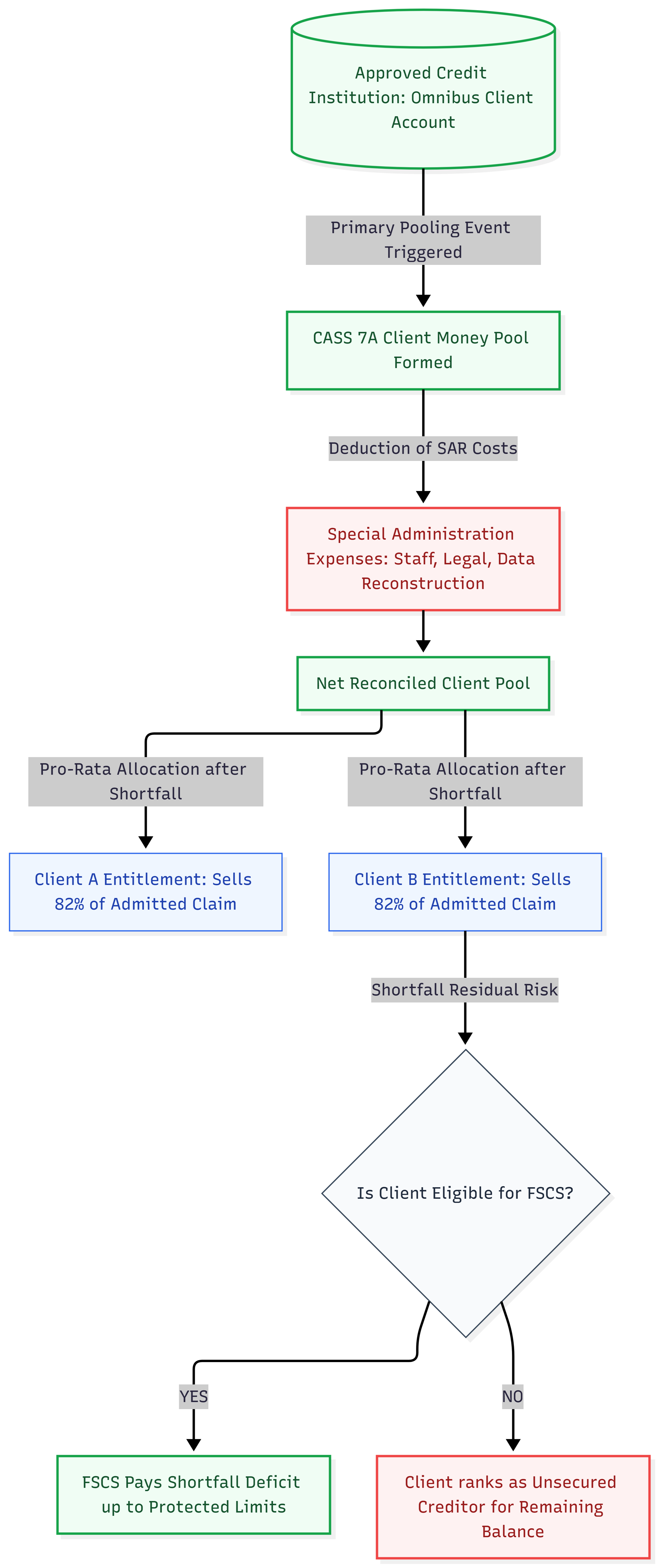
Costs matter too. Many traders believe client money is ring-fenced and immune from administration costs. In reality, that is not always the case. The process of identifying, reconciling and returning client assets costs money. Staff, IT systems, legal advice, court applications, data reconstruction, custody fees, and administrator time all cost money. The FSCS notes in its 2024 Beaufort special administration discussion that the costs of reuniting investors with assets and money may be funded from remaining client assets and money, with FSCS able to cover eligible customers’ share of those costs in many cases. Of course, with the FSCS, there are caps and eligibility rules to consider.
For more information about how FSCS can be involved in covering SAR administration costs, see the two cases “Alpari UK: Retail FX Failure After the Swiss Franc Shock” and “Beaufort: The Cost of the SAR Process ” below.
Why Distribution Can Take Months Or Years
If the broker was FCA-regulated and client money was segregated, why does the return of my money still take so long? That is a fair question that many traders end up asking after a broker failure. The short answer is that insolvency distribution can be complex even when applicable segregation rules were adhered to, and SAR is a process where claims must be painstakingly validated.
Client Pool Identification
The special administrator first needs to identify the client money pool. That means collecting bank statements, transaction records, platform balances, margin records, reconciliations, custody statements, clearing broker balances, exchange statements, and post-failure receipts. Money received after the failure may need separate treatment. The FCA’s CASS 7A rules on primary pooling events distinguish between money held at the pooling event and money received after failure, including money related to unsettled or incomplete transactions.
Client Entitlement
Then, the special administrator must calculate each client’s entitlement. This is where simple balances become complicated. Was the client retail or professional? Were funds held under CASS or title transfer? Were there open positions? Were there pending deposits or withdrawals, and how does this show up in the records? Were there unpaid fees? Was money held in another currency than GBP? Were positions closed before or after the pooling event? Did the client owe margin? Were there chargebacks? Was a payment received but not allocated? Were there duplicate accounts? Was the client sanctioned, deceased, a company in liquidation, or using an introducing broker? Each answer can change the claim.
Custody Assets
The administrator will also need a distribution plan for any custody assets. The FSCS explains that in special administrations, administrators prepare a distribution plan that is reviewed by the creditors’ committee and approved by the court before client assets are returned or transferred. Its special administration guide uses the Beaufort Asset Clearing Services case as an example of how a transfer process may transfer assets to a client’s account with a new broker once the plan is approved. In the case of Beaufort, circa £500 million in client assets (and over £53 million of client money) were returned via transfer to new brokers across 17,000 clients.
Client Responses
Administrators also need to communicate with clients, including sending statements of proposed entitlements that clients can then accept, dispute, or ignore. Some clients have moved, died, become severely ill, changed contact information, lost access to records, or are simply ignoring the messages. Some balances are tiny and the client might not even bother to keep on top of the procedure. Some are large and/or heavily disputed. Some clients retain lawyers. Some accept or dispute claims, but after the deadline.
A bar date may be used. In insolvency language, a bar date is a deadline for submitting claims. It gives the administrator a point after which distributions can be made with more certainty. Without a bar date, a late claimant could disturb distributions already made. But bar dates must be set, communicated, approved where required, and applied fairly. A 2024 article on bar dates in UK investment bank special administrations, published in the Capital Markets Law Journal, notes that even though bar dates are intended to help finality and efficient asset management, their practical speed benefits can vary sharply by case.
Multiple Jurisdictions
Cross-border holdings slow the process further. A UK broker may have assets held through overseas custodians, clearing houses, exchanges, affiliates or banks. Local insolvency law may affect access. Foreign regulators may impose restrictions. Documents may need translation. Corporate actions may occur during the freeze. Sanctions checks may be needed. Tax reporting may be unclear. If the broker used affiliated entities, administrators may need to work out whether client money was properly segregated or moved across group companies.
Competing Claims
The aftermath of the Re MF Global UK Ltd collapse is an example of how large competing claims can block distribution. The FSA told clients in its MF Global investor Q&A that uncertainty over who was entitled to claim a share of the client money pool, including a large claim from MF Global Inc., was preventing a larger initial payout. That is what distribution delay can look like in practice.
You can read more about the MF Global UK Ltd case further down in this article.
Case Studies: MF Global, Alpari, Beaufort and Reyker
MF Global UK: The First Major SAR Test
When MF Global UK entered special administration in 2011, it became the first major test of the UK SAR framework. This firm had client money, open derivative positions, clearing relationships, and cross-border complications. It was not a clean retail broker unwinding with neat balances and no disputes.
The FCA’s MF Global investor guidance explained the situation to the public. Segregated clients had claims against the client money pool, non-segregated clients had unsecured claims, and there was uncertainty over entitlement to the pool. This uncertainty limited the size of early client distributions.
Open positions added another layer. The administrators had to transfer or close positions and value claims. The court discussion in Re MF Global UK Ltd No 4 showed how the choice of valuation methodology for open contracts affected client money shortfall analysis. The issue was not just whether trades were closed, it was which legal date and valuation basis governed client claims.
The MF Global lesson is simple. Even with a statutory regime, client money distribution can become complex when open positions, international group claims, clearing relationships, and client classification disputes collide.
Cross-Border Complications
One of the defining features of the MF Global UK Ltd special administration was that it was not just a UK insolvency. The collapse of the group created competing claims across multiple jurisdictions, particularly between the UK subsidiary and its US parent, MF Global Holdings Ltd.
- In the early hours of 31 October 2011, New York time, MF Global Holdings Ltd. filed for Chapter 11 bankruptcy in the U.S. Bankruptcy Court for the Southern District of New York.
- After MF Global Holdings Ltd. filed for Chapter 11 protection, the U.S. Securities Investor Protection Corporation (SIPC) filed a petition, and the U.S. District Court for the Southern District of New York issued the order placing the group’s US broker-dealer MF Global Inc. into liquidation under the Securities Investor Protection Act (SIPA).
- After a hearing during the morning of 31 October 2011 London time, MF Global UK Ltd was placed into Special Administration, and the High Court in London appointed three KPMG employees as special administrators.
These concurrent proceedings created competing claims over assets and significantly complicated the reconciliation and return of client money and other assets.
- U.S. Chapter 11 governed holding company assets and general creditors
- U.S. SIPA governed customer securities and broker-dealer client property pools
- UK SAR and other applicable UK laws governed UK client money and custody assets
So from day one, there were three overlapping legal frameworks trying to decide who owned what, especially in relation to cash and collateral moving between entities in the group. Understandably, this significantly complicated the return of client assets.
The principal dispute concerned the ownership of hundreds of millions of US dollars held in accounts connected with the UK business. Following the collapse, both the UK special administrators and the US bankruptcy estate asserted claims over certain funds. The UK administrators argued that significant amounts should be treated as client money or otherwise belonged to the UK estate for the benefit of clients and creditors. The US estate argued that some of those assets belonged to the parent company or should be administered through the US bankruptcy proceedings.
The dispute was eventually resolved through a cross-border settlement reached in December 2012 between the UK special administrators and the US bankruptcy trustee. Under the agreement, substantial funds were allocated to the UK estate, enabling the administrators to make significantly larger interim distributions to clients than had previously been possible. The settlement also reduced the need for further costly litigation.
For retail investors, the practical significance is that the delay in returning client money was not caused solely by the complexity of reconciling accounts. It was also the result of a genuine legal dispute over which insolvency estate owned particular assets. Until that question was resolved, the administrators could not safely distribute all of the available funds without risking payments to the wrong parties. The settlement therefore illustrates an important feature of modern broker failures. When firms operate internationally, the recovery of client assets often depends not only on domestic insolvency law but also on effective cooperation and negotiated settlements between insolvency proceedings in different jurisdictions.
It would be wrong to read the term “settlement” and assume that applicable laws were irrelevant, since the parties settled out of court. Laws matter even when a dispute like this one is settled out of court and never proceeds to a final court judgment. Legal rules shape the parties’ bargaining positions, the likely outcome if litigation continues, and therefore the terms on which a settlement is reached. The fact that the dispute was settled rather than determined by a court does not diminish the importance of the underlying legal rules. On the contrary, settlements in complex insolvency proceedings are typically negotiated in the shadow of the law. Each party assesses the strength of its legal position by reference to the applicable insolvency, trust, property, and regulatory rules, as well as the likely outcome, cost, and duration of continued litigation. Those legal rights and risks define the range of outcomes that a court might ultimately impose and therefore influence the terms on which the parties are willing to compromise. In cross-border broker failures such as MF Global, differences between national insolvency regimes, together with questions of ownership, priority, and jurisdiction, can significantly affect the parties’ negotiating positions. The settlement therefore reflected an agreement reached against the backdrop of competing legal claims and the uncertainty inherent in resolving them through litigation.
Alpari UK: Retail FX Failure After The Swiss Franc Shock
The firm Alpari (UK) Limited entered the Special Administration Regime (SAR) on 19 January 2015. The immediate trigger for the firm’s insolvency was the Swiss National Bank’s decision to remove the EUR/CHF minimum exchange rate floor on 15 January, 2015, a move that caused enormous volatility in the Swiss franc and led to severe losses for leveraged FX market participants, including Alpari UK and its clients.
The FCA’s Alpari (UK) Limited customer notice stated that Richard Heis, Samantha Bewick, and Mark Firmin of KPMG LLP had been appointed joint special administrators, and that the initial view was that client money was whole. That phrase, “client money is whole,” did not mean instant access. It meant the early assessment did not indicate a missing client money pool. Customers still had to wait for the administrators to assess claims and return client money through the legal process.
Alpari showed that when CASS rules are followed, broker solvency and client money segregation are two different things. A broker can become insolvent, and segregated client money remains intact. The firm can fail while the client money pool is recoverable.
But Alpari also showed that proper segregation is not any guarantee of instant or even quick cash return. The client money recovery, and distribution process works inside the overall insolvency process, and it can take a long time before traders see their money again, even when client money has been kept segregated. This case also highlighted the high administrative costs associated with SAR even when the client money pool is intact and records are well kept.
When Did Traders Get Their Money Back?
The firm entered the Special Administration Regime (SAR) on 19 January 2015. In June 2015, KPMG issued the notice confirming the first interim distribution of client money would begin shortly. The first interim client money distribution commenced in June 2015, with payments made on a rolling basis as client verification and reconciliation were completed. Most eligible and verified clients received funds by late June 2015, with some residual payments from the first tranche continuing into July 2015. Additional reconciliation and balancing distributions followed in phases during 2015–2017, as claims were still being matched, set-offs applied, and corrections made.
KPMG could not make the final distribution until the High Court of Justice in England and Wales had given its final judgment, which came on 9-11 May, 2017. KPMG then announced that clients would be notified by email by June 2, 2017, confirming that the final distribution had been made. KPMG also noted that claims of less than $51.5 would be disqualified due to a mandated de minimis threshold that was approved by the UK court.
But did not some traders receive their money in May 2015, several weeks before the first payments began to roll out from KPMG? Yes, that is true. Some traders received money even earlier than June 2015. In cases where clients were eligible for FSCS compensation in respect of a compensatable shortfall, the FSCS could make payments directly once client balances had been reconciled by the Special Administrators and the FSCS had completed its own eligibility and entitlement assessments. This meant that many FSCS-eligible clients received their first payments in May 2015, several weeks before the first KPMG client money distributions began. These payments were FSCS statutory compensation based on the compensatable shortfall derived from the reconciled claim position at that time, rather than direct payments from the client money pool or full settlement of account balances.
How Much Money Did The Traders Get Back?
The client money pool itself was broadly intact. However, under the version of the SAR in force in 2015, the costs of distributing client money (including part of the administrators’ remuneration and expenses) could be paid out of the client money pool itself before distributions to clients. As a result, clients did not receive 100 pence in the pound even though the pool was broadly intact.
The special administrator’s final reporting shows that the total client money distributions amounted to approximately 82 cents in U.S. dollars of admitted client money claims. In other words, eligible clients ultimately recovered circa 82% of their admitted client money claim from the client money pool.
Was The Shortfall (Due To Administration Costs) Covered By The FSCS?
The Financial Services Compensation Scheme (FSCS) compensated eligible clients for losses arising from the shortfall, subject to the compensation limits in force at the time, which were £50,000 per eligible claimant and firm.
Eligible FSCS claimants (typically retail individuals and other qualifying claimants) received compensation for the shortfall, up to the applicable FSCS limit. Clients with larger balances or who were not eligible for FSCS protection would bear the remaining shortfall themselves, which meant they now had an unsecured claim against the bankruptcy estate for the balance.
This outcome was one of the reasons the UK later reformed SAR to make it possible for the FSCS to meet certain client asset distribution costs directly, rather than those costs first being borne by the client money pool. For FSCS-eligible clients whose entire shortfall falls within the compensation limit, this change makes little practical difference. It can, however, be very important for other client groups.
It is also worth mentioning that a very large number of the firm’s clients were not based in the UK. Alpari UK had more than 100,000 clients when the company entered into SAR, and approximately 82% of them were based outside the UK. Foreign residence did not, in itself, prevent a claimant from receiving FSCS compensation. Eligibility depended on the FSCS rules (for example, whether the claimant was an eligible individual or qualifying small business) rather than on nationality or place of residence.
Beaufort: The Cost Of The SAR Process
Beaufort Asset Clearing Services went into special administration on 1 March 2018. This is another case that clearly shows that the problem can be less about missing assets and more about the cost and logistics of returning them.
The FSCS explains in its special administrations case study on Beaufort that over £53 million of client money and £500 million in client assets was returned via transfer to new brokers across around 17,000 clients. It also explains that administrators needed funding to cover fees and related costs, including retaining staff and IT providers so systems and data stayed accessible.
This is a part clients often don’t consider. Without the failed firm’s staff and service providers, the administrator may not be able to reconstruct client accounts quickly. The people who ran the back office yesterday may be essential to returning client assets tomorrow, even if the company itself is dead, and these people need to be compensated. SAR costs are not just about the cost of the appointed special administrators, it is also about all the other costs associated with the process.
In this case, FSCS involvement helped eligible clients avoid direct deductions for certain transfer costs. That is not guaranteed in every case, but it shows how today’s FSCS, under its new rules, can support the mechanics of return, instead of being limited to replacing missing money once the pool has been distributed.
Reyker: Transferring Assets
Reyker Securities Plc went into special administration on 8 October 2019, following an application by the Directors. This is a case that is often discussed in the context of client asset transfers under SAR, because it is one of the clearer real-world examples of how the regime can work to return client assets instead of liquidating them. When it comes to assets, bulk transfer is a primary tool under SAR, and liquidation is not the default.
Reyker Securities was a UK investment firm and custodian that provided execution, settlement, and custody services for both retail and institutional clients. It held large volumes of client assets under nominee structures, meaning its operational stability was crucial for safe custody and settlement of those investments. Reyker was heavily involved in holding assets for other platforms and advisers, and that created a major operational challenge. Assets were spread across multiple underlying brokers and custodians, records were complex, and client holdings had to be reconciled across multiple systems.
In the Reyker case, the special administrators successfully transferred many client holdings to other regulated custodians. When possible, assets were moved as complete portfolios.
In quantitative terms, over 98% of transferable custody assets were successfully transferred or instructed for transfer to nominated brokers. This figure relates specifically to assets that were capable of being re-registered and moved in specie, rather than being sold and repaid in cash. This was described as representing the vast majority of client holdings in value terms across the estate, which was estimated at over £900 million in total client assets when custody and cash were combined.
The practical outcome was that most client portfolios were effectively reconstituted at new custodians through bulk re-registration processes, meaning that entire holdings were moved as going-concern portfolios rather than liquidated. However, a small residual portion of assets could not be transferred. These were typically illiquid instruments, securities affected by registrar or issuer constraints, or positions where client-specific issues prevented re-registration. Those remaining assets required separate treatment, which in some cases involved delayed realization or cash distribution through the administration process.
Overall, while the special administrators did not achieve a perfect 100% transfer of all holdings, it did succeed in transferring almost all transferable custody assets, which is why the Reyker case is often cited as a successful example of the SAR’s Objective 1 being achieved in practice.
Preserving and transferring holdings instead of liquidating them and paying the clients in cash can reduce both client losses and market disruption, but it can only be done where records are good enough, and one or more suitable receiving brokers can be found. In the Reyker case, client assets were not all held in a single account structure. Assets were spread across multiple upstream custodians and settlement systems, and the special administrators had to match client entitlements to external holdings before transfer.
In this context, it is also important to remember that while the return of client assets can work cleanly for fully owned, identifiable assets (such as company shares held in custody), it becomes conceptually and legally difficult for leveraged positions. A leveraged position is not a separable asset. It is a live, credit-dependent risk contract. When the firm enters SAR, that contract cannot be “returned” intact, so it is instead closed out, valued, and converted into a claim, rather than transferred to the client in its original form.
Foreign Equivalents: SIPA And Other Broker Failure Regimes
The UK Special Administration Regime (SAR) is not the only bespoke insolvency framework designed for investment firms and other financial services entities. Comparable regimes exist in a few other jurisdictions. Although they differ in legal structure, statutory basis, and institutional design, they are generally directed at addressing a common set of practical and systemic problems that arise when a financial intermediary fails.
It should be noted that specialized insolvency frameworks designed for investment firms and other financial services entities are still rare from a global perspective. Many countries instead rely on their standard insolvency and bankruptcy laws and procedures, combined with segregation and reconciliation rules for client money and assets.
In both types of jurisdictions, the core challenges of unwinding a failed broker tends to be the same. There is a need to safeguard client money and assets, stabilizing or closing out open positions, verifying and adjudicating client claims, transferring accounts or distributing assets and cash to clients, and clarifying any shortfalls between client entitlements and available assets. These processes must be carried out in a way that limits market disruption, reduces the risk of contagion across counterparties and financial infrastructure, and preserves confidence in the integrity of brokerage and custody services more generally. Accordingly, while the legal mechanisms differ between regimes, the underlying objective tend to be the same, i.e. to ensure the orderly resolution of failed financial intermediaries in a manner that prioritizes client protection and maintains trust in the functioning of financial markets.
SIPA In The United States
The Securities Investor Protection Act (SIPA) is the closest equivalent to SAR. Enacted in 1970, SIPA is a U.S. federal law that safeguards investors’ cash and securities when a SEC-registered broker-dealer (retail stockbroker) fails. SIPA also established the Securities Investor Protection Corporation (SIPC), which steps in to recover missing assets and provide insurance protection for eligible claims during a firm’s financial collapse.
On its site, SIPC explains how SIPA liquidation generally begins with a court appointing a trustee for the broker-dealer. The trustee, under SIPC oversight, works to restore securities and cash to customers as quickly as possible, and may arrange transfers of customer accounts to another brokerage firm.
Key aspects of SIPA are the immediate automatic stay on customer accounts, the segregation and return of customer property, the ability to transfer multiple accounts to another broker through bulk transfers, and the high compensation cap for eligible SIPC claims.
The US Courts’ overview of SIPA liquidation draws a useful distinction between normal bankruptcy and SIPA. “The essential difference between a liquidation under the Bankruptcy Code and one under the SIPA is that under the Bankruptcy Code the trustee is charged with converting securities to cash as quickly as possible and, with the exception of the delivery of customer name securities, making cash distributions to customers of the debtor in satisfaction of their claims. An SIPC trustee, on the other hand, is required to distribute securities to customers to the greatest extent practicable in satisfaction of their claims against the debtor.” Source: United States Courts – Securities Investor Protection Act (SIPA).
Hong Kong’s Securities And Futures Commission (SFC) Regulatory Client Asset Regime Combined With General Insolvency Law
There is no single, SAR-style named framework in Hong Kong for broker failures. Instead, Hong Kong uses a combined system of laws and regulatory rules, rather than one unified regime. Hong Kong’s framework for dealing with a failed broker is similar to the UK Special Administration Regime (SAR) in the sense that both systems are designed to protect retail clients when an investment firm becomes insolvent, but the way they achieve that outcome is structurally different.
In both jurisdictions, client assets are required to be segregated from the firm’s own money, so that client cash and securities are not treated as part of the broker’s insolvency estate. In Hong Kong, this is achieved through Securities and Futures Commission (SFC) client money and custody rules, while in the UK it is governed by the FCA’s CASS regime. In both cases, the underlying principle is that properly segregated client assets should be protected and ultimately returned to clients rather than used to satisfy the firm’s general creditors.
Both systems also rely on early intervention by regulators once a broker fails. In Hong Kong, the Securities and Futures Commission (SFC) typically takes the lead in coordinating the response, sometimes alongside the Hong Kong Monetary Authority in cases involving broader financial stability concerns or bank-affiliated entities. The focus is to stabilize the situation, prevent misuse of client assets, and facilitate either the transfer of client accounts to another broker or an orderly reconciliation and return of assets.
Hong Kong does not have a single, dedicated special administration regime equivalent to SAR for investment firms. Hong Kong relies on a combination of ordinary insolvency law and regulatory client asset rules rather than a single bespoke insolvency procedure. The result is a more fragmented system (compared to SAR), in which insolvency practitioners, regulators, and courts each play distinct roles rather than operating within one integrated statutory structure. This can make the process less centralized than the UK SAR, although the practical outcome for retail investors is often similar.
Overall, while both systems aim to protect investors and preserve confidence in brokerage services, the UK SAR is a more unified and purpose-built insolvency regime, whereas Hong Kong achieves similar ends through a combination of regulatory safeguards and general insolvency law operating in parallel.
What Traders Should Check Before Picking A Broker
What happens to your money and assets when a broker fails, and how the process of getting to that outcome will be, is largely determined by jurisdiction. This is one of many reasons why British traders, and especially retail traders, are encouraged to stick to brokers that are regulated and supervised in the United Kingdom, since that ensures SAR treatment of money and assets in case of broker failure, and eligibility for FSCS when applicable.
Traders who decide to pick a foreign broker are stepping out of the UK protective framework, and should therefore ideally carry out more substantial due diligence before parting with any money or assets.
Examples of relevant points during a broker due diligence:
Counterparty And Jurisdiction
The first check is which legal entity is actually your contractual counterparty. This is an important step even if you pick a broker that heavily promotes its FCA license in its marketing, because a single broker brand may operate through several companies spread out over many jurisdictions. One company may be FCA authorized, while another is regulated in The Seychelles or The Bahamas. Make sure you know the exact legal name and location of your counterpart before you enter into any agreement. The client agreement should identify the exact company facing the client, the regulator, the governing law, the forum, and the client money rules that apply.
Most countries around the world do not have a bespoke process like SAR for failing investment firms. If you sign up with a foreign company, check if anything like SAR is applicable. If not, your money and assets will be in the hands of the standard insolvency/bankruptcy process if the company fails.
Client Money Treatment
The second check is client money treatment. If there is no CASS, which rules apply to client money? Can this broker use title transfer collateral arrangements? Are retail and professional accounts treated differently? Can the broker use client margin to support hedging or clearing obligations? Is money held in trust, segregated accounts, omnibus accounts, or transferred to the firm under collateral terms?
Custody Structure
Are securities held in nominee name, with a third-party custodian, through overseas sub-custodians, or inside the broker group? Are assets pooled in omnibus accounts? Are client assets lent, pledged, or subject to security interests? What information does the broker provide about custody chain risk?
How are client money reconciliations performed? Where is client money banked and how is banking diversified? Ask about custody reconciliations, third-party confirmations, sub-custodian risk, and omnibus records. Ask whether the firm has tested an insolvency data extraction process.
Open Position Treatment
What happens to open positions if the broker defaults, loses authorization, or enters insolvency? Can the broker close all open positions without notice? Which price source is used? Can positions be transferred? Are clients liable for negative balances? Does negative balance protection (NBP) apply in this type of situation? Ask about margin close out policy, liquidity provider dependencies, and wind down planning.
Statements And Records
Is it easy for you to access statements? What information does the broker provide regarding record keeping? Traders should ideally keep their own statements, trade confirmations, deposit records, withdrawal requests, and correspondence, and store this information separate from the trading platform and trading account. If a broker’s site or trading platform goes down, you want to be able to still access this information, and you also want it to be tamper-proof. In a clean situation, the broker’s records should be enough. In a messy one, client records help resolve disputes. A few screenshots alone may not prove a claim, but they can strongly support one.
Compensation Eligibility
If your account is not covered by the UK FSCS, make sure you understand if and how it is covered by another scheme. Remember that coverage can vary depending on factors such as trader residence, client class eligibility, firm status, product type, and claim facts. Traders should not assume everything in the trading account is covered just because of a vague line about “protection scheme” in the broker brand marketing material.