
Last Look in FX Trading: Execution Optionality, Liquidity Risk, and Trader-Level Controls



Last Look is one of the most argued-over mechanisms in electronic foreign exchange. It sits inside the milliseconds between a trade request and a final execution report. To a liquidity provider, it is a latency-risk control. To a trader, it comes across as liquidity providers not honoring their quotes.
The basic structure is simple. A liquidity provider streams a price. A liquidity taker tries to trade on that price. Before the trade is finalized, the liquidity provider has a short window to accept or reject the request. That window is Last Look.
The FX Global Code, Principle 17, defines Last Look as a practice utilized in Electronic Trading Activities whereby a Market Participant receiving a trade request has a final opportunity to accept or reject the request against its quoted price. That same paragraph also states that Market Participants receiving trade requests that utilize the last look window should have in place governance and controls around its design and use, consistent with disclosed terms.
Last Look is not automatically manipulation. It is not automatically fair either. It is a conditional execution protocol that gives the liquidity provider optionality after receiving an order. Whether the practice is fair depends on factors such as disclosure, symmetry, response time, rejection logic, governance, and whether the provider uses incoming trade information improperly. The real question to ask is, therefore, not if an LP uses Last Look, but how it uses LP. Transparent disclosures, short and consistent hold windows, no trading on client information during validation, symmetrical rejection logic, and post-trade execution metrics help make Last Look less harmful to traders. Poor transparency, a lack of strict regulatory oversight, opaque rejection, client-favorable reject bias, and missing markout data make it dangerous.
Last Look can make it possible for a liquidity provider to give tighter quoted spreads, but it reduces fill certainty. No Last Look liquidity can improve execution certainty, but usually carries wider spreads because the liquidity provider prices adverse selection directly into the quote. One model is not automatically better than the other; each one of them comes with its own pros and cons.
Last Look is not exclusive to the forex market, but it has become strongly associated with forex trading for a number of reasons, including the fact that the global forex market is OTC. The forex market is fragmented, fast, and vulnerable to stale quote arbitrage. In this environment, giving liquidity providers Last Look as a risk-control mechanism can support tighter spreads. As explained above, the trade-off is execution uncertainty. The trader sees a price, sends a request, and may still be rejected. That optionality has economic value, especially during high volatility.
The Anatomy of Last Look
Core Purpose
Last Look is an execution mechanism chiefly associated with electronic spot FX and related OTC liquidity streams. It allows a liquidity provider (LP) to decide whether to accept or reject a trade request after the client or broker has attempted to hit or lift the streamed quote.
In a Last Look environment, a streamed price is not the same thing as a firm executable order resting on a central exchange. It may be more closely described as an invitation to trade, subject to validation. The LP shows a bid and ask. The liquidity taker sends an instruction. The LP’s system checks whether the quote is still valid, whether the market has moved, whether the trade is toxic, whether credit limits are intact, whether the request passes internal risk controls, and whether the request falls inside the disclosed Last Look logic. If the checks pass, the LP accepts the trade. If any of them fails, the LP rejects the trade. Depending on the broker’s routing model, the trader may then, for instance, receive a rejection, a new price, a re-route to another LP, a partial fill from another liquidity source, or a slipped execution.
The purpose of Last Look is latency-risk management for the LP. FX is fragmented, and prices stream across many venues, single-dealer platforms, multi-dealer portals, aggregators, prime-of-prime networks, retail brokers, and institutional APIs. No single central limit order book defines the entire market. A quote can become stale in milliseconds. Low latency traders can attempt to pick off those stale quotes before the LP can update or cancel them. Last Look exists to protect LPs against being forced to trade at prices that are no longer aligned with the market. That purpose is legitimate. The danger with Last Look, from a trader´s perspective, is that the same mechanism can be configured to act in ways that are not fair. It is, for instance, possible to establish a Last Look mechanism that will reject trades when they benefit the trader and accept them when they benefit the LP.
Structural Asymmetry
Last Look changes the economic status of a quote. In a firm liquidity environment, the quote is executable subject to available size and venue rules. If the liquidity taker trades on the quote, the trade is done. In a Last Look environment, the quote is conditional. The LP streams it, but retains a short option to reject the trade request. That creates structural asymmetry. The trader has committed to the trade. But the LP has not fully committed until the hold window expires and the trade is accepted. This is why Last Look can be described as a tiny option embedded inside electronic execution. It is not an option with a listed premium, expiry date, or exchange contract. It is an operational option, as the LP can decide to accept or reject the trade.
The power asymmetry can be abused by the LP. If the market moves against the LP during the hold window, the LP can reject. If the market moves in favor of the LP, the LP can accept. That is why Last Look can be described as the LP owning a free short-duration option at the trader’s expense.
The Global Foreign Exchange Committee (GFXC) is an international body that promotes good practices, integrity, and effective functioning in the global foreign exchange market. It was established in 2017 following efforts by central banks and market participants to improve standards in the FX market after various misconduct scandals, including FX benchmark manipulation investigations in the early 2010s. So far, the GFXC’s primary achievement is the creation and maintenance of the FX Global Code, a set of principles intended to promote ethical and transparent behavior in the FX market.
Principle 17 of the FX Global Code says market participants using Last Look should be transparent about its use and provide appropriate disclosures to clients. It also says users of the Last Look window should have governance and controls around its design and use, consistent with disclosed terms. But the FX Global Code is not a law or a regulation, and it does not create legally binding obligations. The FX Global Code is a voluntary set of principles for conduct in the foreign exchange market.
It was developed by a number of central banks and private-sector market participants through the GFXC, and it is followed by a wide range of FX market participants, including many banks, asset managers, hedge funds, corporations, electronic trading platforms, and non-bank liquidity providers, to promote trust, transparency, and consistent standards of behavior across the global FX market.
But GFXC does not have any enforcement powers. Participants simply elect to follow the FX Global Code since it is considered an industry benchmark for good conduct. To publicly demonstrate their commitment, a firm can elect to sign a Statement of Commitment, to become more appealing to counterparties who prefer to trade with firms that have expressed their commitment to following the Code.
The Last Look Order Flow Timeline
A simplified Last Look timeline looks like this:
Client Click → Network Transit → Broker Bridge Aggregator → LP Landing Engine → Hold Window → Execution or Rejection
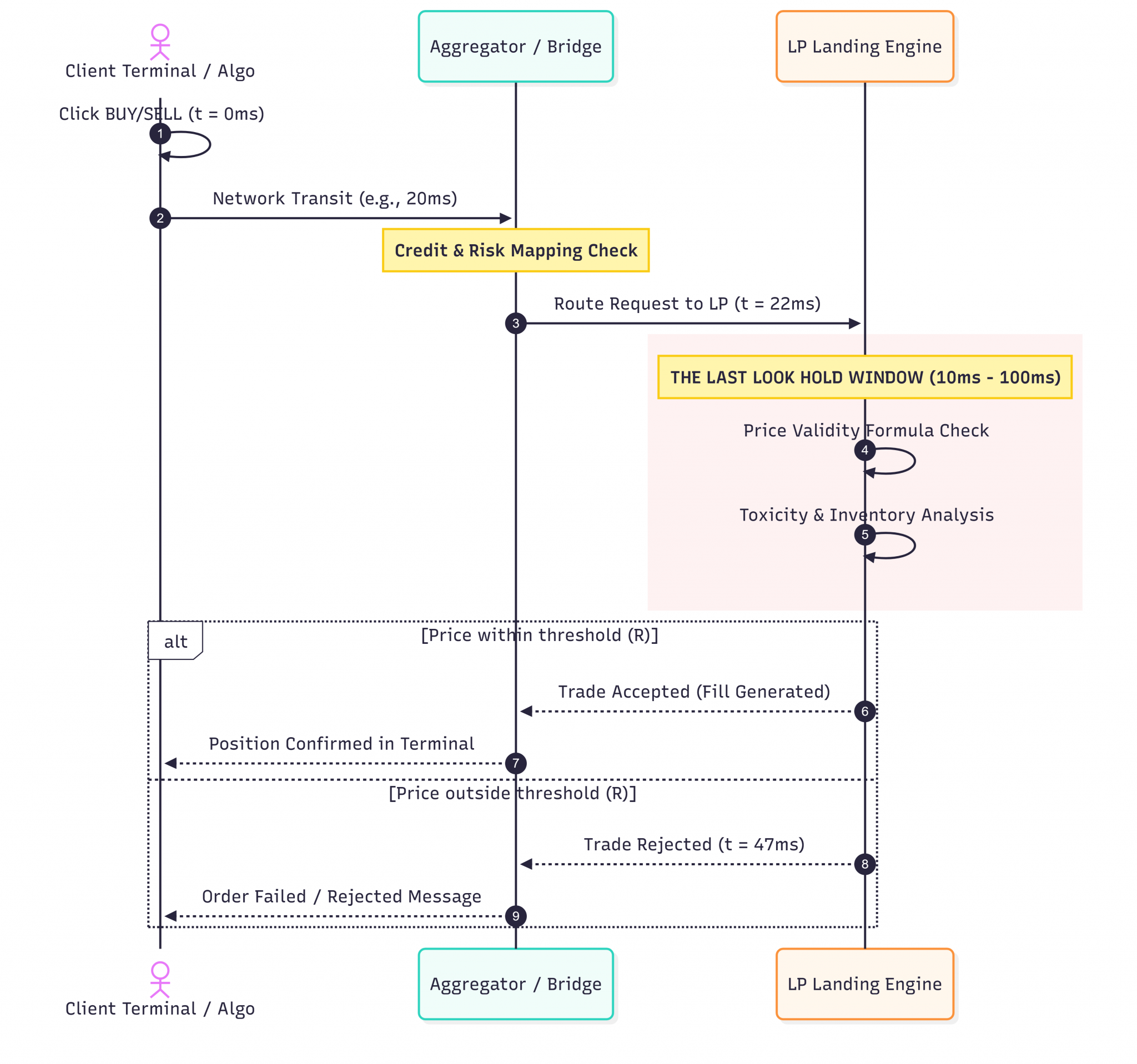
The client click is the moment the trader, algorithm, or broker routing engine sends the trade request. In institutional FX, this may be an RFQ response, a streaming executable price interaction, or an order submitted through a liquidity aggregator. In retail FX, the client may be several layers away from the LP. The retail platform sends to the retail broker, the retail broker sends to a bridge, the bridge sends to an aggregator, and the aggregator sends to LPs.
- Network transit is the first source of uncertainty. A trade request sent from a colocated server in Equinix LD4 to a London liquidity provider may arrive very quickly. A request sent from a home internet connection in another part of the world may arrive significantly later. In FX markets, “later” does not need to mean seconds, because even a delay of 20 milliseconds can matter. During fast-moving market conditions, that may be enough time for prices, liquidity conditions, or hedging opportunities to change.
- The broker bridge or aggregator receives the order and decides how to route it. It may send the request to the top-of-book LP, sweep multiple LPs, apply internal risk logic, or internalize part of the flow. If the broker uses a prime-of-prime, the order may also pass through credit and symbol mapping checks before reaching the LP.
- The LP landing engine receives the request. This is where the Last Look process becomes active. The LP’s system checks the trade request against the streamed quote, current market, internal reference price, client profile, toxicity metrics, credit limits, and disclosed acceptance criteria.
- Then comes the hold window, sometimes called the validity check period. The exact duration varies by LP, client arrangement, venue, and product. It is commonly discussed in milliseconds. A short hold window may be around 10 milliseconds. A longer one may approach 100 milliseconds. The shorter the window, the more the LP must absorb residual stale-price risk.
- At the end of the window, the LP accepts or rejects. Acceptance produces a fill. Rejection returns an execution failure to the liquidity taker, broker, or aggregator. The broker may then route elsewhere, fill internally, slip the client, or return a failed order message, depending on the execution model.
The Hold Window In Milliseconds
Let’s take a look at the process from an ever closer perspective to understand it better:
- At 0 ms, the LP streams EUR/USD at 1.10000/1.10002.
- At 3 ms, the broker’s aggregator displays or uses that quote.
- At 8 ms, the trader’s algorithm sends a buy request at 1.10002.
- At 15 ms, the request reaches the broker bridge.
- At 20 ms, the bridge sends the trade request to the LP.
- At 22 ms, the LP receives it and starts the Last Look hold window.
- If the hold window is 25 milliseconds, the LP may not accept or reject until roughly 47 ms. During that period, the LP’s internal reference price may change. If EUR/USD moves to 1.10008/1.10010, selling at 1.10002 is bad for the LP. Depending on the disclosed logic, the LP might reject the request. If EUR/USD instead moves to 1.09996/1.09998, selling at 1.10002 is good for the LP. The LP would benefit from accepting.
This is the core adverse selection debate. If the LP rejects only when the move is bad for it and accepts when the move is good, the trader receives a biased fill set. The trader’s filled trades are more likely to be worse than the visible quote suggested, while the rejected trades may have been the more profitable ones.
The GFXC Last Look report notes that inappropriate Last Look use may be indicated by patterns such as low acceptance rates, differences in the time taken to accept or reject trade requests, or significant market movement against the liquidity consumer when a request-to-trade is rejected.
The Mathematical and Economic Drivers Behind Last Look
Adverse Selection Defense
Liquidity providers stream prices to many venues at once. A bank or non-bank market maker may quote on single-dealer platforms, multi-dealer platforms, aggregators, prime-of-prime networks, and broker systems. Each venue has different latency, client mix, toxicity, order size, and rejection tolerance. Without Last Look, an LP streaming tight prices to fragmented venues faces stale quote risk. If the market moves and the LP cannot update every venue instantly, a low-latency trader can hit the stale quote before the update arrives. This is latency arbitrage. The trader is not predicting the market in the ordinary sense; the trader is exploiting the delay between one market updating and another venue still showing the old price. From the LP’s perspective, repeated stale quote hits create inventory risk. The LP is forced into positions at prices already known to be wrong. If this happens often enough, the LP must either widen spreads, reduce quote size, stop streaming to certain venues, or apply Last Look.
This is why Last Look and spread width are connected. LPs can quote tighter when they retain the right to reject toxic or stale requests. Remove that right, and they price the risk into the spread. For traders and policy makers, this is the trade-off. If we remove Last Look, LPs will adapt by changing other factors that ultimately impact traders. Liquidity provision is not charity, and if LPs cannot control adverse selection through a hold window, they will manage their risk through wider prices, smaller size, or no quote at all.
The Option Value of the Hold Window
The hold window has economic value, and that value rises when price volatility, price velocity, and window length rise.
Let:
Tₕ = hold window length in milliseconds
v = short-term price velocity in pips per millisecond
σ = short-horizon volatility during the hold window
Pq = quoted price
Pt = market reference price during validation
R = rejection threshold
Q = trade size
A simple deterministic movement during the hold window can be approximated as:
Expected Price Drift = v × Tₕ
If the LP quotes a sell price to the client and the market moves higher before acceptance, the LP would be selling too cheaply. The adverse movement is:
Adverse Move = Pt − Pq
A rejection condition might be simplified as:
If Adverse Move > R, then reject
The expected loss avoided by rejecting is approximately:
Avoided Loss = (Adverse Move − R) × Q
This is a simplified model, and real LP systems are more complex. They may compare the requested price against an internal fair value, multiple reference feeds, volatility bands, client-specific skew, markout history, credit exposure, and market depth. But the basic economics are the same. The LP owns a short window in which it can avoid trades that become unfavorable during transit.
As volatility rises, the probability of a meaningful move during the hold window rises. As the hold window gets longer, the probability rises again. As trade size increases, the dollar value of rejection rises.
A very short example shows why. Suppose a EUR/USD LP applies a 50 millisecond hold window. During normal conditions, price velocity might be 0.002 pips per millisecond. Expected movement is:
50 × 0.002 = 0.1 pips
That is small. Rejection probability may be low.
During a macro release, price velocity might jump to 0.08 pips per millisecond. Expected movement becomes:
50×0.08=4 pips
Now the same hold window becomes economically powerful. A four-pip move on a 20 million EUR/USD trade is material. The LP’s rejection option has real value.
This is why traders often see Last Look problems at the exact moment they most want certainty. During normal markets, tight Last Look pricing may feel excellent. During news, the hold window becomes a filter, and the best-looking price is often the least certain price.
Probability of Rejection
A basic rejection probability model can treat price movement during the hold window as a random variable.
If the short-term price change is:
ΔP follows a normal distribution with mean 0 and variance σ² × Tₕ
and the LP rejects the trade when adverse movement exceeds the threshold R, then the simplified rejection probability is:
Probability of Rejection = Probability that ΔP > R
For a directional trade request, this becomes:
Probability of Rejection = 1 − Φ(R / (σ × √Tₕ))
where Φ is the cumulative distribution function of the standard normal distribution.
This model is too clean for live FX. Price changes are not always normally distributed, especially during news. Jumps, clustered volatility, spread widening, and order book withdrawals matter. Still, the formula shows the relationship. If volatility rises or hold time increases, the denominator grows, and rejection probability rises. If the LP widens the tolerance threshold RRR, rejection probability falls, but LP stale-price risk rises.
Firm Liquidity vs. Last Look Spreads
The No Last Look model (also known as firm liquidity) removes the LP’s post-request rejection option. If the quote is executable and the trade request reaches the venue under the rules, the fill occurs. That improves certainty for the trader, but it also increases the LP’s risk.
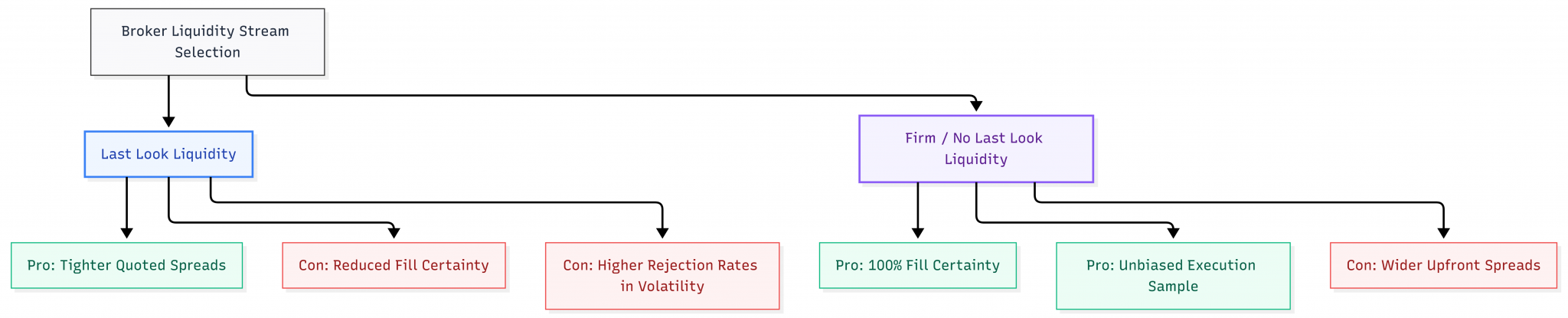
The economic trade-off is straightforward. Last Look streams can show tighter spreads because the LP retains a safety valve. Firm liquidity must price the risk upfront, and that usually means wider spreads, smaller displayed size, stricter credit controls, or selective access.
Last Look may show a 0.1 pip spread, but reject during high velocity conditions. Firm liquidity may show a 0.4 pip spread, but fill when hit. The cheapest visible spread is not always the cheapest realized execution.
This is especially important for high-frequency strategies. A scalper whose average target is 1.5 pips cannot ignore rejection bias. If the LP rejects the best 20% of entries and fills the rest, the strategy will definitely not play out as it did in the perfect world of play-money Demo Mode. A swing trader holding for 80 pips may, on the other hand, care less about occasional microstructure rejection and more about a lower average spread.
Regulatory Guardrails and Predatory Practices
The Debate
The “Last Look” debate is about whether Last Look is a fair and necessary risk-control tool in electronic FX trading, or a practice that opens up for opacity and unequal treatment between liquidity providers and clients.
Supporters of Last Look argue that it is essential for managing real-world FX market risks. They say prices can move extremely quickly, especially during volatile conditions, and without a brief validation window, liquidity providers would be forced to honor outdated prices. This could expose them to systematic losses from high-speed traders exploiting delays between price updates and execution. From this perspective, Last Look is seen as a legitimate safeguard that helps liquidity providers continue offering tight spreads and continuous liquidity to the broader market.
Critics of Last Look argue that the same mechanism creates asymmetry between liquidity providers and clients because the liquidity provider sees the order before deciding whether to accept it. This raises concerns that rejection decisions might not always be based purely on whether the price is stale, but could also be influenced by whether the trade is profitable or unfavorable for the liquidity provider. The lack of visibility into internal rejection logic, latency thresholds, or toxicity assessments makes it difficult for clients to determine whether they were rejected for legitimate market reasons or for discretionary reasons that are not fully transparent.
The debate became more prominent after episodes of FX market misconduct investigations in the early 2010s, which led to increased scrutiny of electronic trading practices. While these investigations were not specifically about Last Look, they triggered a much broader reassessment of FX market structure. This eventually contributed to the creation of the FX Global Code under the Global Foreign Exchange Committee, which did not ban Last Look but instead emphasized transparency. The Code’s position is essentially that Last Look can be used, but it should be clearly disclosed, and clients should understand the conditions under which orders may be rejected.
In practice, the debate continues because even with disclosure, there is still disagreement about how much transparency is enough and if we can trust LPs to actually honor their proclaimed policies. Some market participants believe Last Look is a necessary and well-controlled feature of modern FX market structure, while others believe it inherently creates an imbalance of information and therefore should be tightly constrained or eliminated.
So the core tension is between efficiency and protection against toxic flow on one side, and fairness and transparency in execution on the other.
In August 2021, the Global Foreign Exchange Committee published its “Execution Principles Working Group Report on Last Look”, which specifically discusses this topic and how Last Look should be handled to promote a fair market. The report supports Last Look as a legitimate risk-control tool, but argues that it should be used in a transparent, consistent, and narrowly defined way that aligns with disclosed policies and the FX Global Code principles. In essence, the report reinforces a “permit-but-constrain-through-transparency” approach rather than a prohibition or strict regulatory overhaul.
On the question of stricter regulation, the report does not recommend turning Last Look into a tightly regulated practice under law. Instead, it leans on the existing framework of voluntary market standards under the GFXC and the FX Global Code, combined with supervisory expectations from regulators that firms behave fairly and transparently. The implicit view is that formal hard regulation would be difficult to standardize globally and could reduce liquidity provision, while improved transparency and adherence to common principles are a more practical solution.
In their 2015 paper on Last Look, Norges Bank Investment Management (NBIM), the asset management arm of Norway’s central bank, takes a slightly more skeptical stance compared to the GFXC, and is a tad more positive to increased scrutiny and regulation of LPs and how they apply Last Look. This might not be very surprising, considering how NBIM is an arm of a central bank, while GFXC consists of senior representatives from both central banks and the private FX industry, including large global commercial banks that are FX liquidity providers and non-bank FX liquidity providers.
Norges Bank Investment Management (NBIM) describes Last Look as a feature that gives liquidity providers the option to reject orders received in response to their quote, and links the mechanism to latency arbitrage risk in fragmented high-speed markets. While acknowledging that Last Look serves a legitimate need of liquidity providers and can help improve available liquidity to investors, the paper also talks about the intrinsic conflicts that this feature creates. Although NBIM is fairly aligned with GFXC, NBIM can be said to lean a bit more heavily toward the idea that market discipline alone is not sufficient. It argues that without stronger transparency, clients cannot reliably evaluate execution quality or distinguish between legitimate stale-price rejections and potentially discretionary or selective behavior. In that sense, it implicitly supports greater scrutiny and clearer oversight of how Last Look is applied, particularly through disclosure requirements and the ability for clients to assess execution outcomes more rigorously.
However, it is important to be precise: NBIM does not call for direct statutory regulation or a ban on Last Look. Its core recommendation is enhanced transparency and better information for clients, which would allow both market participants and supervisors to more effectively monitor behavior.
Compared to that, the GFXC/FX Global Code approach is more explicitly consensus-based and industry-balancing. It accepts Last Look as part of market structure and focuses on ensuring it is used in a disclosed, consistent, and fair way. It does not frame Last Look primarily as a problem requiring heightened supervisory intervention, but rather as a practice that should be governed through principles of transparency and good conduct.
So the difference is this: NBIM is more explicitly critical of the information asymmetry and therefore more supportive of stronger transparency-driven oversight pressure, while the GFXC framework is more stabilizing and accommodation-oriented, aiming to standardize acceptable usage rather than intensify supervision. Neither proposes strict regulation or prohibition, but NBIM’s framing gives more weight to the need for external scrutiny to mitigate structural conflicts.
The Pre-Hedging Ban During the Hold Window
In this context, pre-hedging is hedging that happens before a trade is actually completed, i.e., before the LP is contractually bound by an executed client order. This makes it different from the normal type of hedging in FX, where an entity has already taken on risk from a filled trade and then offsets that exposure in the market, i.e. post-trade risk management.
With pre-hedging, the entity does not yet have a confirmed execution. Instead, it is acting on the expectation or knowledge that a client order is likely to be executed, or is in the process of being worked, for example, during an RFQ or Last Look window, and it may trade in the market to manage the anticipated exposure before final acceptance. The entity is managing risk before execution is finalized.
This distinction matters in the context of FX Last Look because the Last Look window creates a sensitive information asymmetry. With a Last Look workflow, the liquidity provider sees a client’s order details before final acceptance (or rejection). If the LP trades on that information before the client’s order is accepted, it raises concerns about whether the client’s information is being used fairly, even if the intent is risk management rather than exploitation.
It can be legitimate in some contexts when a dealer manages risk around an anticipated transaction, but it becomes problematic if it disadvantages the client or uses confidential order information improperly. During Last Look, the concern is sharp because the LP has not yet accepted the client’s trade. If an LP receives a buy request from a client, holds it, buys in the market ahead of acceptance, and then rejects or fills based on the resulting movement, the LP has transformed Last Look into an information advantage. That is the kind of behavior Principle 17 of the FX Global Code is meant to block.
The FX Global Code says market participants should not conduct trading activity during the Last Look window that uses information from the client’s trade request. Under the Code, the LP can check price validity, and it can apply disclosed controls. But it cannot treat the client’s request as a signal to trade for itself during the hold window.
Of course, in practical reality, a policy and a pinky-swear from an LP are not enough to ensure that the Code is adhered to, and this is a part of the problem. In order to properly evaluate an LP’s action, it would be necessary to carefully study records showing hold window length, rejection reasons, internal price reference, trading activity during the window, and whether any desk or automated strategy used the request information before acceptance.
Asymmetric Last Look Exploitation
While pre-hedging is a valid concern, most traders are more worried about reject/fill bias, i.e. the possibility that a liquidity provider’s accept/reject decisions are not driven purely by whether the price is stale, but also by whether the resulting trade is favorable or unfavorable to the provider.
With Last Look, the liquidity provider sees the order before it is finalized, and the trader has no visibility into the internal decision logic. As a result, traders can not know if orders are treated differently depending on which side the market has moved, or how profitable the trade would be for the liquidity provider.
In a symmetric model, the LP rejects trades according to disclosed price validity logic, regardless of whether the price movement favors the LP or the client. In practice, the exact symmetry may not be perfect because trade direction, spread, inventory, credit, and market state all matter. But the principle is that rejection should not be a one-way filter for the LP’s benefit. In an exploitative Last Look model that abuses the trader, the LP fills when the market moves in its favor and rejects when the market moves against it. For the trader, this creates a toxic accepted-trade sample. The trades that are filled are more likely to have poor immediate markout, and the trades that would have had good markout are more likely to be rejected.
This is why looking at fill ratio alone is not enough. A 95% fill ratio can still be bad if the rejected 5% are the most valuable trades. A 75% fill ratio can be acceptable if the rejections are disclosed, symmetrical, and economically consistent with stale price protection. Traders need markout analysis, not just a percentage.
The GFXC report identifies several indicators that may suggest inappropriate Last Look usage, including significant market movement against the liquidity consumer when trade requests are rejected. That is a direct route to testing reject/fill bias. If rejected trades would have benefited the trader much more than accepted trades, the trader needs to ask why.
Post-Trade Transparency
From the trader’s perspective, many of the variables that determine whether an order is accepted or rejected after Last Look are not directly observable. While the trader may estimate latency and infer market volatility, they typically do not know the LP’s rejection thresholds, flow-quality assessments, Last Look parameters, or client-specific execution settings. Consequently, post-trade transparency is important. Without it, the trader cannot reliably determine whether a rejection resulted from a genuinely stale quote, legitimate risk controls, or other discretionary execution criteria.
In the context of Last Look, post-trade transparency means giving the trader information after an order has been accepted or rejected so that the trader can better understand why that outcome occurred. The need for post-trade transparency arises because the trader cannot see what happens inside the liquidity provider’s systems during the Last Look window. The liquidity provider performs several actions, e.g. verifying whether the quoted price is still valid, assessing market movements, evaluating hedging conditions, and applying internal risk controls. Most of these processes are invisible to the trader, and without information provided by the LP, the trader does not know whether a rejection occurred because the market genuinely moved beyond an acceptable threshold, because the quote became stale, because the liquidity provider’s risk limits were reached, or because some other execution criterion was triggered.
Post-trade transparency helps bridge this information gap. It does not necessarily mean revealing the liquidity provider’s proprietary algorithms or internal decision-making models. Rather, it means providing enough information for the trader to assess whether execution outcomes are consistent with the liquidity provider’s stated policies. For example, if a liquidity provider claims that orders are rejected only when the market has moved materially during the Last Look window, then post-trade reports, execution statistics, or rejection analyses may allow traders to verify whether rejections actually occurred under those conditions. The goal is not to expose every internal detail but to give clients a reasonable basis for understanding and evaluating the execution they receive.
This is why post-trade transparency has become an important topic in discussions about Last Look. A trader can observe that an order was rejected, but without additional information, it can be difficult to distinguish between a legitimate stale-price rejection and some other discretionary decision. Greater transparency makes it easier for clients to assess whether the liquidity provider’s behavior is consistent, fair, and aligned with its disclosed execution practices.
Policy Information
Greater transparency makes it less difficult for clients to discern if a certain Last Look model would be right for them and fine-tune their trading strategy. An example of a strong disclosure set would be information about whether Last Look is used, the purpose of the hold window, the maximum hold time, the average hold time, whether hold time varies by client or product, acceptance ratio, rejection reasons, positive and negative slippage distribution, average response time for accepts, average response time for rejects, and whether client information is used during the window.
Many traders will not get that full set, not even if they ask the broker outright. Retail traders almost never do. Institutional clients have a better chance, especially if they trade through FIX, prime broker relationships, or direct liquidity agreements. But the principle remains. The more opaque the execution stack, the more the trader must assume hidden optionality exists.
A broker routing to Last Look LPs should be able to explain how it monitors LP behavior. Does it compare LP acceptance ratios? Does it remove LPs with poor markout? Does it measure reject latency? Does it disclose whether orders are routed to Last Look or firm liquidity streams? Does it pass positive slippage? Does it internalize rejected flow? But this is typically not information that a retail broker will happily volunteer in their glossy marketing brochure.
Why the Legal Brokerage Entity Matters in the Context of Last Look
Before signing up with any broker, you need to make sure you know exactly who your legal counterpart will be. This is important for many reasons. In the context of Last Look, where a broker is based and licensed can have a huge impact on disputes regarding execution quality, order rejections, and an LP’s Last Look practices. If a problem occurs, your rights, complaint options, and regulatory protections chiefly depend on the legal entity that holds your account, not on the country where you live or where the headquarters for the global broker brand is located.
It is possible for an online broker to accept traders from country A without being based in and licensed by Country A. For example, a broker might accept clients from Germany through an offshore entity based in The Seychelles, and the German trader holds a contract regulated by Seychelles law. This is something we’ve explained in detail in our guide that unpacks the structure and risks of offshore trading brokers.
Traders should therefore pay attention to which entity they are signing up with and under which regulator that entity operates. A broker’s marketing material may be global, but the terms, protections, and complaint procedures often vary significantly depending on exactly which company is your contractual counterpart.
Don’t Believe the Marketing Materials
Don’t put much stock in a broker’s global marketing material. You need to find out what is true for the exact legal entity you have as your legal counterpart and for your specific account type. When a broker advertises features such as “no Last Look,” “high fill rates,” or “best execution,” it can be unclear which companies and trading accounts those claims apply to.
Many global brokerage brands operate dozens of different companies in different jurisdictions around the world, and the execution model can differ significantly between different companies, between retail and professional accounts, between different account types (e.g. Dealer Desk vs. ECN), and between different liquidity streams offered by the broker.
Practical Auditing and Operational Mitigation for High-Frequency Traders
Auditing the Broker’s LP Mix
A programmatic trader should not ask only whether the broker offers low spreads. The more useful question is, what kind of liquidity creates those spreads? The broker may use bank LPs, non-bank market makers, ECNs, prime-of-prime aggregators, internalized flow, firm liquidity pools, Last Look streams, or a hybrid. The trader may not receive a full LP list, but they can still inspect execution behavior.
FIX API logs are the best evidence where available. They may show timestamps, order routing events, execution reports, reject messages, liquidity venue identifiers, last liquidity indicators, and response latencies. Platform journal logs are weaker but still useful. MT4 and MT5 logs can show order send time, modification time, rejection messages, and fill results. Broker-provided execution reports can add more detail if the broker is serious.
The trader should parse the response latency. A firm liquidity fill should generally produce a different latency signature from a Last Look rejection. If rejected trades consistently take 30 to 80 milliseconds longer than accepted trades, a hold window may be present. If response times cluster around a specific threshold, that may indicate validation logic. If rejects spike during news and immediately after price movement, Last Look or broker-side stale price controls are likely involved.
When you know more about the execution structure, you can better decide whether that structure suits your strategy.
Last Look Footprints In Logs
Common Last Look footprints include delayed rejects, asymmetric markout, lower fill rates during high velocity periods, different response times for accept versus reject, and higher rejects on client-favorable price moves. A simple audit table should include order ID, symbol, side, timestamp sent, timestamp acknowledged, timestamp filled or rejected, requested price, fill price, reference mid at send time, reference mid at response time, response latency, and five-second markout.
The markout is especially important. For a buy order, if the price rises after the trade request, the order would have been good for the trader and bad for the LP. If these orders are rejected more often than orders where price falls, the trader has evidence of adverse selection filtering.
A simple markout formula is:
Markout = Future Price − Execution Price
For buy orders, a positive markout favors the trader. For sell orders, the sign should be inverted:
Sell Markout = Execution Price − Future Price
The trader should compare accepted and rejected requests. If rejected requests show materially better theoretical markout than accepted trades, that is cause for concern. That may be a legitimate stale quote rejection, or it may be excessive optionality. Either way, it affects strategy performance.
Reducing Latency
Traders can reduce Last Look rejection risk by reducing latency. They cannot remove the LP’s optionality, but reduced latency reduces the risk of stale quotes.
Latency monitoring should track round-trip ping, jitter, packet loss, platform disconnects, order acknowledgement time, and execution response time. Average latency is not enough. A system with 5 ms average latency and periodic 300 ms spikes is dangerous for high-frequency execution.
A trader using a VPS or dedicated server close to the broker’s bridge or liquidity aggregator can reduce network transit time. Less transit time means the requested price is less stale when it reaches the LP. But colocating near the wrong server is useless. The trader needs to know where the broker’s trading server, bridge, and liquidity aggregation engine actually sit. A broker incorporated in Seychelles may host trading infrastructure in London. A UK-regulated broker may route certain liquidity through New York. The country of regulation and the server location are not the same thing.
Code efficiency also matters. An algorithm that receives a tick, performs heavy calculations, waits on external calls, and then sends an order has self-inflicted latency. Developers should precompute where possible, avoid blocking operations, reduce unnecessary logging during live execution, and separate signal generation from execution routing.
Strategy-Routing Matrix
An execution model that works well for one strategy can be horrifying for another. Notably, high-frequency scalping and news straddling are poor fits for Last Look liquidity. These strategies depend on fast fills during rapid price movement, which is exactly when Last Look rejection probability rises. They should route to firm liquidity or No Last Look pools where possible, accepting wider spreads in exchange for fill certainty. This is not because firm liquidity is cheaper on the screen. It usually is not. It is because a strategy with a tiny edge cannot survive selective rejection. Paying 0.4 pips firm may be cheaper than seeing 0.1 pips and missing the best fills.
Medium-term algorithmic execution can use Last Look streams more comfortably. If the holding period is hours or days and the trade is not built around a millisecond edge, tighter spreads may matter more than occasional rejection. A swing system trading EUR/USD with 80-pip targets is less sensitive to a 20ms validation window than a scalper targeting 1.2 pips.
Hedging flow depends on urgency. If the hedge must be completed immediately, firm liquidity is preferable. If the hedge can be worked passively or split across time, Last Look liquidity may reduce average spread cost. Corporate FX and real-money execution desks often care about both spread and certainty, so they evaluate LPs through transaction cost analysis.
Broker flow is more complicated. Retail brokers may route toxic or profitable flow to A-book Last Look LPs, internalize small flow, and use firm liquidity for certain products or conditions. The trader does not see this decision directly. The logs and fills are the only evidence.
When To Accept Wider Spreads
Traders often overpay attention to quoted spread and underpay attention to realized execution. Last Look makes this mistake worse because it can make the visible spread look artificially attractive. A wider firm spread can be rational when the strategy needs certainty, when the order size is meaningful, when the market is fast, when rejection cost is high, or when missed execution creates unhedged risk. This includes news trading, stop-loss execution, forced hedging, liquidation protection, and high-frequency strategies. A tighter Last Look spread can be rational when markets are calm, trade size is modest, latency is low, strategy horizon is longer, and execution urgency is low. The trader gets a lower visible transaction cost and accepts some conditionality.
The wrong move is to choose one model by ideology. No Last Look is not automatically better. Last Look is not automatically worse. Each is a cost structure. The trader’s job is to match the cost structure to the strategy.
Broker Questions That Matter
A serious trader should ask whether the broker uses Last Look liquidity, whether the account can access No Last Look streams, whether positive slippage is passed to clients, whether rejection rates are monitored by LP, whether the broker publishes execution statistics, whether the broker internalizes rejected flow, whether response times are available, whether the broker uses symmetrical rejection logic, and whether the broker can identify venue-level performance in post-trade reports. As stated above, you also need to know exactly which legal entity will be your counterpart.
Optimistic live chat answers are not enough. The order execution policy, client agreement, FIX specifications, LP disclosures, and post-trade reports carry more weight. If the broker cannot answer basic Last Look questions but advertises institutional liquidity, assume the answer is not favorable.
Building A Defensible Execution Audit
A defensible audit should run over a statistically meaningful sample. 10 trades prove little. Hundreds or thousands of orders across market conditions are better. The audit should separate normal market hours from news, major pairs from exotics, small orders from large orders, and entries from exits. The audit should measure fill ratio, rejection ratio, average response time, response time by accept and reject, average slippage, positive slippage rate, negative slippage rate, markout after accepted trades, theoretical markout after rejected trades, and execution cost versus independent reference data.
If the broker is regulated in jurisdiction with strong trader protection, the audit can support a formal complaint if execution appears inconsistent with the order execution policy. If the broker is in a jurisdiction with weak trader protection, the audit still matters, but legal recourse may be weaker. In the latter case, the audit is mainly a way to spot if a broker is wrong for you and your strategy. The best dispute is the one avoided.
Is Last Look Exclusive to FX Trading?
Last Look is most commonly associated with electronic spot FX trading, though similar discretionary acceptance or confirmation mechanisms exist in other OTC markets under different names and structures. When similar behaviors can exist in other markets (for example, dealer RFQ systems or OTC derivatives workflows where quotes can be refreshed, withdrawn, or require confirmation), these are not typically referred to as “Last Look” and do not operate under the same standardized FX market convention.
Last Look, as a defined term, market convention, and execution model, is overwhelmingly associated with electronic spot FX and some precious metals OTC trading. Outside of that, you can see analogous behaviors, but they are not formally called Last Look and are not implemented in the same standardized way.
Discretionary Acceptance Mechanisms in Precious Metal Trading
In precious metals OTC trading, particularly for gold and silver, you can find mechanisms that are similar to Last Look, but they are not called Last Look. These discretionary acceptance mechanisms are not used in a consistent or formally standardized way across the gold and silver markets.
The discretionary acceptance mechanism appears mainly because the trading structure of spot precious metals closely resembles the FX spot in practice. Both markets are largely OTC, both rely heavily on streaming electronic prices from banks and large liquidity providers, and both involve fast-moving, electronically matched order flow. Dealers in the precious metals gold, silver, platinum, and palladium face similar risks to FX dealers, including price movement between quote and execution, exposure changes during the latency window, and arbitrage-driven or toxic flow that can be difficult to hedge instantly. Because of these shared structural features, FX-style execution safeguards such as post-request validation windows have emerged in some precious metals trading systems.
In FX, “Last Look” is a widely recognized concept with a relatively established meaning in industry discussions and regulatory scrutiny. In precious metals, the same or similar functionality is more often described in other ways, such as quote validation, RFQ acceptance logic, or dealer discretion within streaming pricing systems. The exact label varies depending on the specific liquidity provider, trading venue, or internal bank.
There is no dedicated precious metals “Last Look” regulatory framework. Instead, oversight comes from broader financial regulation and contractual structure. Depending on jurisdiction, general conduct rules such as best execution obligations, fairness principles, and market abuse regulations apply through frameworks like the UK FCA regime, MiFID II in Europe, or US regulatory systems, depending on the entities and instruments involved. In addition, the London Bullion Market Association (LBMA) provides widely used industry guidance for precious metals market conduct, but it does not formally define or regulate “Last Look” as a mechanism. In practice, the actual permission to accept or reject trades is governed by bilateral agreements between counterparties, platform rulebooks, and internal risk management policies of liquidity providers.
Mechanisms such as quote validation, RFQ acceptance logic, or dealer discretion within streaming pricing systems are not exclusive to precious metals, but they are more common there than in industrial metals. Precious metals like gold and silver are heavily financialized and trade in deep, fast-moving OTC markets that resemble FX spot in structure, including streaming prices and high-frequency electronic trading. That makes them more compatible with FX-style execution controls. Industrial metals such as copper, aluminum, and zinc tend to be more exchange-referenced or physically anchored, often trading on venues like the LME or through slower OTC negotiation processes. Those structures reduce the need for ultra-fast post-quote acceptance or rejection logic, so FX-style “last look” mechanisms are less central and often unnecessary.
When it comes to precious metals, discretionary acceptance mechanisms similar to Last Look are chiefly associated with gold and silver. They are the most liquid and electronically traded metals, and these markets have the deepest OTC streaming liquidity and the closest resemblance to FX spot market structure. Platinum and palladium can also exhibit similar dynamics, but typically with less consistency due to lower liquidity and greater reliance on dealer-specific pricing and RFQ workflows. For less liquid or more niche precious metals products, trading is more likely to occur through traditional request-for-quote negotiation rather than FX-style streaming liquidity systems with any kind of last-look-like functionality.