





London Stock Exchange (LSE) brokers offer access to one of the world’s top trading hubs. We rank the best brokerages with access to the London Stock Exchange for active traders based on our hands-on tests in 2026, explain what to consider when comparing providers, walk through a step-by-step guide to placing a trade on the LSE, and answer key questions for beginners.
Top Brokers With Access To The LSE
After reviewing broker market coverage and testing their platforms, these are our leading choices for trading London Stock Exchange-listed markets:
-
- Demo account
- Min. deposit: $0
- Min. trade: $1
-
- Demo account
- Regulator: FINRA, SEC
- Min. deposit: $250

Learn how we test brokers and why you can trust our ratings.
Why Did These LSE Brokers Stand Out?
Here is a summary of why we recommend these brokers in October 2026:
- Interactive Brokers is the best broker with access to the LSE in 2026 4.3/5 Interactive Brokers (IBKR) is a premier brokerage, providing access to over 170 markets across 40 countries, along with a suite of comprehensive investment services. With over 40 years of experience, this Nasdaq-listed firm adheres to stringent regulations by the SEC, FCA, CIRO, and SFC, amongst others, and is one of the most trusted brokers for trading around the globe.
- Zacks Trade 3.9/5 Zacks Trade is a FINRA-regulated US broker offering trading on stocks, ETFs, cryptocurrencies, bonds and more through a proprietary terminal. The broker is geared toward active traders and offers very affordable fees on most assets as well as an app and a vast amount of market data.
How Reliable Are The Best LSE Brokers?
We examined each broker’s regulatory credentials, account protections and wider safety measures:
| Broker | Trust Rating | Guaranteed Stop Loss | Negative Balance Protection | Segregated Accounts |
|---|---|---|---|---|
| Interactive Brokers | ✘No | ✘No | ✔Yes | |
| Zacks Trade | ✘No | ✘No | ✘No |
Are The Top LSE Brokers Good For New Traders?
We looked at how easy these brokers make it for beginners to access and trade LSE-listed markets:
| Broker | Demo Account | Minimum Deposit | Minimum Trade | Education Rating | Support Rating |
|---|---|---|---|---|---|
| Interactive Brokers | ✔Yes | $0 | $1 | ||
| Zacks Trade | ✔Yes | $250 | $3 |
Are The Best LSE Brokers Suitable For Experienced Traders?
Experienced traders usually want strong UK market access, efficient execution, advanced tools and competitive pricing for LSE-listed instruments - here’s how the top brokers compare:
| Broker | Automated Trading | VPS | AI | Pro Account | Leverage | Low Latency | Extended Hours |
|---|---|---|---|---|---|---|---|
| Interactive Brokers | TWS API | ✘No | ✔Yes | ✘No | 1:50 (major forex pairs), 1:2-1:4 (equities) | ✔Yes | ✔Yes |
| Zacks Trade | Yes (algos) | ✔Yes | ✘No | ✘No | - | ✘No | ✘No |
Compare Ratings For The Top LSE Brokers
See how the leading LSE brokers performed across the main areas in our review process:
| Broker | Trust | Platforms | Assets | Mobile | Fees | Accounts | Research | Education | Support |
|---|---|---|---|---|---|---|---|---|---|
| Interactive Brokers | |||||||||
| Zacks Trade |
Community Sentiment
See how users rate these brokers based on the average customer ratings submitted on DayTrading.com, plus ratings from Trustpilot, the Apple App Store and Google Play.
| Broker | Our Users' Rating | Trustpilot Score | Trustpilot Reviews | iOS App Rating | Android App Rating |
|---|---|---|---|---|---|
| Interactive Brokers | 5527 | ||||
| Zacks Trade | - | 13 |
Which LSE Trading Platforms Are The Most Widely Used?
We reviewed client figures across our top-rated broker choices:
Why Use Interactive Brokers To Trade LSE Markets?
Interactive Brokers is one of the best brokers for advanced day traders, providing powerful charting platforms, real-time data, and customizable layouts, notably through the new IBKR Desktop application. Its superb pricing and advanced order options also make it highly attractive for day traders, while its diverse range of equities is still among the best in the industry.
 Christian Harris, Reviewer
Interactive Brokers quick facts
- Demo Account
- ✔Yes
- Instruments
- Stocks, Options, Futures, Forex, Funds, Bonds, ETFs, Mutual Funds, Cryptocurrencies
- Regulator
- SEC, FINRA, CFTC, NFA, CIRO, FCA, CBI, ASIC, SFC, SEBI, JFSA, MAS
- Platforms
- Trader Workstation (TWS), IBKR Desktop, GlobalTrader, Mobile, Client Portal, AlgoTrader, OmniTrader, TradingView, eSignal, TradingCentral, ProRealTime, Quantower
- Minimum Deposit
- $0
- Minimum Trade
- $1
- Account Currencies
- USD, EUR, GBP, CAD, AUD, INR, JPY, SEK, NOK, DKK, CHF, AED, HUF
Stock Exchanges
Interactive Brokers offers trading on 18 stock exchanges:
- Abu Dhabi Securities Exchange
- Borsa Italiana
- CAC 40 Index France
- Chicago Mercantile Exchange
- Euronext
- IBEX 35
- Japan Exchange Group
- Korea Exchange
- London Metal Exchange
- London Stock Exchange
- Nairobi Securities Exchange
- Nasdaq
- Nasdaq Nordic & Baltics
- New York Stock Exchange
- Russell 2000
- Shenzhen Stock Exchange
- Tadawul
- Toronto Stock Exchange
Pros
- IBKR continues to deliver unmatched access to global stocks with tens of thousands of equities available from 100+ market centres in 24 countries, most recently the Saudi Stock Exchange.
- The new IBKR Desktop platform takes the best of TWS while adding bespoke tools like Option Lattice and Screeners with MultiSort to create a genuinely impressive trading experience for day traders at every level.
- IBKR is one of the most respected and trusted brokerages and is regulated by top-tier authorities, so you can have confidence in the integrity and security of your trading account.
Cons
- TWS’s learning curve is steep, and beginners may find it challenging to navigate the platform and understand all the features.
- IBKR was fined $11.8m by the US OFAC in 2025 for providing services in sanctioned jurisdictions. It was also fined $125k by FINRA in 2025 for municipal bond disclosure failures.
- Support can be slow and frustrating based on tests, so you might find it challenging to reach customer service representatives promptly or encounter delays in resolving issues.
Why Use Zacks Trade To Trade LSE Markets?
Zacks Trade will suit active day traders with experience using advanced trading software. Fees and margin rates are low while the market research is excellent.
Christian Harris, Reviewer
Zacks Trade quick facts
- Demo Account
- ✔Yes
- Instruments
- Stocks, ETFs, Options, Mutual Funds, Bonds, Warrants, IPOs
- Regulator
- FINRA, SEC
- Platforms
- Zacks Trade Pro (Desktop), Zacks Trader (Web), and Handy Trader (App)
- Minimum Deposit
- $250
- Minimum Trade
- $3
- Account Currencies
- USD, EUR, GBP, CAD, AUD, NZD, INR, JPY, ZAR, TRY, SEK, NOK, DKK, CHF, HKD, SGD, PLN, CZK, HUF
Stock Exchanges
Zacks Trade offers trading on 4 stock exchanges:
- London Stock Exchange
- Nasdaq
- New York Stock Exchange
- S&P 500
Pros
- The ability to place trades by phone with a human broker at no additional charge beyond the standard penny-per-share commission is a genuine rarity among discount brokers. Most competitors either don't offer this at all or charge a meaningful premium for it, making it one of the few features here that Zacks Trade genuinely owns.
- While Zacks Trade charges commissions that most competitors have eliminated, it wins back ground on borrowing costs. Its margin rates start at 8.83% — a figure that sits notably below what traders pay at the major household-name brokers — making it a practical choice for anyone who regularly carries leveraged positions overnight. The savings are modest on small balances but compound meaningfully for traders running larger margin books across a full year.
- Most brokers at this price point offer little beyond basic charts and a news ticker. Zacks Trade goes considerably further — standard accounts come with over 20 free research subscriptions, plus access to more than 80 additional paid options spanning providers like Morningstar, Dow Jones, Seeking Alpha, and Thomson Reuters.
Cons
- Traders cannot access forex, cryptocurrencies, commodities, or futures — a meaningful gap for anyone trading across multiple asset classes. Given that the infrastructure runs through Interactive Brokers, which supports all of these, it feels like an artificial ceiling rather than a genuine platform limitation.
- The account-opening process is fully digital but overly complicated, with verification taking more than a week in some cases. Multiple document steps and an experience-assessment stage before approval make this one of the more tedious onboarding processes in retail brokerage, at a time when most competitors have it down to hours.
- Most brokers have dropped stock and ETF trading to $0, making Zacks Trade's penny-per-share fee stand out. For casual traders, the cost is negligible, but a 10,000-share trade costs $100 in commission — and in a market where zero-commission alternatives are everywhere, that's a harder position to defend.
How We Selected The Best Brokers With Access To The LSE
To choose the best trading brokers for London Stock Exchange access, we:
- Checked which brokers in our database provide LSE-listed instruments. This involved signing up with brokers, reviewing their market coverage, and, where possible, logging into their platforms to verify access to UK shares, ETFs, investment trusts, indices or other LSE-related products. A number of our team have bought and hold stocks listed on the LSE.
- Ranked LSE brokers using our complete broker scoring framework. Our scores draw on more than 200 data points, including LSE market availability, charges, regulatory oversight, platform performance, execution quality, research tools and account features, alongside the views of our expert reviewers after hands-on testing.
Critical Factors When Choosing An LSE Broker
LSE traders vary widely in their goals. A FTSE 100 momentum trader scalping Shell on an earnings day has very different needs from someone swing-trading an AIM-listed biotech. Below are the factors we weight most heavily when comparing London Stock Exchange brokers, based on our hands-on testing.
Direct Market Access (DMA) vs Retail Routing
Trading directly on LSE order books is unusual at the retail level. Instead, most London Stock Exchange brokers route your orders through Retail Service Providers (RSPs) – middlemen who quote prices in small volume increments, and you can only trade at the price they show.
For active traders, this is a meaningful drag. DMA and order book access give you faster execution, the ability to sit between bid and ask, and visibility into the depth of book – all of which matter on volatile days when spreads widen. On a liquid FTSE 100 name like BP or HSBC, shaving a fraction of a penny off the spread adds up quickly over hundreds of trades a month.
Brokers that offer genuine LSE order book access include Interactive Brokers (0.05% of trade value fixed commission on UK shares, minimum £3) and IG (via L2 Dealer and ProRealTime). If you’re a swing trader in FTSE 100, retail routing may be fine; if you’re scalping AIM stocks or trading size, DMA is important given how essential cost control is when trading frequently.
Regulation and Fund Safety
Brokers should be authorized by ‘green tier’ bodies in our regulator database, such as the UK’s Financial Conduct Authority (FCA). This helps provide safeguards like client money held in segregated accounts and eligible deposits covered by investor compensation schemes if the broker fails.
Costs – Commissions, Spreads, and Stamp Duty
LSE trading costs are not just about headline commissions. The full cost stack on a typical UK share purchase looks like this:
- Commission – Ranges from £0 (some newer brokers) to around £10 per trade at full-service firms. Interactive Brokers charges 0.05% of trade value (£3 minimum) for UK shares on direct routing.
- Spread – Tight on FTSE 100 stocks, noticeably wider on AIM small-caps.
- UK Stamp Duty Reserve Tax – 0.5% on most UK share purchases (AIM stocks are exempt). This is a government tax, not a broker fee, but it hits every buy order.
- PTM Levy – £1 flat fee on UK trades over £10,000.
- FX conversion – If you fund your account in USD or EUR, conversion costs on GBP-denominated trades can add 0.25%-1% depending on the broker.
- Overnight financing / swap fees – Only applies to CFD and margin positions, not share ownership.
Look for LSE brokers that publish a clear, itemised fee schedule. If you have to dig through three pages to find out what a trade actually costs, that’s a red flag.
Platform Quality and Level 2 Data
The platform is your interface to the market. For active LSE traders, we look for:
- Level 2 / order book data – Important for AIM stocks and anything outside the top 50 by volume, where you need to see real depth to judge whether a fill is achievable.
- Reliable charting – Integrated TradingView is a big plus, as is support for ProRealTime on IG’s platform. Some brokers have good to great charting features built in; with others, traders commonly prefer outside charting platforms.
- Mobile parity – The best LSE brokers offer apps that match the desktop in functionality, not a stripped-down viewing client.
- Alerting – Price, news, and technical alerts pushed to phone or email.
IG, for example, offers its own proprietary web platform plus access to MetaTrader 4 and ProRealTime. Personal preference is a big factor. Some traders swear by MT4, others find it poorly suited to equities. Test a few in demo mode before committing.
LSE-Specific Instrument Availability
Not every broker gives you the full range of LSE products. When comparing, check whether the broker offers:
- Full Main Market coverage – All FTSE 100, FTSE 250, and FTSE SmallCap constituents.
- AIM stocks – Some brokers restrict access to AIM’s smaller names or charge wider spreads.
- LSE-listed ETFs – Including UK-focused trackers and GDR-heavy index products.
- Fractional shares – Increasingly offered on US stocks but still rare on LSE names. Still worth checking if you want to build a position in higher-priced FTSE 100 stocks like Rightmove or AstraZeneca without committing to full share prices.
- GDRs (Global Depositary Receipts) – For exposure to emerging-market firms listed via London.
Extended Hours and Overnight Trading
Traditional LSE hours run 08:00-16:30 London time, but an increasing number of brokers offer extended-hours equivalents on LSE CFDs or US ADRs of UK-listed firms, letting you react to after-hours news. Research from Sodali & Co suggests that over 40% of daily equity volatility already occurs overnight, making extended-hours access genuinely useful for news-driven traders. If you want to react to a mining sector announcement from Australia before London opens, extended-hours capability matters.
Customer Service
The best London Stock Exchange brokers provide access to responsive support – integrated live chat and UK-based phone lines are more useful than automated bots. Look for human support during LSE hours at minimum; 24/5 is a bonus.
LSE brokers with 24/5 customer service include XTB, FxPro, and Interactive Brokers.
LSE – Headline Details
- Direct Market Access (DMA) beats retail routing for active LSE traders. It cuts out Retail Service Provider middlemen. In turn, this gives you faster execution and the chance to trade inside the spread on liquid FTSE 100 stocks.
- Regulation is non-negotiable. Many of the best London Stock Exchange brokers are authorised by the UK’s Financial Conduct Authority and offer FSCS protection up to £85,000 on eligible cash.
- Costs vary widely – commissions, spreads, FX conversion fees on GBP trades, and UK Stamp Duty Reserve Tax (0.5% on most UK share purchases) all chip away at returns. Look for fee-transparent, low-commission brokers.
- Platform quality matters for active trading on volatile small-caps and AIM-listed stocks. Level 2 order book data, reliable charting, and mobile parity separate a usable platform from a competitive edge. Many top LSE brokers integrate TradingView charts for technical analysis.
- Try before you commit. Most top LSE brokers offer demo accounts with virtual funds. This way you can test execution, spreads, and the platform on real LSE instruments risk-free.
How To Place A Trade On The London Stock Exchange
Here’s the step-by-step process I followed to place an LSE trade. This walkthrough mirrors what you’ll see on most of the platforms in our toplist.
Step 1: Open and fund the account (or use demo)
I have an Interactive Brokers account and have been using them since the very beginning. It’s my personal favourite and a broker that you never really have to worry about outgrowing.
Step 2: Search for the ticker
I searched for Shell (ticker: SHEL). IBKR is a well-built platform, and it came up instantly with the exchange clearly flagged as LON or LSE. This is important because Shell is also cross-listed in New York, and you don’t want to accidentally buy the US ADR if you meant the primary London listing.
Step 3: Check the spread
Shell showed a bid-ask spread of around 0.02% on screen during the continuous session – tight, as expected for a FTSE 100 heavyweight. For comparison, an AIM small-cap I looked at next showed a spread closer to 1.5%. This is the single biggest reason active traders stick to liquid names: the spread on small-caps eats your edge before the trade even moves.
Step 4: Choose order type
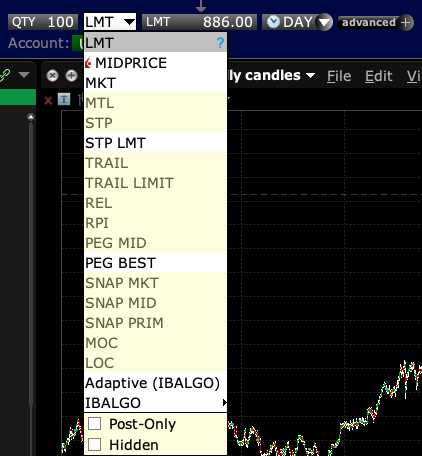
For a liquid FTSE 100 stock mid-session, a market order could be fine. You’ll fill near the quoted price. At the same time, a limit order helps you fill at your specified price.
For less liquid stocks, around auctions, or on news days, a limit order helps to avoid getting gapped. I always use limit orders, but it’s a personal preference.
IBKR has a wide range of order types.
Step 5: Review the order confirmation
The confirmation showed me: estimated total cost (share price x quantity), commission, PTM levy where applicable, stamp duty (0.5% on Shell as a Main Market stock – AIM stocks are stamp-duty exempt), and any FX conversion if I were funding in a non-GBP currency.
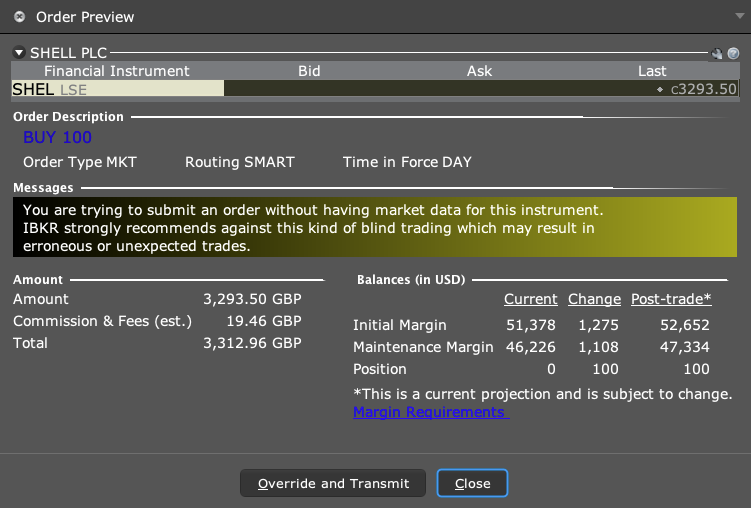
Total all-in cost is the number that matters, not the headline commission.
Step 6: Place the trade and monitor
If you set a limit order, it will then show up in your queue.

Prices can gap a lot between the pre-auction indicative and the actual uncross. If you must trade the open on a smaller name, use a limit order. And always check when a company is scheduled to report earnings. Surprise numbers at 07:00 UK time can move mid-caps 10% or more before the bell.
What Is The London Stock Exchange?
The London Stock Exchange (LSE) is the UK’s main stock exchange and one of the world’s oldest continuously operating exchanges, founded in 1801. It hosts over 1,900 companies from more than 60 countries.
Since 2007, the LSE has been operated by the London Stock Exchange Group (LSEG), which itself trades on the exchange under ticker LSEG.
The building is physically located in the London borough of Westminster at 10 Paternoster Square, next to St Paul’s Cathedral, London, EC4M 7LS. In addition to the headquarters, LSEG has operations across multiple financial hubs worldwide including New York, Bengaluru, Milan, and Colombo.
Online LSE brokers and platforms are based in various investing hubs around the world, from the UK to Europe and Asia.
History
Key milestones in the LSE’s history include:
- 1571 – Queen Elizabeth I opened the Royal Exchange, though stockbrokers were barred from it due to their manners.
- 1698 – John Castaing began posting stock and commodity prices at Jonathan’s Coffee House.
- 1773 – 150 brokers formed a new “Stock Exchange” in Sweeting’s Alley.
- 1801 – The London Stock Exchange was formally founded as a regulated exchange.
- 1812 – The ‘First Rule Book’ was introduced, covering trade settlement and defaults.
- 1986 – The LSE was deregulated on October 27 (“Big Bang”), bringing electronic trading and ending the traditional open-outcry floor.
- 1995 – The Alternative Investment Market (AIM) was launched for smaller growth companies.
- 2007 – Merger with Borsa Italiana formed London Stock Exchange Group (LSEG).
- 2015 – FTSE Group and Russell Indexes combined to form FTSE Russell.
- 2021 – LSEG completed its acquisition of Refinitiv, transforming the group into a major global financial data provider.
- 2026 – The FTSE 100 surpassed the 10,000-point milestone for the first time.
Primary and Secondary Markets
Primary markets:
- Main Market – Houses established firms from more than 60 countries. The FTSE 100 Index measures the performance of the 100 largest UK-listed firms on this market.
- Alternative Investment Market (AIM) – Smaller, high-growth firms trade here. AIM uses a simpler admission procedure and attracts early-stage through to established growth companies seeking expansion funding. AIM stocks are exempt from UK Stamp Duty Reserve Tax, a meaningful advantage for active traders.
Secondary market instruments traded: Bonds, derivatives, debt securities, common stock, covered warrants, structured products, gilt-edged securities, ETFs, ETCs, and Global Depositary Receipts (GDRs).
Indices
- FTSE 100 – The benchmark, tracking 100 of the LSE’s largest blue-chip companies
- FTSE 250 – The 101st to 350th largest firms by market cap
- FTSE 350 – The FTSE 100 and FTSE 250 combined
- FTSE SmallCap – Smaller companies outside the FTSE 350 but on the Main Market
- FTSE All-Share – The aggregate of the FTSE 100, 250, and SmallCap
- FTSE AIM All-Share and FTSE AIM 100 – Covering the AIM market
Trading Hours
Standard London Stock Exchange market hours are 08:00 to 16:30 local time, Monday to Friday, excluding UK bank holidays. The detailed daily schedule is:
- Trade reporting – 07:15-07:50
- Opening auction – 07:50-08:00
- Continuous trading – 08:00-16:30
- Closing auction – 16:30-16:35
- Order maintenance – 16:35-17:00
- Trade reporting only – 17:00-17:15
The market is closed on UK bank holidays: New Year’s Day, Good Friday, Easter Monday, May Bank Holiday, Spring Bank Holiday, Summer Bank Holiday, Christmas Day, and Boxing Day. If New Year’s Day, Christmas Day, or Boxing Day fall on a weekend, the next business day is observed. The exchange also closes early or fully on 24 and 31 December.
London Stock Exchange brokers often provide an updated holiday calendar so you are not caught out by closures.
FAQs
What companies can I trade with London Stock Exchange brokers?
Popular LSE-listed firms accessible through most brokers include AstraZeneca, HSBC, Shell, Unilever, Rolls-Royce, Rio Tinto, BP, Barclays, Lloyds, GlaxoSmithKline, BAE Systems, National Grid, Vodafone, Diageo, RELX, Compass Group, Prudential, plus thousands of AIM-listed small caps. Check your broker’s instrument list before opening an account if there’s a specific name you want to trade.
Can I trade the London Stock Exchange from a broker in the USA?
Yes. US-based brokers such as Interactive Brokers offer direct access to LSE-listed stocks. Tax treatment (including the US-UK tax treaty on dividends and UK Stamp Duty on buys) is worth understanding before you start.
Do LSE brokers offer Level 2 data?
Most of the best London Stock Exchange brokers for active trading offer Level 2 order book data, though sometimes as a paid add-on. Level 2 shows the full depth of bids and offers rather than just top-of-book, and is close to essential for trading AIM small-caps or any name outside the most liquid FTSE 100 constituents.
What is the equivalent of the S&P 500 on the LSE?
The FTSE 100 is the closest comparison – it tracks the 100 largest UK-listed companies, similar to how the S&P 500 tracks the 500 largest US firms. The main difference is weighting: the FTSE 100 is dominated by financials, energy, pharma, and miners, whereas the S&P 500 is heavily tech-weighted.