





Main Differences Between Multilateral Trading Facilities (MTFs) And Systematic Internaliser (SIs)
Multilateral Trading Facilities (MTFs) and Systematic Internalisers (SIs) have their similarities, but they are not the same thing, and they are treated differently under MiFID II.
Under MiFID II, an MTF is a venue, while an SI is not.
- Under MiFID II Article 4, an MTF is a multilateral system operated by an investment firm or market operator that brings together multiple third-party buying and selling interests in financial instruments, in the system and under non-discretionary rules, in a way that results in a contract.
- Under MiFID II Article 4, a Systematic Internaliser (SI) is an investment firm that, on an organized, frequent, and systematic basis, deals on its own account in equity instruments by executing client orders outside a regulated market, MTF, or OTF, without operating a multilateral system, or opts into SI status. That phrase “without operating a multilateral system” is important. If the firm is bringing together multiple client buying and selling interests in a system, it is no longer just internalizing bilaterally; it is drifting into trading venue territory. MiFIR Article 23(2) says an investment firm operating an internal matching system that executes client orders in shares, depositary receipts, ETFs, certificates, and similar instruments on a multilateral basis must ensure it is authorized as an MTF and comply with the relevant MTF provisions. That rule exists because regulators do not want firms to build private exchanges while pretending they are just bilateral dealers. A firm can be an SI. A firm can operate an MTF. It cannot blur the two whenever convenient. Well, it can try. Regulators have built a fair amount of machinery to stop that particular game.
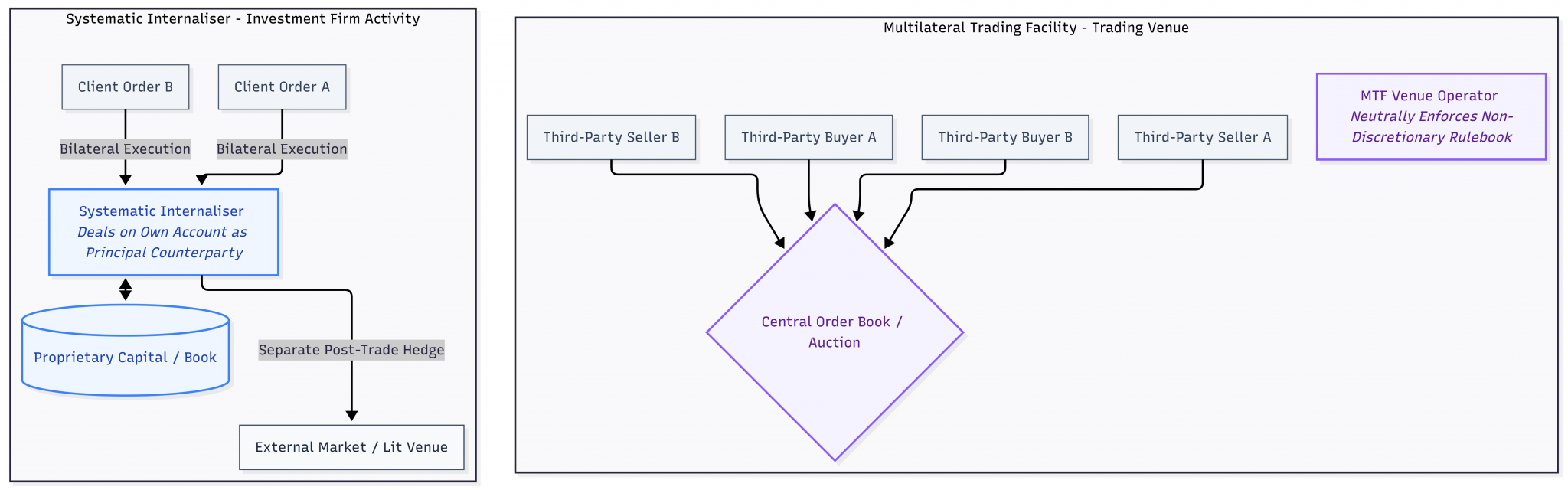
The two models create different risk, transparency, and price formation effects.
- On an MTF, the operator runs a rulebook and matching environment. The operator is not meant to choose trade-by-trade whether it wants to be the other side. The value of the model is rule-based interaction between participants. Under MiFID II, MTF operators must use non-discretionary execution rules and are not allowed to execute client orders against proprietary capital or engage in matched principal trading on the MTF.
- On an SI, the firm is dealing on its own account when executing client orders. It is quoting, accepting or declining client flow, and managing the market risk that comes from being the counterparty. An SI is an investment firm dealing on its own account when executing client orders outside a regulated market, MTF, or OTF. It is bilateral, not multilateral. The client trades against the SI, and the SI manages the resulting market risk. The SI may publish quotes and provide useful liquidity, but it is not a trading venue.
The differences are important, and MiFID II takes them seriously. Multilateral matching belongs in a regulated market, MTF, or OTF. Bilateral own-account internalization belongs in the SI framework. A firm that runs an internal matching system for client orders on a multilateral basis cannot simply call itself an internaliser and avoid the MTF obligations.
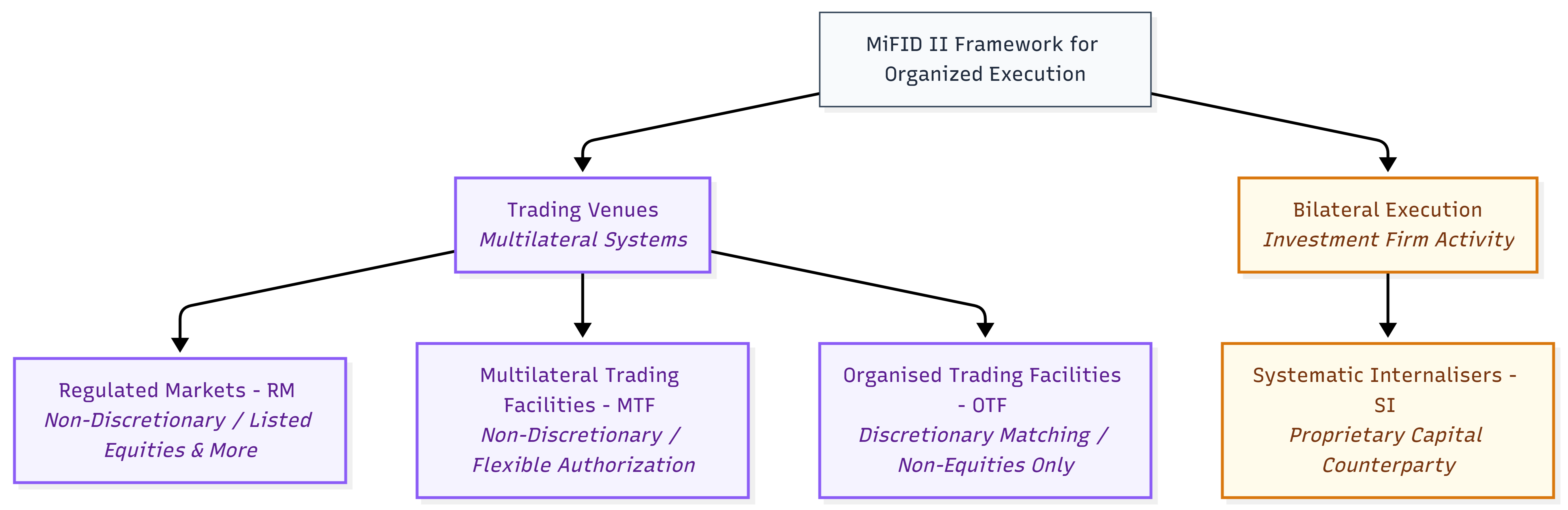
MiFID II Categories For Organised Trading
MiFID II separates organized trading into categories. The main categories are regulated markets, MTFs, and OTFs. These are trading venues. SIs sit outside that venue category, even though an SI can be a permitted execution channel for certain instruments.
Regulated Markets
A regulated market is the traditional exchange-style category. The regulated market is a multilateral system operated or managed by a market operator, bringing together multiple third-party buying and selling interests under non-discretionary rules, resulting in contracts in instruments admitted to trading under its rules. Well-known examples of regulated markets in the European Union are Deutsche Börse, Euronext Amsterdam, and Nasdaq Stockholm.
A regulated market is a fully licensed exchange operated by a market operator and authorised as a regulated market under MiFID II. It is the highest regulatory category of trading venue under MiFID II, and typically what people mean by a “stock exchange”.
Many of the regulated markets in Europe have very old roots. Euronext Amsterdam can, for instance, trace its roots to the Amsterdam Stock Exchange, founded in 1602 by the Dutch East India Company (VOC). It is widely regarded as the world’s oldest stock exchange. Over centuries, it evolved from an open-air trading venue into a modern electronic exchange. In 2000, it became part of the pan-European exchange group Euronext, forming Euronext Amsterdam.
MTFs
An MTF is similar to a regulated market when it comes to trading functionality, but it sits under a different authorisation framework and has a bit more flexibility. It can be operated by an investment firm or a market operator.
Examples of well-known MTFs in the EU are Cboe Europe, Aquis Exchange Europe SAS, Euronext Access, and Nasdaq First North Growth Market. Euronext Access and Nasdaq First North Growth Market are primarily listing venues, whereas Cboe Europe B.V. and Aquis Exchange Europe SAS are primarily secondary trading venues competing with regulated markets for order flow.
- Cboe Europe B.V. (Netherlands): This is one of the largest MTFs for equities, and it competes directly with national stock exchanges across Europe. Based in Amsterdam, it is authorized by Autoriteit Financiële Markten (AFM). The parent company for this MTF is Cboe Global Markets, headquartered in Chicago, USA.
- Aquis Exchange Europe SAS (France): This MTF trades shares listed across many European markets and is a large MTF for equity in the EU. It is authorised by the Autorité des marchés financiers. In 2024, SIX Group, which operates SIX Swiss Exchange, acquired Aquis Exchange PLC.
- Euronext Access: This MTF, which is operated within the Euronext group, primarily serves Small and Medium-sized Enterprises (SMEs) and growth companies seeking a lighter listing regime than a regulated market. Euronext Access is smaller than Cboe Europe B.V. and Aquis in terms of trading activity.
- Nasdaq First North Growth Market: This MTF is operated by the Nasdaq exchanges in Sweden, Finland, Denmark, and the Baltic states. It is designed for growth companies rather than being a primary venue for large-cap equity trading.
In addition to the larger MTFs, there are also smaller and more specialized MTFs present in the EU, e.g. niche MTFs for bond trading, derivatives, or specific national markets.
OTFs
An Organised Trading Facility (OTF) is another multilateral system. It is used for the trading of bonds, structured finance products, emission allowances, and derivatives. Multiple third parties who are buying and selling interests in bonds, structured finance products, emission allowances, or derivatives interact in a way that results in a contract. Execution is carried out on a discretionary basis.
Equities are not permitted on an OTF under MiFID II, subject to very narrow structural edge cases.
Unlike a regulated market or an MTF, the operator of an OTF exercises discretion in arranging or executing transactions, subject to the requirements of MiFID II. The fact that the operator exercises discretion in arranging or executing transactions is a defining feature of an OTF. The operator may exercise discretion when deciding whether to place an order into the system, and/or when deciding whether to match two compatible orders. By contrast, on an RM or MTF, orders are matched according to non-discretionary rules established by the venue. If two orders satisfy the matching algorithm, the venue does not decide whether they should trade.
MiFID II introduced the OTF category to bring previously less regulated dealer-driven trading (particularly in fixed income and derivatives) within the regulatory framework for trading venues. Before MiFID II, much trading in these instruments occurred through broker-dealer systems that did not fit neatly into the existing categories of regulated markets or MTFs. The new category was created by MiFID II to regulate dealer-assisted and discretionary multilateral trading, primarily in non-equity instruments, while recognising that these markets function differently from equity exchanges.
Examples of firms operating OTFs authorised under MiFID II include:
- Tradeweb Europe Limited (fixed income and derivatives)
- Bloomberg Trading Facility B.V.
- MarketAxess Europe Limited
SIs
MiFID II’s own definitions make the map clear. Article 4 of MiFID II defines a “trading venue” as a regulated market, an MTF or an OTF. It does not include an SI in that definition. An SI is an investment firm activity, not a venue category.
- An MTF is a multilateral trading venue, while an SI is a bilateral dealer execution model run by an investment firm.
- An MTF matches multiple third-party interests, while an SI deals on own account against client orders.
- An MTF has venue rules, while an SI has investment firm obligations plus SI transparency and quoting duties where applicable.
The difference is not cosmetic. It decides who the client faces, how the price is formed, what transparency regime applies, what surveillance obligations exist, and whether the operator is permitted to use its own capital in the execution.
A broker receiving a retail order in an EU share may route it to a regulated market, an MTF, an SI, or an equivalent third-country venue, subject to the share trading obligation and execution policy. MiFIR Article 23 says investment firms must ensure trades in EEA ISIN shares traded on a trading venue take place on a regulated market, MTF, SI, or equivalent third-country venue, unless an exception applies. That is why traders see SIs in execution reports alongside regulated markets and MTFs. They are all permitted execution destinations.
When it comes to price formation, a regulated market or MTF is a multilateral system where the price forms through interaction between multiple participants under the rulebook. An SI will instead provide or accept bilateral liquidity using its own account. The SI may use external market data, hedge elsewhere, manage inventory, and quote competitively, but the execution is against the SI. The client is not being anonymously matched with another third-party client.
Examples of firms operating as Systematic Internalisers (SIs) under MiFID II include:
- Citadel Securities, a major electronic liquidity provider active in European equity markets.
- XTX Markets, which provides electronic liquidity across multiple asset classes, including European equities.
- Jane Street, which operates as a liquidity provider in various European markets.
- Optiver, active in electronic market making and liquidity provision.
- Major investment banks, including Deutsche Bank, JPMorgan Chase and Goldman Sachs, which operate SI businesses in various asset classes.
What Is An MTF?
A Multilateral Trading Facility (MTF) is a system that brings together multiple third-party buying and selling interests in financial instruments. It must do so under non-discretionary rules, and the result must be a contract.
An MTF is structurally closer to an exchange than to a broker-dealer, but it is not a regulated market (RM). Its instruments may be equities, ETFs, bonds, derivatives or other financial instruments depending on authorisation and rules. The trading architecture is multilateral and rule-driven.
Multiple Third-Party
The phrase “multiple third-party buying and selling interests” is important. The MTF is not meant to be a private bilateral quote channel where one dealer faces all clients. It is not supposed to be a broker manually matching selected clients with selected liquidity when it feels like it. There must be a multilateral interaction between third-party interests. Those third-party interests can be orders, quotes, or actionable indications of interest depending on the trading model, but the core point is that more than one participant can interact with more than one other participant under the system’s rules.
MiFID II requires MTFs (and OTFs) to have at least three materially active members or users, each having the opportunity to interact with all the others in respect of price formation. That requirement appears in MiFID II Article 18(7). It is there to stop a platform being nominally multilateral while functionally operating as a one-dealer channel. If only one market maker realistically sets every price and all client flow goes to that same party, the label multilateral does not fit.
Non-Discretionary Rules
The second key feature of an MTF is non-discretionary rules. Under MiFID II Article 19, an MTF operator must establish and implement non-discretionary rules for executing orders in the system. Non-discretionary means the operator cannot decide case by case whether it likes a given match once the rules say the trade should execute.
Non-discretionary does not mean every venue uses the same matching algorithm. An MTF can, for instance, operate a central limit order book, a request-for-quote system, a periodic auction, a block crossing mechanism, or another rule-based system.
Operator Neutrality In Execution
The third key feature is operator neutrality in execution. MiFID II Article 19 states that Member States must not allow firms or market operators operating an MTF to execute client orders against proprietary capital or engage in matched principal trading on the MTF. That is a major difference from an SI. The MTF operator can earn fees, run technology, set access criteria, and enforce the rulebook. It cannot use the MTF as a way to trade against its users on its own book.
MiFID II Article 18 adds more venue-level obligations. MTF operators must have transparent rules and procedures for fair and orderly trading, objective criteria for efficient order execution, transparent rules on instruments traded, non-discriminatory access rules based on objective criteria, conflict management arrangements, adequate systems and contingency arrangements, settlement responsibility disclosures, and notification to competent authorities.
An MTF must also monitor activity on its systems. MiFID II Article 31 requires operators of MTFs and OTFs to monitor orders, cancellations and transactions to identify rule breaches, disorderly trading conditions, market abuse indicators and system disruptions. An SI, on the other hand, must comply with market abuse and transaction reporting obligations like other firms, but it is not running a multilateral venue surveillance function in the same way.
An MTF is best understood as a regulated matching environment. The operator creates the system, admits members or users, defines the rulebook, applies objective access criteria, publishes relevant data, monitors activity, and ensures trades executed under the system are handled according to the rules. A broker routing a client order to an MTF is not asking the MTF operator to decide whether to take the other side. The broker is sending the order into a system where it may interact with multiple third-party interests. If it matches, it matches under the rulebook. If it does not, it rests, expires, is cancelled, or follows whatever the venue rules say.
How Do Orders Cross On An MTF?
The mechanics of an MTF depend on the trading model, but the regulatory logic stays the same. Third-party interests interact inside the system under non-discretionary rules. A key point is that execution is between third-party interests. If a retail broker sends an order to an MTF, that order may be entered under the broker’s membership, through a direct market access arrangement, through an algorithm, or through another routing structure. The order can interact with other brokers, market makers, proprietary firms, institutions, or other participants. The MTF operator runs the system, but it is not the bilateral counterparty. The MTF functions as a marketplace for matching third-party buying and selling interests, and does not serve as a dealer that executes trades as principal from its own balance sheet.
For institutional orders, MTFs can be used to source liquidity without exposing too much information to a single dealer. A buy-side firm may, for instance, use an MTF for block trading, periodic auctions, or RFQ competition. For retail orders, the client may not know the MTF by name, but the broker’s execution report may show the venue. The retail client sees “executed.” Behind it, the broker’s smart order router may have compared a regulated market, an MTF, and an SI, then routed based on price, cost, likelihood of execution, speed, and other best execution factors.
MTF With Central Limit Order Book
In a central limit order book, participants submit priced orders, and the orders are matched according to matching rules. The ranking is typically based on price-time priority, but some venues use other published matching algorithms (e.g., pro-rata allocation, size priority, or hybrid methods).
When a buy and sell order are compatible, the system matches them. The operator does not pick the counterparty by hand or any other discretionary method. It all happens according to the published matching rules.
MTF With Periodic Auction
In an MTF with periodic auction, orders accumulate during a defined window, and the system uncrosses at an auction price according to published rules. This can concentrate liquidity and reduce market impact. Again, the venue operator is not deciding manually which client deserves a fill. The rulebook governs the result.
MTF With RFQ-Style Trading
An RFQ (Request for Quote) is a trading protocol in which a participant asks one or more liquidity providers, dealers, or market makers to provide prices for a specific instrument. The providers respond with quotes (bid, offer, or both), and, depending on the venue’s rules, the requester may choose to execute against one of those quotes.
In an RFQ-style MTF, a participant requests quotes from multiple liquidity providers or members. The venue’s rules define:
- Which participants can receive the RFQ.
- Whether other participants can see the RFQ or the responses.
- When quotes become firm and executable.
- How long quotes remain valid.
- How trades are matched and executed.
RFQ-style MTFs must still meet MiFIR and MiFID transparency and rulebook requirements. ESMA’s Q&A work on transparency has repeatedly focused on how RFQ systems should provide pre-trade transparency and comply with trading venue obligations. The broad point is simple: calling something RFQ does not remove the need for the system to behave like a venue if it is an MTF.
Are All MTF’s Lit?
No, an MTF can be lit or dark, and it can also vary within the same MTF depending factors such as instrument, trading model, and waivers. This means that some MTFs publicly display quotes and orders before execution (lit), others keep that information hidden until after a trade is completed (dark), and some MTFs even offer both lit and dark trading for different instruments or trading models.
For equity and equity-like instruments, MiFIR Article 3 requires trading venues to make public current bid and offer prices and depth of trading interests advertised through their systems, with calibration for order book, quote-driven, hybrid, and periodic auction systems. Waivers can apply, for example, for large-in-scale orders or certain other conditions, but the starting point is venue transparency.
How Does The MTF Make Money?
An MTF typically earns transaction fees, data fees, connectivity fees, and/or membership fees. It is not supposed to make its money because clients lose to its proprietary book.
An MTF is not free from conflicts-of-interest. It may own data, charge complex fees, favour certain order types, design market maker incentives, or compete for flow. But the central execution conflict is different from an SI because the MTF operator is not meant to trade against participants.
Under MiFID II, an MTF can offer market maker incentive schemes, but only if they are designed and applied in a way that is fair, transparent, and non-discriminatory. The MTF can, for instance, provide fee rebates or reduced fees for firms that meet certain liquidity-provision obligations. The incentive scheme must support fair and orderly markets rather than distort trading. The MTF venue rulebook tells participants how orders are prioritised, cancelled, amended, matched, auctioned, suspended, rejected, crossed, and settled. It also tells them which participants can access the venue, what instruments can be traded, what conduct is prohibited, and how errors are handled.
What Is A Systematic Internaliser (SI)?
A Systematic Internaliser (SI) is an investment firm that internalises client orders by dealing on own account outside a trading venue. It is not a multilateral trading venue. Under MiFID II, the SI is a dealer model with specific transparency and conduct rules.
Under MiFID II and MiFIR, a Systematic Internaliser (SI) is an investment firm that, on an organised, frequent, systematic and substantial basis, deals on its own account by executing client orders outside a regulated market, MTF or OTF, without operating a multilateral system. An investment firm may also choose to opt in and be treated as an SI even if it does not meet the quantitative thresholds.
The delegated rules specify how to assess whether an investment firm meets the SI thresholds. Commission Delegated Regulation (EU) 2017/565 sets out the detailed calculation methodologies for determining Systematic Internaliser (SI) status across different asset classes, including shares, bonds, structured finance products, derivatives, and emission allowances. The “substantial basis” assessment is determined using quantitative criteria based on the firm’s OTC trading activity, measured against the firm’s total trading activity in the relevant financial instrument and/or the total Union-wide trading activity in that instrument. The relevant quantitative criteria are set out in Articles 12–17 of Commission Delegated Regulation (EU) 2017/565, depending on the asset class concerned.
- Article 12 – Shares, depositary receipts, ETFs, certificates and similar instruments
- Article 13 – Bonds
- Article 14 – Structured finance products
- Article 15 – Derivatives
- Article 16 – Emission allowances
- Article 17 – Relevant assessment periods
Understanding The Term “Internaliser”
The word “internaliser” can be confusing. It does not mean the SI matches clients against each other inside a private venue. That would be multilateral matching. It means the firm internalises by using its own account. The client order is executed against the firm’s proprietary capital. The SI may hedge immediately elsewhere, internalise risk temporarily, offset inventory later, or manage the position as part of a wider book. But the client’s trade is always with the SI.
Commission Delegated Regulation (EU) 2017/565 clarifies that a Systematic Internaliser (SI) must not operate a multilateral system or bring together multiple third-party buying and selling interests in a manner functionally equivalent to a trading venue. An SI cannot operate an internal matching mechanism that matches client orders with other client orders on a multilateral basis. Using the SI label to avoid venue rules while functionally running a private matching system is not permitted. MiFID II and MiFIR draw the line at multilateral interaction.
In practice, an SI may receive a client order, quote a price, execute against its own book, then hedge on an exchange, MTF, another SI, an OTC dealer, or not at all. The SI’s client sees a fill from the SI. The SI sees a risk position. If the client buys 10,000 shares from the SI, the SI sells from inventory or shorts and then manages that exposure. If the client sells, the SI buys. The SI may be providing price improvement relative to public markets or offering execution in size with lower market impact. It may also be capturing spread and information value.
The SI model can be useful for both liquidity providers and clients seeking bilateral execution. In fragmented European equity markets, SIs can provide an additional source of liquidity by executing broker and client flow bilaterally, including at or inside publicly available prices where permitted. In fixed income and derivatives markets, where trading is often quote-driven and relationship-based, SI-style execution may align naturally with existing dealer-client practices. For example, a bond client may request a price from a dealer, the dealer provides a quote, and the client decides whether to execute. This bilateral interaction is closer to the SI model than to an anonymous central limit order book.
The conflict is also clear. The SI is the counterparty. It may profit from spread, inventory management, hedging efficiency, and client flow characteristics. If the SI has an informational advantage or routes only certain flow into its own book, clients can suffer. In the European Union, the regulatory answer has not been to treat SIs as exchanges. Instead, MiFID II imposes specific quotation, transparency, conduct, and reporting obligations designed for SIs. Under MiFID II, a lawful SI is essentially a dealer with strong transparency obligations.
Opting-In To SI Status Under MiFID II
MiFID II Article 4(1)(20) defines a Systematic Internaliser (SI) as an investment firm that, on an organised, frequent, systematic and substantial basis, deals on own account by executing client orders outside a regulated market, MTF or OTF, without operating a multilateral system. The definition also allows an investment firm to voluntarily opt in to SI status. This means that an investment firm does not need to meet the quantitative SI thresholds in order to elect SI status for one or more financial instruments.
The opt-in mechanism does not allow an MTF to choose to be classified as an SI. An SI cannot operate a multilateral system or bring together third-party buying and selling interests in a manner equivalent to a trading venue. The opt-in provision applies to investment firms that engage in bilateral dealing on own account outside a regulated market, MTF or OTF and wish to assume the regulatory obligations applicable to SIs even where they do not meet the quantitative thresholds.
Note: An investment firm can wear different regulatory hats for different activities, provided it complies with the applicable rules and keeps the activities appropriately separated. For example, an investment firm might operate an MTF as one part of its business and be an SI for certain OTC client trading outside that MTF.
Why Would A Firm Elect SI Status?
A firm might, for instance, choose SI status because it wants to provide clients with a recognized OTC execution venue, because it seeks greater control over client execution and liquidity provision, because it wants to compete with exchanges and MTFs for order flow, or because it has a business model that aligns with internalizing client orders.
The Process
Firstly, the firm makes an internal business decision to operate as an SI for specified instrument classes (or specific instruments), even though the quantitative thresholds are not met.
The next step is to notify the firm’s national competent authority (NCA) that it intends to act as an SI. The exact notification process varies by EU member state because each NCA administers its own procedures. The firm does not notify the European Securities and Markets Authority (ESMA) or any other EU-level authority directly, although NCAs and trading venues may subsequently provide relevant information to ESMA in accordance with the applicable regulatory framework.
Once an investment firm has opted in to SI status in accordance with the applicable regulatory procedures, it must comply with all SI obligations from the date its SI status becomes effective. This will for instance include publishing firm quotes where required for liquid instruments, executing client orders in accordance with SI rules, meeting transparency obligations, complying with best execution and recordkeeping requirements, and following the conduct and reporting obligations applicable to SIs.
How Do Orders Execute Through an SI?
An SI execution is bilateral. The client order is executed against the SI’s own account. The SI may provide a firm quote, respond to a request, stream prices, or execute at a reference price depending on the instrument and rules, but the legal counterparty is the SI.
For equity instruments, MiFIR establishes a pre-trade transparency regime applicable to Systematic Internalisers (SIs). The public quote requirement is designed to reduce the transparency gap between venue trading and systematic internalisation, for the applicable instruments. Pursuant to MiFIR Article 14, an investment firm that is a Systematic Internaliser in shares, depositary receipts, ETFs, certificates, or other similar financial instruments admitted to trading on a trading venue must make public firm quotes where the relevant instrument has a liquid market, and the SI is prompted for a quote by a client. Where the relevant instrument does not have a liquid market, the SI is not subject to the public quotation obligation but must disclose its quotes to clients on request where it agrees to provide a quote.
The execution path is usually straightforward. The broker or client requests a price or sends an order. The SI checks the instrument, size, client, risk limits, and current market. The SI accepts and fills from its own book or rejects under its terms. The SI then updates inventory and may hedge. Hedging is separate from the client execution. If the SI sells shares to the client and later buys shares on an MTF to flatten risk, the client’s trade is still with the SI, not with whoever sold to the SI on the MTF. That separation is the whole model. The SI can warehouse risk, quote selectively within regulatory limits, provide midpoint executions, offer price improvement, manage information leakage, and reduce market impact for larger orders. It can elect to internalise retail flow, which is popular since retail flow is often less toxic than institutional flow.
Asset And Class
The SI regime differs across asset classes. For equity and equity-like instruments, MiFIR establishes a relatively extensive pre-trade transparency regime, including public quotation obligations for Systematic Internalisers (SIs) in liquid instruments under specified conditions. By contrast, the transparency framework for non-equity instruments has been significantly revised by Regulation (EU) 2024/791, which amended MiFIR. The amending regulation explains that the previous pre-trade transparency requirements for SIs in non-equity instruments under Articles 18 and 19 of MiFIR required the publication of quotes that were typically tailored to individual clients and therefore provided little informational value to the wider market. As a result, those SI quote publication requirements were removed. This illustrates that the SI regime is calibrated according to the characteristics of different asset classes rather than applying a single, uniform transparency framework across all financial instruments.
No Multilateral System
As explained above, an SI cannot operate a multilateral system. If Client A wants to buy and Client B wants to sell, the SI cannot simply run an internal matching engine where those two client interests interact in a venue-like way while avoiding MTF classification. Instead, the SI can buy from one client and sell to another as principal. It can manage inventory. It can match risk economically on its own book. But the legal execution remains bilateral: Client A trades with the SI, and Client B trades with the SI. The two clients do not directly interact with each other under a multilateral rulebook.
That may sound like a technical distinction, but it changes everything. In bilateral principal trading, the SI stands between the clients and takes execution and market risk. In multilateral venue trading, the system brings third-party interests together directly or functionally under applicable rules designed for multilateral venue trading. A practical way to test the structure is to ask: Who is the counterparty at the moment of execution?
Examples Of Main Differences Between MTFs And SIs Under MiFID II
Legal Category
The first regulatory difference is legal category. An MTF is a trading venue. An SI is an investment firm operating an internalisation activity and is not a trading venue. MiFID II’s definition of trading venue includes regulated markets, MTFs, and OTFs, but not SIs.
Multilateral Vs. Bilateral Trading Structure
An MTF brings together multiple third-party buying and selling interests. An SI deals against client orders on its own account and is not allowed to operate a multilateral system. Understanding this difference is necessary to understand the other regulatory difference, since everything else flows from it.
Discretion Vs. Non-Discretionary Execution Rules
An MTF must have non-discretionary execution rules. Once orders meet the published conditions for execution, the system follows the rulebook. An SI has discretion in whether to quote, how to manage risk, whether to accept certain flow within the applicable rules, and how to hedge. That does not mean the SI can ignore best execution or discriminate unlawfully, but it makes it clear that the SI is a dealer, not an automatic rule-based matching engine for third parties.
Price Formation
On an MTF, price forms through the interaction of third-party interests under rules. On an SI, price is formed by the dealer’s quote or response, usually by reference to public markets, internal models, inventory, and risk. The SI is not a public order book.
Proprietary Capital
An MTF operator is not allowed to execute client orders against proprietary capital or engage in matched principal trading on the MTF. This rule is stated in MiFID II Article 19(5). An SI, by definition, deals on its own account when executing client orders. The MTF is structurally neutral in execution. The SI is structurally principal.
Principal Market Risk
An SI carries market risk because it deals on its own account. It may hedge that risk quickly, but the client’s execution is still against the SI. An MTF operator is not the execution counterparty. Therefore, it does not normally carry the same principal market risk from each trade as an SI does.
Access
MTFs must establish, publish, maintain, and implement transparent and non-discriminatory access rules based on objective criteria under MiFID II Article 18(3). An SI is not an open venue in the same way. The SI deals with clients and may apply client-by-client commercial relationships, subject to conduct, transparency, and non-discrimination constraints where applicable. An SI can not be required to give every market participant venue-style access to interact with every other participant, because there is no such participant interaction in the first place.
Surveillance
MTF operators must monitor orders, cancellations, and transactions on their systems to identify rule breaches, disorderly trading, market abuse indicators, and system disruption under MiFID II Article 31. An SI must comply with market abuse rules, transaction reporting, and internal controls, but it is not running a multilateral order book with venue-level member surveillance obligations. It faces dealer supervision duties, not venue operator duties.
Transparency
The seventh difference is transparency calibration. MTFs are subject to trading venue pre-trade and post-trade transparency rules. In equities, MiFIR Article 3 requires trading venues to make public current bids, offers, and depth advertised through the system. For SIs, equity transparency is handled through firm quote obligations under MiFIR Article 14. These are different forms of transparency. The MTF shows the state of trading interests in a system. The SI publishes dealer quotes where required.
Price Formation: MTFs Vs. SIs
As noted above, the price formation mechanics constitute a major difference between MTFs and SIs.
On an MTF, price forms through the interaction of third-party interests. On an SI, price is formed by the dealer’s quote or response. This explains a main point of policy tension between how MTFs and SIs are regulated within the EU. Regulators want trading to be efficient, competitive, and accessible, but they also worry that too much execution away from transparent venues can weaken public price discovery.
MTFs contribute to price formation because trading interests interact in a multilateral system. A lit order book displays bids, offers, and depth. A periodic auction publishes auction information under the relevant transparency model. An RFQ MTF may publish or make available pre-trade information according to its design and MiFIR requirements. The key point is that the MTF’s system can generate price signals from participant interaction. MiFIR’s equity venue transparency rule is clear. Article 3 of MiFIR requires market operators and investment firms operating a trading venue to make public current bid and offer prices and depth of trading interests advertised through their systems for shares, depositary receipts, ETFs, certificates, and similar instruments traded on a trading venue. That requirement is calibrated by trading system type.
A Systematic Internaliser (SI) contributes to market transparency in a different way from a trading venue (including MTFs). Where the applicable conditions are met, an SI is required to make public firm quotes in certain liquid equity and equity-like instruments. However, those quotes represent the SI’s own bilateral dealing interest rather than the aggregated buying and selling interests of multiple market participants. Pursuant to MiFIR Article 14, an investment firm that is a Systematic Internaliser in shares, depositary receipts, ETFs, certificates or other similar financial instruments admitted to trading on a trading venue must make public firm quotes where the relevant instrument has a liquid market, and the SI is prompted for a quote by a client. The purpose of this pre-trade transparency regime is to increase the visibility of bilateral dealer liquidity and to facilitate price competition and best execution, while preserving the fundamentally bilateral nature of the SI model.
Pre-Trade Transparency: MTF Vs. SI
MTFs and SIs contribute to market transparency in fundamentally different ways because they represent different execution models. An MTF is a multilateral trading system where multiple third-party buying and selling interests are brought together under non-discretionary rules. An SI, by contrast, is an investment firm executing client orders bilaterally against its own account and does not operate a multilateral system.
The practical distinction concerning pre-trade transparency is therefore:
- For an MTF, the pre-trade transparency is the visibility of a multilateral pool of trading interests (unless a waiver applies).
- For an SI, the pre-trade transparency is the visibility of a dealer’s own liquidity where regulatory requirements require publication.
Both models can provide liquidity, but they support price formation in different ways. MTFs contribute through interaction between multiple participants, while SIs contribute through bilateral dealer liquidity and competition among liquidity providers.
For MTFs, pre-trade transparency is linked to the visibility of market interest. A lit MTF displays orders, prices, and available liquidity to the market, allowing participants to interact with the displayed order book. However, an MTF is not necessarily always fully transparent. Under MiFIR, an MTF remains a regulated trading venue even where its trading model benefits from an approved pre-trade transparency waiver. Such waivers allow certain types of trading systems or transactions to operate without publishing the full pre-trade information normally required under MiFIR Article 3. As a result, an MTF may offer non-displayed or partially hidden liquidity while continuing to operate within the regulatory framework applicable to trading venues.
For SIs, pre-trade transparency operates differently because the liquidity originates from the investment firm’s own trading interest rather than from an aggregated order book. In equity and equity-like instruments, MiFIR Article 14 requires an SI in certain liquid instruments to make public firm quotes where the applicable conditions are met. These quotes represent the SI’s own prices and available liquidity. They do not represent the combined interests of multiple market participants. The 2024 MiFIR reforms illustrate that pre-trade transparency requirements are not applied identically across asset classes. Regulation (EU) 2024/791 removed the previous SI pre-trade transparency requirements for non-equity instruments because those quotes were often tailored to individual clients and provided limited informational value to the wider market. A quote provided by a bond dealer to a specific client for a specific size and circumstance may not contribute meaningfully to general price discovery.
Post-Trade Transparency: MTF Vs. SI
Post-trade reporting also differs. Trades executed on a venue (e.g. an MTF) are reported under the venue’s regime. OTC trades through an SI are published through the appropriate post-trade transparency route, usually involving an Approved Publication Arrangement, depending on the instrument and rules. The technical details vary by asset class and reform timeline, but the policy aim is the same. Market users should know trades occurred, at what price and size, subject to deferrals and exemptions where allowed.
The key distinction is:
- For the MTF, post-trade transparency shows completed transactions resulting from interaction between multiple market participants on a trading venue.
- For the SI, post-trade transparency shows completed bilateral transactions where the SI provided liquidity as principal.
Unlike pre-trade transparency, post-trade transparency focuses on making executed transactions publicly available after the trade has occurred. Both MTFs and SIs are subject to MiFIR post-trade transparency requirements, although the obligations apply differently depending on the role of the entity and the type of instrument traded.
For an MTF, post-trade transparency reflects the trades executed on the trading venue. Executed transactions are made public according to the applicable MiFIR requirements, providing the market with information about completed trades, including details such as price, volume and time of execution, subject to permitted publication deferrals. The applicable provision depends on the asset class: MiFIR Article 6 applies to equity and equity-like instruments, while MiFIR Article 10 applies to non-equity instruments.
For an SI, post-trade transparency applies to transactions executed by the investment firm when acting as a systematic internaliser. The transaction is a bilateral execution between the client and the SI, with the SI acting on own account as principal. The resulting trade report therefore reflects liquidity provided by the SI rather than the matching of multiple third-party interests within a trading venue. MiFIR Article 20 is the post-trade transparency provision for shares, depositary receipts, ETFs, certificates, and other similar equity-like instruments executed by investment firms outside a trading venue. For non-equity instruments, the relevant provision is MiFIR Article 21.
For non-equity instruments, MiFIR Article 21 establishes the post-trade transparency obligations applicable to investment firms executing transactions outside a trading venue. The obligation is not limited to Systematic Internalisers, it applies more broadly to investment firms that execute relevant OTC transactions. However, SIs are a key category of firms subject to Article 21 because their business model involves bilateral execution of client orders outside regulated markets, MTFs and OTFs.
Understanding RetailAnd Institutional Routing
A retail equity order can pass through several stages before execution. The client submits a buy or sell instruction through an application or broker platform. The broker receives the order and, depending on its business model and execution arrangements, may use a smart order router or other execution logic to determine the most appropriate execution destination.
The possible execution destinations may include regulated markets, multilateral trading facilities (MTFs), Systematic Internalisers (SIs), periodic auction mechanisms, or other eligible liquidity sources. The choice of destination must be consistent with the broker’s execution policy and its obligation to obtain the best possible result for the client, taking into account factors such as price, costs, speed, likelihood of execution and settlement, size, nature of the order, and other relevant considerations.
Where an order is routed to an MTF, the order enters a multilateral trading system in which multiple third-party buying and selling interests interact according to pre-established, non-discretionary rules. The execution outcome is determined by the rules of the venue, such as an order book, auction mechanism, or other matching methodology.
Where an order is executed by a Systematic Internaliser, the trade takes place outside a trading venue, with the SI acting as principal and executing the client order against its own account. The SI may provide liquidity by quoting prices or otherwise facilitating execution within the regulatory framework applicable to SIs. The broker must still ensure that the execution is consistent with its best execution obligations.
The client may not focus on the execution destination itself unless they examine execution quality. Different execution mechanisms may be advantageous in different circumstances. A small retail order in a highly liquid equity may receive a competitive outcome through an SI providing price improvement. A larger institutional-style order may achieve a better result through an auction mechanism or a venue offering access to deeper liquidity. A highly liquid instrument may execute efficiently on the primary regulated market, while a less liquid instrument may require access to multiple liquidity providers or request-for-quote processes.
There is therefore no single execution destination that is optimal for every order. The appropriate route depends on the characteristics of the order, the instrument, prevailing market conditions, and the available liquidity.
Institutional routing is generally more deliberate because institutional orders can be large enough to influence market prices. An asset manager executing a significant equity position may divide a parent order across several execution channels, including lit MTFs, MTFs operating under pre-trade transparency waivers, periodic auctions, SIs, and the primary market. The objective may be to minimise market impact, access block liquidity, obtain midpoint execution, manage information leakage, and achieve the required benchmark or investment objective.
In fixed income markets, the execution approach is often different because liquidity is typically more fragmented and instruments are less standardised. An institutional investor may use electronic request-for-quote (RFQ) systems, dealer SIs, MTFs, OTFs, or bilateral negotiation depending on factors such as the size of the trade, the liquidity of the bond, the number of available counterparties, and the risk of signalling trading intentions to the market.
The choice between an MTF and an SI involves different trade-offs. An MTF can provide access to multiple participants and competitive liquidity, but the trading process may involve greater disclosure of trading interest depending on the transparency model used. An SI can provide bilateral liquidity and potentially greater discretion, but the client is relying on a single dealer or liquidity provider and must consider the implications of information disclosure and potential conflicts of interest. Institutional traders therefore balance several factors when selecting execution routes: transparency, liquidity, execution quality, market impact, and information leakage. The most appropriate execution model is not determined by the label of the venue or counterparty alone, but by how effectively the arrangement achieves the best outcome for the specific order.
What Traders Should Inspect
Here are a few examples of factors that a trader can inspect to better understand how an investment firm, or section of an investment firm, handles trading, and if they are a suitable choice for a particular trading strategy.
Legal Classification And Licensing
The first thing to inspect is the execution. Are the orders executed on a regulated market, MTF, OTF, SI, or something else? A platform claiming to be multilateral should be authorised as a regulated market, MTF, or OTF. A firm claiming SI status should not be operating a multilateral internal matching system.
- Regulated Market (RM): A regulated market requires a specific authorization from the national competent authority (NCA). The market operator must be authorized to establish and operate a regulated market.
- Multilateral Trading Facility (MTF): An MTF requires specific authorization to operate an MTF. The MTF itself is not licensed as a separate legal entity. Instead, the investment firm or market operator must have its MiFID authorization include permission to operate an MTF. If the firm’s existing authorization does not cover this activity, it must obtain an extension to its authorization.
- Organised Trading Facility (OTF): An OTF also requires specific authorization. As with an MTF, the OTF is not separately licensed. Instead, the investment firm or market operator must have its MiFID authorization include permission to operate an OTF. If this permission is not already included, the firm must obtain an extension to its authorization.
- Systematic Internaliser (SI): A Systematic Internaliser does not require any additional authorization or separate licence. An investment firm that is already authorized under MiFID II becomes subject to the SI regime when it meets the applicable SI criteria for certain financial instruments or elects to opt in as an SI.
Realised Price And Total Cost
Execution quality should be measured by realised price and total cost. Did the SI provide a better price than the available venue quote? Did the MTF offer midpoint, auction, or deeper liquidity?
Concentration
If a broker routes most retail equity flow to one SI, that may be fine if execution quality is strong. It may be poor if the broker receives commercial benefits or fails to compare other routes. If most flow goes to one MTF, the same question applies. Concentration is not proof of bad execution, but it is a reason to investigate more.
Conflicts
Conflicts of interest are unavoidable. The key is to identify the relevant conflicts and ensure they are managed through appropriate controls.
For an MTF operator, the main conflicts typically relate to venue design, participant access, fee structures, market data, and market surveillance. These arise from the operator’s responsibility for running a fair, transparent, and orderly trading venue.
For a Systematic Internaliser (SI), the primary conflicts stem from principal trading and the potential to capture the bid–ask spread when dealing with clients. Because an SI acts as the counterparty to client trades, it must manage the inherent conflict between its commercial interests and its obligation to treat clients fairly.
Both MTFs and SIs are required to have effective conflict-of-interest controls, but the nature of those controls differs because the risks associated with their business models are fundamentally different.
Transparency
MTFs and SIs are subject to different transparency requirements.
An MTF must comply with the MiFIR transparency regime applicable to trading venues, including the relevant pre- and post-trade transparency requirements for the asset classes it supports.
An SI, by contrast, must comply with the quoting and trade publication rules that apply to Systematic Internalisers for the relevant asset class.
Where transparency is waived, deferred, or otherwise not required, it is a good idea for the trader to investigate further to understand why, instead of simply accepting it blindly. Make sure you know the legal basis for the exemption and consider what the absence or delay of transparency means for factors such as price discovery and execution quality.
Side Note: Understanding The role Of OTFs
As explained earlier in this article, MiFID II recognises three categories of trading venue. There is the regulated market (RM), the multilateral trading facility (MTF), and the organised trading facility (OTF).
Since this article is primarily concerned with understanding the differences between MTFs and Systematic Internalisers (SIs), it would be easy to overlook the OTF as a specialist venue that is only relevant to only bond traders or derivatives professionals. But that would be a mistake. Understanding the purpose and regulation of OTFs is important to understand the overall MiFID II framework and how the EU regulators have elected to regulate the situation. The EU regulators recognize that not all markets operate in the same way and that a single regulatory model would not suit every asset class.
Many of the concepts discussed elsewhere in this article, such as multilateral trading, transparency, conflicts of interest, and execution arrangements, make much more sense when viewed alongside the OTF regime. An appreciation of OTFs therefore helps explain why MTFs and SIs are regulated differently in the first place.
Examples of well-known firms that operate OTFs authorised under MiFID II are Tradeweb Europe Limited, Bloomberg Trading Facility B.V., and MarketAxess Europe Limited. These firms are prominent participants in European fixed income and derivatives markets, providing institutional investors with electronic trading platforms designed for products that are often less standardised and less liquid than listed equities.
Why MiFID II Created The OTF Category
Before MiFID II, European trading venues fell largely into two categories: regulated markets and multilateral trading facilities. These categories worked reasonably well for equity markets, because shares are generally traded through transparent order books and using standardised matching rules.
The position was very different in fixed income and derivatives markets. Before MiFID II, many bonds, structured finance products and over-the-counter derivatives were traded in the EU through dealer-driven systems. Traders often requested quotations from several dealers, negotiated prices, and relied heavily on broker intermediation. Electronic systems did exist, but many of them did not fit comfortably within the legal definition of either an RM or an MTF. The systems were often multilateral in practice, yet the operator exercised judgment when arranging trades instead of simply allowing a computer algorithm to match orders automatically.
European legislators concluded that this situation needed to be firmed up by legislation. If a system was genuinely bringing together multiple third-party buying and selling interests, it should fall within the regulatory framework for trading venues, even if trading was conducted differently from an exchange. The OTF category was therefore introduced by MiFID II to capture these discretionary, dealer-assisted trading systems without forcing them into a regulatory model that had been designed primarily for equity exchanges.
What Is An OTF?
An Organised Trading Facility (OTF) is a multilateral system that is neither a regulated market nor an MTF, in which multiple third-party buying and selling interests interact in bonds, structured finance products, emission allowances or derivatives in a way that results in a contract.
The definition contains several important elements.
First, an OTF is multilateral. As explained earlier in this article, “multilateral” means that multiple independent buying and selling interests can interact within the same system. The operator is not merely dealing bilaterally with clients, as a Systematic Internaliser does. Instead, the OTF provides an organised environment in which different market participants can trade with one another.
Secondly, the system must bring together third-party interests. The venue operator is facilitating trading between participants rather than simply acting as principal against clients.
Thirdly, the instruments traded are generally limited to:
- bonds
- structured finance products
- emission allowances
- derivatives
Unlike regulated markets and MTFs, OTFs are not intended for equity trading. MiFID II deliberately excludes shares from the OTF regime, subject only to very narrow structural exceptions arising from the legislation itself. This reflects the different market structures that exist between equity markets and fixed income or derivatives markets.
Discretion As A Defining Characteristic
The single most important feature distinguishing an OTF from an MTF is discretion. This point cannot be overstated because it explains almost every significant regulatory difference between the two venue types.
On an MTF, orders are matched according to predetermined, non-discretionary rules. Once compatible orders satisfy the venue’s matching methodology, the operator does not decide whether they should execute. The matching process is automatic and governed by transparent rules established in advance.
An OTF operates differently. The operator may exercise discretion when deciding whether to place an order into the system, whether to withdraw an order, or whether two compatible trading interests should actually be matched. The discretion must always be exercised within the framework established by MiFID II and the venue’s published rules, but genuine judgment remains part of the trading process.
This reflects the commercial reality of many fixed income and derivatives markets, where negotiations, market conditions, liquidity considerations and the characteristics of individual instruments often make rigid automatic matching impractical. The exercise of discretion is therefore not a weakness of the OTF model; it is its defining feature. Discretion changes the regulatory risks facing the venue.
As discussed earlier in relation to MTFs, one of the principal governance concerns for an MTF operator is ensuring that its trading rules remain objective, transparent, and consistently applied. Once those rules are established, the operator should not interfere with the outcome produced by the matching engine. An OTF operator faces a different challenge. Because discretion exists, EU regulators want to ensure that it is exercised fairly, consistently, and in accordance with clearly documented procedures. This creates governance obligations that differ significantly from those applying to MTFs. The existence of discretion requires stronger oversight of decision-making processes, staff conduct, conflicts of interest and supervisory controls.
OTFs And Principal Trading
Another important feature of the OTF regime concerns principal trading. MiFID II generally prohibits OTF operators from executing client orders against their own proprietary capital. The purpose is straightforward. Since the operator already exercises discretion in arranging transactions, allowing unrestricted proprietary trading could create unacceptable conflicts between the interests of the venue operator and those of its participants.
But there are limited exceptions where the regulators do allow some extra leeway. In particular, an OTF operator may engage in matched principal trading in certain circumstances where this is permitted under MiFID II and the client has consented. In matched principal trading, the operator interposes itself between buyer and seller solely to facilitate settlement while assuming no market risk beyond the very brief period required to complete both legs of the transaction. Even here, however, strict regulatory safeguards apply because regulators remain concerned about conflicts of interest.
In this way, the OTF is very different from a Systematic Internaliser (SI), whose business model is based precisely on dealing on its own account with clients.
Transparency
Like other trading venues, OTFs are subject to the MiFIR transparency regime.
As explained earlier in this article, transparency obligations vary depending on the type of financial instrument being traded. The detailed rules for bonds and derivatives differ from those applying to equities because liquidity characteristics differ substantially across markets. OTFs operate within the same general transparency framework as regulated markets and MTFs for non-equity instruments. Depending on the instrument and applicable regulatory conditions, transactions may be subject to pre-trade transparency, post-trade transparency, waivers or deferred publication.
Where transparency is deferred or waived, the objective is generally to balance market transparency with the need to protect liquidity and minimise market impact, particularly for large transactions or trading in less liquid instruments.
Conflicts Of Interest
Every market structure creates its own conflicts of interest.
Earlier in this article, we discussed the principal conflicts associated with MTF operators, including venue design, participant access, fees, market data and surveillance. Those conflicts arise because the operator controls the infrastructure through which participants trade.
OTFs share many of these governance concerns but add another significant dimension: discretionary decision-making. Whenever staff exercises judgment over order handling or execution, regulators require firms to demonstrate that decisions are objective and rules are applied consistently. Proper documentation is also mandatory. Internal governance, supervisory review, and compliance monitoring therefore become particularly important.
Why OTFs Matter In An Article About MTFs And SIs
At first glance, OTFs may appear to be outside the main scope of an article comparing MTFs and Systematic Internalisers. In reality, they help explain the logic of MiFID II itself. An MTF demonstrates how regulators expect a non-discretionary multilateral venue to operate. An SI illustrates the regulatory framework for bilateral principal trading. The OTF occupies the middle ground. It is multilateral like an MTF but permits a level of operator discretion that would be incompatible with an MTF’s rule-based matching model.
Recognising these distinctions helps explain why the regulatory obligations differ. It also clarifies why the same trading activity cannot simply be labelled according to commercial preference. Under MiFID II, the legal classification follows the way the trading system actually functions.
For compliance professionals, traders, risk managers and market participants, understanding OTFs is therefore more than an academic exercise. The classification of a trading system determines the regulatory framework that applies, including governance requirements, transparency obligations, conflicts of interest, execution arrangements and supervisory expectations.
Ultimately, the introduction of OTFs reflects one of MiFID II’s central objectives, which is to ensure that functionally similar trading activity is subject to appropriate regulatory oversight while recognising that different markets require different trading models. Appreciating that principle provides a stronger foundation for understanding the more detailed comparison between MTFs and Systematic Internalisers developed throughout the rest of this article.