
Dunning-Kruger Effect in Trading & Finance



The Dunning-Kruger effect is a cognitive bias in which people with low ability at a task overestimate that ability.
It has serious implications for short-term trading and is something you see in various financial contexts, from your own trading to the financial advice from an in-law who knows nothing about finance.
It can hurt your decision-making, your risk assessment, and, in the end, your financial outcomes.
We’re going to walk through why it hits short-term traders harder than almost anyone else, and what you can actually do about it. We look at the main causes of the Dunning-Kruger effect in trading, and the things to keep in mind so it doesn’t put a dent in your trading account.
Trading is one of the few activities where a complete beginner can open an account, fund it, put on a position, get a great result, and walk away convinced they have a skill.
There’s no gatekeeping like most other professions. We can’t go up to the local hospital and start working with patients or go up to the airport and fly 300 passengers over to Beijing. Yet it’s statistically more difficult to make money as a trader than a doctor or pilot or most other professions where serious training is required.
The market hands out wins and losses and doesn’t tell you which ones you earned and which ones you got by accident. That noise is what feeds the bias.
The faster and more active your trading, the more of that noise you get, and the easier it becomes to mistake luck for competence.
Key Takeaways – Dunning-Kruger Effect in Trading & Finance
- Overestimation of Ability
- Traders with limited experience or knowledge often overestimate their trading skills.
- Tends to lead to overly aggressive strategies and lack of risk management – and ultimately losing plenty of money.
- Making money early tends to lead to overconfidence, which they pay for later.
- They might not recognize the complexity, nuances, and dimensionality of markets.
- Underestimation of Risks
- Novice traders generally underestimate market risks.
- They might ignore or misinterpret market data and fail to properly understand their potential downside.
- Building Skill Helps Diminish Its Effects
- The Dunning-Kruger effect shows the importance of continuous education and self-awareness in trading and finance.
- Traders should actively seek feedback, understand their competency limits, weaknesses, and blind spots.
- We all have specific skills, abilities, and ways of thinking that make us suitable for some tasks and bad for others.
- Remember that you don’t have to be competent at everything and can’t be expected to. Weaknesses are less important if you can find ways around them.
What the Dunning-Kruger Effect Actually Is
The bias works in two directions at once. People who a) lack skill at something also b) lack the skill needed to recognize that they lack it.
For example, a person who is bad at reasoning doesn’t have the reasoning ability to see that their reasoning is bad (unless they’re self-aware). So they stay confident in flawed conclusions, unable to perceive the flaws, because perceiving them would require the very competence they lack.
For a short-term trader, this shows up in a specific way. You take 20 trades, 15 go your way, and you conclude you’ve figured out the market. What you have actually figured out is what a short, lucky run looks like. At this point, traders don’t yet have the experience to tell the difference between a real positive expectancy and a favorable stretch of variance.
And because the early results felt good, you size up, trade more often, and take on more risk right when the confidence isn’t justified.
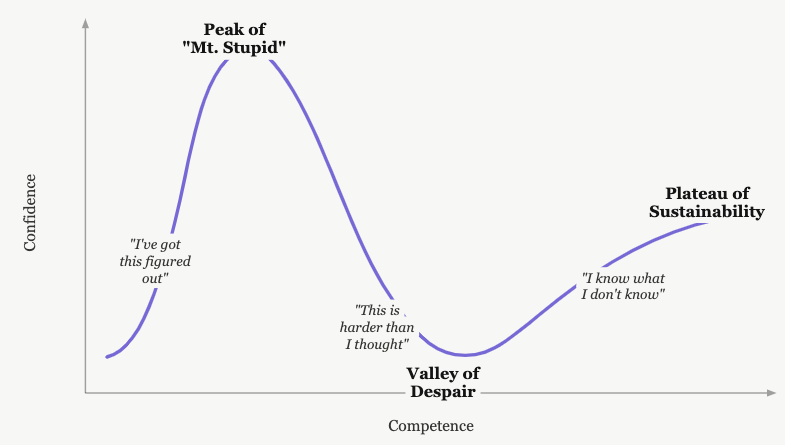
The bias is strongest near the bottom of the skill curve (see below) and it fades as competence grows. The most dangerous period in a trader’s life is generally the first profitable stretch. That’s when the gap between perceived skill and actual skill is widest, and when the size of the bets tends to grow.
Why Day Traders & Short-Term Traders Are Especially Exposed
Why does this hit day traders, scalpers, and swing traders harder than long-term passive investors?
Three reasons, and they compound.
Feedback Is Quick, But Noisy
First, the feedback is fast but noisy. A short-term trader might take several to dozens of trades a day. That feels like rapid learning, but it isn’t.
Over short samples, results are dominated by chance, so the lessons you think you’re absorbing are often just random patterns you’ve attached a story to.
Long-term investors get fewer, slower data points, but those points carry more signal. Passive investors often pay little attention. Short-term traders get a flood of data points that carry almost none.
Leverage & Position Size Mistakes
Second, leverage and position size turn small mistakes into large ones quickly. An overconfident buy-and-hold investor who is wrong generally loses slowly. An overconfident futures or options (or simply leveraged) day trader who is wrong can lose a quarter of their account in an afternoon. The bias and the instrument combine badly.
The Odds
Third, the numbers are brutal. The most thorough study of this comes from Brazil. Chague, De-Losso, and Giovannetti (2020) tracked every individual who began day trading equity index futures on the Brazilian exchange between 2013 and 2015 (a total of 19,646 new traders) in the third-largest equity index futures market in the world.
Among those who persisted for more than 300 trading days, 97% lost money. Only about 1% earned more than the Brazilian minimum wage. Only about half a percent earned more than a bank teller’s starting salary – while taking a lot more risk.
The single best performer averaged around $310 a day, but with a standard deviation of $2,560, meaning the swings in their results dwarfed the average gain.
The finding that matters most here is that the researchers found no evidence of learning. Traders didn’t get better the longer they traded. The ones who kept going simply kept losing. Experience alone didn’t turn beginners into winners.
The whole premise of “I’ll learn as I go” assumes that screen time converts into skill. It can. But the data says it often doesn’t, at least not on its own.
Taiwan tells a similar story over a longer window. Barber, Lee, Liu, and Odean studied the entire Taiwan Stock Exchange across fifteen years and found that well under 1% of day traders earned reliably positive returns after fees.
US studies of retail brokerage accounts have found the same pattern in a different form: the households that traded the most underperformed the market the most, after costs.
None of this means trading short time frames is impossible. A small number of people do build a genuine edge. But the base rate is harsh, the feedback is misleading, and confidence arrives long before competence does. Knowing that is your first line of defense.
Description of Each Stage
Pretend trading skill runs on a 0-10 scale.
0 = They don’t know or don’t care and know they don’t know.
1-2 = Know almost nothing, but they don’t know enough to even be aware of what they don’t know. The “overconfident beginner” stage.
3-5 = “Dang, this is a lot more difficult than I thought it was.” Usually takes struggling or painful experiences to get to this stage. Tends to feel really bad in the moment, but forces you to make changes and learn how to do it differently.
6-7 = “I’m getting better but still don’t know a lot.”
8-10 = “I can do this, but I’m still careful, have doubts, manage risk carefully, and know that I will still be wrong a lot and should never be overconfident.”
How to Test Where You Actually Sit on the Curve
The 0-10 scale above is easy to read and understand, but it’s hard to apply to yourself. In general, it’s hard to self-assess.
You want to be good at something, so sometimes you think you already are.
The bias can hide your own position on it, because the judgment and the thing being judged come out of the same head. Asking yourself how good you are produces an answer that has to do with your confidence – or even the confidence you want to have – not your actual results.
What works instead is evidence you collected before you knew the outcome. Here are five tests you can run against your own trading records this week.
Check Your Sample Size Before You Trust Your Win Rate
Say you’ve taken 30 trades and won 55% of them. Feels like an edge. Run the math on how uncertain that number actually is.
The standard error of a win rate is the square root of p(1-p)/n, where p is your win rate and n is your number of trades.
At 55% over 30 trades, that comes out to about 9 percentage points. A 95% range (which is two standard deviations) around your result runs from roughly 37% to 73%. A basic coin flip is inside that range.
Take the same 55% over 100 trades… The range narrows to about 45% to 65%. Still includes a coin flip. At 400 trades, it tightens to roughly 50% to 60%, and only then does your result begin to separate from chance.
And of course, this assumes an even chance of a win or loss, which isn’t generally the case.
So when you catch yourself drawing conclusions after a good month of 40 trades, you now have a number to hold against the feeling. Forty trades tells you little about your win rate, and less than that about your expectancy, which needs a larger sample still because it depends on the size of your wins and losses as well as the frequency.
And if you’re a longer term trader, it’s less about volume of trades but time.
Write the Trade Down Before You Take It
Record five things before you click – the condition that triggered the setup, your entry, the price that proves you wrong, your target, and what you expect the win rate and reward-to-risk to be for this type of trade.
That last item is the real test. You’re making a prediction, and predictions can be checked. After 50 trades of one setup, compare what you expected against what you got. A trader who predicted 50% at 2-to-1 and delivered 48% at 1.9-to-1 knows something real about their method.
A trader whose results bear no relationship to their predictions is more about telling themselves a story and calling it analysis.
Science runs a version of this. Registered reports require researchers to submit hypotheses and methods before they collect any data. Scheel, Schijen, and Lakens found in 2021 that around 96% of standard psychology papers reported positive results, against roughly 44% of registered reports.
Writing the prediction down first changes what you can claim afterwards.
Subtract the Market From Your Results
If you trade mostly long, part of your return belongs to the market rather than to you – what’s called “beta” returns.
This, of course, assumes you’re trading stocks rather than “neutral” markets like FX and commodities.
The S&P 500 rose about 16% in 2020 and about 27% in 2021 and enormous numbers of people started trading in that window with the pandemic shutdowns. Robinhood’s monthly active users climbed past 21 million by the middle of 2021. The index then fell about 19% in 2022, and Robinhood’s monthly actives dropped to roughly 11 million by the end of that year. A lot of what may have seemed like skill was just direction and riding a wave.
For every trade, log which way the broad market moved over your holding period. Then split your results into trades taken with the prevailing move and trades taken against it.
If your entire profit sits in the first bucket, you’re running a directional bet that pays more in costs than the equivalent position held quietly.
Barber and Odean measured the cost of that across 66,465 US households at a discount broker between 1991 and 1996. The most active fifth of traders earned about 11.4% a year net, against a market return near 17.9%. Their gross returns were close to average. Trading took the difference.
Also factor in risk adjustments. Most stocks move more than the aggregate market (the diversification of the broader market tends to tamp down on the overall volatility).
Add Up What Trading Actually Costs You
Most traders know their commission rate and ignore other costs.
Take a trader running 20 round turns a day in one E-mini S&P contract. Commission runs around $4 per round turn at a typical retail futures broker. Add half a tick of average slippage, which is $6.25 on a contract where a full tick is worth $12.50. That’s roughly $10 per round turn, $200 a day, and about $50,000 across 250 trading days.
On a $50,000 account, that trader has to produce 100% gross before keeping a dollar.
Run the same calculation on your own statements using your real fills, and not the prices you meant to get.
The gap between the price you wanted and the price you received is the number most beginners never measure, and it’s usually bigger than the commission difference.
Grade the Decision, Not the Outcome
Sort every trade into one of four boxes:
- followed your rules and won
- followed your rules and lost
- broke your rules and won
- broke your rules and lost
The box that tells you the most about your future is the third one. Breaking your rules and getting paid teaches you the wrong lesson when you’re most receptive to it.
A trader who widened a stop and got rescued will widen it again, and the fourth or fifth time tends to cost more than the first four saved.
Count the boxes monthly. A trader somewhere around 3-5 on that skill scale usually finds 30% or more of their trades sitting in the two rule-breaking boxes. A trader at 8-10 finds almost none, and treats a rule-breaking win as a problem to correct rather than a result to enjoy.
Your rule-following percentage is the one number you control completely. Your P&L isn’t.
Of course, make sure your rules are thoroughly tested and you’re positive there’s statistical edge. Following rules that aren’t proven won’t help.
The Main Takeaways of the Dunning-Kruger Effect in Trading
Overestimation of Ability
Traders with limited experience or knowledge often overestimate their trading skills.
This tends to lead to overly aggressive strategies and blow out their risk. They might not recognize the complexity, the nuances, and the many dimensions of markets, or the importance of analysis from multiple angles, which raises the risk of large losses.
For a short-term trader, overestimation usually looks like overtrading and oversizing. The aggression feels like conviction. It’s usually just an inflated sense of your own read.
Underestimation of Risks
Novice traders generally underestimate market risks or don’t know all that can happen to them. They might ignore or misinterpret market data and fail to properly understand potential downside.
The Need to Keep Learning
In trading you never really “make it.” What constitutes an edge is always changing.
Just as most professional sports keep going to progressively higher levels (or is changing in some way), such is also the case in markets in terms of what it takes to have an edge.
Traders should understand the limits of their competence and identify their weaknesses and blind spots. We all have specific skills, abilities, and ways of thinking that make us suitable for some tasks and bad for others. Weaknesses don’t matter if you can find solutions to them.
What Causes the Dunning-Kruger Effect in Short-Term Trading
Illusory Superiority
This is a common phenomenon where new traders badly overestimate their abilities, lacking the experience to accurately evaluate their own skill level.
We’ve all heard the statistics where most people rate themselves as more intelligent, a better driver, and so on, than average.
Someone might also have some level of financial success, meaning they make money from their job, but this has nothing to do with financial skill. Or they think having success in one thing makes them knowledgeable in another.
For example, say someone saves $2,000 per month for 45 years. Because of poor trading skill, instead of getting roughly 7% standard market returns through indexing, they got 0%. They would still have over $1 million saved. Even though they did very poorly overall, their savings contributions carried them.
In short-term trading, a trader who is up 10% in a strong trending month attributes it to skill. The market was simply going up, and almost any long-biased approach made money. When that changes, the same approach gives it all back, plus costs. The edge was never there; it was simply a market-based tailwind.
Limited Self-Awareness
This is the inability of less-skilled individuals to recognize their own weaknesses and knowledge gaps accurately.
A deficiency in metacognitive ability prevents people from accurately evaluating their limitations and the areas where they don’t know.
This can apply to specific knowledge domains, such as football strategy, financial markets, or policymaking, or to broader skills (e.g., reasoning).
In trading, the tell is that the trader can’t articulate their edge in concrete terms. Ask a struggling short-term trader why a setup works and you’ll get generic answers about momentum or feel. Or a reason that probably doesn’t make a lot of sense.
Ask a profitable one and you’ll usually get something specific and testable: a defined condition, an expected win rate, an average reward-to-risk, a sample size.
If you can’t describe your edge precisely enough to test it, that’s a sign you don’t yet have one.
Lack of Financial Literacy
Fundamental misunderstandings of basic financial concepts can lead people to overestimate their trading and financial decision-making abilities. They may have no specific training in economics or finance, or any background at all.
For example, someone trading or investing in a foreign bond may think the return is just the nominal yield, simply because that’s what they see. The reality is far more complicated, because currency moves and inflation can erase the yield entirely.
For short-term traders, the literacy gap usually shows up around costs and probabilities. Many beginners don’t understand how much the spread and commissions eat into a high-frequency strategy. If you pay a few ticks on every round trip and you trade 20 times a day, costs alone can swamp a modest edge.
Many also don’t understand expectancy: that a 40% win rate with a 2-to-1 reward-to-risk ratio beats a 60% win rate at 0.7-to-1. Without that math, win rate becomes a vanity metric. As the baseball analogy goes, a higher slugging percentage can compensate for a lower batting average.
The Complexity and Dimensionality of Markets
Novice traders often underestimate how complex markets are. They will tend to misjudge the nuances and trade-offs in markets.
The deeper problem is the multidimensionality. Markets move on order flow, positioning, macro data, sentiment, liquidity, and the actions of participants far larger in the amount of capital and faster in terms of how they can execute than any individual.
Focusing on a few favorite variables while neglecting the others, and not even being aware that the others exist, produces an illusion of comprehension. It’s easy to mistake thinking one understands the picture because you understand a corner of it.
Early encounters with the market can create a misleading sense of understanding, particularly if trades go your way, or if the trades that go against you get filed under “bad luck.”
Information Overload
The vast availability of information can lead to a belief that you’re making informed decisions, when you’re actually misinterpreting data or trends. You might look at the recent past to decide what to do in the future, or reach specious conclusions to fit a narrative.
Short-term traders drown in this. Real-time quotes, level 2, news feeds, scanners, social feeds, dozens of indicators stacked on a chart. More inputs feel like more edge.
But often they’re noise that produces false confidence and analysis paralysis at the same time. The trader who watches six screens isn’t necessarily better informed than the one watching one. They’re frequently just more overstimulated and more certain of conclusions that don’t hold up.
Mistaking Luck for Skill
Markets have variance, so amateur traders can sometimes get better results than professionals, just as an amateur poker player can beat professional ones. This is especially true over the short run, the same as in other high-variance games, and with smaller sums of money.
Transaction costs and market depth are much bigger concerns for institutional traders than for individuals, so a small account can sometimes do things a large one can’t.
Success that comes from chance leads to overconfidence when you mistakenly attribute it to personal skill. And short-term trading is the highest-variance corner of the market.
The shorter the holding period and the smaller the sample, the more your results are driven by variance rather than skill. A great week proves basically nothing. For example, when we talk about investing and a basic index fund getting you maybe 7% per year over the long run, that’s a yield of 0.02% per day or about 0.10% over 5 trading days.
A great quarter proves maybe a little. Only a large sample of trades, hundreds at minimum, starts to separate edge from chance.
Most blow-ups come from traders who got the sequence backwards: they bet bigger after the lucky streak instead of after the proof.
Beginner’s Luck
Following from the above, initial successes can boost confidence through favorable variance, and lead people to attribute their luck or favorable conditions to skill. It’s easy to put on a trade and get lucky.
This is arguably the single most dangerous thing that can happen to a new short-term trader: winning early.
The trader who gets lucky out of the gate sizes up, trades more, and carries that inflated confidence straight into the variance that eventually corrects it.
Social Media and Echo Chambers
Exposure to success stories and reinforcement from echo chambers on social media can distort how easy trading success looks. You see the screenshots of the winning trades. You never see the blown accounts, because not many post those – or if they do, it’s almost treated like a joke or an excessive risk-taker that won’t be them.
And those most influential on social media tend to be good marketers with a personality that fits media, which of course is a completely different skill set from trading well.
Many of the loudest “traders” make their money selling courses and signals, not trading. Social and traditional media often present oversimplified hot takes and superficial judgments that fail to capture the depth, the nuances, and the trade-offs involved in real decisions, which require weighing multiple factors and considering different perspectives.
The clean, confident chart someone posts after the move is not how trading feels in real time, when the outcome is still unknown.
Confirmation Bias
This bias leads people to favor information that confirms their pre-existing beliefs while disregarding evidence to the contrary. This is the one bias that even experienced traders admit to the most.
For a short-term trader, confirmation bias is what keeps you in a losing position long after the thesis (i.e., the central reason for doing it) broke. You went long, so you find reasons the chart is still bullish and dismiss the reasons it isn’t. You add the indicator that agrees with you and ignore the three that don’t. The discipline that fights this is mechanical: define your invalidation level before you enter, write it down, and honor it regardless of the story you start telling yourself once you’re in the trade.
Overconfidence Bias
Traders and investors might overrate their ability to analyze, predict future moves accurately, and produce consistent returns. This can prompt them to take undue risks. The reality is that outperforming markets is not easy, and a small percentage of traders make a lot while most lose relative to a representative benchmark.
Overconfidence shows up most clearly in position sizing. The overconfident short-term trader risks 10% or 20% of the account on a single “high-conviction” trade, because they’re sure. Conviction and accuracy are not the same thing. A disciplined trader risks a small, fixed fraction per trade, often 1% or less, precisely because they know any single read can be wrong, and they intend to survive long enough to let an edge play out across many trades.
The Illusion of Knowledge
The volume of information around financial markets can create a deceptive sense of expertise. It can lead people to believe they understand more than they do.
Reading about a strategy isn’t the same as having traded it live, including the drawdowns that test whether you’ll actually follow it when real money is on the line.
Slow, Noisy Feedback
Feedback in markets is noisy and delayed, which leads to longer learning cycles.
The delay or ambiguity in performance feedback hinders the timely recognition and correction of errors and misconceptions.
It looks like the feedback is instant, because a day trade resolves in minutes or hours. But the feedback you actually need, whether your process has a positive expectancy, only emerges across a large sample.
A good trade can lose and a bad trade can win, so any single result tells you almost nothing about whether the decision was sound.
Traders who grade themselves on individual outcomes can learn the wrong lessons fast. Traders who grade themselves on process, measured over many trades, learn the right ones slowly.
Overreliance on Anecdotal Evidence
A preference for personal success stories, your own or other people’s, over empirical evidence amplifies the Dunning-Kruger effect. The one trade that worked spectacularly gets remembered and repeated.
The pattern that quietly bleeds money over a hundred trades gets ignored, because no single instance hurt enough to notice.
How to Counter It as a Short-Term Trader
Education and Awareness
Building financial literacy through real education and quality experience helps you understand your limitations and the complexity of markets.
For a short-term trader specifically, that means understanding expectancy, position sizing, the true cost of your trading, and how variance behaves over small samples.
You don’t need a finance degree. But you do need to stop confusing activity with understanding.
Risk Management
Strong risk management, paired with an honest acknowledgment that trading is high-risk, curbs the damage that overconfidence does.
When traders are inexperienced they like to express themselves aggressively, because making money is seemingly the whole point. But we learn over time to balance aggression and defense for the sake of our own sustainability.
In practice, defense is what keeps you in the game long enough to find out whether you can win. Fixed fractional risk per trade, a hard daily loss limit, predefined stops, and position sizes small enough that no single trade can do real damage. The aggressive trader maximizes the upside of any one trade. The durable trader minimizes the downside of being wrong, repeatedly, which is the only thing that lets an edge compound.
The math is worth sitting with.
Risk 1% per trade and a string of five losers, which any strategy produces eventually, costs you about 5% of the account, and you recover it with a good stretch.
Risk 10% per trade and that same five-loss streak takes you down to roughly 60% of your starting capital (100 minus 10+9+8+7+6), a hole that’s hard to climb out of, because now you need a 67% gain just to get back to even.
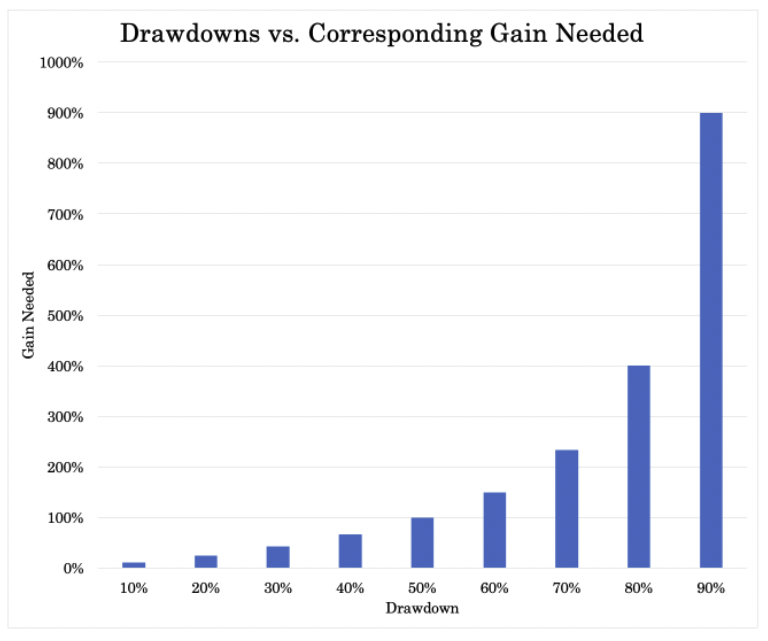
The overconfident trader treats a losing streak as something that happens to other people. It happens to everyone. The only question is whether your sizing and overall risk management lets you survive it.
Seeking Outside Perspective
Getting traders and investors to consult experienced professionals gives them a more grounded read on their abilities and their approach.
For short-term traders, this can mean a mentor who has actually traded profitably over years, an honest peer who will tell you your strategy has no edge, or a track record reviewed by someone with no incentive to flatter you.
The value is in the external check, because you can’t see your own blind spots by definition.
But also make sure that people are worth listening to, not just because they match or don’t match your own biases or they sound confident.
Psychological Training
Building psychological understanding into your trading education helps you identify and correct cognitive biases, including the Dunning-Kruger effect.
Being on this article and getting down this far already means you’re serious.
Knowing the bias exists isn’t the same as being immune to it, but it does let you build rules that protect you from yourself. The trader who knows they tend toward overconfidence after a winning streak can set a rule to reduce size after three wins in a row, rather than increasing it.
Continuous Learning and Humility
A habit of education and modesty keeps you open to new information – and aware that you’re likely overestimating your own competence about something.
The market always reminds you of how bad you are at your job, no matter your skill level.
Open-Mindedness
Open-mindedness matters a great deal in trading, because markets keep changing, and new information or perspectives can challenge what you previously believed.
Keeping an open mind lets you adapt, consider alternative approaches, and make better decisions. The more open-minded you are, the less likely you are to be surprised.
Thinking in probabilities and distributions helps, which all traders at a certain level do.
For short-term traders, things change based on the type of market. A strategy that does well in a trending, high-volatility market can stop working entirely in a choppy, range-bound one.
The trader who insists their method works in all environments, against the evidence of their own results, will inevitably give back the gains (and often then some).
Recognize How Little We Know Relative to What There Is to Know
What we know is a small fraction compared to what we don’t know, both the things we know we don’t know and the things we don’t even know that we don’t know.
And not only that, but in markets it’s relative to what’s already baked into the price.
That limited understanding should instill humility and keep us willing to learning across economics, finance, markets, trading, and the other disciplines that feed into success.
Overconfidence and Risk-Taking
Be aware of how the Dunning-Kruger effect can push you toward unwarranted risk-taking through a false sense of security.
The feeling of safety is exactly what’s most dangerous, because it arrives right before the position you were too sure about teaches you otherwise.
Poor Decision-Making
Recognize that inflated confidence leads to relying on insufficient information or faulty analysis. This is central to building better decision-making habits.
Certainty is the problem, not the solution.
Refusal to Learn
Yes, you need to decide and act in order to place trades and make money. But it’s important not to get stuck in your ways. Markets and strategies are always changing in certain ways.
The trader who decides they’ve got all they ever need, the market eventually finds the part of their approach that no longer works.
Sometimes You Need to Let People Make a Mistake
If someone is doing something wrong, or their opinion is unlikely to be correct, but they’re resistant to direction, sometimes it’s better to let them make the mistake, assuming it isn’t too serious and there’s a clear penalty for the error that they bear directly.
That way, if they’re self-aware and reflective, they might learn the consequences of that action firsthand.
This applies to all of us, in a contained way. Many short-term traders only internalize position sizing after a small account teaches them, through a painful but survivable loss, what oversizing does.
But the key think is to make those lessons cheap. Trade small enough early on that your mistakes educate you instead of putting you out of the game entirely.
Even experienced traders make the same mistakes. But they tend to be more aware of them, and less willing to blame outside factors, like “the market is rigged,” or blaming politicians or whoever or whatever else for their shortcomings or poor outcomes.
Things happening that you could have never anticipated is part of risk management.
Taking responsibility for results is what makes correction possible. Blaming the market guarantees you’ll repeat the error.
Vulnerability
Acknowledge that an exaggerated sense of your own knowledge can lead you to believe things that aren’t true, or to act on incomplete information when it would have been judicious to collect more to improve your odds of being right.
The cost of that, on short timeframes with leverage, can be a meaningful chunk of your capital in a single session.
Treating your own confidence with suspicion is how you protect the account.
Keep People’s Credibility in Mind
It’s important to be open-minded, but you also have to be discerning. Before taking financial or trading advice from anyone, keep a few things in mind:
- Verify their credentials, experience, and track record. Have they actually done the thing in question, profitably, many times, over a long period and across a range of market conditions?
- If you can’t verify their track record, you have to go by the quality of their reasoning. Are you able to assess that objectively?
- Understand their incentives and potential conflicts of interest. Are they making money trading, or making money selling you something?
- Make sure the advice fits your own goals, constraints, and risk tolerance, not theirs.
- Don’t blindly follow advice. Do your own research and due diligence, and test claims against data before you risk capital on them.
Conclusion
The Dunning-Kruger effect is not a beginner’s problem you outgrow once and forget. It’s a permanent pull that strengthens whenever results are good and you start to feel certain. Short-term traders and day traders feel that pull constantly, because the wins come fast, the feedback lies, and the leverage amplifies every mistake.
The data is clear about the base rate. In the Brazilian study, 97% of persistent day traders lost money, and the researchers found no evidence that experience alone made anyone better. In other words, screen time doesn’t automatically become skill. Deliberate, honest, measured work might.
So what does this mean for you, deciding how much to risk on the next trade? Trade small enough to survive your own mistakes. Use bad experiences to figure out how to do things differently. Measure your process over large samples, not your outcomes over single trades.
Hold your views with calibrated confidence rather than certainty. Think in ranges, distributions, and probabilities.
Stay open to the market telling you you’re wrong, and act on it when it does. And whenever you notice that certain feeling that you’ve finally figured it out, treat it as a warning, not a reward.
The most dangerous trader is the one who is sure. Be prepared, not certain.
Article Sources
Barber, B. M., & Odean, T. (2000). Trading is hazardous to your wealth: The common stock investment performance of individual investors. The Journal of Finance, 55(2), 773-806.
Barber, B. M., Lee, Y. T., Liu, Y. J., & Odean, T. (2014). The cross-section of speculator skill: Evidence from day trading. Journal of Financial Markets, 18, 1-24. https://doi.org/10.1016/j.finmar.2013.05.006
Chague, F., De-Losso, R., & Giovannetti, B. (2019). Day trading for a living?. SSRN Electronic Journal. https://doi.org/10.2139/ssrn.3423101
The writing and editorial team at DayTrading.com use credible sources to support their work. These include government agencies, white papers, research institutes, and engagement with industry professionals. Content is written free from bias and is fact-checked where appropriate. Learn more about why you can trust DayTrading.com