





DAX 40 brokers give you access to the 40 largest blue-chip companies trading on the Frankfurt Stock Exchange, names like SAP, Siemens, Allianz and Volkswagen. Germany runs the biggest economy in the eurozone, so the DAX (Deutscher Aktienindex) is one of the most watched indices in Europe.
On this page we rank the best brokers with access to the DAX 40 for active traders, based on our hands-on testing. We cover what to weigh up when comparing providers, walk through placing a DAX trade step by step, and answer the questions beginners ask most.
DAX 40 Brokers
These are the 2 best brokers for trading on the DAX GER 40 Index:
-
- Demo account
- Platforms: MT4, MT5, TradeLocker
- Min. deposit: $50
-
- Demo account
- Regulator: NFA, CFTC
- Platforms: WebTrader, Mobile, MT4, MT5, TradingView

Learn how we test brokers and why you can trust our ratings.
This is why we think these brokers are the best in this category in 2026:
- Plexytrade 3.9/5 Established in 2024 and headquartered in Saint Lucia, Plexytrade is an ECN/STP broker. Geared towards active traders, it supports four account options, crypto deposits and withdrawals, plus very high leverage up to 1:2000 made possible by its unregulated status.
- FOREX.com 4.3/5 Founded in 2001, FOREX.com is now part of StoneX, a financial services organization serving over one million customers worldwide. Regulated in the US, UK, EU, Australia and beyond, the broker offers thousands of markets, not just forex, and provides excellent pricing on cutting-edge platforms.
Community Sentiment
See how users rate these brokers based on the average customer ratings submitted on DayTrading.com, plus ratings from Trustpilot, the Apple App Store and Google Play.
| Broker | Our Users' Rating | Trustpilot Score | Trustpilot Reviews | iOS App Rating | Android App Rating |
|---|---|---|---|---|---|
| Plexytrade | 95 | ||||
| FOREX.com | 2538 |
Plexytrade
Plexytrade is a newcomer in the brokerage scene with attention-grabbing features like 1:2000 leverage, zero spreads on select instruments and fast execution speeds of less than 46 milliseconds. However, the absence of regulation is a significant concern, while the non-existent research and educational tools place it far behind industry frontrunners.
 Christian Harris, Reviewer
Plexytrade quick facts
- Demo Account
- ✔Yes
- Instruments
- CFDs, Forex, Indices, Stocks, Commodities, Crypto
- Platforms
- MT4, MT5, TradeLocker
- Minimum Deposit
- $50
- Minimum Trade
- 0.01
- Account Currencies
- USD, EUR
Stock Exchanges
Plexytrade offers trading on 15 stock exchanges:
- Australian Securities Exchange (ASX)
- CAC 40 Index France
- DAX GER 40 Index
- Dow Jones
- Euronext
- FTSE UK Index
- Hang Seng
- Hong Kong Stock Exchange
- IBEX 35
- Japan Exchange Group
- Nasdaq
- New York Stock Exchange
- Russell 2000
- S&P 500
- SIX Swiss Exchange
Pros
- The choice of accounts provides a solution for various trading styles, with Gold Raw appealing to day traders owing to its spreads from 0.0 pips.
- Sub 50ms execution speeds are fast enough for intraday trading setups.
- Plexytrade accommodates a range of trading methods and short-term strategies, including scalping, hedging, and automated trading.
Cons
- There are no research and educational materials, falling short of alternatives like IG, while access to the economic calendar is restricted to clients with balances of $500.
- Plexytrade lacks regulation in major jurisdictions, significantly increasing the risks of opening an account and depositing funds.
- There are no social or copy trading features for inexperienced traders to replicate the trades of more experienced investors, trailing category leaders like eToro.
FOREX.com
FOREX.com remains a best-in-class brokerage for active forex traders of all experience levels, with over 80 currency pairs, tight spreads from 0.0 pips and low commissions. The powerful charting platforms collectively offer over 100 technical indicators, as well as extensive research tools.
Christian Harris, Reviewer
FOREX.com quick facts
- Demo Account
- ✔Yes
- Instruments
- Forex, Futures and Options on Metals, Energies, Commodities, Indices, Bonds
- Regulator
- NFA, CFTC
- Platforms
- WebTrader, Mobile, MT4, MT5, TradingView
- Minimum Deposit
- $100
- Minimum Trade
- 0.01 Lots
- Account Currencies
- USD, EUR, GBP, CAD, AUD, JPY, CHF, PLN
Stock Exchanges
FOREX.com offers trading on 14 stock exchanges:
- Australian Securities Exchange (ASX)
- Borsa Italiana
- CAC 40 Index France
- DAX GER 40 Index
- Dow Jones
- Euronext
- FTSE UK Index
- Hang Seng
- Hong Kong Stock Exchange
- IBEX 35
- Japan Exchange Group
- Nasdaq
- S&P 500
- SIX Swiss Exchange
Pros
- The in-house Web Trader continues to stand out as one of the best-designed platforms for aspiring day traders with a slick design and over 80 technical indicators for market analysis.
- With over 20 years of experience, excellent regulatory oversight, and multiple accolades including runner-up in our 'Best Forex Broker' awards, FOREX.com boasts a global reputation as a trusted brokerage.
- FOREX.com offers industry-leading forex pricing starting from 0.0 pips, alongside competitive cashback rebates of up to 15% for serious day traders.
Cons
- The group being FOREX.com, GAIN Capital Group LLC, had to pay a $700k fine to NFA for improperly handling some client accounts.
- FOREX.com's MT4 platform offers approximately 600 instruments, significantly fewer than the over 5,500 available on its non-MetaTrader platforms.
- There’s no negative balance protection for US clients, so you may find yourself owing more money than your initial deposit into your account.
How to Compare DAX Brokers
We tested each broker by opening accounts and trading the DAX ourselves. Here’s what we measured:
- Real trading costs. We placed live DAX positions and recorded the spread during liquid hours, any per-trade commission, and the overnight financing charged on positions held past the daily cut-off.
- Execution. We watched how each platform filled DAX orders around the volatile 09:00 CET open, checking for slippage and requotes when the price moved quickly.
- Range of DAX products. We checked whether you can trade the cash index, DAX futures, DAX ETFs, and the individual constituent shares all from one account.
- Platform and data. We tested charting, available order types, and whether live Xetra or Eurex price data costs extra.
- Regulation and protection. We confirmed each broker holds a recognised licence (for example the FCA, BaFin, CySEC or ASIC), keeps client money segregated, and offers negative balance protection to retail accounts.
Critical Factors When Choosing A DAX 40 Broker
The DAX is faster and more volatile than most European indices, so the broker you pick changes your results more than it would on a slower market. Here’s what matters.
Execution speed and order routing
The DAX swings hard in the first 30 minutes after the 09:00 CET Xetra open and again when US markets open around 15:30 CET. In those windows a slow fill costs you points. Most retail brokers quote the DAX as a market-maker priced CFD rather than routing your order straight to the Xetra order book, so the spread and fill speed you get depend on the broker’s own pricing engine. Test this in a demo account during the open: place a market order and see how far the fill drifts from the price you clicked. Interactive Brokers fills DAX orders quickly in our testing.
Which DAX instruments the broker offers
“Trading the DAX” can mean several different products, and not every broker carries all of them:
- Cash (spot) index CFD for short-term day trades.
- DAX futures (FDAX, Mini-DAX FDXM, Micro-DAX) listed on Eurex, with no overnight financing but fixed expiry dates.
- DAX ETFs such as iShares Core DAX or Xtrackers DAX, which work for US traders who can’t access CFDs.
- Individual constituent shares, so you can trade SAP or Siemens directly instead of the whole index.
If you want to switch between the index and single German stocks without opening a second account, check the instrument list first.
Spreads, commissions and overnight financing
Day traders place a high volume of trades, so a wide DAX spread eats your returns fast.
Two more costs catch people out: the per-trade commission on share or DMA accounts, and the overnight swap on CFD positions held past the daily cut-off. If you hold DAX trades for more than a day, that financing adds up, which is one reason multi-day traders often prefer futures. Compare the all-in cost, not just the headline spread.
Extended trading hours
Xetra, where the official DAX price comes from, runs Monday to Friday from 09:00 to 17:30 CET (Deutsche Börse). But the index keeps moving long after Frankfurt closes, because US-session news and overnight events shift it before the next open. Many brokers quote the DAX as a CFD or futures contract for far longer than Xetra’s core session, often from early morning into the evening. Eurex DAX futures trade across Asian, European and US hours, roughly 01:00 to 22:00 CET. If you want to trade the US-session reaction or hedge an overnight gap, check how long your broker keeps the DAX market open.
Platform, charting and data feeds
You’ll spend the whole session inside the platform, so test it properly. Look for fast charts, the order types you use (especially limit and guaranteed stop orders), and reliable uptime. Common choices include MetaTrader 4 and 5, cTrader, and brokers with TradingView integration for charting. If you trade DAX futures, you may want Level II depth-of-book data to see resting orders during volatile moves; some brokers charge a monthly fee for live Eurex or Xetra data, so factor that in.
Risk controls for gap risk
The DAX gaps. It can open well above or below the previous close after overnight news, jumping straight past an ordinary stop-loss. A guaranteed stop-loss order (GSLO) closes you out at your chosen price no matter how far the market gaps, usually for a small premium. Retail accounts in the UK and EU also come with negative balance protection by law, so you can’t lose more than your deposit. Confirm both are available before you size up.
Regulation and currency conversion
Trade with a broker licensed by a recognised regulator (FCA, BaFin, CySEC, ASIC), with client funds held in segregated accounts. One DAX-specific cost: the index is priced in euros, so if your account is in dollars or pounds, you may pay a conversion charge on every trade and on financing. Some brokers let you hold a euro sub-account to avoid this. Check the conversion rate, not just the spread.
DAX 40 – Headlines
The DAX 40 tracks the 40 largest companies on the Frankfurt Stock Exchange and covers over three quarters of the market value listed there (STOXX).
It’s a performance index, so it includes reinvested dividends. That’s why the DAX prints a higher number than price-return peers like the FTSE 100 and CAC 40.
The index set a record above 25,500 points in January 2026, after climbing from around 16,000 at the end of 2022 (TradingView).
SAP and Siemens are the two heaviest constituents, together making up close to a fifth of the index, so their earnings move the whole market.
Most retail traders access the DAX through CFDs or spread betting. US traders use ETFs or Eurex futures.
Practise on a demo account and keep a trading journal before risking real money.
How To Place A Trade On The DAX 40
Here’s the exact process I follow to open a DAX position. I ran these steps in an Interactive Brokers account so you can see what each screen looks like.
Open and fund an account
I’m already signed up with IBKR, a regulated broker.
If you aren’t already, they just need basic personal information, then you can fund it to get started.
Search for the DAX
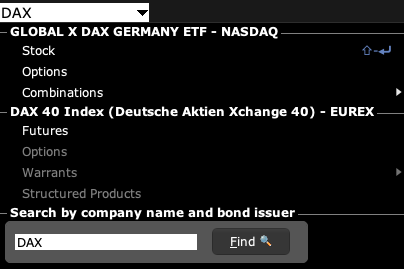
Brokers label it differently, so I searched “DAX”, which should do the trick. Other brokers might have naming conventions like “Germany 40”, “GER40” and “DE40” until the index came up.
You’ll see something like this:
Pick the instrument
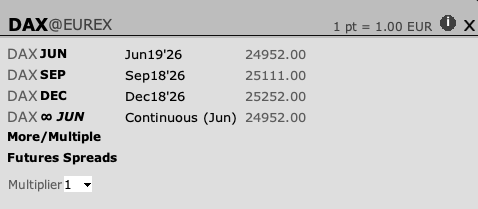
Either the index itself (via a tradable instrument) or a component stock.
DAX futures on Eurex is one option.
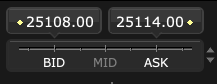
Check the spread and price
Before clicking anything I looked at the buy and sell prices and the gap between them. On the high-volume DAX that spread is usually tight during the 09:00 to 17:30 CET session and wider outside it.
As I’m looking just before the market open, I see a 2-3bp spread (6 pts on the index).
Choose the order type
Around the volatile open it’s generally best to use a limit order rather than a market order. So I don’t get filled several points away if the price jumps the instant I click.
In general, I strongly prefer limit orders so I can control what price I’m in and out at.
Set size and risk
I entered my position size. For CFD traders, leverage on a retail DAX CFD is capped at 20:1 in the UK and EU, so a single index point moves my account by the contract value times my size.
Here we’re doing futures.
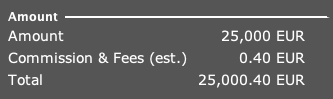
Read the confirmation
The order confirmation will show you things like the estimated cost, commission, and the margin required. I check this every time.
Place and monitor
I confirmed the trade, then as a limit order, I have to wait for it to fill, which will show up in your order queue.

Trading The DAX vs. Other European Markets
The DAX behaves differently from its neighbours. Because it’s a total-return index, its level isn’t directly comparable to the price-return FTSE 100 or CAC 40; the DAX number is inflated by years of reinvested dividends. The DAX leans heavily on industrials, software and autos, so it reacts to ECB rate decisions, the euro, German export demand and global tech sentiment. The FTSE 100, by contrast, is weighted toward energy, mining and financials. The DAX overlaps a lot with the Euro Stoxx 50, since several DAX heavyweights sit in both.
Liquidity And Volatility Profile
The DAX moves more than most large European indices, which is why active traders like it. A handful of heavyweights drive that movement: when SAP or Siemens reports earnings, the whole index lurches. The most volatile windows are the 09:00 CET open and the 15:30 CET overlap with the US open, when DAX and Wall Street react to each other. That volatility creates more setups in a session, but it also means wider gaps and faster reversals, so position sizing and stops matter more here than on a slow market.
How The DAX Is Built And Rebalanced
The DAX is free-float market-cap weighted, so bigger companies carry more influence. To stop any one firm from dominating, individual weights are capped (currently 15%) and reviewed each quarter (STOXX). Deutsche Börse reviews the constituents in March, June, September and December, adding or removing companies based on size and liquidity rules. On these review and rebalancing days, trading volume in the affected stocks spikes, and the index itself can move as funds adjust. A good broker handles these high-volume days without widening spreads excessively, which is worth watching for in your testing.
DAX Futures
If you trade multi-day or want round-the-clock access, DAX futures listed on Eurex are the main alternative to CFDs. They come in three sizes: the standard DAX future (FDAX) at €25 per index point, the Mini-DAX (FDXM) at €5, and the Micro-DAX at €1, so you can size to your account. Contracts expire on the third Friday of March, June, September and December. Unlike CFDs there’s no overnight financing, but you do roll the contract before expiry. Pricing is in euros.
Why Trade The DAX?
Volatility
Bigger daily ranges than the FTSE 100 mean more trading opportunities through the session, especially around the open. That cuts both ways, so it rewards traders with a clear plan and tight risk control.
Long trading window
While Xetra closes at 17:30 CET, brokers quote the DAX as a CFD or future for much longer, letting you trade morning moves and US-session reactions in the same day.
Final Word On DAX Brokers
The DAX is the most-traded index in Europe and a useful read on both the German and wider global economy. To trade it well you need a broker that fills fast around the open, keeps costs low across spreads and financing, offers the DAX products you actually use, and protects you against gap risk. Compare the providers in our toplist above, test them in a demo first, and keep a record of every trade so you can see what’s working.
FAQs
Which brokers give access to the DAX 40?
Most major CFD and spread betting brokers offer the DAX, often labelled “Germany 40”. Our toplist above ranks the providers we’ve tested for matters like cost, execution and DAX product range. Check each broker’s instrument list to confirm whether they carry the cash index, futures, ETFs and individual German shares.
Can I trade the DAX 40 if I’m outside Germany?
Yes. International brokers give access to the DAX from most countries. The product you use depends on your location: traders in the UK, Europe and many other regions use CFDs or spread betting.
US traders typically use DAX ETFs or Eurex futures, as CFDs aren’t available to them.
Can I trade the DAX outside Xetra’s 09:00-17:30 CET hours?
Often, yes. The official DAX price comes from Xetra during its core session, but many brokers quote the DAX as a CFD or future well beyond those hours, and Eurex DAX futures trade across most of the day. Check your broker’s stated DAX trading hours, as they vary.
What does it cost to trade the DAX with a broker?
You’ll pay the spread on every trade, sometimes a commission, and overnight financing if you hold a CFD position past the daily cut-off. The DAX is priced in euros. So a non-euro account may also pay a currency conversion charge.
Be sure to compare the all-in cost rather than the headline commission or spread.
Can I buy actual DAX 40 shares, or only CFDs and futures?
Both, depending on the broker. CFD and spread betting accounts give you price exposure without ownership. To own the underlying, you can buy a DAX ETF or the individual constituent shares through a broker that offers direct German share dealing.
When is the best time of day to trade the DAX?
Many day traders focus on the 09:00 CET open, when the DAX makes its biggest moves in the shortest time, and the 15:30 CET overlap with the US open. A broker with fast execution and tight spreads in these windows makes the most difference.