
Pattern Day Trading Rules Explained



The pattern day trading rule historically has been a restriction imposed on retail investors. The rule prevented traders from placing a certain number of trades over a short period unless they met minimum equity requirements. Understanding the restriction can help traders avoid legally required margin calls while the old framework remains in use during brokers’ transition to the new intraday margin standards. In this guide, we explain what pattern day trading means, how to navigate the rules and where the restrictions apply.
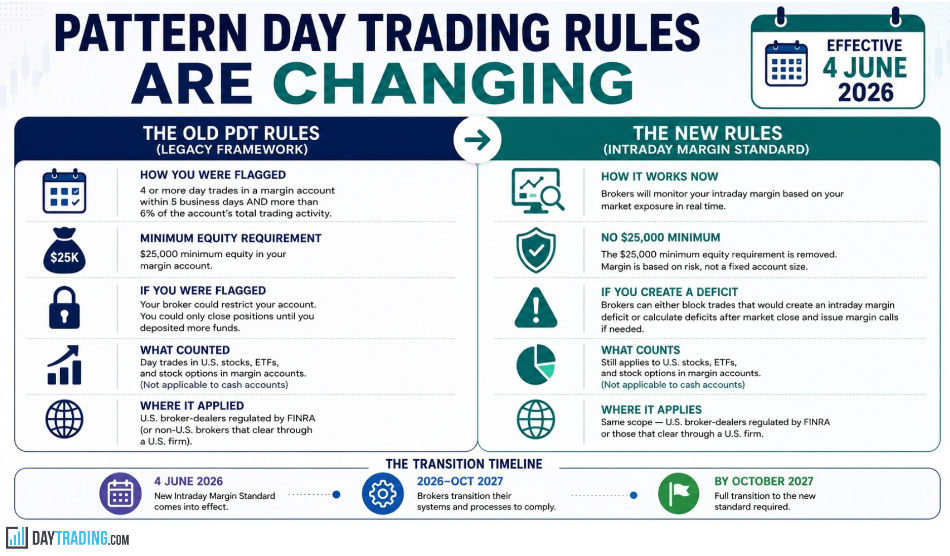
Major Regulatory Update: US regulators scrapped the long-standing $25,000 minimum equity rule for pattern day traders. FINRA approved a shift to intraday margin requirements in September 2025. The old framework was replaced with a risk-based Intraday Margin Standard that came into effect on 4 June, 2026. Brokerages have until October 2027 to fully transition their systems. The move should make active day trading much more accessible to smaller retail investors.
What Are The New Pattern Day Trading Rules?
In 2026, FINRA replaced the old pattern day trading framework with new intraday margin requirements. The changes removed the way the number of day trades were counted to label customers as “pattern day traders” and got rid of the $25,000 minimum equity requirement.
Instead, brokers have to monitor margin accounts for intraday margin deficits based on the respective client’s market exposure. Firms can either block trades that would create an intraday margin deficit or calculate deficits after market close and issue margin calls where required.
In practice, we expect the transition will vary between brokers. Firms with stronger real-time risk systems may be able to block trades that would create an intraday margin deficit, while others may rely on end-of-day calculations and margin calls. The result of this is that the new rules might not feel identical or particularly cohesive across platforms, especially at first, which traders who use different brokerage firms should keep in mind.
It’s also important to clarify what the new rule isn’t – it is not a blanket removal of all broker and margin-related risk controls. It may make it more accessible for retail investors with more limited balances, but equity still needs to be commensurate with intraday exposure.
What Does Pattern Day Trading Mean?
The pattern day trading rule was implemented by US regulators in 2001, but FINRA’s day-trading margin provisions have been replaced with new intraday margin standards.
The purpose of the rule is to protect day traders in the US from the risks associated with leveraged retail trading accounts. Customers who are day trading must demonstrate they can afford to cover losses when trading on margin.
Pattern Day Trading Rules
Under the legacy framework, a pattern day trader is someone who executes four or more day trades in a margin account within five business days, and those day trades represent more than 6% of the account’s total trading activity over that period.
If the account holder meets this threshold under the legacy framework, this can result in a margin call enforced by the broker, meaning they’ll need to deposit more funds.
The guidelines state that during this time, a trader should only be able to close trades. If the individual meets the margin call, they can continue to trade. Under the legacy framework, the minimum equity a pattern day trader must have in their account is $25,000; under the new framework, this is being replaced by intraday margin requirements based on market exposure.
The pattern day trading rule applies to US securities traded in margin accounts, such as stocks (including penny stocks and ETFs) and stock options.
It generally does not apply to spot forex, most futures, or most cryptocurrencies, although some brokers may impose their own day-trading limits on those markets.
What Happens If You Pattern Day Trade?
Under the old framework, there is no penalty for a pattern day trading violation other than the freezing or restricting of a margin account until more funds are deposited. The rule does not apply to cash accounts. Since the restriction is implemented by the broker, the penalty can vary.
Under the legacy framework, the flag is not always permanent and may eventually go away. It will often last for 90 days, though if a broker is lenient the timeline can be reduced.
The ban does not apply to institutional stock brokers as it is designed to protect retail traders. It is not illegal to be a pattern day trader, but those who are flagged as using the strategy must prove they can afford to cover the associated risks.
If you are pattern day trading with sufficient capital, when filing your taxes you may find you qualify for Trader Tax Status (TTS).
Examples Of Pattern Day Trading
The pattern day trading rule is simple when explained through examples. Let’s imagine Sarah has opened a margin account with $1000. If she were to short stocks in Apple on Monday and close the trade within trading hours on the same day, this would count as one day trade.
Let’s imagine she then goes long on Tuesday and closes the trade shortly after making a profit. If Sarah were to repeat this pattern on Wednesday and Thursday, this would be four day trades in a five-day period and, under the legacy framework, a warning would be placed on Sarah’s account.
How To Navigate Pattern Day Trading Rules
The pattern day trading rule was designed to protect retail traders from absorbing risks beyond their means, so looking for loopholes is not advised. While brokers transition to the new intraday margin standards, here are some tips for how you can navigate the legacy pattern day trading rule:
- Hold positions overnight – The PDT rule only applies to day trades. Therefore, if you hold a position overnight, this would not count towards your four allotted trades under the old system.
- Premarket vs after hours – Opening and closing the same position on the same trading day does count as a day trade, even if it happens in premarket or after-hours; it only stops being a day trade if you hold the position overnight.
- Consider broker training implications – A broker can add a pattern day trading warning notice to an account if they have sufficient reason to believe this is one of your strategies. One common method is by noting any day trading training qualifications with the broker.
- Use a cash account – Pattern day trading is only applicable to margin accounts. If you are trading without margin (using a cash account) you can avoid the rule altogether.
- Sufficient capital – Pattern day trading is legal, however, you must have the capital in your account to show that you can afford to take the risk. Under the older framework, this generally means maintaining at least $25,000 in a margin account; under the new framework, brokers will assess intraday margin requirements based on market exposure.
- Limit day trades: If the legacy PDT framework remains in use at your broker, ensure you don’t execute four or more day trades (buying and selling the same security on the same day) within a rolling five-business-day period.
- Try swing trading: Shift your trading strategy from day trading to swing trading, which involves holding positions for several days or weeks. This approach not only circumvents the PDT restrictions but also may align better with broader market trends and reduce transaction costs. It may also reduce the time intensity associated with day trading, given the trades are less frequent and held longer.
- Use a broker that offers PDT flexibility: Some brokers offer specific accounts that provide more flexibility with the PDT rule. For example portfolio margin accounts. These often have relaxed PDT restrictions, but require larger account balances (north of $100,000) and a higher level of trading sophistication.
- Focus on international markets: If feasible, consider trading in markets outside the United States, as the PDT rule is specific to US stock markets. International markets may have different regulations and opportunities.
- Try other forms of trading: Futures trading isn’t subject to PDT rules. You can actively trade futures contracts without worrying about day trading restrictions. Just remember that futures involve leverage and higher risk.
- Education and simulation: Enhance your trading skills and strategies through simulators and practice accounts. Engaging in education and using trading simulators allow traders to refine their strategies and test their market approaches without risking real capital or making actual trades that could classify them as PDTs.
Is There A Pattern Day Trading Rule In The UK & Canada?
The pattern day trading rule applies to margin accounts carried by US broker-dealers regulated by FINRA. Traders using non-US brokers in the UK, Europe, India, Australia and most other jurisdictions are typically not subject to PDT, unless their account is actually held or cleared through a US firm.
Examples of brokers that apply pattern day trading rules on US margin stock accounts include major US firms like Interactive Brokers, Schwab, Fidelity, Vanguard and many app-based brokers such as Robinhood and Webull, as well as some non-US brokers that route orders through US clearing firms.
FAQs
Does My Broker Allow Pattern Day Trading?
If your margin stock account is held with a US broker-dealer regulated by FINRA, or a non-US broker that clears through a US firm, the legacy pattern day trading rule may continue to apply while that broker transitions to the new intraday margin standards.
Local brokers in Europe, Asia or Australia usually aren’t subject to PDT for accounts held under their non-US licences, but platforms that offer US margin stock trading via a FINRA member will still need to enforce it.
You can avoid the rule by reducing the volume of day trades you exercise in a given period. You can also speak to your broker about how to disable and avoid pattern day trading warnings, for example.
What Happens If You Pattern Day Trade?
Under the older system, if the pattern day trading recognition software concludes you have met the threshold, you may be asked to deposit more capital into your account. Once you have done this, you can continue to trade as normal. If you do not, you may be restricted to closing trades only. Under the newer framework, brokers will instead monitor for intraday margin deficits.
Does The Pattern Day Trading Apply For Forex?
No – the US pattern day trading (PDT) rule does not generally apply to spot forex trading.
Why Is Pattern Day Trading Bad?
Pattern day trading is not bad per se and is technically not illegal. However, day trading on margin is a risky activity. The rule aims to minimise the losses of traders who cannot afford the risk. It does this by freezing a retail account until they can prove they have sufficient funds to cover any potential losses.
Can I Be A Pattern Day Trader?
If you’re trading outside the US or you have the funds to ensure a minimum of $25,000 in your margin account while the legacy framework remains in use, you’re generally free to day trade. Once the new framework is implemented by your broker, day trading will instead be subject to intraday margin requirements based on market exposure.
How Does Pattern Day Trading Work?
Under the old system, a trader is classed as a pattern day trader if they execute a certain number of day trades within a short period. This causes the broker to add a flag to their account. The trader must then prove they have sufficient funds to cover this strategy by depositing further capital. This framework is being replaced by intraday margin standards.
Does Pattern Day Trading Apply To Crypto?
In some cases, the pattern day trading (PDT) rule does not apply to crypto, because PDT is a US rule for stock and options day trading in margin accounts, not for spot crypto on dedicated exchanges.
However, if you’re trading crypto inside a brokerage securities account (or via products structured as securities), that broker may apply similar PDT-style restrictions at the account level, so you still need to check your platform’s rules.