
Best Australian Securities Exchange (ASX) Brokers 2026



Brokers with access to the Australian Securities Exchange (ASX) enable traders to access one of the world’s leading securities exchanges. We’ve compiled a list of the top ASX brokers, including useful comparisons.
Top Brokers With Access To The ASX
After assessing broker market coverage and testing their platforms, these are our top choices for trading Australian Securities Exchange-listed markets:


What Makes These The Top ASX Brokers?
This is why we think these brokers are the best in this category in 2026:
- Moomoo is the best broker with access to the ASX in 2026 - Moomoo is an SEC-regulated app-based investment platform that offers a straightforward and affordable way to invest in Chinese, Hong Kong, Singaporean, Australian and US stocks, ETFs and other assets. Margin trading is available and the brand offers a zero-deposit account as well as several bonuses.
- FOREX.com - Founded in 2001, FOREX.com is now part of StoneX, a financial services organization serving over one million customers worldwide. Regulated in the US, UK, EU, Australia and beyond, the broker offers thousands of markets, not just forex, and provides excellent pricing on cutting-edge platforms.
How Secure Are The Best ASX Brokers?
We reviewed each broker’s regulatory status, account safeguards and client protection measures:
| Broker | Trust Rating | Guaranteed Stop Loss | Negative Balance Protection | Segregated Accounts |
|---|---|---|---|---|
| Moomoo | ✘ | ✘ | ✔ | |
| FOREX.com | ✘ | ✘ | ✔ |
Are The Top ASX Brokers Good For Beginners?
We assessed how straightforward these brokers are for newer traders looking to access ASX-listed markets:
| Broker | Demo Account | Minimum Deposit | Minimum Trade | Education Rating | Support Rating |
|---|---|---|---|---|---|
| Moomoo | ✔ | $0 | $0 | ||
| FOREX.com | ✔ | $100 | 0.01 Lots |
Are The Best ASX Brokers Suitable For Active Traders?
Active traders often need broad Australian market access, reliable execution, advanced tools and competitive pricing for ASX-listed instruments - here’s how the top brokers compare:
| Broker | Automated Trading | VPS | AI | Pro Account | Leverage | Low Latency | Extended Hours |
|---|---|---|---|---|---|---|---|
| Moomoo | Moomoo OpenAPI | ✘ | ✔ | ✘ | 1:2 | ✔ | ✔ |
| FOREX.com | Expert Advisors (EAs) on MetaTrader | ✔ | ✔ | ✘ | 1:50 | ✔ | ✘ |
Compare Ratings For The Leading ASX Brokers
See how the top ASX brokers performed across the key areas in our broker reviews:
| Broker | Trust | Platforms | Assets | Mobile | Fees | Accounts | Research | Education | Support |
|---|---|---|---|---|---|---|---|---|---|
| Moomoo | |||||||||
| FOREX.com |
Community Sentiment
See how users rate these brokers based on the average customer ratings submitted on DayTrading.com, plus ratings from Trustpilot, the Apple App Store and Google Play.
| Broker | Our Users' Rating | Trustpilot Score | Trustpilot Reviews | iOS App Rating | Android App Rating |
|---|---|---|---|---|---|
| Moomoo | 506 | ||||
| FOREX.com | 2498 |
Which ASX Trading Platforms Are The Most Popular?
We compared client figures across our highest-rated broker picks:
Why Trade ASX Markets With Moomoo?
"Moomoo remains an excellent choice for new and intermediate stock traders who want to build a diverse investment portfolio. What really stands out is the broker's user-friendly app and the low trading fees."
Jemma Grist, Reviewer
Moomoo Quick Facts
| Demo Account | Yes |
|---|---|
| Instruments | Stocks, Options, ETFs, ADRs, OTCs |
| Regulator | SEC, FINRA, SIPC, MAS, SFC, ASIC, FMA, CIRO, CIPF, JFSA, SC |
| Platforms | Desktop Platform, Mobile App |
| Minimum Deposit | $0 |
| Minimum Trade | $0 |
| Account Currencies | USD, CAD, AUD, JPY, MYR, HKD, SGD, CNY |
Stock Exchanges
Moomoo offers trading on 5 stock exchanges:
- Australian Securities Exchange (ASX)
- Chicago Mercantile Exchange
- Hong Kong Stock Exchange
- Nasdaq
- New York Stock Exchange
Pros
- Moomoo's analytics and insights are impressive and detailed compared to other brands
- The broker offers access to extended pre-market trading hours
- The Moomoo AI assistant, found in the desktop software and app, provides genuinely useful market insights to inform active traders
Cons
- Moomoo has faced multiple regulatory penalties in recent years, including fines and orders in 2026 that stopped it temporarily accepting some Japanese and Chinese clients
- The account range is narrow compared to other brokerages in its class with no managed portfolios or robo-advisor solutions
- There is no negative balance protection, which is a common safety feature at top-tier-regulated brokers
Why Trade ASX Markets With FOREX.com?
"FOREX.com remains a best-in-class brokerage for active forex traders of all experience levels, with over 80 currency pairs, tight spreads from 0.0 pips and low commissions. The powerful charting platforms collectively offer over 100 technical indicators, as well as extensive research tools."
Christian Harris, Reviewer
FOREX.com Quick Facts
| Demo Account | Yes |
|---|---|
| Instruments | Forex, Futures and Options on Metals, Energies, Commodities, Indices, Bonds |
| Regulator | NFA, CFTC |
| Platforms | WebTrader, Mobile, MT4, MT5, TradingView |
| Minimum Deposit | $100 |
| Minimum Trade | 0.01 Lots |
| Account Currencies | USD, EUR, GBP, CAD, AUD, JPY, CHF, PLN |
Stock Exchanges
FOREX.com offers trading on 14 stock exchanges:
- Australian Securities Exchange (ASX)
- Borsa Italiana
- CAC 40 Index France
- DAX GER 40 Index
- Dow Jones
- Euronext
- FTSE UK Index
- Hang Seng
- Hong Kong Stock Exchange
- IBEX 35
- Japan Exchange Group
- Nasdaq
- S&P 500
- SIX Swiss Exchange
Pros
- With over 20 years of experience, excellent regulatory oversight, and multiple accolades including runner-up in our 'Best Forex Broker' awards, FOREX.com boasts a global reputation as a trusted brokerage.
- There’s a wealth of educational resources including tutorials, webinars, and a stacked YouTube channel to help you get educated in the financial markets.
- FOREX.com offers industry-leading forex pricing starting from 0.0 pips, alongside competitive cashback rebates of up to 15% for serious day traders.
Cons
- FOREX.com's MT4 platform offers approximately 600 instruments, significantly fewer than the over 5,500 available on its non-MetaTrader platforms.
- There’s no negative balance protection for US clients, so you may find yourself owing more money than your initial deposit into your account.
- The group being FOREX.com, GAIN Capital Group LLC, had to pay a $700k fine to NFA for improperly handling some client accounts.
How We Chose The Best Brokers With Access To The ASX
To identify the best trading brokers for Australian Securities Exchange access, we:
- Reviewed which brokers in our database offer ASX-listed instruments. This involved registering with brokers, checking their market coverage, and, where possible, logging into their platforms to confirm access to Australian shares, ETFs, indices, options or other ASX-related products.
- Scored ASX brokers using our full broker rating framework. Our ratings are based on more than 200 data points, including ASX market access, trading costs, regulatory oversight, platform quality, execution standards, research tools and account features, alongside the findings of our expert reviewers after hands-on testing.
How To Compare ASX Brokers
Online brokers act as an intermediary platform for you to access the Australian Securities Exchange. Choosing the right ASX broker will help you meet your trading goals. Consider the following factors when comparing brokers with access to the Australian Securities Exchange.
Platform & Tools
When looking for the best Australian Securities Exchange brokers, consider the tools and software offered. Whilst some traders prefer the established MetaTrader 4 or MetaTrader 5 terminals, others will feel more comfortable executing trades from a modern and sleek mobile application.
However you choose to trade, look out for Australian Securities Exchange brokers that offer the charts, indicators, and execution modes to execute your trading strategy. An integrated economic calendar could also help you keep on top of ASX news updates and announcements.
Fees
A competitive and transparent fee structure is an important comparison between Australian Securities Exchange brokers.
XM, for example, offers commission-free trading on the AUS200Cash index, with tight spreads. IG, on the other hand, offers Australian shares for a low commission, with same-day bank transfers also free if depositing above a minimum threshold.
You should consider all non-trading charges too. As well as account funding fees, review inactivity costs, withdrawal charges and any currency conversion rates if trading in a currency other than your account denomination. If this information is not readily available, reach out to the ASX broker’s customer support team.
Regulation
Regulation is also an important factor when comparing brokers with access to the Australian Securities Exchange. These will help protect you from scams while ensuring negative balance protection and segregated client funds.
The Australian Securities and Investments Commission (ASIC) regulates registered providers of financial services and aims to promote informed participation from traders, creating an environment of transparency and integrity. Look out for the ASIC logo when choosing between ASX brokers. Alternatively, look for oversight from other trusted agencies, such as the UK’s Financial Conduct Authority (FCA).
Educational Resources
Accessing educational resources is important, particularly for beginners. The top ASX brokers will provide materials that could help with understanding market cap, top 100 and 200 index listings, and YTD valuation by share value. Leading Australian Securities Exchange brokers will integrate this content into their service offering and update information regularly.
You may also wish to view video and YouTube content, access peer-to-peer platforms, or use books and other internet resources. AvaTrade, for example, offers a comprehensive education section, suitable for traders of all experience levels, with access to webinars and live events. These sessions are often run by experts in the field and may be able to set you up with useful ASX tutorial demonstrations, plus help you understand key trading hours and live trading examples.
What Is The Australian Securities Exchange?
The Australian Securities Exchange (ASX), originally the Australian Stock Exchange, is one of the leading global securities exchanges by value, with a total market capitalization of over US$2 trillion (CEIC Data). Based in Sydney, it was the first major financial market open every day.
Today, the exchange remains one of the largest markets for interest rate derivatives in Asia and is among the globally recognized exchanges for raising capital.
History
The Australian Stock Exchange was founded on 1st April 1987, after the government passed legislation to combine six independent stock exchanges. Although the combined exchange is relatively new, some of the state-based original exchanges dated as far back as the 1800s, including the Sydney Stock Exchange, which was established in 1871. This stock exchange was in fact home to the first computer installed within an Australian exchange, used to streamline clearinghouse functionality and broker-client accounting services.
The Australian Stock Exchange and the Sydney Futures Exchange merged in 2006. This merger expanded ASX’s asset range to include energy and agricultural commodities, index options and interest-rate securities. As a result, the company was renamed to the Australian Securities Exchange to reflect this new diversity of trading products available. The holding company today is also known as the ASX Group.
In 2012, the Australian Liquidity Centre (ALC) was launched, a state-of-the-art data hub supporting the Australian Securities Exchange trade execution and post-trade platforms. In 2013, the exchange expanded to offer global network connectivity via ASX Net Global. Recent activities highlight continuous innovative functionality aiming to enhance the features of the exchange. This includes new platform integration, post-trade solutions for equity market trading and the introduction of mFund, permitting traders to hold, buy and sell units in unlisted funds.
Australian Stock Exchange Vs Australian Securities Exchange
Although still used interchangeably, it should be noted that the stock exchange in Australia is officially called the Australian Securities Exchange (definition ASX, mic code XASX). The Australian Stock Exchange and the Futures Exchange of Sydney merged in 2006 and were renamed under the securities title. Members can trade on the two platforms offered by ASX; ASX Trade and ASX Trade24. We cover these in more detail below.
What Is The Australian Securities Exchange Used For?
The purpose of the Australian Securities Exchange is expansive. It offers listings and trading, has a clearing role, is a market operator and acts as a payments facilitator. Functions also span learning resources for retail traders via the ASX education centre. It also implements and oversees regulator guidance with its operating rules and promotes standards of corporate governance in the market. The company is structured around four divisions; listings, markets, technology & data and securities & payments.
As many significant national companies are listed on the Australian Securities Exchange markets, it can also indicate a gauge of economic health or act as a reflection of the impacts of major events. The Australian stock exchange is well known for being used as a trading venue by individuals across the globe who attempt to profit from stock price fluctuations. Traders can take positions on a listed corporation’s stocks, ‘short selling’ or ‘going long’ depending on market sentiment trends via registered ASX brokers.
The Australian Securities Exchange live asset list is comprehensive and enables retail traders access to options trading, equities, futures, commodities, mutual funds and more.
How The Australian Securities Exchange Works
Listing Rules
There are several requirements that companies must adhere to before being listed as members on the exchange and being available for intraday trading via registered Australian Securities Exchange brokers. The rules serve the interests of both listed entities and traders, ensuring international competitiveness and the facilitation of efficient capital raising. The application is comprehensive and approval is granted by the provisions of the Corporations Act. The Australian stock exchange’s trading rules include:
- Financial statements should be produced in accordance with adequate auditing standards
- Corporations must disclose information about corporate governance practices to allow security holders the opportunity to express their views openly to the board and management members
- Timely disclosure of information that may have a material effect on the price or value of an entity’s securities
As with all exchanges, the Australian stock exchange strictly prohibits insider trading.
ASX Systems
There are two Australian Securities Exchange platforms available to intraday traders: ASX Trade and ASX Trade24.
ASX Trade
Used for trading equity securities. This platform is based on the NASDAQ OMX system. It is recognized as one of the fastest platforms in the world.
ASX Trade24
Used for trading derivative securities. This platform is globally distributed with gateways in New York, London and Sydney and offers 24-hour trading by maintaining two active trading days.
Indices
Stock market indices operate to depict the condition of the market and support traders in identifying patterns and economic health. The S&P/ASX 200 is Australia’s leading share market index, a popular index offered by many international ASX brokers. It comprises the top 200 companies listed on the Australian Securities Exchange by market capitalization.
Significant listed companies by revenue include Australia and New Zealand Banking Group Ltd (ANZ), Qantas Airways Ltd, Goodman Group, Vanguard Australian Shares Index Exchange Traded Managed Fund (VAS) and gold mining companies like Newmont Corporation. Use the company search function on the ASX website for full listing details.
The index is maintained by Standard & Poor’s and is considered the benchmark for the Australian Securities Exchange equity performance.
The components of the index are selected by the S&P committee based on the below criteria:
- Daily Market Cap – minimum benchmark sizes apply and the previous six months must be considered institutionally investable
- Liquidity – public float trading volume (shares not owned by employees, directors, government agencies, etc.) must meet a minimum requirement
- Listing – only stocks listed on the Australian stock exchange can be considered for inclusion and must be an ordinary or preferred equity stock (e.g. no warrants or bonds)
The index was launched in 2000 and is rebalanced quarterly to ensure the included stocks meet the eligibility requirements. The top companies listed typically account for a substantial share of the index’s total market cap. The best Australian Securities Exchange brokers will offer key financial metrics on these companies, including any significant impacts on their revenues.
How To Place A Trade On The ASX
Let’s look at a basic workflow on how to place a trade on the ASX.
Step 1: Open And Fund Your Account
I have an account with Interactive Brokers. If you’re new to any broker, the registration process is relatively straightforward. If you don’t already have an account with them, most brokers will ask for basic personal information and verify your identity before you can get up and running with a live account (at which point you can fund it). If you’re looking to try out a broker before committing real money, consider a demo account.
Step 2: Search For An ASX Ticker
Once inside the platform, I can search for a ticker. Let’s look at BHP Group (BHP), a popular mining and resources major on the ASX. It normally has a tight bid-ask spread of just A$0.01 during regular hours during normal market activity.
The ticker appears along with a price chart, bid-ask spread, and basic company information.
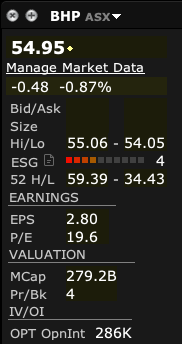
In our testing, searching for the major ASX instruments was fast and easy. When searching for BHP Group, I typed in its ticker symbol BHP and hit Enter to see the display. This produced a pop-down menu on the order entry page.
I also searched for several of the other top ASX 200 components to compare. The spread on CSL Limited (CSL) and Macquarie Group (MQG), and others was tight, normally only 1-2 cents during market hours. This is typical for the largest ASX names. At the same time, lower-weighted ASX components will commonly show slightly wider spreads outside the busiest hours of the session.
Step 3: Analyze The Spread
The SPDR S&P/ASX 200 Fund (STW) is one of the most heavily traded ETFs on the ASX, tracking the benchmark S&P/ASX 200 index. The bid-ask spread was tight at just one cent. The ETF’s strong daily trading volume makes it a popular choice for traders looking for broad exposure to the Australian market. It will nonetheless widen out outside the main session like all other securities.
For individual ASX components, the spread can vary. The biggest names generally offer the tightest spreads during normal market hours when news and events aren’t being priced into the market. Smaller-weighted ASX components can widen out a bit, especially the times around the open and close. If you’re trading smaller individual ASX stocks rather than the STW ETF, account for the wider spread as an additional cost every time you move in and out of the trade.
Step 4: Select Your Order Type
I placed a limit order rather than a market order. I rarely use any type of market order to better control the price.
Some brokers (including Interactive Brokers) have adaptive pricing, which is a type of market order that works at getting you the best price. MidPrice is an option as well, which splits the bid and ask.
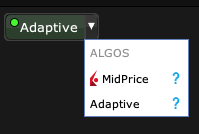
For most intraday ASX trading, limit orders are the safest default. This is especially true during the first 15-30 minutes after the opening bell when prices are often changing faster than any other part of the day until the close.
Step 5: Confirm And Execute
Before submitting, the platform displayed an order confirmation screen showing the ticker, order type, quantity, limit price, estimated commission, margin requirements (initial and maintenance margin), and total estimated cost.
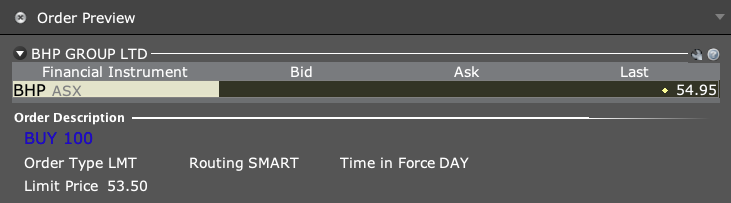
I reviewed these details and clicked confirm.
As a limit order, it shows up in your personal queue and you wait for it to execute.

Bottom Line
Australian Securities Exchange (ASX) brokers offer intraday opportunities. With some of the largest corporations in the country listed on the exchange, the indices and markets offer openings to try and trade the price fluctuations of different companies as well as changes in the economic performance of the country as a whole.
Compare Australian Securities Exchange brokers before you get started, follow our top trading tips above, and check out our list of the top ASX brokers.