




CELO is the governing cryptocurrency for the Celo blockchain payment platform. While the platform was designed to enable simple and decentralised payments via mobile app, it is the cryptocurrency itself that has piqued the interest of day traders. Like many cryptos, CELO is subject to considerable price volatility, with large price swings presenting both opportunity and high risk.
In this guide, we cover what CELO is, how it works, how to start trading this DeFi crypto. We’ve also tested and ranked the best platforms for trading CELO.
Top CELO Trading Brokers
We logged into each of these trading platforms to confirm they offer CELO with competitive trading conditions:
-
- Crypto Spread: Variable
- Crypto Lending
- Crypto Staking
-
- Crypto Spread: Market
- Platforms: Own
- Min. deposit: $0
-
- Crypto Spread: 0.5% - 1% (BTC)
- Crypto Lending
- Crypto Staking



Learn how we test brokers and why you can trust our ratings.
Here is a short overview of each broker's pros and cons
- OKX 4.1/5 OKX continues to offer a superb selection of 400+ tokens including Bitcoin and Ripple. You can buy and sell tokens or trade cryptos on margin via derivatives, including perpetual swaps, options and futures. OKX stands out for its low fees, extensive range of tokens and speedy crypto transactions.
- Pionex 3.4/5 Make spot, future and leveraged trades on over 120 cryptocurrencies via Pionex's proprietary platform with built-in trading bots and highly customizable automated trading options. Up to 50x leverage is available on selected crypto perpetuals.
- Coinbase 3.5/5 Coinbase excels in its user-friendly crypto trading environment, complete with over 240 digital assets, from Bitcoin to emerging altcoins, and terrific tools through its TradingView-powered platform and Advanced Trade, providing advanced charts and market data for crypto traders.
Community Sentiment
See how users rate these brokers based on the average customer ratings submitted on DayTrading.com, plus ratings from Trustpilot, the Apple App Store and Google Play.
| Broker | Our Users' Rating | Trustpilot Score | Trustpilot Reviews | iOS App Rating | Android App Rating |
|---|---|---|---|---|---|
| OKX | 1810 | ||||
| Pionex | 636 | ||||
| Coinbase | 23282 |
OKX
OKX is a top pick for crypto traders looking for emerging coins and crypto projects to invest in. Traders can also make use of the broker's copy trading service and automated bots.
 William Berg, Reviewer
OKX quick facts
- Coins
- 1INCH, AAVE, ACA, ACE, ACH, ADA, AERGO, AEVO, AGLD, AIXBT, ALCX, ALGO, ALPHA, AMP, ANIME, APE, API3, APT, AR, ARB, ARG, ARKM, ARTY, ASTR, ATH, ATOM, AUCTION, AVAX, AXS, BABY, BABYDOGE, BADGER, BAL, BANANA, BAND, BAT, BCH, BERA, BICO, BIGTIME and many more
- Crypto Mining
- ✘No
- Auto Market Maker
- ✘No
- Crypto Spread
- Variable
- Crypto Lending
- ✔Yes
- Crypto Staking
- ✔Yes
- Platforms
- AlgoTrader, Quantower
- Minimum Deposit
- 10 USDT
- Regulator
- FinCEN, VARA
- Account Currencies
- USD, EUR, GBP, INR, JPY, SGD, RUB, AED, SAR
Pros
- There's a vast developer lab plus access to a marketplace of pre-built trading bots with auto-arbitrage
- X-Perps, added in 2026, provides opportunities on traditional financial assets, including US stocks and commodities
- In 2025, OKX secured a MiFID II license, enabling it to offer regulated derivatives products across Europe, providing peace of mind
Cons
- The quality of customer support was inconsistent based on testing
- In 2025 OKX agreed to pay over $500 million in penalties for violating AML laws in the US
- The firm offers limited regulatory oversight, though this is common among crypto exchanges
Pionex
Pionex is an excellent option for crypto traders with an interest in cutting-edge AI like ChatGPT and automated trading.
William Berg, Reviewer
Pionex quick facts
- Coins
- BTC, LTC, ETH, BUSD, EOS, BTT, TRX, NFT, DOGE, XRP, HT, ALICE, FIL, DOT, JST, AXS, UNI, AAVE, WIN, SUN, CAKE, LINK, BAKE, BCH, ETC, SNX, TFUEL, ADA, PUNDIX, ICP, MDX, FLOW, DODO, MFT, BSV, MATIC, CSPR, SHIB, ATOM, SUSHI and many more
- Crypto Mining
- ✘No
- Auto Market Maker
- ✘No
- Crypto Spread
- Market
- Crypto Lending
- ✘No
- Crypto Staking
- ✘No
- Platforms
- Own
- Minimum Deposit
- $0
- Regulator
- CBI
Pros
- 16+ free integrated trading bots with no coding or programming requirements, which can also be deployed on tokenized U.S. equities and real-world assets, not just cryptocurrencies
- Expanded to support 280+ tokenized instruments, including U.S. stocks like AAPLX and TSLAX, traditional ETFs, and commodities like Gold with 24/7 trading and USDT settlement (not available to US clients)
- Low spot trading fees compared with other major exchanges at 0.05% maker and taker
Cons
- Limited contact options
- Weak regulatory oversight raises safety concerns
- Withdrawal fees and limits may apply
Coinbase
Coinbase is ideal for beginners looking for an intuitive platform to buy and sell a wide variety of cryptocurrencies, with robust security and regulatory compliance. However, its fees are higher compared to competitors in our tests, and it’s not as tailored for short-term traders.
 Christian Harris, Reviewer
Coinbase quick facts
- Coins
- 1INCH, AAVE, ACH, ADA, AGLD, ALCX, ALGO, AMP, ANKR, APE, API3, APT, ARB, ASM, ASTR, ATOM, AUDIO, AVAX, AXS, BAL, BAND, BAT, BCH, BICO, BLUR, BONK, BTRST, BTC, CELO, CELR, CHZ, CLV, COMP, COTI, CRV, CTSI, CVC, DAI, DASH, DESO and many more
- Crypto Mining
- ✘No
- Auto Market Maker
- ✘No
- Crypto Spread
- 0.5% - 1% (BTC)
- Crypto Lending
- ✔Yes
- Crypto Staking
- ✔Yes
- Platforms
- Coinbase, Advanced Trade, Wallet, NFT, TradingView
- Minimum Deposit
- $0
- Regulator
- CSSF, CBI, CySEC, BaFin, MAS, OSC, ASIC, BMA
- Account Currencies
- USD, EUR
Pros
- Coinbase supports 240+ cryptocurrencies, including Bitcoin (BTC), Ethereum (ETH), Solana (SOL), and more recently listed altcoins like $Trump, giving early access to emerging tokens.
- Coinbase Advanced has added TradingView integration, a feature rarely offered by crypto exchanges, allowing users to trade spot and futures markets directly from real-time charts with powerful technical analysis tools.
- Some users can secure a credit card by using their stablecoins (USDC) as collateral, with up to 4% paid back in Bitcoin.
Cons
- High crypto fees based on tests, especially compared to competitors like Kraken and BitMEX, and notably on the standard dealing platform.
- There are woeful research tools; Advanced Trade has TradingView charts but lacks features like news feeds, economic calendars, and AI market insights.
- Frustrating customer support during testing, with most help options hidden behind login, making it tough for locked-out users or non-account holders to get assistance.
How Celo Works
Celo was set up to enable decentralised mobile payments using just a phone number. By linking a phone number to a crypto wallet, users are able to send and receive payments via the mobile app, anywhere in the world.
The token works by applying a hashing algorithm to the linked phone number, which is stored on the blockchain.
Celo is based on Ethereum Layer 2 and uses a proof-of-stake protocol with a centralised sequencer.
Because the crypto is permissionless like Bitcoin and Ethereum, wallet and transaction data on the network is publicly available using the Celo explorer. This makes the blockchain project truly decentralised and scalable.
Celo Stablecoins
CELO, previously known as Celo Gold (CGLD) is the platform’s native currency. However, by linking its tokens to other assets it is less subject to volatility. This can include fiat currencies, commodities and natural resources. These linked assets are referred to as stablecoins, and it is these tokens that people will use to make payments, preventing the value of a transaction from changing dramatically once completed.
The stablecoin is an elastic-supply, stable value asset, whereas CELO is a fixed-supply, variable value asset. CELO is the governance mechanism that sits in a reserve and can be exchanged for the stablecoin to balance out high demand or shortage. By providing incentives for the stablecoin supply to match its demand, the token closely follows the price of its linked asset as follows:
- New stablecoins can be created by sending CELO to the reserve
- If demand for the altcoin rises, a profit can be made by creating a new stablecoin using CELO, then selling the coin at the market price
- This eventually drives the stablecoin back to its target price (the price of the linked currency)
- The opposite can be done if there is less demand for the coin
The first stablecoin supported by Celo was the Celo Dollar (cUSD), which tracks the price of the US Dollar, meaning its value will stay close to 1 USD; this has been joined by cGBP and cEUR. However, as the price of the native coin depends on the demand for tokens, CELO is a lot more volatile – and a lot more interesting to traders.
Wallets
Longer-term investors looking to hold Celo should store it in a crypto wallet, to ensure it is safe and accessible. Holding the token in a crypto wallet also enables traders to participate in staking. There are various types of crypto wallets available, including hot wallets that are connected to the internet, or cold wallets that are completely offline. Both types have their advantages and disadvantages; while a hot wallet allows for more convenient access (for example through an app), they can also be less secure.
How To Start Trading Celo
Finding An Exchange Or Broker
Traders are most likely to buy and sell the native asset (CELO), which is not linked to other currencies. This can be done through either an exchange or a broker. An exchange simply allows traders to convert one currency into another, whereas a broker permits trades without owning the underlying currency. Brokers also offer a range of financial tools and increased flexibility in the type of trades that can be carried out. For example, with an exchange, a trader may look to deposit funds in USD or GBP, then exchange this for CELO. With a broker, traders can easily speculate on a range of cryptos and pairs such as CELO/USDT.
One of the most popular options for buying CELO is on the Coinbase exchange, which also permits CELO staking in return for rewards. Other Coinbase resources include mini crypto courses and quizzes, with the potential to earn additional rewards in return for correct answers.
Storing Celo
Many exchange and broker platforms offer crypto wallets as part of their service. However, for traders looking for alternative wallet providers, the X and S hardware wallets on Ledger are highly recommended. Unfortunately, Celo is not supported on the popular Exodus hot crypto wallet.
Analysing Celo
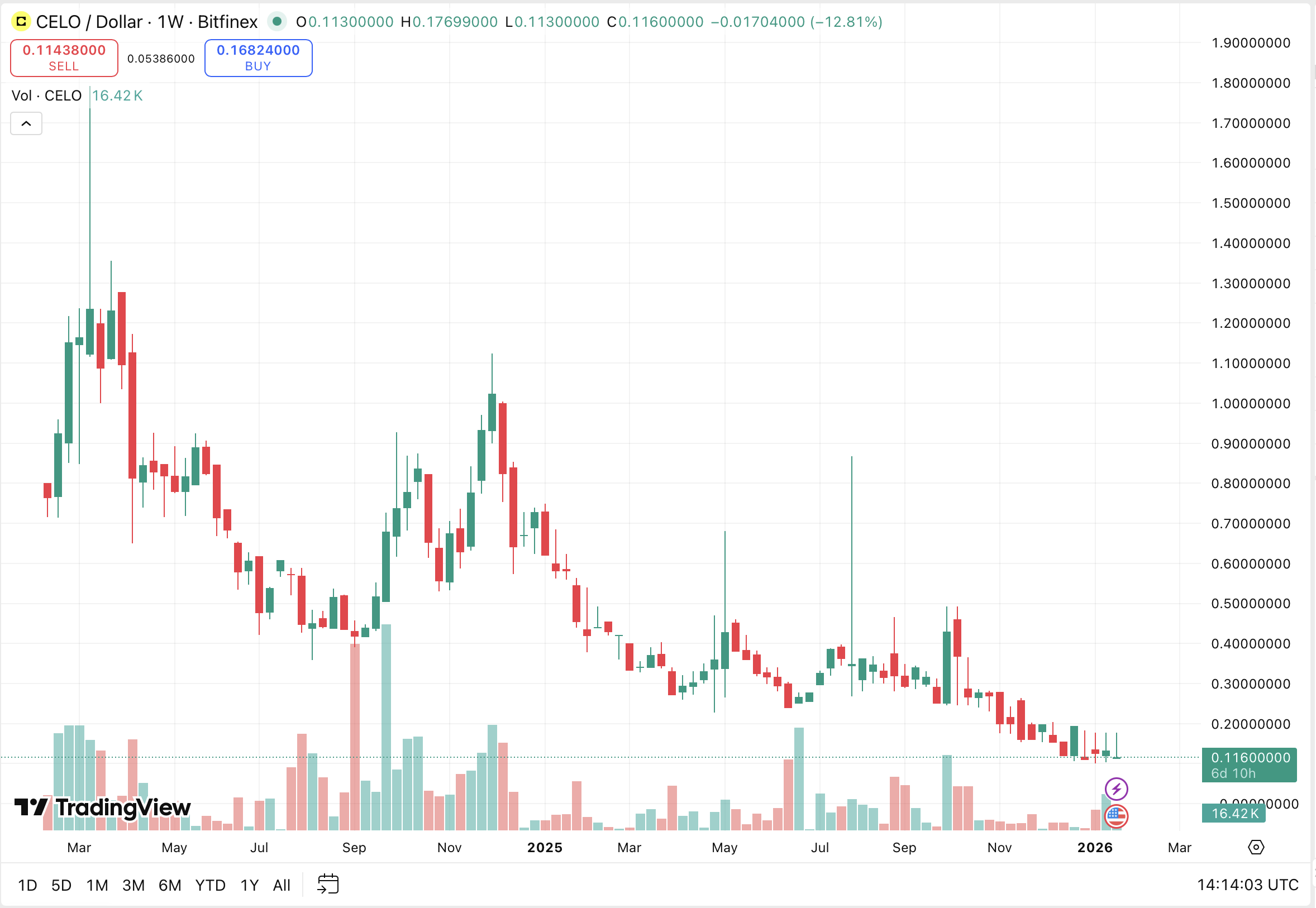
Cryptocurrency is a volatile market that can be highly influenced by factors including regulation and adoption in certain industries. Fundamental analysis is therefore extremely important when trading Celo. Keep on top of the latest token and general crypto news and outlook now, as well as the live price today. Traders can set price notification limits using their platform, or using the TradingView price chart. The Twitter page @celoorg is a great source of information for the latest updates, plus roadmaps laying out the future of the crypto and its underlying technology.
Pros Of Trading Celo
- Celo is a not-for-profit alliance designed to increase the accessibility of payments around the world, with its logo representing the unification of communities. This is a key differentiator versus the majority of other cryptocurrencies.
- The software is open-source which both encourages innovation and enhances its security.
Cons Of Trading Celo
- Transaction fees apply when making a payment, which is done by requesting to make a change to the ledger.
- Like other crypto tokens, CELO is less firmly regulated than traditional financial products, and the CFTC and other major regulators consider crypto assets to be high risk.
- The token has historically not been widely adopted, with the low liquidity making it a challenging token for day traders to profit from.
Bottom Line
While CELO’s use case is promising, it is one of many innovative crypto tokens and its success depends on adoption. As with any investment, traders can reduce risk by diversifying their portfolio, across other crypto and non-crypto assets.
FAQ
What Is CELO?
CELO is the native cryptocurrency of the Celo platform, which is a ‘mobile-first decentralised payment system. It works alongside stablecoins such as cUSD to produce a less volatile payment currency. However, the coin itself is a fixed-supply asset, which means its price reflects the market demand and is therefore subject to increased volatility.
Is CELO A Good Investment?
The platform has a promising use case, but its market capitalisation has remained relatively low. Its success ultimately depends on the level of adoption of CELO in future years. It will always be a high risk investment.
How Can I Buy CELO?
The crypto can be bought through a broker or exchange such as Coinbase. Some platforms also offer an integrated crypto wallet option for longer-term storage of the token
What Is The Difference Between CELO Vs Stellar?
Both cryptos have been created by not-for-profit organisations that aim to provide payment options to those without bank access. However, Celo focuses on mobile-first L2 with phone-number wallets, while Stellar uses federated consensus for cross-border payments.
How Does Celo Work?
The Celo platform combines the crypto coin with stablecoins such as cUSD to reduce volatility. This is done by incentivising the creation of stablecoins using CELO when there is high demand for stablecoins and vice versa. It is the stablecoins that are generally used to make payments, though it is the CELO crypto coin that is arguably worth buying for traders.