
Best Nasdaq Dubai Brokers 2026

Nasdaq Dubai is the international exchange inside the Dubai International Financial Centre (DIFC), and one of the world’s largest venues for Sukuk (Shariah-compliant bonds). Alongside Sukuk it lists conventional bonds, equities, REITs and single-stock derivatives, giving traders access to instruments from across the Gulf, the wider Middle East, Turkey and the Indian sub-continent.
This guide ranks the best brokers in 2026 with access to Nasdaq Dubai for active traders, based on our hands-on tests. We cover what to weigh up when comparing providers, walk through placing a trade on the exchange step by step, and answer the questions beginners ask most.
Nasdaq Dubai Brokers
Sorry, there are no brokers that accept traders from your location (United States). If this location is incorrect, please change it.
Critical Factors When Choosing A Nasdaq Dubai Broker
Nasdaq Dubai is not a like-for-like substitute for a broad equity market, so the checklist you use for a US or UK exchange only half applies here. These are the factors that matter most for this venue.
Exchange membership and how you actually get access
There are two routes onto Nasdaq Dubai. To own shares or Sukuk outright, you need a broker that is a licensed Member of the exchange, plus a National Investor Number (NIN). The NIN is free to apply for and works across both Nasdaq Dubai and the Dubai Financial Market (DFM), so one number covers both. From outside the UAE, most retail traders instead reach the exchange through CFDs, which give price exposure without ownership.
Before you fund anything, confirm which route your broker offers. Direct market access suits traders who want to hold positions and receive profit distributions or Sukuk redemptions. CFDs suit shorter-term traders who want leverage and the ability to go short.
Which Nasdaq Dubai instruments the broker covers
The exchange’s depth is in Sukuk and bonds. Its equity segment is small, with a handful of REITs such as Emirates REIT and ENBD REIT, plus single-stock futures and the FTSE Nasdaq Dubai UAE 20 index. Many international CFD platforms carry only a narrow slice of this, or none of the Sukuk at all.
So match the broker to what you want to trade. If you are here for a specific Sukuk, the UAE 20 index or single-stock futures, check the instrument is actually listed on the platform before opening an account. A provider that covers the US Nasdaq will not automatically cover Nasdaq Dubai.
Liquidity, and why it varies so much here
Liquidity on Nasdaq Dubai is uneven. Its Sukuk and larger names trade actively, but parts of the equity segment are thin, which means wider spreads and the risk of slippage when you enter or exit. For an active trader that matters more than it would on a deep market. A good broker shows you real order-book depth so you can size trades sensibly and avoid moving the price against yourself. Before you commit to an instrument, watch its spread and typical volume for a few sessions. If both are thin, treat it as a position to hold rather than something to trade in and out of.
Shariah screening and compliance tools
The main reason to trade Nasdaq Dubai over other venues is its Shariah-compliant range. A broker that flags which instruments are Shariah-certified, or integrates screening into the platform, saves you cross-checking every line against a certification list yourself. If halal trading is the point, this feature matters more to you than a marginally tighter spread. See our guide to halal trading for how the screening works.
Currency and the dirham peg
Nasdaq Dubai equities trade in UAE dirhams (AED), while most Sukuk are quoted in US dollars. The dirham has been pegged to the dollar at 3.6725 for decades, so a dollar-based trader carries very little currency risk on AED positions. That peg is one reason the UAE draws foreign capital, since it removes the exchange-rate swings common in other emerging markets. You should still check the conversion fee your broker applies on deposits and withdrawals, which can quietly add to your costs.
Fees, commissions and spreads
Costs vary widely between providers. Citi, for example, has applied a 0.45% commission on online brokerage trades worth up to $99,000. On CFD platforms you instead pay the spread plus overnight financing on any position held past the close. Work out the all-in cost for the trade size you actually place. A commission that looks small on a $500 trade can dominate your returns if you trade often.
Settlement, custody and international access
Nasdaq Dubai settles on a T+2 cycle and connects to Euroclear and Clearstream, so international custody is straightforward. If you hold through a foreign broker rather than a UAE member firm, confirm how your shares or Sukuk are held in your name, and whether corporate actions such as profit distributions and redemptions are passed through to you cleanly. This is easy to overlook and awkward to fix after the fact.
Trading hours and the time-zone gap
The main session runs Monday to Friday, roughly 10:00 AM to 2:45 PM Gulf Standard Time (GMT+4). The UAE moved its exchanges from a Sunday-to-Thursday week to Monday-to-Friday on 1 January 2022, so older guides showing Sunday trading are out of date. That is a narrow window, and for traders in Europe or the Americas it lands early in the day or overnight. A platform with a reliable mobile app and price alerts helps you act inside those hours instead of missing them.
Platform quality, data and demo access
Judge the platform on the basics: fast and reliable execution, enough historical data to run your analysis, a mobile app, and charting with technical indicators. An economic calendar for regional announcements helps you avoid trading blind into news. Above all, look for a free demo account loaded with virtual funds so you can test your approach and learn the platform before committing real money. Pairing a demo with a trading journal to log what worked is one of the fastest ways to improve.
How To Place A Trade On Nasdaq Dubai
Here is the process we followed placing a beginner-level trade.
1. Open and fund the account
For a live account you complete identity verification and, for direct market access, apply for a NIN.
I’m using Interactive Brokers for this exercise.
2. Find the instrument
Searching for a single equity is different from finding a Sukuk. As DP World is one of the most popular companies on the Nasdaq Dubai, we typed the company’s name into the platform’s search bar and the equity appeared instantly. For fixed income you often browse by issuer instead, since Sukuk are listed under the issuing entity rather than a short ticker.
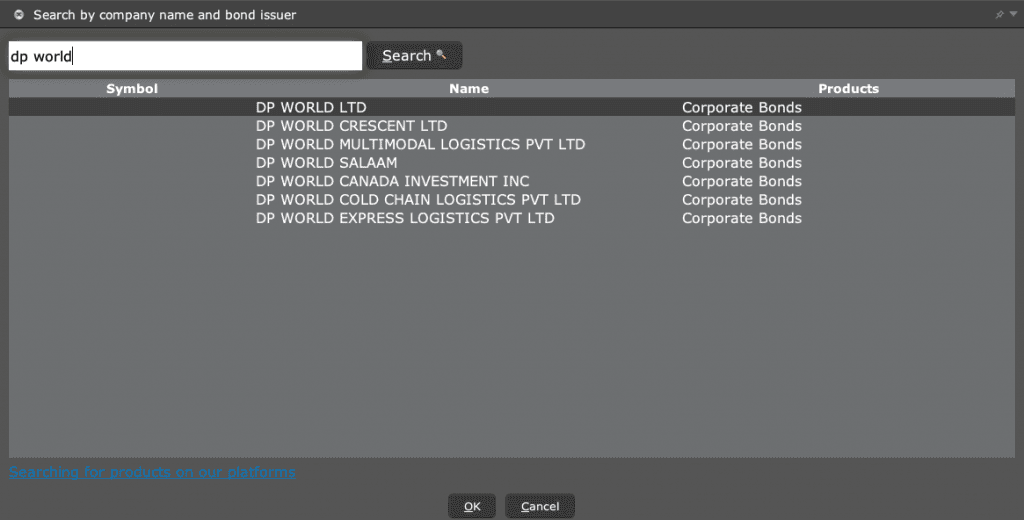
I’m going to go with DP World LTD bonds, specifically choosing the 2049 maturity.
3. Read the quote and the spread
We checked the bid and ask before doing anything, as that’s a real cost you pay on entry and exit. A wide spread on a small position can outweigh any move you are hoping to catch.
For individual bonds, most of them have wider spreads, which generally fits more of a longer holding profile.

With limit orders you don’t have to worry about the spread being too wide. You simply name your price.
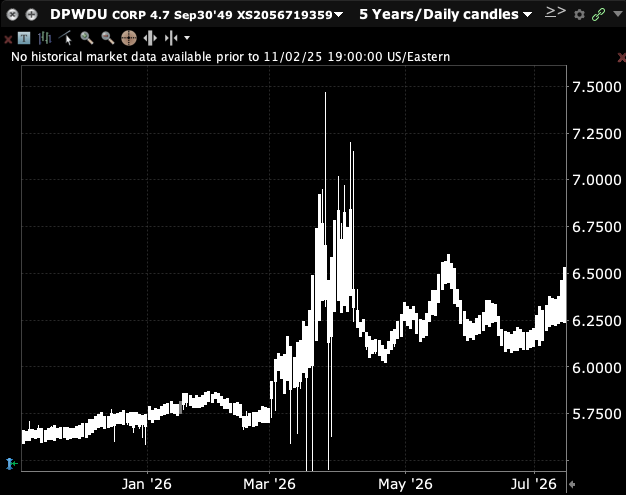
You can also check a chart of prior history. In this case, not price history but yield history.
4. Choose the order type
A limit order only fills at the price you set or better.
Given individual bonds tend to be less liquid than stocks, we went with a limit order.
5. Set your size and check the estimated cost
We entered the number of units and the limit order price.
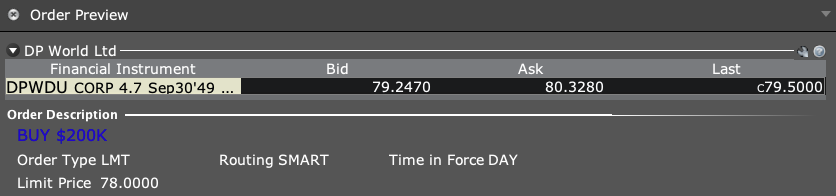
The platform will also give an estimated total, including any commission or spread. Reading this line before you confirm is the single easiest way to avoid any surprise on cost.
6. Place the order
We confirmed the order and it appeared in the open positions list. Before moving on we set a plan for closing it, since deciding your exit in advance keeps a losing trade from drifting.
If you’re new to trading, our strongest advice for beginners is to run this whole sequence in a demo account a few times first. The steps become second nature quickly, and you learn the quirks of a specific platform without paying for the lesson.
Nasdaq Dubai – Headlines
- Nasdaq Dubai is best known for Sukuk, and its outstanding Sukuk listings passed $100 billion in 2025 (source: Zawya), making it one of the largest Sukuk venues in the world.
- Two routes exist: direct market access through a Member broker with a NIN, or CFD exposure through an international provider. Your choice depends on whether you want ownership or short-term, leveraged trading.
- The exchange’s equity segment is small; its strength is fixed income. Confirm your broker lists the specific instrument you want before funding.
- The main session runs Monday to Friday, about 10:00 AM to 2:45 PM Gulf Standard Time, a narrow window for overseas traders.
- Practise first. A free demo account, ideally paired with charting software like TradingView and a trading journal, lets you learn the platform before risking capital.
What Is Nasdaq Dubai?
Nasdaq Dubai Limited is the international financial exchange serving the region between Western Europe and East Asia. It gives traders access to Sukuk, conventional bonds, equities, REITs and derivatives from within the region.
The exchange was founded by the Nasdaq OMX Group and Borse Dubai in September 2005 as the Dubai International Financial Exchange (DIFX). In May 2010 the Dubai Financial Market (DFM) acquired a two-thirds stake; Borse Dubai retained one third, and Nasdaq OMX has since exited. That ownership split still stands today.
Dubai is one of the world’s largest centres for Sukuk listings, and Nasdaq Dubai carries the bulk of it. By the end of 2025 the total value of outstanding Sukuk on the exchange had climbed past $100 billion, reaching roughly $103 billion, an eightfold increase from $12.6 billion in 2013 (source: Khaleej Times). Counting conventional bonds as well, outstanding debt securities on the exchange stood at about $146 billion, and cumulative issuance since inception has topped $245 billion, including $177 billion in Sukuk.
The exchange’s region covers the Gulf Cooperation Council (GCC), the wider Middle East and North Africa, Turkey and the Indian sub-continent. Hamed Ali serves as chief executive of both Nasdaq Dubai and DFM, and Abdul Wahed Al Fahim chairs the exchange.
Dubai Financial Market vs Nasdaq Dubai
Both are Dubai exchanges, and DFM is the majority shareholder in Nasdaq Dubai. The practical difference for a trader is what each lists: DFM handles UAE-domiciled equities in dirhams, while Nasdaq Dubai was set up to list international shares, Sukuk and bonds to an international standard.
They answer to different regulators. DFM sits under the UAE Securities and Commodities Authority (SCA), a government body. Nasdaq Dubai sits under the Dubai Financial Services Authority (DFSA), the independent regulator of the DIFC, which applies international standards. For retail traders the day-to-day experience is similar, since both run on the DFM trading platform and share the NIN system. The main difference is the range of instruments available. In practice, brokers with access to DFM usually offer Nasdaq Dubai too.
Trading Nasdaq Dubai vs other regional markets
It helps to know where Nasdaq Dubai sits among Gulf exchanges. Saudi Arabia’s Tadawul is the region’s largest equity market by a wide margin, and for UAE shares themselves, DFM and the Abu Dhabi Securities Exchange (ADX) host most of the listings and retail volume. Nasdaq Dubai’s role is different: international and dual listings, and above all Sukuk and bonds to a DIFC standard.
So if your goal is deep, liquid Gulf equity trading, ADX, DFM or Tadawul may suit you better, and many brokers with Nasdaq Dubai access offer those markets too. If you want Shariah-compliant fixed income or international exposure through one regulated venue, that is the reason to choose a broker for Nasdaq Dubai specifically.
What Can You Trade On Nasdaq Dubai?
Sukuk
The exchange’s core product. Sukuk are Shariah-compliant instruments that behave like bonds.
Listing requires a minimum market cap of $2 million, Shariah certification and a Shariah supervisory board.
Indices
The FTSE Nasdaq Dubai UAE 20 Index tracks the 20 largest eligible constituents by full market cap. FTSE also runs a Nasdaq Dubai Shariah index series that covers Islamic-compliant companies.
Futures
Single-stock futures cover sectors from real estate and petrochemicals to banking and transport, including names such as Aldar Properties, e& (formerly Etisalat) and Saudi Arabian Mining. The exchange also runs a Murabaha platform for Islamic financing.
Note that single-stock futures are less liquid. While an interesting idea in practice, the market has been moving away from these types of products.
Bonds
Conventional bonds list alongside Sukuk, including issues from regional banks and UAE government paper. In 2025 the exchange also grew its ESG range, with sustainable debt instruments reaching about $30 billion across 41 issuances.
REITs
Real Estate Investment Trusts such as Emirates REIT and ENBD REIT trade on the exchange, both admitted after IPOs.
Private market
Private companies can issue shares through the Central Securities Depository (CSD), with trades settled off-exchange through Member brokers.
A note on crypto: 3iQ’s The Bitcoin Fund (QBTC), once the first listed digital-asset fund in the MENA region, was voluntarily delisted from Nasdaq Dubai on 31 July 2025 (3iQ). Direct crypto products on the exchange have changed since, so check current listings before assuming a fund is available.
History
- September 2005: Launched as the Dubai International Financial Exchange (DIFX), listing equities and index products.
- 2007: Listed the largest IPO in the Middle East at the time, DP World, which raised $4.96 billion.
- 2008: Nasdaq OMX acquired a one-third stake and DIFX became Nasdaq Dubai. The exchange also launched the UAE’s first equity derivatives market.
- 2010: DFM acquired a two-thirds stake for $121 million and Nasdaq Dubai moved its equities onto the DFM trading platform.
- 2011: The Official List of Securities transferred to the DFSA, streamlining prospectus and listing approvals.
- 2012: The DFSA cut the minimum market cap for listing from $50 million to $10 million, opening the door to SMEs and family-owned businesses.
- 2013: Sukuk and conventional bond trading launched on-exchange, part of Dubai’s push to become the global hub for Sukuk.
- 2014: Emirates REIT became the first REIT to list on a GCC exchange, and the exchange launched its Murabaha platform.
- 2020: DP World delisted and returned to full private ownership under Ports, Customs & Free Zone Corporation (Lloyd’s List).
- 2022: The UAE moved its exchanges to a Monday-to-Friday trading week.
- 2025: Outstanding Sukuk on the exchange passed $100 billion, a record year, with debuts including Ajman Bank, Mashreq, OMNIYAT and China Development Bank.
Rules, Regulation And Trading Hours
Nasdaq Dubai is licensed by the DFSA, which sets its rules on admission, disclosure, corporate governance, clearing and settlement. Those rules govern how companies get securities admitted, their obligations once listed, how Member brokers must behave toward customers, and how trades clear and settle.
Trading hours
The exchange operates Monday to Friday, with the main session running from about 10:00 AM to 2:45 PM Gulf Standard Time (GMT+4). Settlement follows a T+2 cycle. Because the US and UAE observe different weekends and holidays, USD settlement doesn’t run on some days that are otherwise trading days, so check your broker’s calendar around Islamic holidays such as Eid Al Fitr and Eid Al Adha, whose dates shift each year, and around US Federal Reserve holidays for dollar-denominated instruments.
Trader resources
Two exchange services are worth knowing. The Nasdaq Dubai Academy runs courses for issuers, members and the public to build financial literacy. CANDI, the exchange’s Company Announcements and News Disclosure system, is where issuers publish regulatory disclosures, which is useful for keeping up with the instruments you trade.
FAQs
Which brokers give access to Nasdaq Dubai?
Both UAE member firms and international CFD providers can offer access. See our ranked list above for the brokers we rate highest for active traders, based on our own testing.
Do I need a NIN to trade Nasdaq Dubai through a broker?
For direct ownership of shares or Sukuk, yes. A National Investor Number is free to apply for and works for both Nasdaq Dubai and DFM. If you trade through CFDs, you take price exposure without owning the security, so a NIN is not required.
Can I trade Nasdaq Dubai from outside the UAE?
Yes. Overseas traders usually access the exchange through international brokers offering CFDs, or through a Member firm that accepts non-resident accounts. Check the trading hours, since the session falls early in the day or overnight in Europe and the Americas.
Are Nasdaq Dubai brokers regulated?
The exchange itself is regulated by the DFSA. Your broker will be regulated by its own authority, so confirm it holds a licence from a credible regulator before depositing funds. That regulation is what underpins your capital protection.
Is trading on Nasdaq Dubai halal?
The exchange was built around Islamic finance and lists a wide range of Shariah-compliant Sukuk, indices and funds. Whether a specific trade is halal depends on the instrument and your broker’s structure, so use a provider that flags Shariah-certified products. See our guide to halal trading for detail.
What does it cost to trade via a Nasdaq Dubai broker?
It depends on the route. Direct brokerage charges a commission, for example Citi’s 0.45% on online trades up to $99,000, while CFD platforms charge the spread plus overnight financing.
Always be sure to compare the all-in cost for your usual trade size rather than the advertised rate.